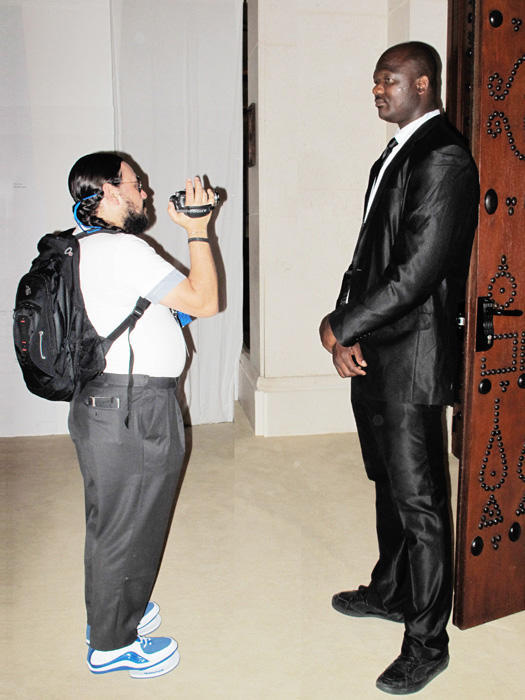
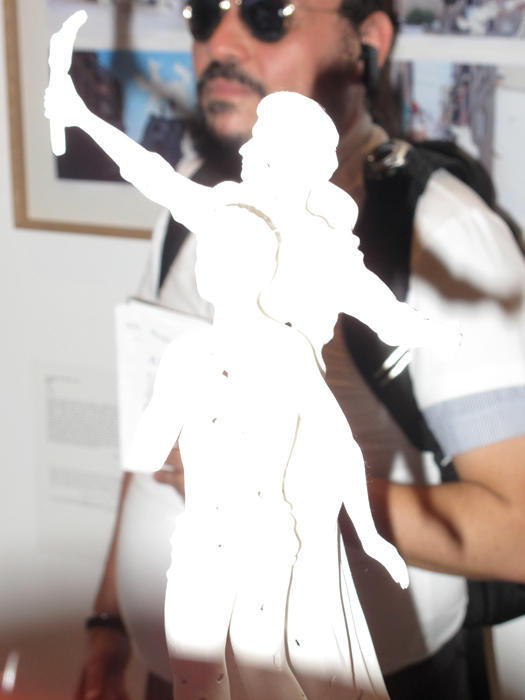
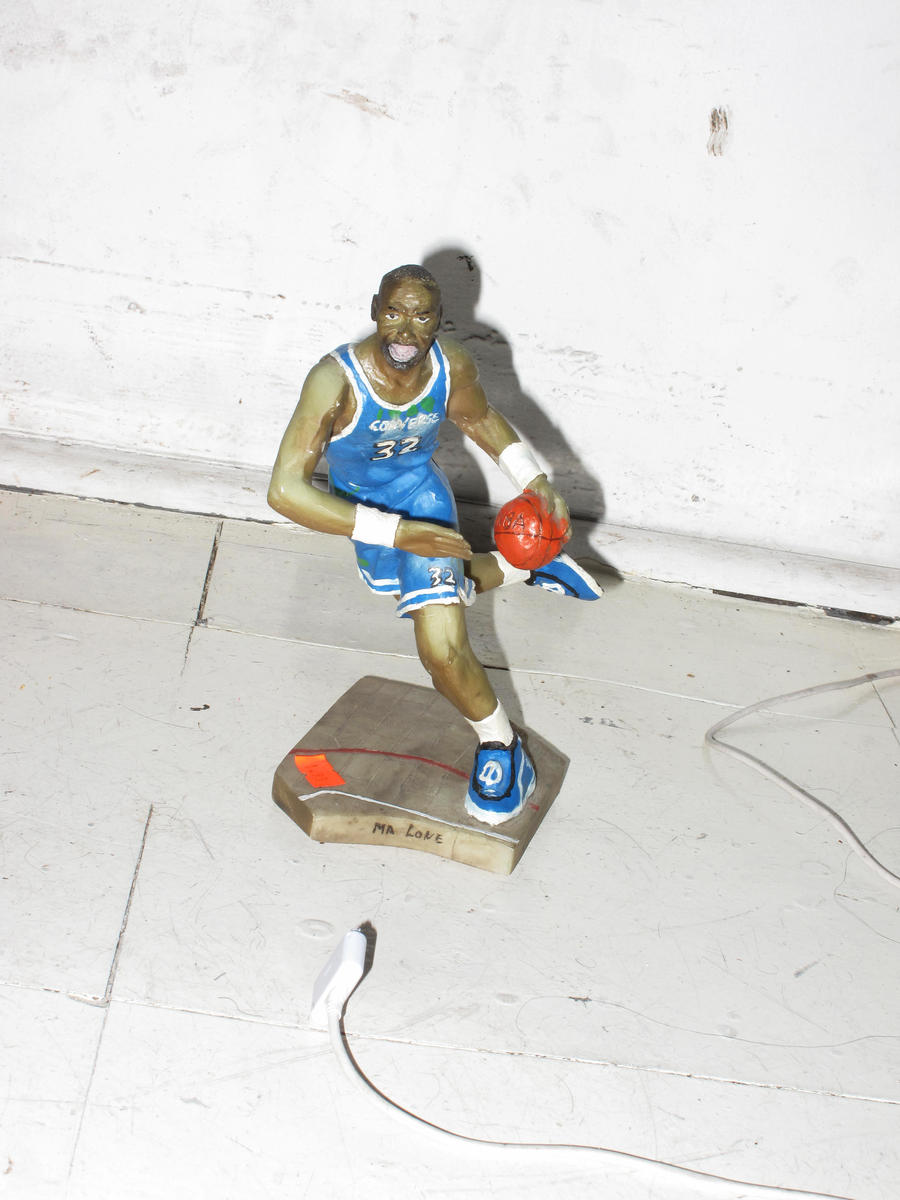
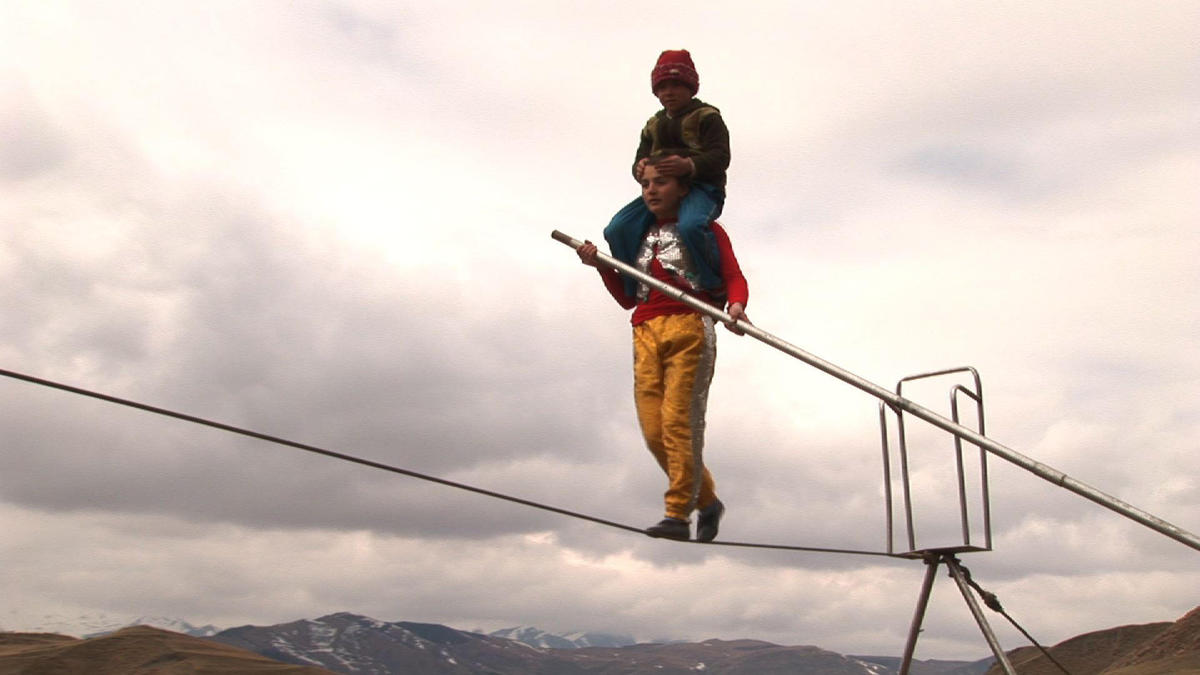
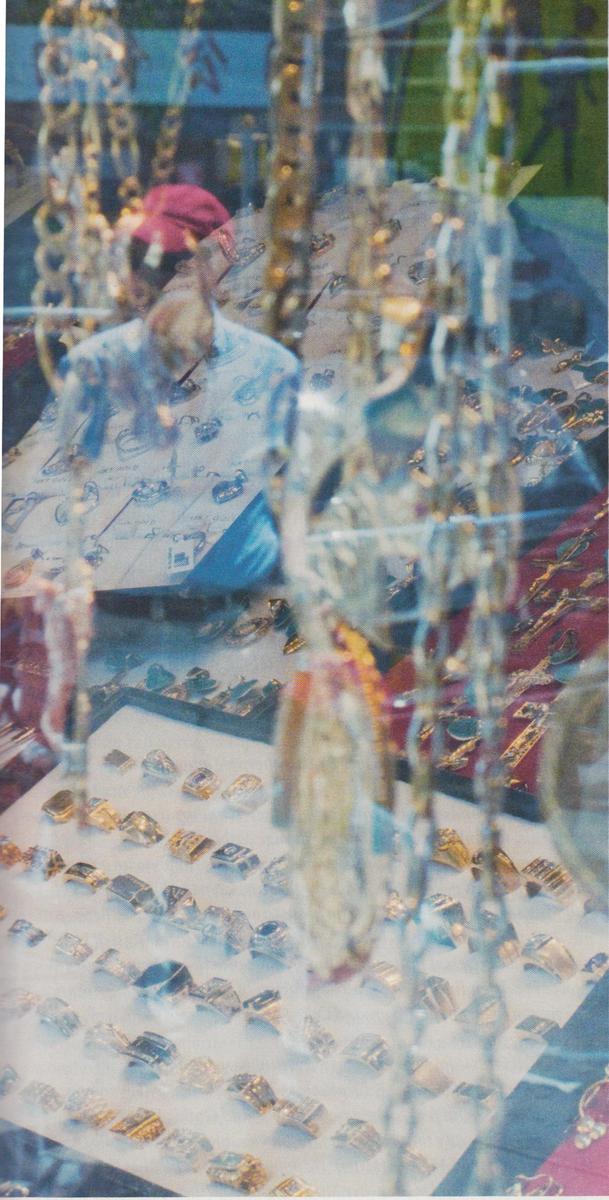
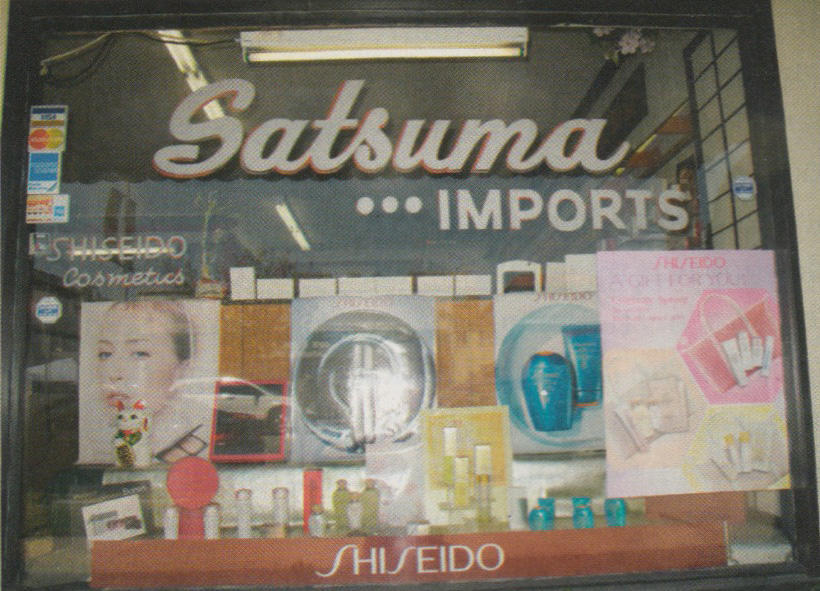
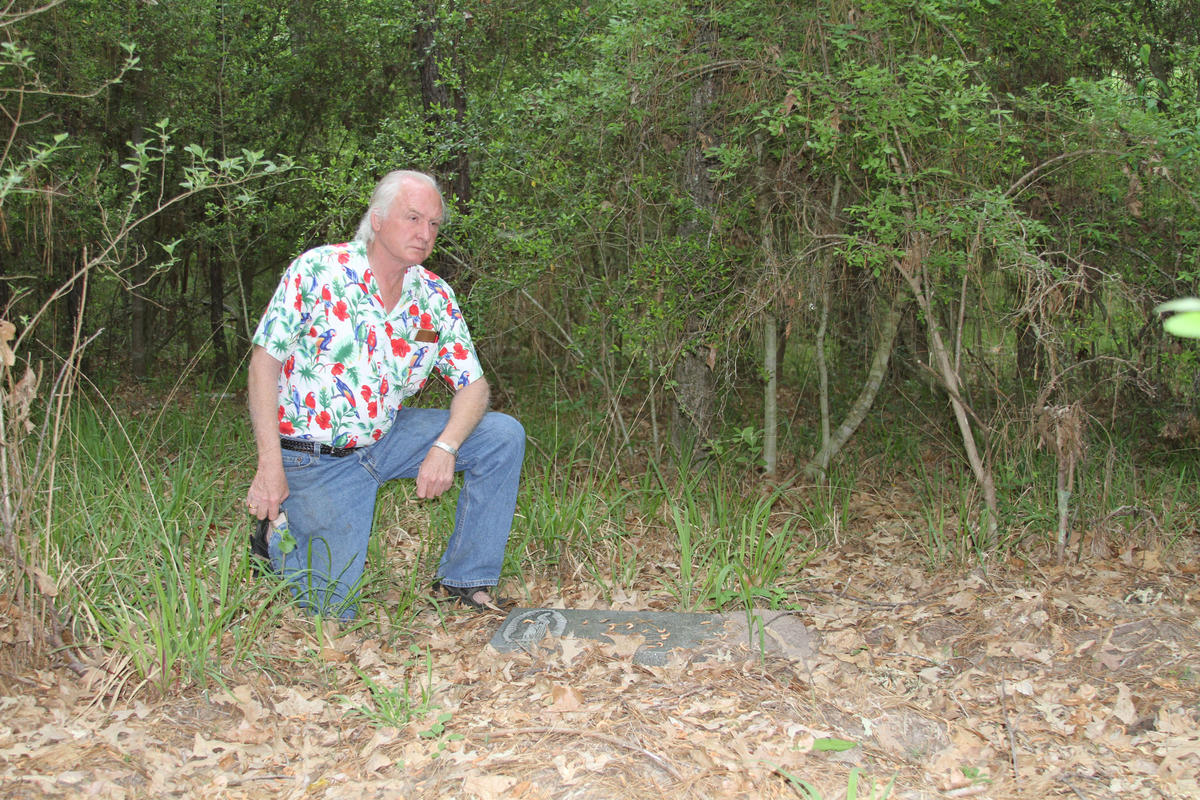
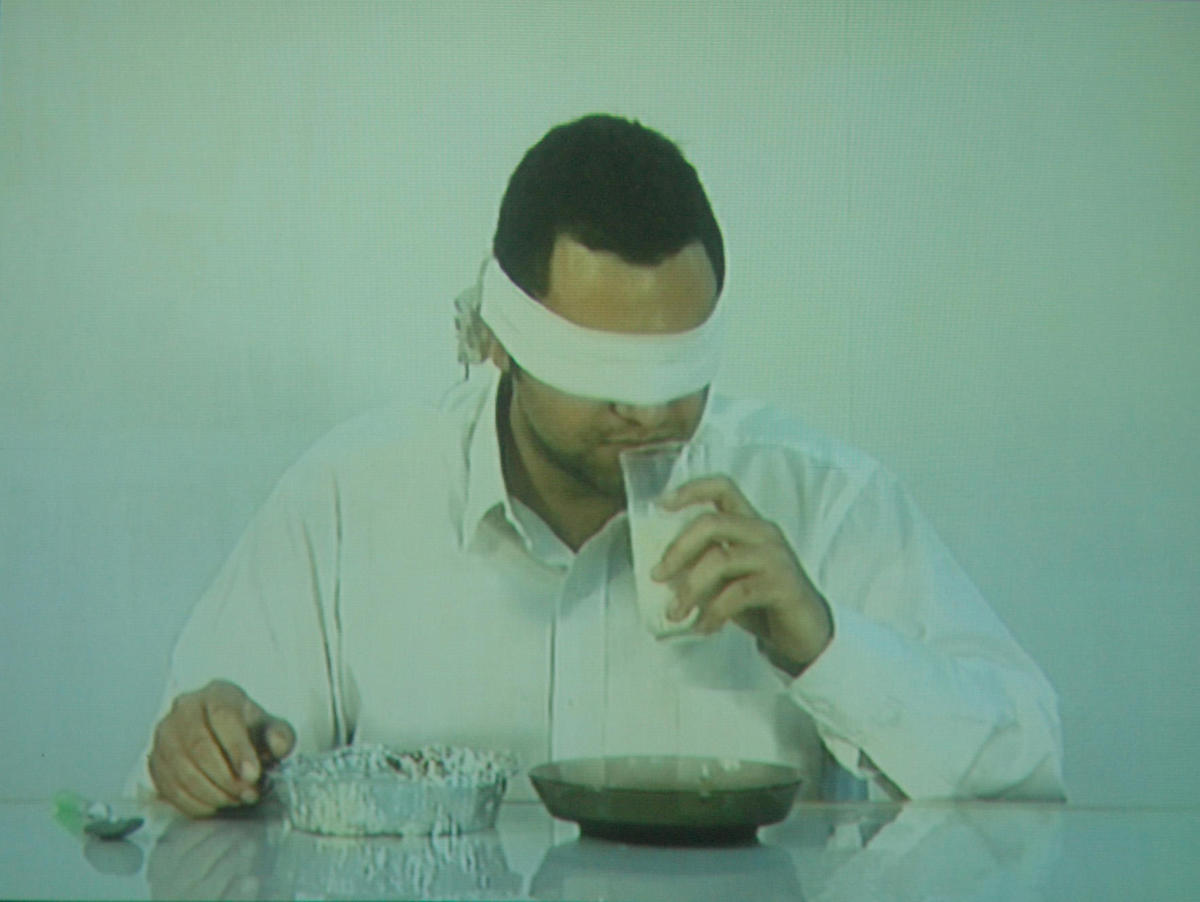
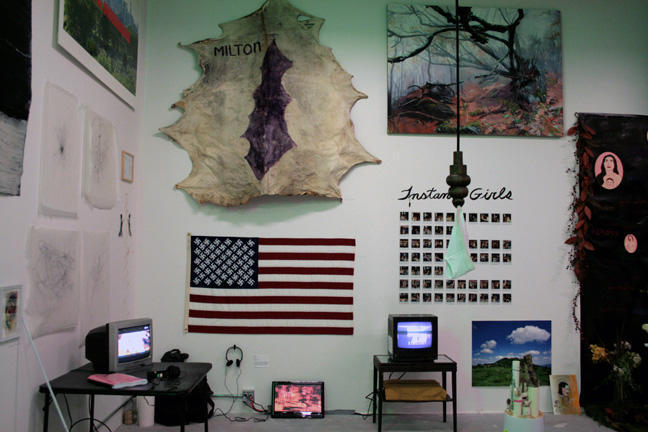
Daniel Bozhkov doing video research for his artist-led tour of the fair
This past March, Bidoun Projects was the curatorial partner of Art Dubai. We would like to extend a big thank you to all of the artists and curators who contributed to our programs, performances, talks, and exhibitions at the fair.
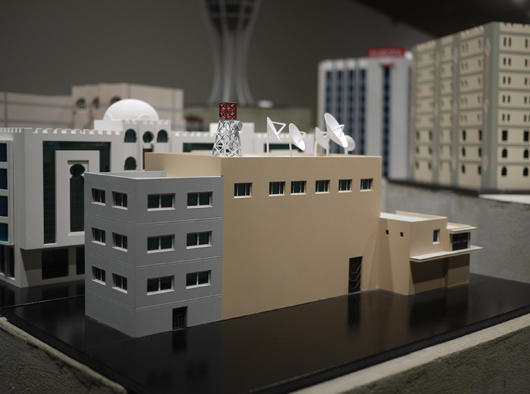
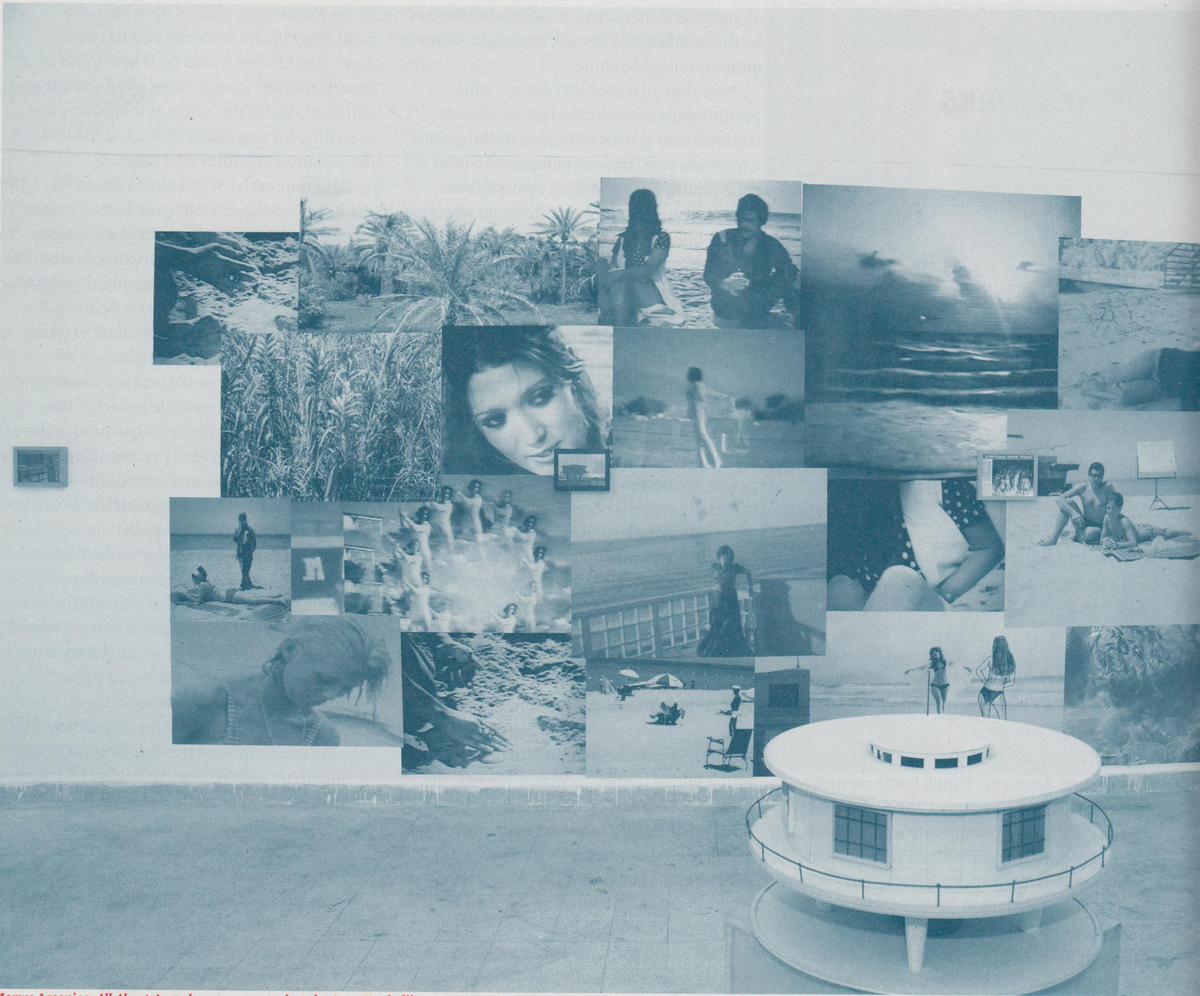
Among the projects produced were substantial new commissions by Ebtisam Abdulaziz, Vartan Avakian, Farhad Moshiri, and the duo of Shamma Al Amri and Mona Fares, as well as the remaking of Alice Aycock’s seminal 1971 work Sand/Fans. Matt Sheridan Smith and Nikolas Gambaroff produced a version of their collaborative piece Stoop, and Khalil Rabah, Sophia Al-Maria, and Daniel Bozhkov each led highly popular artist’s tours of the artworks and booths throughout the fair. ‘A New Formalism’ was a group exhibition curated by Bidoun that included work by U5, Iman Issa, Mahmoud Khaled, and Hazem El Mestikawy. We also exhibited a version of ‘Forms of Compensation’ (a project featured in our last issue) at a booth within the fair, featuring counterfeits of iconic artworks fabricated in the auto mechanic neighborhood around the Townhouse Gallery in Cairo. Several days later, the same show (with second-wave counterfeits of the same artworks) opened at Townhouse.
The Art Park in the Bidoun Lounge was the place for panels and discussions, and this year we celebrated our yearlong and growing collaboration with UbuWeb, an incredible online resource of avant-garde film and sound, by inviting the site’s founder Kenneth Goldsmith and filmmakers Peggy Ahwesh and Hamlet Hovsepian to present their work in Dubai. We also featured a discussion on artists and libraries courtesy of Banu Cennetoğlu, Vasif Kortun, and Payam Sharifi of Slavs and Tatars, and The Big Idea, a “pitching forum” for new ideas that was packed by young Emirati artists, designers, and entrepreneurs on the opening night of the fair.
Many thanks also to project staff of Tima Ouzden and Badriah Al Khoury, and a dynamic team of interns managed by Bader Saud Bukhari.
We also launched Bidoun Video, an annual touring video program curated by our staff and guests, which at the time of writing is about to screen at Townhouse, as part of ‘Invisible Publics,’ curated by Sarah Rifky (May 23–June 20). This year we’re showcasing four programs: Strike a Pose (Özge Ersoy and Sohrab Mohebbi); Cloudy Head (Bidoun); Hollywood Elegies (Aram Moshayedi); and Exploding Nostalgia (Masoud Amralla Al Ali and Antonia Carver).
The Bidoun Library also continues its peregrinations, from Art Dubai to 98Weeks in Beirut during April. Next stop is the New Museum in New York. June 1 marks the opening of a permanent home for the library at Shelter, our base in Dubai.
The six-month Writing About Art program came to an end in May, with around forty writers from the Gulf and beyond completing this intensive course of seminars and workshops. Managed by Antonia Carver and Hassan Khan, with Ali Al-Sabi, lead tutors included Kaelen Wilson-Goldie, Kevin Mitchell, and Shumon Basar. Guest presenters and artists included Douglas McLennan, Wael Shawky, Clare Davies, Abbas Akhavan, Jeffar Khaldi, Jonathan Shainin, and Murtaza Vali. Thanks to the support of Dubai Culture and Arts Authority (Dubai Culture), the course was offered for free.
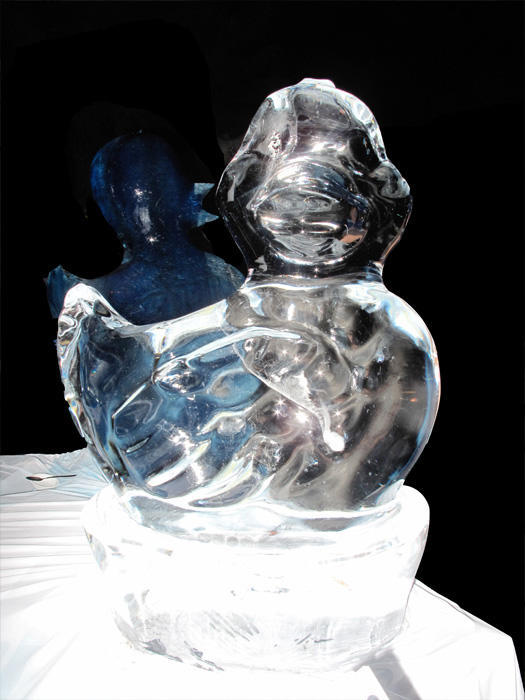
Ice sculpture by Farhad Moshiri, VIP opening night
And as ever, keep abreast of our media archive BubuWeb, our repository for avantgarde media from in and around the Middle East, hosted by UbuWeb (www.ubu.com). Our latest additions to Bubu include rare animations by Iranian artist and Kanoon pioneer Ali Akbar Sadeghi, an early short by Senegalese filmmaker Djibril Diop Mambéty, animations by Indian avant-garde filmmaker Rani Day Burra, and more.
See www.bidoun.com and sign up to our e-newsletter for further news and updates.
Last time out, we delved into the business of the art world, a somewhat aerified realm, with its auctions and parties and oh-so-critical discourse. This time we wanted to get our hands dirtier. Mucky, even. So one thing we did was seek out the details — good, bad, and gory — of how work works. What the oil spill in the Gulf of Mexico is doing for beauty salons in America. How the protests in Thailand have affected red-dye manufacturers in Karachi. Why the Iraq War has been a bonanza for health clubs in occupied Baghdad.
The whole BAZAAR business originated on a trip to Dubai, the Las Vegas of the Middle East. Or rather, a trip to the Las Vegas of the Las Vegas of the Middle East. At the Indian mall in the down-market Karama district, the prime real estate belongs to Las Vegas Fashion LLC, a clothing store whose windows are lined with bedoo-rag’d mannequins in b-boy poses.
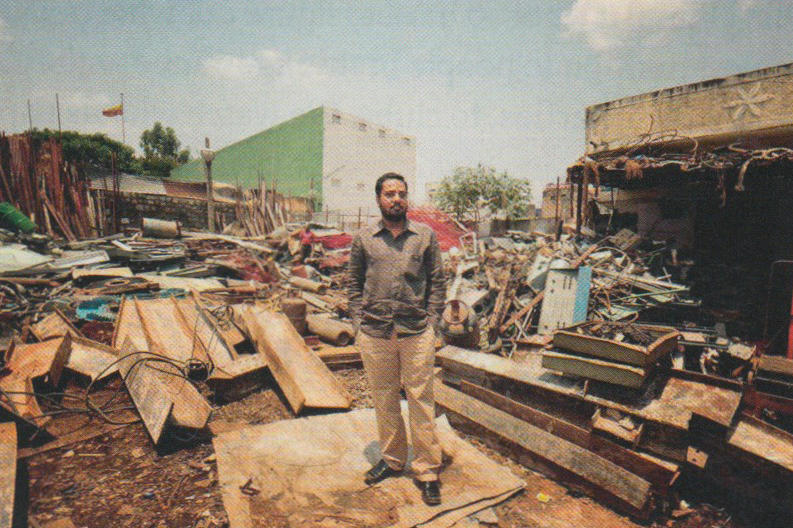
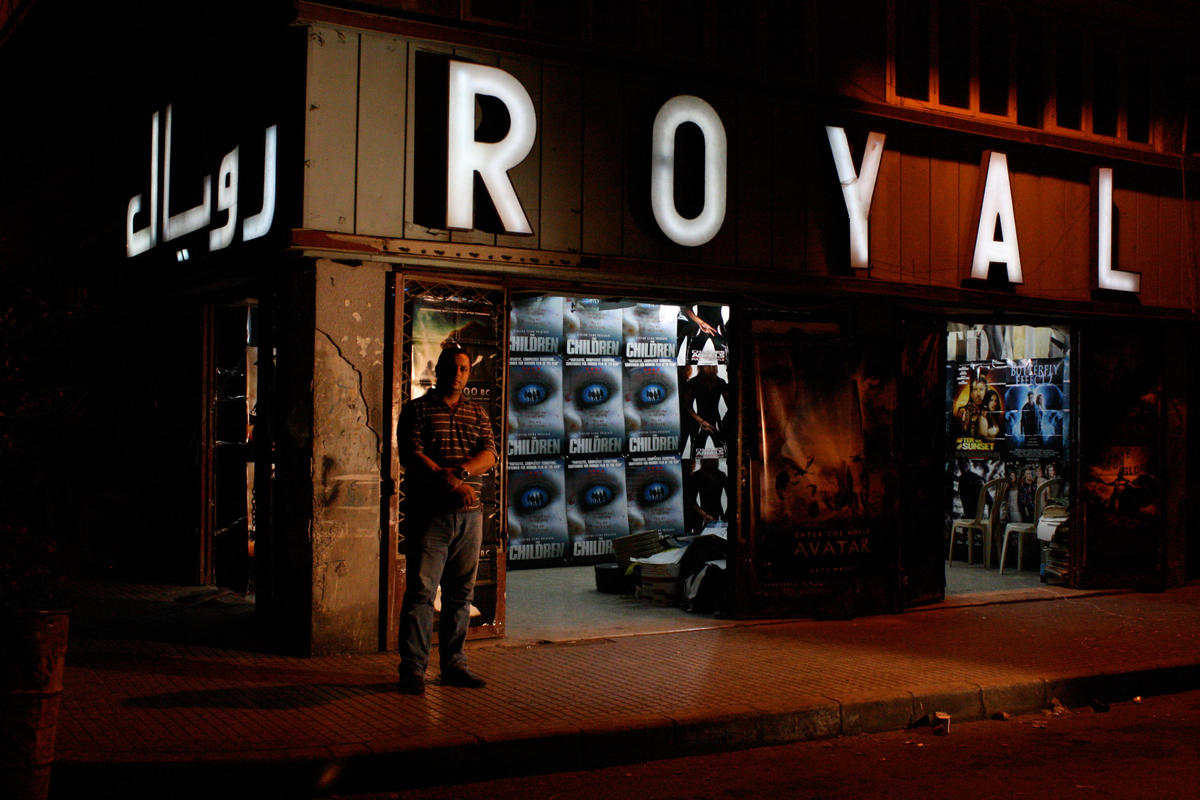
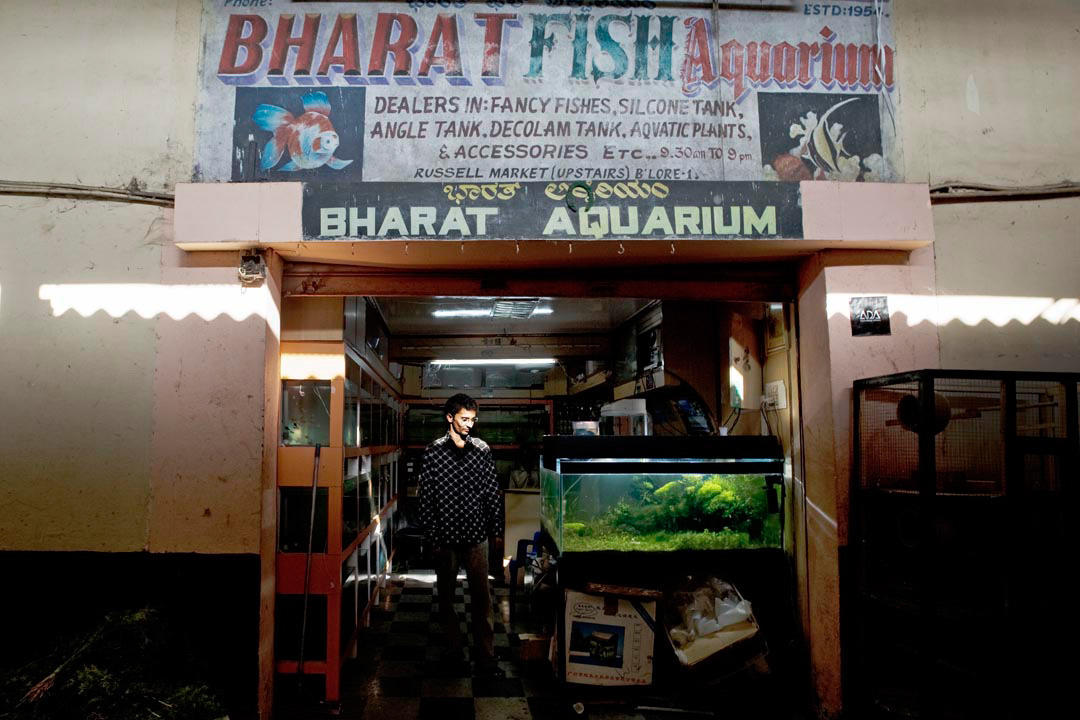
Fittingly, Adham Alshorafa, the man behind Las Vegas, is the subject of one of the fourteen profiles, interviews, and as-told-to accounts that comprise our portfolio, How’s Business — along with a Chinese language instructor in Cairo, a recycler in Bangalore, a defense contractor in Kandahar, and many more stories from the annals of globalization.
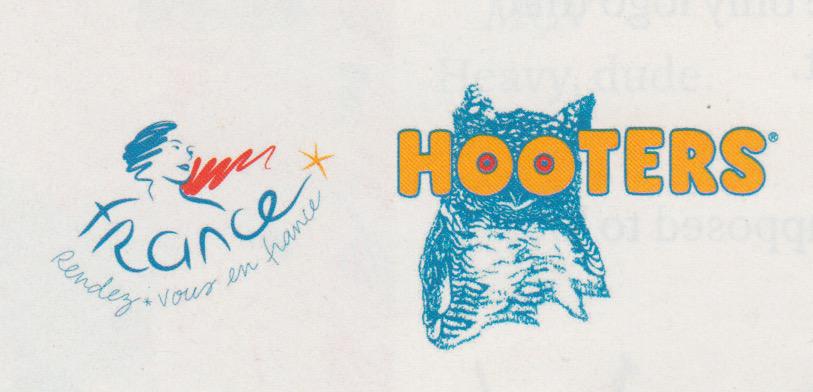
The globe itself is the canvas for Simon Anholt, the reluctant magician of nation branding. In Your Brand Is My Brand, Babak Radboy considers the feedback loop that powers the multimillion dollar business of national identity. Bonus: a ragtag team of amateur nation branders examine brands from across the Bidounosphere, asking the age-old question, “Is that an atom hovering over the I in Israel?”
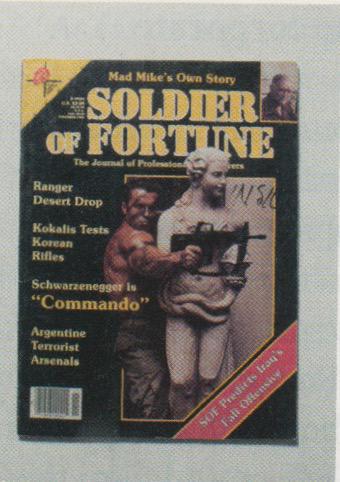
In the Magazine Bazaar, we discuss the business and pleasure of being a niche magazine, with a quartet of trade publications servicing mercenaries, utility contractors, haunted house owners, and disgruntled artists.
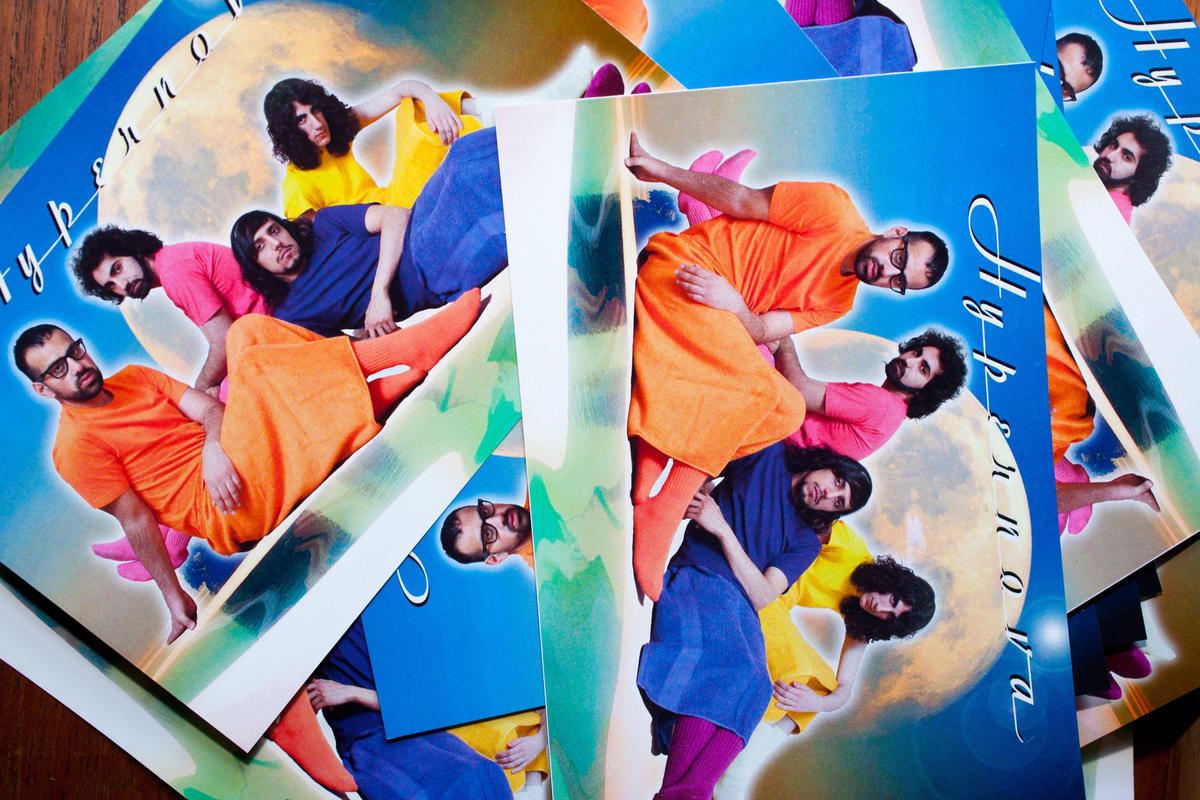
When we first considered doing something on up-and-coming Iranian rock band Hypernova, our interest was in their media celebrity. But what we had envisioned as a tale of political opportunism and ethnic marketing took an unexpected turn when we discovered that the old countercultural dream of rock and roll was actually alive and well and living underground, in the Iranian rock scene from whence Hypernova exploded. Our interview with the band begins on page 42.
Plus: Binyavanga Wainaina on becoming spam. Fatima Al Qadiri on ill-gotten goods. Gary Dauphin on the prehistory of infotainment. Kaelen Wilson-Goldie on the enigmatic art of Mohamed Soueid. The wit and wisdom of the 1982 Kuwait stock market crash. And so on.
Beirut
Rasha Shammas: emBODYment
The Running Horse
June 9–July 24, 2010
Beirut’s contemporary art space The Running Horse celebrates its tenth show — ‘emBODYment’ — with an exhibition by Rasha Shammas, of black and white nudes, focusing on tattoos. A publication from the exhibition is forthcoming.
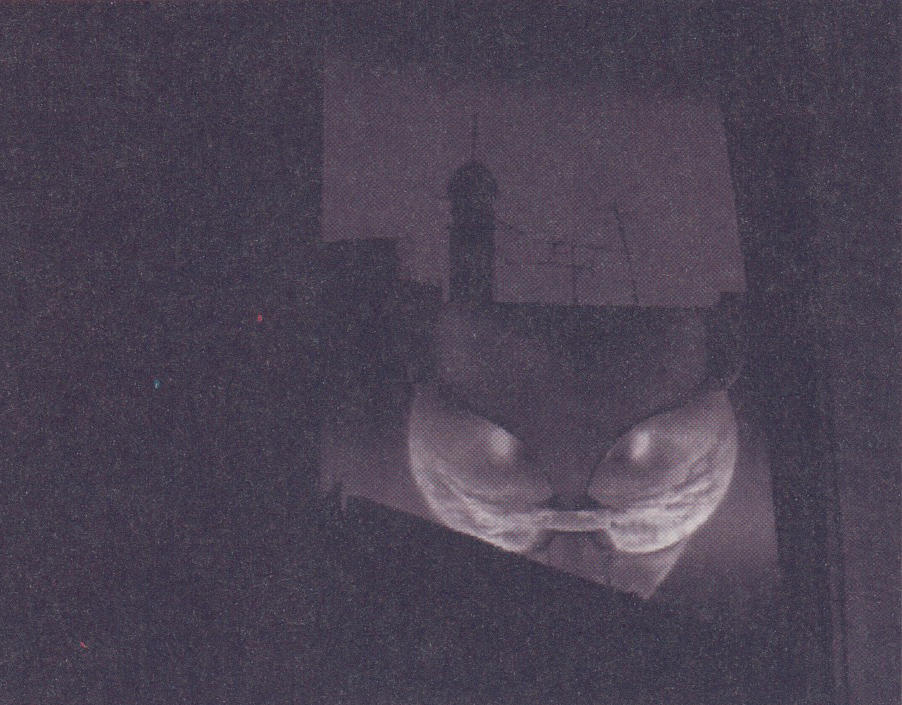
Mona Hatoum, Witness, 2009, photographed at Art Dubai
Beirut Mona Hatoum: Witness Beirut Arts Center June 10–September 9, 2010
Mona Hatoum’s first solo show in Lebanon, at the Beirut Arts Center, features the products of a recent five-week residency in the country. Witness itself is a miniature porcelain rendition of the Place des Martyrs monument in the center of Beirut.
Brittany, France From Giacometti to Murakami Palais des Arts, Dinard June 12–September 12, 2010
The town of Dinard, Brittany, follows up the spectacle of last year’s Pinault Foundation–reliant Qui a peur des artistes with From Giacometti to Murakami, a major exhibition of fifty works from leading figures including Ed Ruscha, Richard Serra, Alighiero e Boetti, Lucio Fontana, and Sigmar Polke alongside works from Shirazeh Houshiary, Ramin Haerizadeh, Mona Hatoum, and Farhad Moshiri.
Dubai Zoulikha Bouabdellah: Set Me Free From My Chains Gallery Isabelle van den Eynde June 14–August 15, 2010
Zoulikha Bouabdellah’s Set Me Free From My Chains opens at the Dubai gallery with a series of large-scale calligraphic neon works.
Dubai I. U. [Heart] The Third Line gallery June 23–July 29, 2010
The Third Line Dubai stages an exhibition, I. U. [Heart], on the phenomenon of Iran-US relations and the Iranian diaspora in the Emirates.
Los Angeles Dennis Hopper: Art Is Life Museum of Contemporary Art July 11–September 27, 2010
Jeffrey Deitch’s first show as director of MOCA is Dennis Hopper: Art Is Life, curated by artist and filmmaker Julian Schnabel.
Gwangju 8th Gwangju Biennale: 10,000 Lives Various venues September 3–November 7, 2010
The 8th Gwangju Biennale, curated by Massimiliano Gioni, will include works by more than a hundred artists, realized between 1901 and 2010. Titled 10,000 Lives, the sprawling exhibition will be configured as a temporary museum, focusing on our global obsession with images — as portraits, avatars, effigies. The exhibition will reflect on inter-human interconnections and the sheer scale of modern image production and consumption.
Basel Art Basel Various venues June 16-20, 2010
This year’s Art Basel will feature three hundred of the world’s leading galleries, as well as the customary special exhibitions and events, Art Basel conversations, spinoff fairs such as Liste and SCOPE, and all the Campari Bar you can handle.
Amsterdam Bint al-Dunya at Amsterdam Noord September 5–December 5, 2010
Mediamatic, Amsterdam, invites Cairene artists — including Osama Dawod and Ayman Ramadan — to relocate from their home base of Egypt to Bint al-Dunya, aka Amsterdam Noord, an impoverished yet spacious neighborhood in Holland, to make work in response to radically different urban conditions. Coordinated by Nat Muller.
Seoul 6th Media City Biennale September 7–November 17, 2010
The 6th Media City Seoul Biennial will coincide with the Gwangju Biennale. The joint curatorial team of Fumihiko Sumitomo (Museum of Tokyo), Clara Kim (REDCAT), and Nicolaus Schafhausen (Witte de With) have selected a roster of works from media artists including Tarek Atoui, Yael Bartana, Walid Raad, Jimmie Durham, and more.
London Slavs and Tatars: Friendship of Nations: Polish Shi’ite Showbiz Calvert 22 September 2010
Bethnal Green’s recently opened space is devoted to the exhibition of Eastern European and Russian contemporary art. This exhibition is from the polemical collective Slavs and Tatars.
New York New Photography 2010 Museum of Modern Art September 29, 2010–January 10, 2011
MoMA features four artists, Roe Ethridge, Elad Lassry, Alex Prager, and Amanda Ross-Ho, whose photographs draw from images in print media, television, and cinema.
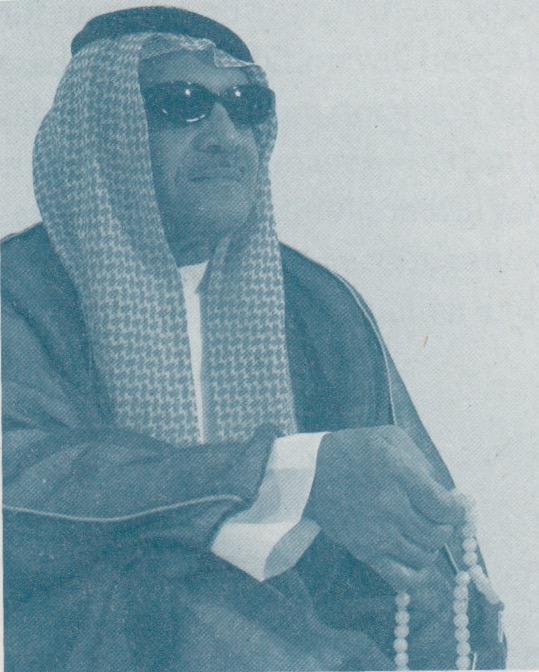
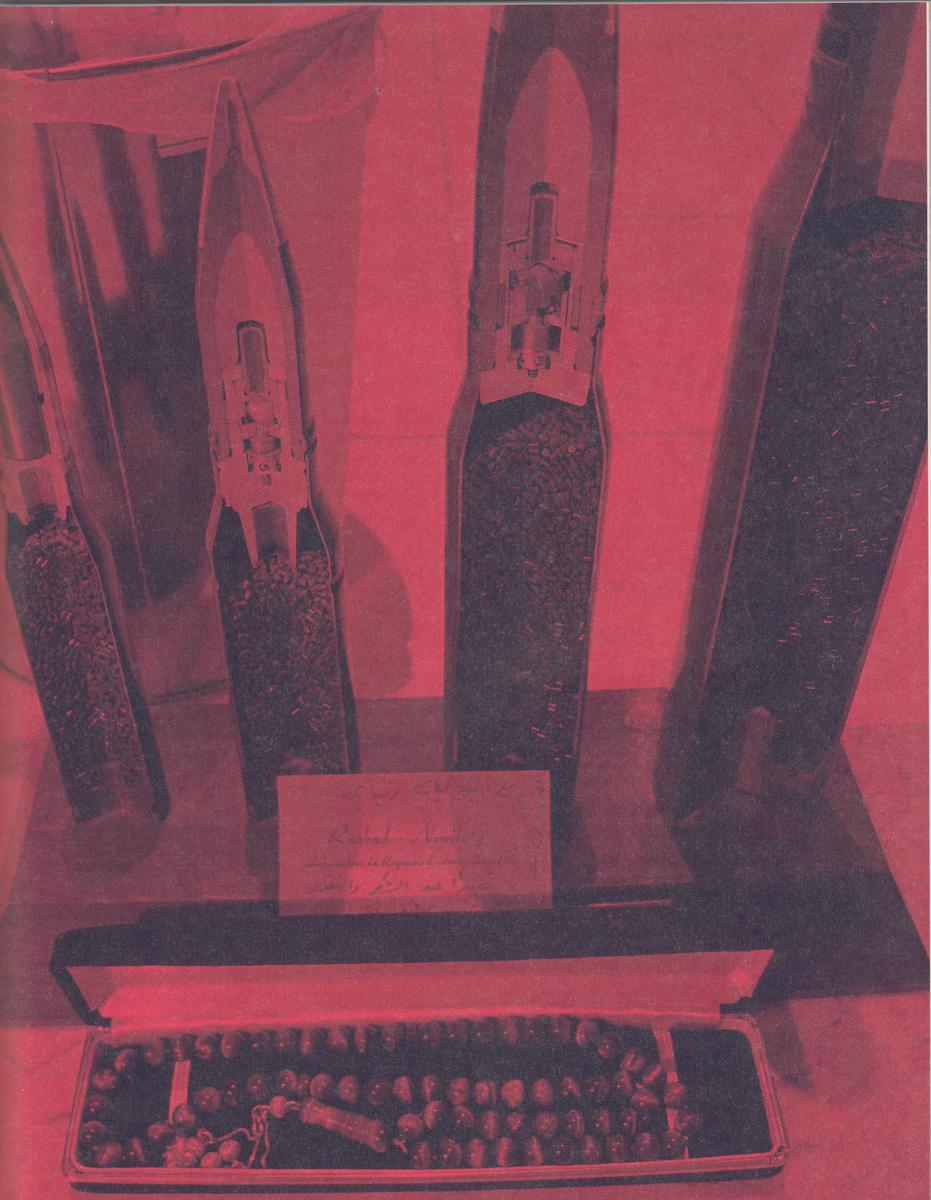
Daddy with misbah and rockets. Photographs by Fatima Al Qadiri
There’s a Kuwaiti proverb: “All theft is forbidden except the theft of misabeeh.” So my Kuwaiti father tells me. A misbah (singular) is a string of prayer beads, like a rosary, used for prayer and meditation and for keeping one’s hands busy in times of boredom. My father is a misbah thief.
He steals mostly at the diwaniyah, where Kuwaiti men gather to talk politics, play cards, watch television, and generally shoot the shit. In this relaxed male environment, many a misbah can be found in a constant, generous, elaborate twiddle. If he’s given the opportunity, he’ll swipe a misbah without thinking twice.
My father began stealing misabeeh as a young man in the early 1970s. Carefully unpacking his pirate’s booty one day, we counted a grand total of 177. They came in every color and size imaginable. Some were in beads of plastic; others wood, silver, or gold. Still others were turquoise, jade, ivory, pearl, malachite, black onyx. One was made of coffee beans. But most were made of kahram, a kind of yellowish amber that releases a faint scent of lemon when rubbed.
My father tells me that thieving is all about timing. He’s never been caught outright. A few times, a former owner has suspected my father and run after him; my dad denies the theft every time, of course. Sometimes the person will keep asking after his beads, regaling my father with stories about their sentimental meaning, until my father is overcome with guilt, pity, compassion, or annoyance, and gives them back. But this almost never happens — maybe a handful of times in four decades.
A good theft is “artistic,” according to my father. “Sometimes you have to get up, run off, put the misbah in your car, and dash back before anyone notices. So that when they ask to look in your pockets, they’re empty.” I asked him once if there had ever been a court case involving a stolen misbah. He’d never heard of one.
It seems that, though this practice isn’t universally loved, it’s nonetheless accepted. And even though it’s not common in the rest of the Gulf, if a Kuwaiti steals a misbah from someone in the region, it’s somehow okay; they respect it out of regional kinship.
Most all the misabeeh in my father’s collection are new. A couple are older, kept in cloth bags, broken beads worn down by the anxious hands of their former owners. But the turnaround on misabeeh is pretty high, so the thief ’s cache tends to be in mint condition. My father keeps them all in a duffle bag, which is locked in a safe in his room.
“Ninety-five percent of the former misbah owners have no clue that I am the thief. There’re a few men with a reputation for stealing misabeeh, but I keep a pretty low profile myself. Personally, I think my collection is moderate.
“What is the most valuable misbah I’ve stolen? The tiger’s eye stone misbah that I stole from the Saudi ambassador in Senegal in the early 1980s. It’s valued at a little over $3000. He figured it out pretty quickly, though. He actually sent me a little box with a note, officially gifting it to me. ‘Halal 3alek,’ as we say. ‘Halal on you.’ Meaning, ‘It’s all yours.’
“It was a rare feat to steal a misbah outside Kuwait.” My father smiles. “It’s a joy to steal misabeeh. Remember, as with all forms of theft, the most important thing is sleight of hand — in the pocket and bounce before they figure it out! One day soon, I want to put all of them in a big display case and invite everyone I’ve stolen from to look at their former misabeeh. That would make me happy.”
Gold Rubbish and the Saudi Ambassador’s stolen misbah Photographs by Fatima Al Qadiri
Mohamed Soueid, stills from Civil War, 2002, courtesy of the artist
Mohamed Soueid describes his interview style as a cross between a police investigation and a psychotherapy session. On occasion, he might talk to his subjects for two, four, even six hours — to the point where the experience verges on painful for his subjects. He is drawn to narratives of death, loss, disappointment, disillusionment, and regret. He makes people laugh and cry, boast and tell jokes, perform and ultimately disarm. Like a detective or therapist, he waits, listens, and takes his time. At fifty-one, he is strenuously patient. He might shoot up to forty hours of video footage for a film than runs less than an hour from beginning to end. He considers the act of editing a process of writing, that’s where his authorship emerges. His films are cinematic essays that play with the languages of documentary, fiction, and experimental video. He rarely tells a single story, opting instead for a tangle of narrative threads.
In How Bitter My Sweet, from 2009, for example, Soueid follows several strands at once, assembling a cast of six characters from almost as many Arab countries. He rides from one side of Beirut to the other with a pensive, soft-spoken taxi driver; lingers over tea with the bombastic, self-styled archivist of Saida; listens to music with a shy jewelry designer; goads a loquacious housewife into telling him what a beauty she was in her day; and brings a shopkeeper to tears by probing his relationship with his dead brother. There’s little to no relationship from person to person, yet their stories collectively touch on themes related to migration and belonging.
Soueid is widely regarded as Beirut’s first video artist, the pioneer and progenitor of the wide-ranging, deeply probing visual experimentation that has made the city such a hub for video production over the last twenty years. After years of working as a film critic and an assistant director on commercial films, Soueid made his first independent video in 1990. Al-Ghiyab (Absence) delves into the stories of four people who lost friends or relatives during the civil war in Lebanon, though their deaths were pointedly unrelated to the conflict.
The forty-five-minute piece, a tender rumination on life and death, wasn’t shown publicly in Beirut until last year (according to rumor, it was the subject of a financial dispute between Soueid and a company he had hired to do the subtitling). But it was often screened in private, at a time when the city’s contemporary art scene was just beginning to percolate. It profoundly influenced a generation of artists and filmmakers — Akram Zaatari, Ghassan Salhab, and Mahmoud Hojeij among them — as did Soueid’s later work, most notably the trilogy Tango of Yearning (1998), Nightfall (2000), and Civil War (2002).
Born in 1959 in Beirut, Soueid is too young to be the godfather of Beirut’s current contemporary art scene, but he is a serious contender for the role of elder statesman. There was a time when he was frequently lumped into “the group” of artists, writers, and filmmakers from Lebanon who have become known internationally over the past decade. Soueid’s films were programmed into some of the seminal showcase events — Catherine David’s ‘Contemporary Arab Representations’ at the Witte de With in 2002; ‘Possible Narratives’ organized by Christine Tohme and Akram Zaatari for Videobrasil in 2003; ‘Beyond Truth and Fiction’ in Cairo in 2005 — that served to crystallize and codify the Beirut scene. But Soueid never really decamped to, and was never fully embraced by, the art world, locally or internationally.
Soueid fell in love with cinema as a child. He remembers the plot of the first movie he ever saw in a Beirut theater, the Empire Cinema on the eastern edge of the city center, which has long since been destroyed. “It was a western,” he says. “My father took me to see it. You know, it was the kind of western that takes place in a Mexican village. Not a Pancho Villa film, but something like this. It was about a buried treasure. Everyone wanted to find the treasure. The American heroes arrived to the place where the treasure was hidden. But when they uncovered it and opened the chest, they found it was not full of gold, but an olive branch.”
At that time, film criticism was flourishing in Lebanon alongside the rituals of a robust movie-going public. “I used to read a lot about cinema in the newspapers,” recalls Soueid. “The movies used to change in the theaters on Mondays, so new reviews would always appear in the papers on Mondays, as well as in the cultural supplements that were published on Sundays. Film critics at the time were really serving film culture properly. They were writing about New Wave, Neorealism, and they didn’t encourage people to follow fashion or gossip. They covered European, American, and Egyptian cinema. Youssef Chahine was at his best at the time, and you also had people like Salah Abu Seif and Tawfiq Saleh. Later, in the 1970s, the critics started talking about Lebanese filmmakers like Borhane Alaouie and Maroun Baghdadi. And from my childhood I wanted to be a director. I thought that being behind the camera was the most important place to be.”
When Soueid reached university age, the closest thing to a film school he could find was the theater department at the Lebanese University. Since this wouldn’t have put him anywhere closer to that coveted spot behind the camera, he studied chemistry in the faculty of sciences instead. But he dropped out of school a few months before graduation and began working on the crews of features films. “I’m self-taught,” he says with a cringe of modesty.
Soueid also got a job at the pro-Syrian newspaper Al-Sharq and began writing criticism of his own. Later, he moved to the left-leaning As-Safir, where he took over as the lead film critic when Yousry Nasrallah left Beirut, and began contributing to Al-Mulhaq, the weekend cultural supplement of Lebanon’s largest and most mainstream newspaper, An-Nahar. In addition to accumulating decades of experience and clips, Soueid has written a book about films produced during the civil war, a highly personalized history of cinemas in Beirut; and a novel, titled Cabaret Souad and fueled by an oversize obsession with the late Egyptian actress Souad Hosni.
During the fifth edition of the Home Works Forum in Beirut this past spring, Soueid delivered a lovely lecture — curiously described as such, rather than as an artist’s talk — that traced the history of foreign film production in Lebanon during the 1960s and ’70s, against the backdrop of Soueid’s fascination with actresses such as Hanna Schygulla and Jane Birkin, and his enduring affection for a city he saw refreshed in their eyes. Jumping from Volker Schlöndorff ’s Circle of Deceit to Delta Force, 24 Hours to Kill, The Man with the Golden Gun, Marlon Brando, the disappearance of Mussa Sadr, and an indefatigable Greek singer who was kidnapped in Lebanon in the 1980s, Soueid created a web of wild associations: “We cannot look into things with an investigator’s or a detective’s eyes,” he said. “Things converge that have nothing to do with one another, but then somehow it all makes sense in the end.” If nothing else, this was an incredibly apt description of all Soueid’s work to date.
What is striking, however, is that despite Soueid’s intense love of cinema, he has only ever shot video, never film, and he seems completely uninterested in making features. He tried once, in 1986, but the shooting was repeatedly interrupted, his producer bailed, and the lead actor left the country. “It was a bad experience,” he says, a characteristic understatement. He still has the footage, under the working title Merry Go Round, on U-matic cassette tapes, the first video format available in Lebanon. “I never had the financial means for shooting on film,” he says. “I always worked on underground films, so video was kind of my savior.”
Soueid did spend several years working on other people’s feature films, and in 2003, he collaborated with Egyptian director Yousry Nasrallah in adapting Elias Khoury’s Bab al-Shams to the big screen (a four-and-a-half-hour epic). But overall, he says, “I’m still in love with the documentary approach. It’s therapy, and I need it. I’m very attached to the street. It’s where I can experiment.”
Soueid’s work is prone to dwelling on themes of love, sex, longing, and sorrow. These are the gritty bits of emotional life that are so often absent from the work of his most immediate peers. In the art world more generally, they’re also the subjects that tend to be anaesthetized into oblivion, abstracted in the prevailing lingo as affect, a lame and increasingly overused term that has become a catchall for anything earthbound and messy. Soueid is also somewhat unique in that he doesn’t shy away from issues of socioeconomic class, that elephant in the room of Lebanese contemporary art, nor does he avoid gut-wrenching grief.
“I come from popular culture,” he says. “I still live in the old quarter of Beirut where I was born. If you live in these popular areas, you receive sounds and stories. In these poor areas where I live, there are always problems. I have a great love for Egyptian movies and novels. Take Egyptian movies, plus the influence of the women in my family, and you might call it melodrama, though I would call it tenderness. I was never an optimistic guy, even as a child. I remember in school I was very touched by the melancholic stories of French literature, Chateaubriand’s stuff. I remember the teachers who taught us French literature — some of them used to recite poetry, and they would cry. At some point, being melancholic was a kind of fashion.” Still, the stories folded into his first film are pretty harrowing, particularly that of a young girl who died by falling from her window in the middle of the night.
It’s interesting to consider the relationship that Soueid cultivates between improvisation and control. In an interview for the journal Parachute with fellow video-maker Akram Zaatari, he once said he was sensational rather than intellectual in his work, and that if he evoked intellectual issues, he didn’t do so by intellectual means (he was drawing a distinction between his work and that of Walid Raad). But while Soueid allows for a lot of emotional leakage, and follows issues and conflicts as they seep and bleed into one another, he also exerts a great deal of formal rigor.
When he was preparing to shoot Al-Ghiyab, for example, he studied the sunrise, sunlight, and sunset of every location he intended to film. And despite the fact that his work relies on the unpredictable paths of several interviews, he somehow managed to script the entire thing, talking to his subjects in advance without exhausting their capacity to speak naturally and not sound rehearsed.
“When I did Al-Ghiyab, I was coming out of the experience of working as an assistant director on mainly commercial films. I thought these commercial films were made badly. We rarely worked from fully written scripts. Everything was chaotic. The shooting, chaotic. The editing, chaotic. So I suppose in the beginning I thought the best thing to do was not work like this, to have a full script and sketches of everything. So despite the fact that my first film was a documentary, out of the meetings I had with the people who appear in the film, I was able to construct a kind of script. And I shot the film as it was scripted. I wasn’t surprised or embarrassed by the interviews. It was basically people talking to me about their sorrows.”
Like many creative figures in postwar Beirut, Soueid found employment, and room to breathe, in the local television industry. At the end of Lebanon’s civil war, the country’s media landscape was a mess. Every political party worth its salt had a television station of its own; most of them broadcast only slipshod news programs, all highly skewed toward their respective party positions. They filled the rest of their airtime with Egyptian movies and American sitcoms. But starting in the 1990s, the government began regulating the industry and cut more than fifty stations down to around ten. That time equally represented a moment of fleeting optimism and economic opportunity in the region, when it looked like a substantive peace deal might be struck in the Arab–Israeli conflict, and investments flooded into several of Lebanon’s creative industries.
Soueid joined the state-run station Télé-Liban in 1993. He spent the next three years making adaptations from theater, and daring documentaries, such as Cinema Fouad (1994), a sensitive portrayal of a Syrian transsexual — who was living in downtown Beirut at the time; had been a soldier, a servant, and a cabaret dancer; and was saving up for a sex change — that explored identity and desire in the form of a grueling, twenty-eight-minute interview.
For a time, the television industry was aggressively recruiting young talent and providing unfettered access to equipment, along with relative freedom to produce experimental work. But that situation didn’t last long. Akram Zaatari, who worked as the executive producer of a morning show on Future TV, got out of the game in 1997. Rabih Mroué, who also worked at Future TV until just a few years ago, regarded it as little more than a day job. Soueid, meanwhile, is still deeply embedded in the industry.
When he left Télé-Liban in 1996, he often says, he thought his career was finished. But he spent the next six years making the trilogy that in many ways defines him. Tango of Yearning digs into a personal story of heartbreak and obsessive love. In Nightfall, he reunites with colleagues from his days as a member of Fateh’s Student Brigade, for whom fighting in the civil war often meant guarding an abandoned roadside ditch. Civil War, the strongest and most moving of the three, delves into the mysterious death of a close friend, the cinematographer Mohamed Douybaess, who held out a theory that the civil war was caused, at least in part, by sexual frustration.
In 2002, Soueid took a job with the MBC Group. He headed up a documentary division, and now makes films for the satellite station Al Arabiya. One of the downsides of working in television is that he rarely retains the rights to his work. DVDs of his masterful film My Heart Beats Only for Her are widely available, but his name is nowhere to be found. That film — a melancholic portrait of cities such as Beirut and Dubai, poised between the models of Hong Kong and Hanoi — is the second installment of another trilogy, which began with The Sky Is Not Always Above, a winding history of Beirut’s southern suburbs. Both films dig into the subject of revolution and explore the disjunction between the ideologies of revolutionary movements and their practices. Soueid is currently planning the third and final installment, but is reticent about disclosing its subject.
Unusually for Soueid’s later work, My Heart Beats Only for Her was feted with a theatrical release in Beirut last year, thanks to the efforts of Hania Mroue, who directs the art house cinema Metropolis and in 1999 cofounded the film collective Beirut DC with Soueid, among others. (Though supportive of Beirut DC’s work, Soueid is no longer actively involved. Young people still believe in politics, he says, but their politics exhausted him long ago.) Alongside Christine Tohme of Ashkal Alwan, Mroue has been trying to coordinate a retrospective of Soueid’s films for years, an initiative that would necessarily involve restoring some of his older works and subtitling the majority of them. But Soueid isn’t ready to play along. “When I hear the word retrospective,” he says, “the first thing that comes to mind is that I retire. I would have to make a full stop, or end a chapter in my career. I would have to reach a point where I’ve said what I have to say, and that’s it.”
Elad Lassry’s most recent 16mm film — Untitled (Passacaglia), 2010 — begins with a slow and deliberate tracking shot across the surface of a garish and discordant painting. The painting, a pastiche of bright colors, evokes early twentieth-century Orphism, and even more specifically, appears to be a reproduction of Robert Delaunay’s 1916 oil-on-canvas work Tall Portuguese Woman. As the camera’s movement becomes increasingly unsympathetic to the logic of its subject — a rigid axial angularity at odds with the painting’s concentric circles — the image is reduced to an arrangement of geometric patterns. As it happens, Delaunay’s practice, and Orphism more broadly, maintained a consistent engagement with the task of translating sensorial phenomena into a singular contained image. Untitled (Passacaglia) takes this premise as its point of departure, and from there, proposes that in order to grasp the presence of an image, that image must first be reduced to nothing more than a filmic prop.
In the years immediately following the Second World War, another painter associated with Orphism, Fernand Léger, was appointed president of the newly established International Federation for Art Films, an organization jointly initiated by UNESCO, the International Council of Museums, and the Cinémathèque Française. The federation was intent on the use of film as a tool in the interpretation, appreciation, and popularization of the visual arts throughout the developing world. As both a painter and filmmaker, Léger seemed particularly suited to the task — the program set out to establish standards of quality for the cinematic documentation of important works of art. In the years that followed, filmmakers were sent to major international museums to capture the “essence” of paintings and sculptures for audiences unable to experience their wonders in the flesh. Films on art were commissioned en masse, and their proponents argued that the application of novel cinematic technologies could adequately convey that which is unavailable to the unassisted eye. Motion picture film, it seemed, was capable of lingering on static images so as to communicate their hidden properties, as if they revealed themselves over the duration of time.
Lassry’s interests are at least tangentially related to this lesser-known history, but his strategies also bear obvious resemblance to more recent developments in advanced art — an area where the fascination with images has been subsumed by the rhetoric of theory. The films of Michael Snow, Jack Goldstein, and Sharon Lockhart are, for Lassry, important points of comparison. While these artist-filmmakers are linked by an attraction to the mysteries of image production, their tendencies have been characterized as reflective of a structuralist impulse — a cinema of the mind rather than the eye, as it was once described by P. Adams Sitney. The remnants of structuralism are undeniably present in Lassry’s films, but a shorthand reliance on such categorical explanations loses sight of the transformation that occurs when one visual form mediates and communicates the properties of another. Untitled (Passacaglia) irresolutely fixates on the texture and quality of types of images that have long been the subjects of film but that have, nevertheless, remained relegated to their own medium-specific domains. Lassry’s films, to date, have been evocative of a structural concern, but they also reveal an awareness of the medium’s troubled relationship with its history as a form employed for the documentation and reproduction of other visual arts.
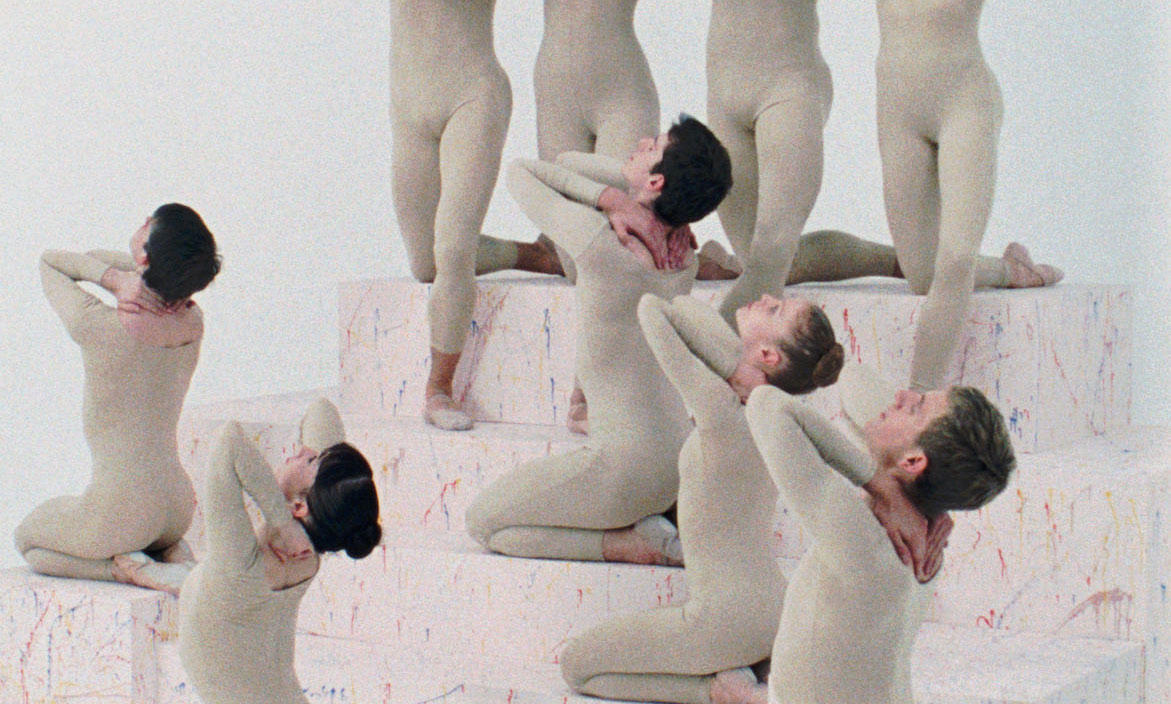
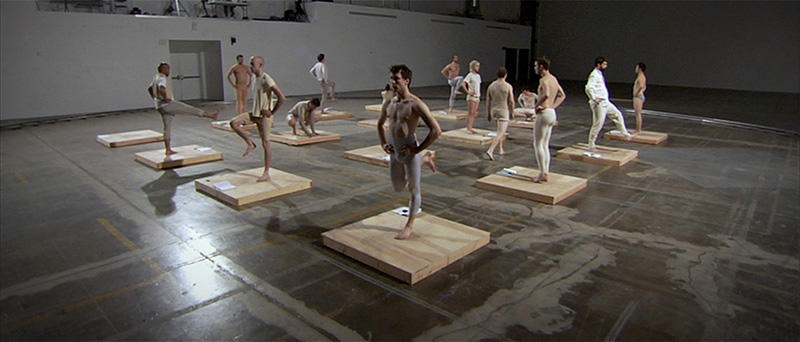
In this incarnation, Lassry’s fifteen-and-a-half-minute film departs from the legacy of the late American choreographer Doris Humphrey’s Passacaglia, which aired on National Education Television in 1966. While Lassry’s recreation of that event reflects the artist’s long-standing interest in the filmic documentation of modern dance, dance is only a tool for understanding how the processes of perception become visible when external forms of performance and visual art are translated by another visual medium. Much like his previous films, Untitled (Passacaglia) couches a preoccupation with dance in a thinly veiled disguise. It is true that dance has recently become an art world fetish. But above and beyond the particular context of dance, Lassry’s films on the subject insist upon the fundamental relationship between moving images and the visible world they attempt to capture. Untitled (Passacaglia) is perhaps concerned more with the image that dance offers of itself, than with the form’s peculiarities.
To produce this work, Lassry engaged performers from the New York City Ballet to recreate Humphrey’s radical work of modern choreography. When the reactionary piece was imagined in 1938, it defied convention and broke away from the rules of ballet. Lassry’s restaging is not a facsimile; the dancers’ repetitive movements become peripheral and their muted presence seems to obstruct the view of the patterned set that grounds the performance. Rather than privilege the dance, the camera’s focus is on the stage — risers splatter-painted in the style of California Drop Cloth’s ’70s-era “Celebration” upholstery, a signature textile pattern influenced by the drip paintings of Jackson Pollock. The performers’ bodies are awkwardly framed so as to resist any semblance of a total picture. It’s a tightly cropped scene with few dynamic edits; it denies a visual command of the dance and resists the filmic strategies of the original televised performance to which Lassry’s film refers. Eventually, in the film’s third and final vignette, the knockoff Delaunay painting reappears as a backdrop, in front of which three particularly iconic dancers pose uncomfortably, as if for an off-camera photo shoot. In the end, Lassry’s recasting of these original works of art is not tinged with irreverence or even art-historical critique.
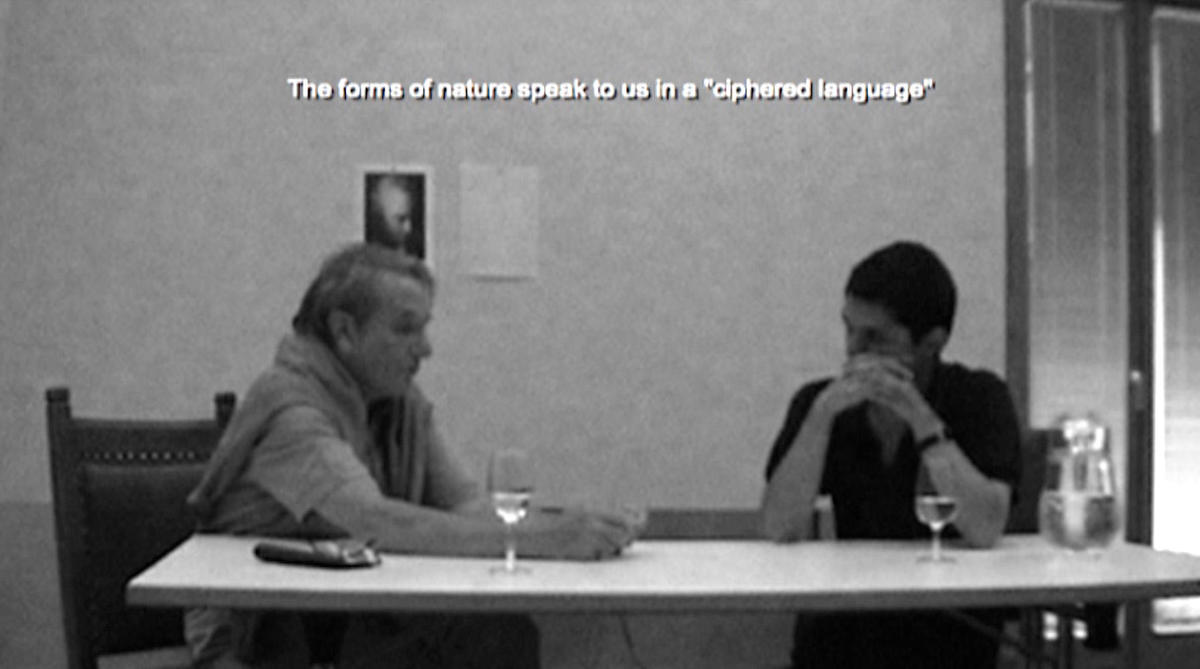
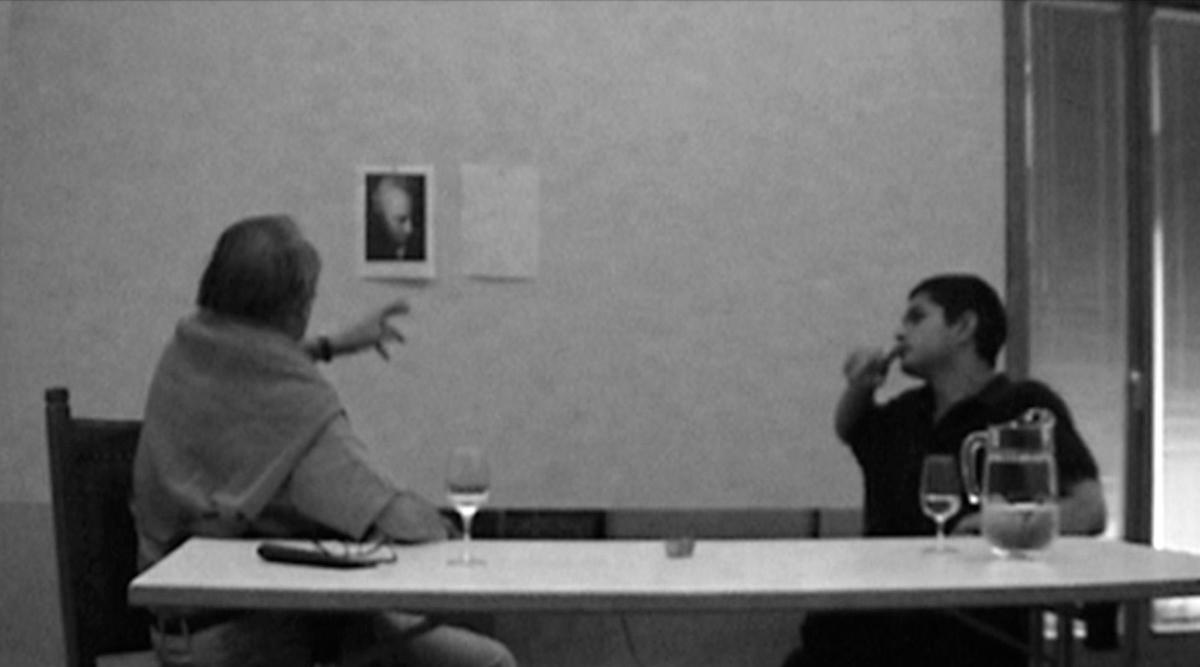
Amir Mogharabi, stills from Discussion Around a Stone, 2009
In September 2009, Amir Mogharabi presented a performance entitled Stone, at X Initiative in the former DIA space on West 22nd Street in New York. The piece was built around videotaped, one-on-one conversations between the artist and three icons of contemporary philosophy: Michael Hardt, Sylvère Lotringer, and Jacques Rancière. In each, a table separated the artist and his guest, and on the table sat a stone. Two stones, actually: a hard-edged chunk of gleaming pyrite — “fool’s gold” — and an irregular igneous mass several times larger, into which the pyrite was set. The composite was about the size of a baseball, and the men onscreen debated its evocations and origin, pondering it as natural object, art object, and philosophical object. In other words, this was the quintessential philosopher’s stone. All puns intended.
Mogharabi, for his part, claimed nature as the stone’s true origin and maker. But by the end of the project, the stone had acquired new provenances, conceived by the artist and philosophers, all equally true. This possibility, of multiple beginnings, is a seminal concept within Mogharabi’s sprawling practice. At the conclusion of the performance, Mogharabi jolted the stone’s history into action, flinging it across the room at the glass displaying the video’s subtitles, hence propelling another beginning. The glass shattered, and what remained in the aftermath of this event were a pile of random shards and the dust of lofty assertions.
Mogharabi’s art is, by design, inscrutable to most — including, ostensibly, himself. Unfolding as a perpetual series of performances, installations, texts, publications, and obscure actions at large, his intent is always unscripted and undefined, aimed only at spontaneity. If this stream-of-consciousness brand of creative discipline sounds familiar, it could be a modernist reincarnation; Mogharabi’s ascetic earnestness channels a bygone era of avant-garde grandiosity. Broadly put, Mogharabi’s goal is “to put philosophy into practice as an art.”
Still, the artist maintains that philosophy is not his medium, nor does he advocate an agenda for conceptualizing his art. Instead, Mogharabi calls the project of conceptualism a lie that purports to privilege ideas over objects, as if the two were not yoked. Which is not to say that Mogharabi always disdains dishonesty — he believes in the creative potential of a well-wrought lie, which repackages an empirical truth as new and improved.
At its best, Mogharabi’s work explores these tensions between an object and its life, and by extension, all the lies in between. He assigns significance to each of his actions only after they’re completed (though in his universe, nothing is ever truly completed). Repurposing sequentially, the artist terms his dizzyingly reflexive march towards meaning “retroactive reasoning.” It’s no stretch to imagine the paths that stem and splinter from an initial happening.
After performing Stone at X Initiative, Mogharabi kept the stone and gave the variable “X” (no relation) to the geometric pyrite and “Y” to the unruly material encasing it. He later named these variables Coco Du Nom (X) and Allais Young (Y), two pseudo-pseudonyms to which he assigned specific, Jekyll-and-Hyde parameters for making art. These modes of production were inspired by the conflicting physical properties of the stone(s): “Coco Du Nom intentionally works under rational constraints; Allais Young attempts to forfeit intentionality altogether,” he explains. Thus uncritically outsourcing absolute methods of making work, Mogharabi situates the work he credits to himself between poles of pure rationality and pure intuition, a black and white that key a full spectrum of grays.
To maintain a genuine presence of mind, one can only do one thing at a time, act or reflect. This is true for an artist, who can at any moment either move a practice forward through action or backward through reflection. Movement in either direction is gainful, but to try to go both ways at once results in something of a confused wobble. Mogharabi devoutly separates action from reflection in order for his art to structurally emulate thought. His entire output can be read as an essay built of intuitive gestures that he interprets and edits after they have come into existence. This is how Mogharabi recasts philosophy as art: by approaching art as thinking or writing, never-ending processes that evolve through the retrospective evaluation of previous iterations.
Weeks after his project at X Initiative, Mogharabi summoned the stone again to shatter another pane of glass, this time as part of an installation at Front Desk Apparatus in Soho. Only this time, contact with the glass split the stone itself into two pieces, dislodging X from Y. The total accident as a symbolic incident illustrated the fundamental autonomy of X and Y, how rationality and intuition only ever merge in temporary, constructed arrangements.
Throughout Stone, there was no inherent coalescence of idea and object. The two united later as story, which becomes history over time. The heart of Stone was indeed about making connections — between idea and object, X and Y, action and reflection — but its beat was felt in the gaps that separate those pairings. The split that occurred at Front Desk Apparatus essentially cast the underpinnings of Stone into stone. Mogharabi retired the two pieces to a new life as a sculpture — for now, at least. Despite the seeming finality of that gesture, if he were ever actually to end Stone, that could be the final blow to shatter the meaning of his whole endeavor.
Although Mogharabi is never working toward anything definite, his work is in constant progress. Pressed to answer what’s next, he only offers “the unexpected; indeterminacy; but, always evolving from what has already happened, and then determining how the evolution occurred, retroactively.” In other words, he doesn’t know, and that’s the point. One element of Mogharabi’s practice assumes the form of a written publication called Farimani, which gathers writing on art, music, and theory. He claims to know nothing about its path other than that each volume will grow in physical size until the eleventh and final volume. (Farimani exists online, too.) As for live events and objects, on the evening of April 20, 2010, Mogharabi presented the sixth in a series of lectures at the site of the former X Initiative, to be followed by his participation in ‘Greater New York’ at P.S. 1 Contemporary Art Center and a summer project at the LISTE Fair in Basel. The coordinates are set — though it remains to be seen what will unfold at each subsequent meeting of X and Y.
Photography by Michael Schmelling, Styling by Avena Gallagher
All suits by Marc Jacobs
Once upon a time in America, rock music was dangerous, subversive — revolutionary, even. For the aspiring rocker, that fairytale has had a sad ending — whatever promise or menace might once have attached to words like alternative, independent, or underground have melted into air. Whatever else contemporary rock music might be, dangerous it is not.
Except, of course, if you happen to be an aspiring rocker in the Islamic Republic of Iran, after the president of your country effectively makes it a crime to play rock music at all.
So perhaps it was not just the timeliness of Hypernova’s touchdown on American shores that set off a media frenzy in April 2007. American–Iranian relations were at an especially low ebb, and four fresh-faced (if swarthy) young men from Tehran were a perfect foil for saber-rattling Fox newsmen and other media sensationalists. ABC News called them “Iran’s Latest Ambassadors” — ambassadors from a land where loving rock and roll might get you fined or flogged or even jailed.
Hypernova are back in the news with the release of their debut CD, Through the Chaos. They’re signed to Narnack Records, a label that also features old-school heavies like Lee “Scratch” Perry and The Slits. And they’re featured, indirectly, in Bahman Ghobadi’s film No One Knows about Persian Cats. Last summer, they toured the US supporting aging gothsters Sisters of Mercy; this summer, they’re at or near the top of the bill themselves.
Not long ago, after seeing them perform live at the 92nd Street Y in New York, we invited them down to our headquarters, where the Iranian members of our staff discussed with them the ins and outs of Persian pop, the perils of publicity, and why Pink Floyd is still the biggest thing in Iran since Milan Kundera.
Negar Azimi: How do you feel about being marketed as an Iranian band?
Raam: It’s funny, I just sent an email to our manager today saying we wanted to stop being introduced as an Iranian band… . I think we’ve been very fortunate. We get so much attention just because of where we’re from, which is probably unfair to a lot of other bands who work just as hard as us but don’t get a chance to be heard. But we did go through a lot of hard times back in Iran, getting to where we are. I mean, obviously the story is really interesting to people who aren’t familiar with what’s going on in the underground scene back home. It has this sort of exotic, Oriental feel to it. But at the end of the day, we want our music to speak for itself. We want to have fans of our music, not our story.
NA: We were curious in part because of No One Knows about Persian Cats, that movie about the Iranian rock scene that was ostensibly based on a lot of research. They talked to you guys, right? Do you think the film will have an effect?
Raam: Obviously, the movie gave exposure to a lot of artists, and there are so many talented musicians in the underground scene in Iran. There are many who really aren’t talented or amazing, too — whether or not they deserve to be heard is for other people to decide. But I think you could almost say this movie was the death of the underground. Of this underground, at least. People are on the radar now like never before. The authorities and the government are aware that this is happening; they’re closing things down.
NA: Can you tell us more about that scene, the one that seems to be ending now? The late ’90s scene, when you guys came together, during the Khatami years. Were you collaborating with people, or was it isolated?
Raam: It was very isolated at first, simply because you were in, like, basements. One of the big things was the underground music festival that Tehran Avenue held in 2000. That was the first time anyone in Iran had heard all these bands at the same time. We were all really impressed. Everybody shared that belief, “There’s no punk band, there’s no metal band, we’re the only ones.” We all thought we were the only band in the country.
Kodi: I was too young to even be in that scene, so when I heard all those bands, I was like, “We actually have underground bands!?”
NA: How did they set it up? Did Tehran Avenue put on a big concert?
Raam: It was an online competition, everyone submitted tracks. One of the really great bands I heard for the first time then was this band from Bandar Abbas, a port city in the south where I would never have imagined anything cool happening. I was surprised, pleasantly surprised. After that, websites started going up. I remember on Yahoo! Messenger there were these chat rooms, and we’d have meetings. People would meet up in the parks and trade mixtapes and talk about who’s the fastest guitar player on the planet and dumb things like that.
NA: So what sort of things were you guys talking about? What were you into? Who are your “Western influences”?
Kami: I mean, we grew up listening to garage and alternative.
Kodi: Grunge, punk, alternative music.
Raam: I remember my first cassette was a Queen tape. A lot of Pink Floyd, obviously. I was a huge fan, and I still am.
NA: Why is Pink Floyd so big in Iran?
Raam: Pink Floyd is so big. And Dire Straits, they’re huge in Iran.
NA: Dire Straits?
Raam: I have this stupid theory that someone came to Iran in, like, 1985, with a box full of cassette tapes. And that tape collection was all we had until satellite TV came. I think it’s as simple as that. Then the Internet came along, and suddenly we were up to date with the rest of the world.
I mean, all that you ever heard on the radio was all this poppy Iranian music from L.A., in our homes and on the way to school. We were just sick and tired of it.
Now that I’m here in America, whenever I hear traditional Iranian music, I get all nostalgic… I think of the mountains…
Tiffany Malakooti: Like Toofan?
Kodi: You’d better not say anything bad about Toofan — he’s our friend’s uncle! [Laughter]
TM: I am Toofan’s biggest fan…
Babak Radboy: You were talking about how the scene wouldn’t be the same anymore in Iran, because of the movie. Do you regret, at all, the movie coming out, more people starting bands?
Raam: No regrets. Anyway, there are still really cool underground things happening, that are still pure.
Honestly, there’s only so far we could have gone in the underground in Iran. Back at home, people would always ask me, “What do you do for a living?” We’d be like, “Oh, we’re musicians.” “No, what do you do for a living?” I’m like, “I don’t do anything, I just make music.” In our traditional culture, it’s sort of a taboo to try and be a rock star.
TM: Wait, so what did you guys do for a living?
Kodi: The only one that actually had a real job was
Kami:. I was still in school with high hopes for my university education. [Laughter]
Raam: I made him drop out of school to join the band.
TM: Do you have a fake ID?
Kodi: Uh, I do, but it’s actually my brother’s. I don’t get to use it much anymore, because people at bars know us, so they sneak us in the back door.
TM: And what did you do when you were in Iran?
Kami: I worked for eight years in an industry job, heating and cooling systems for buildings, factories.
BR: Heavy.
Raam: Kami was a hard worker back in Iran. The rest of us were a bunch of lazy bums. I would do a lot of outdoor stuff — I would always be in the mountains camping. It was just the best getaway from all the madness in the city. I would just go out to the mountains and get high and drink and just do crazy shit and have fun. That’s one of the things I miss about Iran. I used to go to the desert.
NA: You made the decision to apply for a visa. Were you conscious of what you were giving up?
Raam: To be honest, I swear to God, when we came to the States, there was no Plan B. We didn’t even say proper goodbyes — we didn’t even know what we were getting ourselves into. We had no idea. And people think that we had this whole thing planned out to move to the United States — we came here with one suitcase and a guitar, literally, and a couple hundred dollars each,
and we had round-trip tickets. We didn’t know anyone in the States, we didn’t have a place to stay, we didn’t know how the music industry worked. We just threw ourselves into this unknown universe and let the chips fall where they may. One thing led to another, and suddenly our parents were calling us and saying, “Why aren’t you coming back home?” [Laughter] And it just seemed like we were onto something. So we decided to ride it out.
There were two features, one on MTV and one in the New York Times, that really got us a lot of attention. When they came out there were, like, a thousand emails in my inbox, people
from around the planet telling us how inspired they were by this story of ours. We were all just overwhelmed. Anderson Cooper wanted me on his show, they wanted me on Fox News, Good Morning America — they wanted us to do all these crazy things, and we just didn’t feel comfortable.
BR: What kinds of things?
Raam: We sort of knew where we were as musicians, you know? And we knew that we were not ready to perform live on national TV. Our first goal in the States was just to develop our sound. Back in Iran, all of our equipment was really crappy, and you never had proper rehearsal space, proper equipment. We couldn’t play our music the way that we wanted to, the way we heard it in our heads.
BR: Did you get the sense that you were being used to tell another story? To the Fox Newses of the world, for example?
Matching sweaters by Lavané
Raam: We’ve done a couple of Fox News interviews, believe it or not. In the beginning, obviously, we were a human interest story. Right when we arrived, there were those British hostages taken in the Persian Gulf, so there were headlines like “British Hostages Taken” and “Underground Band Rocks Ayatollahs.” They used all these catchy headlines, and they would take all my words out of context. And people were emailing me, “What the hell are you saying about Iran?” I realized then how hard it is to do interviews. One of the hardest things I’ve learned in this journey is that I can’t make everyone happy. After every single interview, I get a shitload of hate mail. It’s just how it goes.
TM: Who sends you hate mail?
Raam: Sometimes it’s Americans telling us to go back to Iran. But actually a lot of it is from Iranians. They’re so proud about everything, you know? The smallest thing that we say, they just go all crazy about it. It’s funny — we try to stay away from Iranian media.
NA: In America, you mean?
Raam: We just did one Iranian radio station in Los Angeles. We made fun of Iranian pop musicians, and all of a sudden the phone went off the hook. All this, “Who are you bastards?” But you know, we don’t care, we hate that style of music, that sound. I don’t care what people like. We’re against it. I don’t care what people think.
One of the funniest questions I always get is, “What do you think about the nuclear standoff between Iran and the US?” I’m like, “What the fuck do you want me to say?” People are always trying to make us into some kind of political band. But we’re not Rage Against the Machine.
NA: Do you ever feel you’re being used? Like, that people want you to tell them what they think they already know, confirm every cliché about “life behind the veil”?
Raam: Oh, all the time. I mean, it’s true that everything we did in Iran was illegal. What we did was very dangerous. But at the same time, life isn’t as hard as Fox News imagines. You get used to living with your fear — because it’s true, fear is something you grow up with in Iran, you’re constantly bombarded with threats, and there’s always this sense that you can’t trust anyone. But after awhile, you get to a point where fear doesn’t even play a role in your life anymore. You don’t care if you’re going to get lashed or thrown into jail. You just want to play your music. And that’s where it became easy, actually. Once you don’t care anymore, life becomes pretty easy.
NA: Were you guys surprised by what happened in Iran last summer? I was totally surprised. I’ve spent a lot of time there, and I didn’t think the Iranians had it in them. It always seemed to me that people didn’t feel like having another revolution.
Raam: I wasn’t surprised at all, actually. People just reached a tipping point where they felt like
they had nothing to lose. They were willing to sacrifice everything, especially for a great cause. I think the people really have had enough. The younger generation is becoming disconnected with this sort of archaic government. I think it’s only a matter of
time before the people’s cause will prevail. I really do.
NA: What was it like for you guys, experiencing what happened from the States?
Raam: It was so hard — we had one of our biggest shows, one of the coolest shows of our lives, the El Rey Theatre in Los Angeles, a sold-out show. It was the second night, when we started seeing all the brutal images. It was hard for me to sing that night. We were all very emotional. I was in such a sad state of mind.
Kami: We were 24/7 on YouTube, looking for videos to see what was going on in Iran.
Raam: We couldn’t get off our computers. I was just Twittering, Facebooking, sharing information. Trying to help, to be active somehow. But at the end of the day, it’s up to the people over there to decide their own fate.
NA: Can you trace this back to the election of Ahmadinejad in 2005? Was that a big deal for you?
Raam: During Khatami’s presidency, the reforms were happening, and we saw firsthand how much more freedom we were experiencing, getting together in parks or partying or whatever. Everything felt a lot more comfortable, and the authorities were a lot easier on the kids. There were certain ugly instances under Khatami, of course, but generally it was a much more positive environment.
Under Ahmadinejad, things started slipping away. One of the first things we noticed was the tariffs going up on musical instruments. That was a very subversive way of combating Western music. A guitar that costs $100 here would cost $800 in Iran. The idea was to make it so that kids couldn’t afford to buy instruments. I mean, that’s what I think happened.
BR: It’s funny. The idea of rock ’n’ roll as something illegal — that’s like a dream for a lot of people here in the States, you know?
Raam: The best show we ever played was in Kashan. It was an illegal concert where we forged documents from the Ministry of Culture. Kashan is very religious — after Qom, it’s the most conservative city in Iran. And I’m a very paranoid person. No one told me that the local Basij had raided the place the week before and beat up everyone in the hall. And they weren’t even playing rock music! If I had known that, I would have cancelled the whole thing. The kids at the university forged documents saying that they had permission to hold the concert. So there’s all these forged documents, and we go to the show, and there are, like, 450 people in this big amphitheater, and they’re all sitting down, and there are all these undercover police in the audience with their walkie-talkies. And as we played, there was this big picture of Khomeini on one side and one of Khamenei on the other. And we’re rocking in the middle.
Kami:
And the sign said “Music for Peace.” We covered a Franz Ferdinand song.
Raam:
We had so much fun. And we barely got away with it. Suddenly, as we were leaving the building, the authorities were onto us — like, “What did you guys just do?” A friend of ours distracted them, and we got away. We were really lucky. And the feedback from the kids was so powerful. I don’t think anyone has ever clapped for us the way they did at that show — everyone in that room understood the importance of what was happening. And they appreciated every second, even though, I mean, we sucked musically.
Even just organizing these shows was exciting. Where do we load in, how do we load up, what time do we go, who’s our lookout? We have lookouts on the streets that call us if the police are there. How much money do we put aside to bribe the police?
And then, how will we deal with the sound? Kami would bring foam, and we would put mattresses against the wall, blankets, anything, so the sound wouldn’t get out. It was such a rush! Knowing that at any second everything could be ruined. I have yet to feel that adrenaline here in the States. That feeling, where everybody has everything on the line, is such a unique experience. I don’t think we’ll ever be able to have that sort of experience again.
NA: You mentioned hip-hop being so popular now. I’ve always thought of heavy metal as a sort of defining music in Iran. Is that still a big deal? I mean, do you guys listen to metal?
Kodi: Metal is definitely huge in Iran, but unfortunately Iranian metal bands suck really hard. Whether they’re singing in English or Farsi, there’s no way of relating to them. Whereas with hip-hop, part of why it’s huge is because it’s in Farsi. Hip-hop is a medium for people to communicate their frustrations — and Farsi is a very poetic language, as you know. I think that’s why it goes so well with hip-hop, how they transfer this feeling through the music. It’s very powerful.
BR: Did you sing in English in Iran, too?
Raam: Yeah. We tried singing in Farsi, actually, but English just suits our style of music better. I mean, I actually grew up in the States. I was born in Iran, but I grew up in Oregon. That’s why I became a singer. When I first moved back to Iran, Kami and I wanted to start a band. He played drums, and I had a friend who played guitar. Kami asked me if I played an instrument. I didn’t, so he was like, “Well, you speak English, so you’ll be our singer.” That was it. I was the singer, not because I had a good voice — my voice was awful — but I could write better lyrics in English than Farsi, at the time.
Kami: It was like a dream to find someone in Iran who sang proper English, you know.
BR: If you could go back to Iran and play there, would you?
Raam: Oh, I’d do it in a heartbeat.
BR: Would you guys rather be based there? If it wasn’t, you know…
Raam: For me it doesn’t really matter where I’m based, because I want to be just on tour all the time, around the world. We don’t want to be based in New York — we just want to be on an airplane, basically.
I can’t wait till we do a national tour. One of the best things about touring is that in every city we visit, we find the weirdest, creepiest, Lynchian-type people, and we party with them. Everywhere we go. It’s so cool going out and seeing this. There’s so much happening in America.
BR: Have you noticed a type among your fans?
Kodi: The goth crowd, uh, tends to…
Raam: The goth crowd likes us a lot, apparently.
NA: Do you think it’s your hair color?
Raam: I think it’s because we sound kind of like Bauhaus. And we dig that sound ourselves, too. But we’re a little different.
BR: Are there goths in Iran?
Raam: Not really.
BR: Shia is so goth.
Raam: Yeah, it’s like self-inflicting pain and all that.
BR: No one would even notice if you were goth.
Raam: You’re right, you could totally pull off being a goth.
What are the roles and tasks involved in nation branding?
1) Crafting nation’s Identity and Competitive Strategy and Vision.
2) Supporting the creation of the reality that leverages the Strategy.
— “What is nation branding?” Mathias Akotia, Chief Executive Officer, Brand Ghana
The term “nation branding” was coined seven years after the fall of the Berlin wall, four years after the publication of The End of History, and three years after the release of Jurassic Park. Today the practice is ubiquitous — countries hire marketing firms (or a minister’s cousin) to design logos and websites, perhaps a video destined for YouTube. The idea that nations need to brand themselves is now taken for granted: a country needs a logo, as it needs an army, an anthem, and a flag.
When Oman decided to “rebrand” itself in 2008, the sultanate established a special agency under the command of Sayyid Faisal Al Said, Minister of Heritage and Culture. One result? BrandOman.om, the official website of the Omani national brand (not to be confused with BrandoMan.com, the personal website of a teenager from Lubbock, Texas). “The only sort of government that can afford to ignore the impact of its national reputation,” Al Said said in an interview at the time, “is one which has no interest in participating in the global community, and no desire for its economy, its culture, or its citizens to benefit from the rich influences and opportunities that the rest of the world offers them.”
Oddly enough, Al Said’s claim had appeared word for word on the very same website, months earlier, in a talk by Simon Anholt — an author, researcher, and “independent policy advisor,” who happened to be the inventor of “nation branding” itself. In Anholt’s telling, the idea wasn’t exactly revolutionary. He was just a keen observer of international trends, and in the heyday of paradigmatic multinational brands like Nike, Sony, and IBM, it was easy to transpose the idea of global branding to the identities of nations themselves. Despite the simplicity of the idea — or, more probably, because of it — the reaction was overwhelming.
That is the story, according to Simon Anholt. It turns out to be quite difficult to find anything about nation branding that hasn’t been written by, published by, or in some way linked to Anholt. But if he’s the alpha, he’s also the omega: in addition to being the definite authority on the genesis, practice, and reception of nation branding, he is also its most outspoken critic. In April, the Economic Times of India published a short article by Anholt under the title, “Why ‘Nation Branding’ Doesn’t Exist.” (In May, his Nation Branding Masterclass proceeded as scheduled in São Paulo, Brazil.)
While Anholt bruits his independence — he prefers to work directly with governments, he says, to make sure they don’t fall prey to “marketing firms that often charge exorbitant fees without any real concern for the country’s best interests” — he has partnered with the global market research firm GfK to produce the Anholt-GfK Roper Nation Brands Index, “the only analytical ranking of the world’s nation brands.” The NBI is intended to serve as the universal measure of national brand perception, a kind of Dow Jones of nation-states. Published annually from tens of thousands of interviews conducted internationally, on indicators ranging from people and governance to investment and heritage, fifty nations are ranked from best to worst (with Middle Eastern countries generally occupying the bottom ten).
The NBI is not uncontroversial. Low-ranking South Korea recently decided to ditch their Anholt advised “Korea, Sparkling” campaign, temporarily reverting to the less incomprehensible “Dynamic Korea” brand. (The chairman of the Presidential Council on Nation Branding complained that it made people think of “sparkling mineral water.” Some other brands under consideration include “Miraculous Korea” and “Advanced Technology & Design Korea.”) But they have also enlisted the foundation wing of the Korean electronics megacorp Samsung to create a new national-brand index. The nation-brand aggregator Nation-Branding.info, which had tracked the developing “Korea Sparkling” campaign with enthusiasm, fumed that “the fact that Korea will tailor its own nation-brands index will render the program’s evaluation completely partial and misleading, and additionally it will make comparisons with other nation brands totally pointless.” For its part, South Korea, which has committed seventy-four million dollars to its branding initiative, doesn’t trust Anholt’s brand index.
So is Simon Anholt a fraud? Aren’t Anholt the market-researcher, Anholt the diplomat, Anholt the independent scholar, and Anholt the nation-index working at cross-purposes?
Not necessarily. There’s no law against an information feedback-loop — in fact, like other kinds of intangible value (and money itself), brand value is as a rule deeply reflexive. In the words of Guy Debord, “It is good because it exists, it exists because it is good.” Anholt suggests, too, that if the brand exists, the nation might strive to become it.
Even Anholt the thinker — the shy one at the orgy, whose last book, Brand New Justice (2005), claims to be “fighting globalization with its own weapons,” who claimed recently that “I don’t really know what branding is” — even this Anholt cannot really be called a fraud. Because there’s no law, either, against intellectual conflicts of interest between theory and practice in a discipline. Such conflicts are the rule rather than the exception. Architects critique architecture, art professionals critique art, political scientists critique the government — everyone has a stake in his or her respective field. It’s nothing new, the way critique is instrumentalized to become a value-adding factor to a service or commodity — Anholt is in good company. But the discourse he initiated, and the strangely anemic, multicolored fruit it bears, are very much ripe for satire.
Bidoun invited international relations experts, artists, architects, and 63 members of our editorial and design team to evaluate a selection of exemplary nation brands.
Contributors:
Sophia Al-Maria
Shumon Basar
Nelson Harst
Parag Khanna
Tiffany Malakooti
Andy Pressman
Babak Radboy
Michael C. Vazquez
Nelson Harst: There is something reassuringly early 1990s about this one.
Babak Radboy: Wait… this is just a combination of Odwalla and Naked Juice?!
NH:
Don’t shoot! I surrender!
BR:
It’s like a Special Olympics logo. He’s even crossing a finish line!
Sophia Al-Maria:
A hunchback is trying to get attention from Spain’s shadow.
Michael C. Vazquez:
I think it might be the missing link.
Shumon Basar: This belongs to the Ur-Logo category, no doubt classified in a missing manuscript by Jung as one of civilization’s most enduring archetypes. It morphs into a logo for the Olympics one year, then a World Cup, maybe a FIFA Cup.
Andy Pressman: This one has everything: brush strokes, a flower, many colors, and no meaning.
NH: Were Latvia, Armenia, and Poland all just sold the same kit or did they jostle around to end up with the same crap magic marker pallet?
BR: All of the countries with the most horrific histories end up with this toddlerific fingerpainting look… is it that they employ designers too young to remember?
MCV:
I think it was actually drawn by a child. Look at that M!
NH: This is probably already obvious to everyone else, but I just realized all these new logos are for website banners. Armenia took their cue from Google. Imagine google.com with this over the search box instead.
BR: Armenia: I’m Feeling Lucky
MCV: Man, Turkey desperately wishes it had a vowel with a diacritical mark in it.
BR: Yeah, what it that thing doing to the R? Is it rrrrrrrrolling?
SB: Is that a flame? Or a tulip? Or a swimmer with a flaming head? Or, a tulip? If you have to spend too long figuring out what something is, it’s already failed its job.
BR: It’s totally a Bird of Paradise, which is indigenous to… South Africa?
Parag Khanna: They should go with the whole exotic, spicy, soukeffect somehow. Or use the old “bridge between Europe and Asia” cliché.
BR: They should have just gone for it and put a turkey in the logo… . What is the first thing you think of when you hear Turkey?
SAM: The other white meat?
AP: It’s dark, if you’re doing it right.
BR: But isn’t it interesting that Turkey has both dark and white meat? Europe and Asia?
MCV: Is turkey the pork of Islam?
SB: Never in my wildest, adolescent dreams did I imagine that the letters “R” and “A” could become the ample, pert bosom of a lady who also I presume embodies the noble virtues of the Republique. It says, “We are fine with topless bathing. Look at that famous painting by Delacroix, Liberty Leading the People. She’s got her ‘seins’ out in the middle of battle. We are that liberal!”
PK: Sophisticated yet boring… “Old Europe”!!
But still perky…
NH: Rave flyers and clove cigarettes.
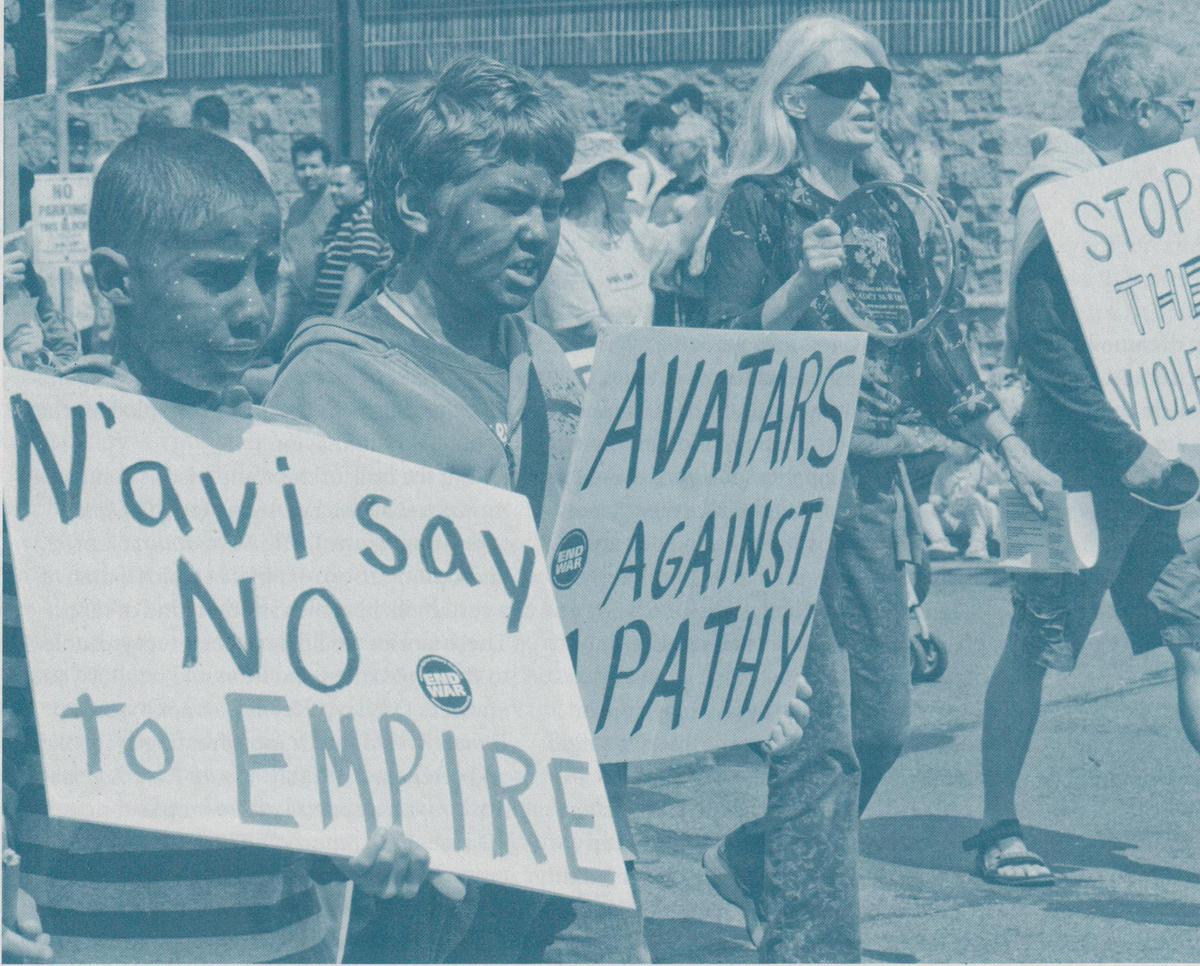
PK: Any watery-blue squiggly pattern now reminds me of the Avatar characters. Too removed from reality to connect to Egypt at all.
NH: There was some sub-brand of cloves that had this very logo circa 1995. Anyone else remember this?
AP: It’s almost as if “Egypt” has been the theme of so many restaurants, hotels, movies, and casinos that the country has mistaken itself for its motif.
MCV: This might be the only logo that had a CGI budget.
AP: What is it even supposed to look like?
BR: Ralph Steadman on ecstasy?
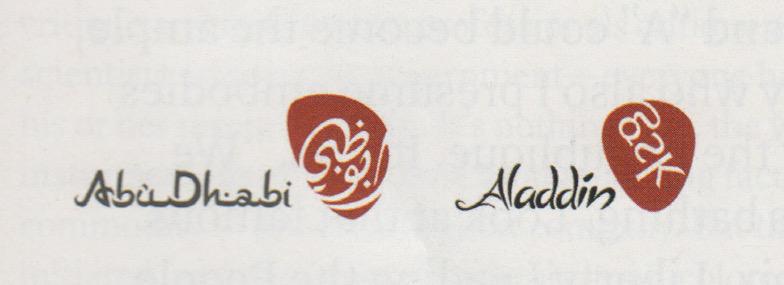
PK: The Abu Dhabi icon looks like a guitar pick.
Tiffany Malakooti: Pardon me but… isn’t that the shocker?
BR: What’s the shocker?
AP: Don’t ask.
BR: Some of the more hilarious campaigns occur when countries seek branding not because they are unknown but because they are well known for terrible things. Here in Bizarro World, Sri Lanka is best represented by five infinitely graceful fingers delicately presenting us a babylotus blossom. Close your eyes and pretend it’s opposite-day!
MCV: Heavy, dude.
SB: How many countries are identified by an indigenous (rather that symbolic) animal? Is this Skippy? Skippy’s great-grandchild? And how did those kids learn to speak kangaroo? Is it taught at school in Australia? Random fact: Flipper the Dolphin was a sex-addict. It looks like the sun is reaching out to stoke the fires of invention in the loins of the kangaroo mother.
AP: I believe that is Australia’s creation myth.
NH: They did not think much past the national airline, Quantas.
SB: Astounding absence of a) the Burj al Arab b) the Burj Khalifah c) anything the world has come to love – or hate – about the idea of Dubai. So many opportunities squandered, surely? Not even some Khaleeji cliché: camel, falcon, dhow – Oh, Qatar got there first. Damn you Qatar. Damn your higher GDP per capita and currency reserves.
BR: It doesn’t look like a place, it looks like a messenger service. Anything having to do with transit. Dubai is on the move. Dubai is an SUV, an airline, a luxury liner…
MCV: Does a condom have to do with transit?
BR: Ah, the wondering Jews.
SB: Israel Wonders while America Freaks Out, Iran Prods, North Korea Stews, Russia Laments, China Outlaws, Great Britain Dwindles, and India Supersizes
BR: “According to a late-2006 National Brand Index survey of nearly 30,000 respondents in 35 nations conducted by branding expert Simon Anholt, Israel had the lowest public perception of any country in the world — except for Iran.”
SB: Good to hear that Iran and Israel are battling it out at EVERY level, military and symbolic. No prizes for second to last…
MCV: Weirdly, I can’t find any information about Israel’s ranking in Anholt’s Nation Brand Index after 2006. Did they just ask to be removed from the list or something?
BR: Wait — is that ‘I’ dotted with an atom?!
NH: Israel: Do you really wonder if we have the bomb?
BR: This looks exactly like the logo of an Arabic children’s network. Oh snap!
SB: Visit Finland and… squiggles? This is a sweeping statement, here goes anyway. I’ve often found the Finns to be the hardest people to read facially. Deadpan and droll do not suffice to describe the incredible imperviousness of what they might be thinking and how that manifests on the outside. I’ve adored this in the few Finns I’ve met. This logo basically does the same thing. I have NO IDEA what it’s thinking. I guess I just have to visit Finland to Fin-d out.
NH: It looks like the logo of a failed social networking site.
MCV: It’s a screensaver. I think this means that Finland’s computer is asleep.
PK: The rings are meant to symbolize the Northern Lights!! But I guess it didn’t work if no one else picked up on that…
BR: Wait, are the aurora borealis God’s screensaver?
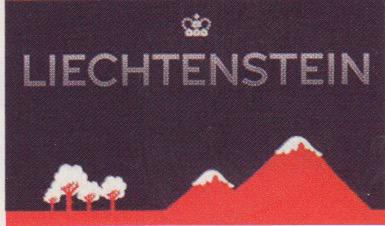
NH: Morocco, Yemen, Kuwait, Liechtenstein and Syria here all have a very conservative, even archaic approach. Am willing to bet they were made in-house (or lifted from an archive) rather than drawn up by an agency.
They are more of a “stamp” than a logo. The other logos can float on any white or neutral background. These are solid, bordered objects to be affixed to letters, postcards, passports, luggage. They are props rather than suggestions. Most of these non-logos also reference the state and state power. Ministry of Tourism (Syria, Yemen). The crown (Liechtenstein). The feudal coat of arms of Kuwait. All are filtered through a sort of early deco-inspired modernism circa 1930.
The dated feel of these “stamp” images reveals the airy inspiration for the newer logos. Travel without borders, without negotiation. A childish simplicity. Sublimation of solid nationalism into a clear vapor of suggestion. Vacation — vacate — vacuum.
MCV: It doesn’t even have its name on it!
SB: I get a sense of how well (or not) the buses run and how fast (or not) you can download the new Owen Wilson movie from this “stamp” logo.
SAM: Is that Mr. Bill there between the I and the first A?
SB: It’s all toothy to me. Totally weirdly toothy. Maybe tusky. Which gets you to… Tuscany! Do I win a prize or what?
MCV: What is that thing? A cactus?
BR: It’s the nose of the sphinx.
PK: A real wasted opportunity for Italy. No hints of its “bella”-ness, design culture, cuisine, history, etc. — just this shapeless blob. Berlusconi should have spent more out of his own pocket to come up with something better.
MCV: I think it’s a scimitar. Remember the Arab conquest of Sicily!
BR: No I don’t.
PK: Colorful and blobby, implying both rainforest and ocean — and Carnival party-time. Brazil can basically do anything it wants with the logo and people will go there.
BR: I thought this was a dead-ringer for the Valvoline logo, but it looks nothing like it.
MCV: I’m telling you, that thing in the Italy logo is a scimitar… AND NOW IT’S COMING FOR BRAZIL!
BR: I told you, it’s a nose.
NH: Doesn’t this make it seem like a made up country?
SB: I think if you do the research you will find out that Liechtenstein IS a made up country.
MCV: If it’s a made-up country maybe they should make the name easier to spell.
PK: This looks like a bland Christmas card.
MCV: Wait, this is totally a screenshot from a side-scrolling video game.
AP: Leichtenquest!
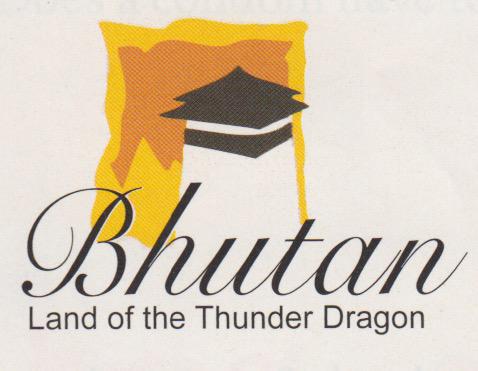
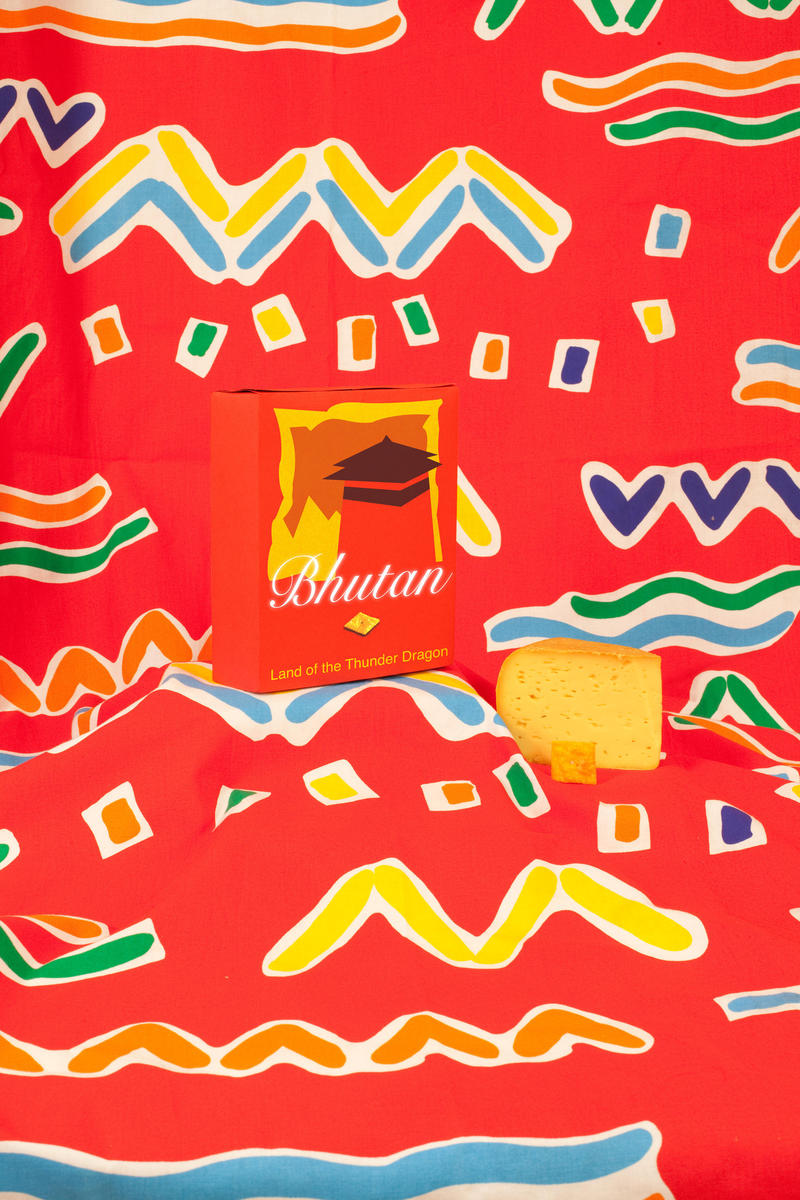
SB: Is the Thunder Dragon a singular entity, like Skippy the Kangaroo? Or is he symbolic, like so many eagles and falcons that bespread many a nations’ flag? This makes me want to go to Bhutan and have my picture taken while petting the nice Thunder Dragon. I hear it likes Cheetos.
BR: Not Cheetos. Cheezits.
PK: The Thunder Dragon only entices kids who would stumble upon it looking for the next Disney movie. Bhutan should have leveraged their pioneering “Happiness Index” in some way.
BR: This is an extremely successful rebranding. Before, when I thought of Bhutan, I imagined a beautiful Buddhist Shangri-La. I thought of its untouched forests and its national hair cut. I thought of the fees they leverage on foreigners to keep it from turning into a gaudy K-hole like Nepal. Now I think of Cheez crackers.
BR: Krittinee Nuttavuthisi wrote in an article in Place Branding and Public Diplomacy (edited by Simon Anholt): ”One of the most important issues placing Thailand at a significant disadvantage is the image of sex tourism.” The whole point of the “Amazing Thailand” campaign was to counteract that image. Then the recession hit and they bit the pillow and added “Amazing Value.”
AP: Bit the pillow?
MCV: Don’t ask.
NH: The problem is that the campaign can now be read “Sex Tourism = Amazing Value”!
SB: Thailand: more Bang(kok) for your Buck!
SB: That there tulip looks like an assassination-induced blood-splatter. To paraphrase Godard, “That’s not blood, it’s just orange paint.” Whatever happened to Roxette?
PK: Simple, abstract tulip is kind of nice actually. But why not be honest and paint a marijuana leaf on the other side? You know, just to acknowledge both sides of their floral charms.
BR: But Van Gogh never painted a tulip — he painted vases of wildflowers, the lowly iris, the roadside sunflower, blooming chestnuts, the poisonous Mediterranean oleander — but never the tulip, that Dutch object lesson in financial speculation.
SB: The Land that Sings. Sings what? Pounding Europop? Alt-folk? And what if you want a quiet getaway, some peace, escape? Does the land ever stop singing? Or is it singing from melancholy? Like a sad Neil Diamond? Now I’m sad.
PK: Until Latvia has won the Euro-Vision song competition, they’re not qualified to claim this.
BR: I found this on the blog of a traveling choir-man:
Early on in my time in Latvia, I was told — nay, warned — that Latvia is the land that sings. The caveat proved to be true in every way, and whether or not it was meant to be prophetic, for me the admonition was self-fulfilling. Many songs were about nature, with titles like “Fast, Fast River Flow” and “Behind the Mountain Smoke is Smoking.” … Other songs were written to celebrate the very act of singing. Take “Song to Song” or the frank “Born Singing, Growing Singing.” One of my personal favorites, “Labvakar, Sievas Mate,” or “Good Evening, Mother-in-Law,” defied all categorizing, with its playfully plaintive timbre.
“And it’s all pretty much about sex!” spewed Fils, an Australian-Latvian teddy bear. Atis, always the diplomat, would turn and say, “Don’t even try to understand these, Tim. We’ve heard these songs since we were on our mothers’ teat.” Then, there was the seemingly innocuous tune by the name of “Rigas Torna Gala Zile,” a song about a finch singing atop the Riga Tower. What could be sexual about that? “This line is ‘You sing between roses, I sing between the girls,’” waxed Gregors.
“‘If you don’t sing nice, I’ll get the boy to eat your feather,’” continued Fils.
The closest translation the guys could give me for “Lokatiesi, Mezu Gali” was simply, “Sex.”
… I decided against inquiring further about “Mazs Bij Teva Novadinis,” or “Small is My Father’s Farm.”
From timinlatvia.blogspot.com
MCV: Isn’t that kind of insulting to the Nigerian people?
BR: I thought so too, but check this out. From
Nairaland.com:
“Nigeria, good people, great nation,” I had exclaimed and someone quickly reminds me that you cannot market a bad product. Much more painful is the fact that this opinion is constantly echoed every time. How have we fallen so far? I ask ‘what is Nigeria?’ As far as I am concerned, Nigeria is the sum of its individual citizens, and to call Nigeria a bad product is to call each and every Nigerian a bad person. …
We all like to complain about what the government is doing or not doing? But ask yourself too, what am I doing? I do not deny that there are bad people in this country, but tell me one country in this world where they are not. Much more, I believe that there are more good people than bad ones in Nigeria; the problem is simply that we have lost our voices and are sitting on our hands. We chant the slogan of the defeated – ‘if you cannot beat them, join them’. …
Let every one of us (good people) who belong to this blessed and most populous black nation in the world begin to use our minds and think of how to make this land better. Let us lift our voice and drown the chorus of ‘bad product’…
I challenge us to dream again, to tell the world of our dreams of a great nation, but most importantly to act. Douglas Everett said ‘there are some people who live in dream world, and there are some who face reality; and then there are those who turn one into the other.’ As we become the latter, we would hear the world join in this awesome refrain – ‘Nigeria, good people, great nation’.
I still believe in green, white and green… do you?
I studied Chinese at Al-Azhar University the first year the language was offered. That was 2001. I thought it would help me get a job. Very few of the Chinese in Egypt speak any Arabic. Some Chinese Muslims speak a little, mostly Uighurs. And then there are those encouraged by the government to learn Arabic so they can work in the Foreign Service… but that’s another story.
Of course, very few Egyptians speak Chinese, either. It’s very hard. I think Chinese is harder than any other language, mostly because of the pronunciation. Try saying “Jang ju Gwao.” Just try! It’s hard. If a European or American comes to Egypt for a long time, they’ll learn Egyptian like a native. But I still don’t speak Chinese like a native. I never will. I’ve met people who’ve spent twenty years in China and still can’t master the pronunciation.
It took me four years of hard study to get to where I am. I was the top student in a class of twenty-five, and I started working immediately after graduating in 2005. With Chinese there are two fields one can go into, translation and tourism. I have done some of both.
There’s a lot of work for a translator — these days Egypt imports Chinese machines and products. Along with the machines, we get Chinese technical assistants. They need translators, too. The Chinese have long arms, they work everywhere. They work with oil in the Sudan, with mining in Niger. Do you know this place, “Chocolate City,” in Guangzhou? It’s like 6th of October City in Cairo, but in China — full of African workers. Hundreds. It’s black China. Anyway, China needs raw materials, and Africa has them. China has established relations with every country in Africa. It’s as simple as that.
I also teach Chinese to about twenty students at Al-Azhar University. There are about six teachers; one of them is Chinese. There are more students studying Chinese now than ever before. There is a Chinese cultural center in Giza. But I don’t really go there. Just to Al-Azhar and on my various work tours.
It takes years to become a tour guide. You can take a two- or four-year training course. Or you can take the Zahi Hawass, an oral exam given by the Ministry of Tourism. Covering five thousand years of Egyptian history! There’s almost no way to prepare. Some people hire private tutors, but there are no books, no study guides. There are all the books in all the bookshops that cover Egyptian history. But which ones to buy? You can’t buy them all.
Different kinds of tourists require different kinds of tours. The Russians just want to go to the Red Sea and have a good time, if you know what I mean. They don’t need to learn much about Egypt. The next easiest are the Spanish. The Germans think they are the best in the world. But the Japanese are just annoying — always waiting for you to make a mistake. It’s like they want to punish you.
The Chinese who come to Egypt are among the better travelled. Most likely they’re younger, born after 1979, after economic liberalization. They tend to be better educated and are often supported by their parents. They’re children of the “Open Door Policy.” They want to see the world. Usually they start in Asia — Thailand, Malaysia, Hong Kong, or Macau — to gamble, play cards. When they get bored of that, they seek out new places. If they can, they go to Europe or America — that’s proof that you have a lot of money.
Of course, there are some older Chinese tourists in Egypt. They just want to eat Chinese food all the time — they’re not as open-minded. Younger Chinese tourists eat Egyptian food, European food, American food. But not koshary. They never eat koshary.
I have to say, when we work with Chinese people, it’s a bit like working in a school. You have to be really prepared, and you have to be ready to deal with children. One time we were at the pyramids, and I was telling them about the pharaohs and so on, and I gave them some time to take photos. One of them received a phone call, and I heard him say, “No, I am not in China.” He looked up at the pyramids and declared, “I am in Turkey!” Another time I took a group to the Red Sea, and one tourist wanted to fight with me because I had cheated him — the sea was not red. Can you believe it?
When the financial crisis hit, the Chinese were afraid to go abroad. But the Chinese are always working and always making money, so there wasn’t a huge dip. It wasn’t too long before they started coming again in large numbers. February is a good month for Chinese tourists in Egypt — they get to go on holiday around Chinese New Year.
I think I will always work in the field of Sinomania, but not always as a tour guide. That work is hard.
I’ve been to China twice, three weeks each time. It’s an amazing place, but it’s not for everyone. They have a great ancient civilization, the mother of Japan and Korea. I like some Chinese people, but not all of them. China was a good and safe place to live in the 1950s, like Egypt was. Chinese people don’t want to harm you. They are village people, from an undeveloped area, and even if they grow rich, they keep a village dweller’s way of life.
The Chinese people are ghalban — they have a restricted style of life. But at root they are good people. They have jokes, but they are not like Egyptians, telling jokes all the time. They have monologues. Even the young people don’t really tell jokes.
I wouldn’t want to live in China. I don’t want to live anywhere but Egypt, in fact. I don’t approve of the kind of Egyptian who gets up and leaves. But I am thinking about going to China this year to study for my master’s. The cultures are so different. Egyptian food is much better. Living in China is so strange. Once at about 9:30pm I wanted to buy something to eat, but everything was closed! All the Chinese people were sleeping! Anyway, I learned to eat with chopsticks here in Egypt. I like to say I am half a Chinese person.
Local ethnographers have speculated that it was the mountainous landscape — Dagestan literally means “land of mountains” — that produced people with extraordinary powers of balance. It was not uncommon to find residents of this land scrambling up narrow paths or crossing swollen rivers on makeshift bridges fashioned from the trunks of trees. When they were introduced to tightrope performances — most probably through migration to neighboring regions for work — Dagestanis adapted the practice and made it their own, concocting a high-wire version of local folk dances. (Those very dances were a major influence on the choreography of the Ballets Russes.) In the nineteenth century, an entire village, Tsovkra-1, was known as “the tightrope walkers’ village.”
During the Soviet era, tightrope walking, like every other trade, came under the aegis of the state. The best dancers joined the state circus and got to travel the world. Amid the chaos that followed the collapse of the USSR in 1991, Dagestan was one of the hardest-hit regions. What ensued was a decline in the quality and quantity of Dagestani tightrope walking practices. Still, in some parts of Dagestan, there has been something of a revival of the art. There have even been efforts to establish a proper school.
Since he left the Kiev state circus, Ali-Ashkab Gasanov manages the Pehlevan troupe in Makhachkala, the strange architectural dystopia that is the Dagestani capital. The troupe’s training takes place in the gymnasium of a local high school. (At one point, the school janitor was so inspired that he decided to take it up himself.) The troupe is made up of three boys and one girl, and they’re sometimes to be found performing at weddings and other festivities.
Tightrope walking is part of our culture. Dagestan’s tightrope walkers have been known to cross the wire while standing on the very tips of their toes — sometimes balancing a jug of water, a plate, a glass of water, another plate, a bottle with a raw egg on top of it, and two daggers attached to the legs, blindfolded. In the past, when two villages were in a blood feud, tightrope walkers would invite both villages to come together, and they would perform for them. The dancers would wear a bear mask and a lambskin coat, and if they managed to cross the wire with the jug and the water and the egg, it meant that the peace would last forever. Women who couldn’t have children used to walk underneath a wire because they believed it would cure their infertility. We also perform our national dances on the rope, like the dagger dance.
As a tightrope walker, you need to be creative, to have a strong will, and to be fearless. We have no safety nets. We used to be on the rope for two hours, now it’s only something like fifteen minutes — mostly because training is not as rigid anymore. One of the tricks I personally have invented is known as “the two boys–one girl bridge,” which involves two boys carrying a ladder on their shoulders and a girl standing on it. You see, people on a rope have to be absolutely synchronized. I have trained three hundred pupils since 1983.
Because we have no professional circus in Dagestan, there aren’t any professionals anymore. We would need an investment of at least 15 million rubles ($500,000USD) to set up a professional school. Since the early twentieth century, Dagestan has provided wrestlers, strongmen, and tightrope walkers to the state circus. We perform in Stavropol every summer. I’m not happy with the level of the troupe today, but we can only practice once a week.
From July to November of 2009, my group was lucky enough to get orders to participate in twelve festivals dedicated to the eightieth anniversary of twelve districts that had been demarcated under the Soviets. Among them were Charodinskiy, Gumbetovskiy, Gunibskiy, Utsukul’skiy, and Kazbekovskiy. All together we made about 600,000 rub ($20,000)! And then, from time to time — approximately once a week — we’re invited to perform at marriage parties of wealthy people in Makhachkala. The maximum they pay is 12,000 rub ($400).
You know, our team is much better equipped than others because we’re located in Makhachkala, where it’s much easier to get information about what’s happening in different parts of the republic. Plus, the school where we train doesn’t charge us any rent. Still, I am worried about the future of my four-person team. In 2010, there are no more district jubilees planned. Each of us has a family to take care of. And I’m not optimistic about gaining support from the Ministry of Culture. It’s the lack of money that’s preventing us from leaving Dagestan and pursuing projects abroad. Maybe one day all the tightrope walkers could get together and form an association. That is my hope.
Business is really good. But we don’t think of this as business. We’re here to spread light. We have a passion to reach as many people as we can. Dubai is becoming more aware each day.
People come to Dubai looking for something. And unlike most other cities, they become big fish in a small pond almost overnight. Suddenly, they get everything they’re looking for — status, money, fame. Then they say, “I should be happy. Why am I not happy?” So spirituality is the ultimate shift. It’s like the Hero’s Journey in a novel. Dubai is the perfect setting for the hero’s transformation. He comes looking for one thing and finds something completely different.
I had one client who was the quintessential Dubai housewife — married, two children, a successful banker husband, and a huge villa in Jumeirah. But she’s struggled to be happy all her life. When we did the first session of hypnotherapy, I found a lot of it involved just clearing out the negative energy of Dubai — the traffic, the noise, the mosque blaring in the morning.
Dubai is a very young place, a city that rose very quickly. There’s a lot of new energy here, many different types of energies trying to coexist. So much pent-up energy. No one is grounded. There are no roots here.
Hypnosis is how we get in touch with the subconscious mind. The subconscious mind has all the answers of your past, present, and future. It’s not we who venture inside the subconscious mind — it’s you who takes that trip. There’s a fear that I might make you do things against your will — bark like a dog or give me all your money. But I’m not a performer; I’m a healer. I help you heal yourself.
Let’s try it out. Take three deep breaths. Inhale. Exhale. Inhale. Exhale. Inhale God’s love, God’s light. Exhale all your fears. Just relax with each and every breath. Imagine pure white light coming from above, as if it’s on top of your head. White light coming down on each and every part of your body: your chest, your hips, your thighs. White light is entering each and every cell. Focus on your eyelids. Breathe out all the stress and all the tension from your eyelids. When you feel you’ve gotten rid of all the stress and all the tension, nod your head and let me know. Now make yourself believe that your eyelids are sewn shut and you cannot open them. The state of relaxation moves up across your chest area. Feel the stress coming out, the relaxation moving up. As I count you down from five to zero, you’ll feel more relaxed and comfortable.
The deepest state is the somnambulistic state, which is when the eyes roll up. That’s when the therapy happens. That’s when you’re in the deepest part of the subconscious mind. This is where the past lives are. Diseases come from past lives. Like asthma. Someone once came to us with incurable asthma. Under hypnosis, he learned that he died by drowning in his past life. We have a lot of clients who don’t really believe in past lives. One Emirati client once said to me, “Whatever you do, don’t take me away from my religion.”
You know, when I first started I didn’t think we were going to see any Emiratis. Our concepts are quite progressive and it is true that in some cases they are in conflict with the religion. But it’s just a matter of perspective. Actually, we’ve had more Emiratis and people from the region than Western expatriates. Jordanians, Syrians, Lebanese… they take to it very quickly. Our method actually has a lot of similarities to Islam once they understand what we’re talking about.
I find that the issues we treat with Emiratis are very similar to those of Indians we treat. This is probably because they have a lot of similar cultural traditions. Among the Indian clients, a lot of women suffer from issues within the family — mothers-in-law, relatives, not being able to break free of tradition. It’s the same with the Emirati women. Under hypnosis, I can trace back many major physical diseases to prior generations when they were subjugated to nasty in-laws or elders.
I have Sheikhas who come to me, but they mostly work with crystals. Otherwise, we get the whole spectrum of social classes and income ranges in here. For people who can’t afford hypnosis, we or help out in some way. I had one client, for example, who found it difficult to pay for a session. She was associated with a company that made towel samples, so she sent a box of towels to our center, which we gladly accepted. The energy here is very free flowing. Otherwise, an average session costs 300 dirhams.
At times, we perform hypno-birthing — releasing the fears of pregnant women during labor. They have no pain in labor. They are complete novices to hypnosis, but their mind is re-programmed so they have no pain. If you are ready to be re-programmed, it is very easy. Everything is connected to thought.
Of course, the placebo effect is very strong. If your mind believes that the healing is taking place, then you see the difference. And this is good for us, because hypnosis, or hypnotherapy, is the last resort; our clients tend to have tried everything else, they have exhausted the traditional therapies. So they think, this has to work!
And it does. So they keep coming back because, ultimately, we show them that they can make their own reality. And they get hooked on that.
Personally, I think Dubai is the spiritual anchor for the entire Middle East. Damascus and more ancient places are inherently spiritual and have always been so. But new spiritual movements will start in places like Dubai. Masses of people will get affected very quickly, and will start making big changes in their lives. I already see it. Dubai will be the start of big changes for the wider Middle East. Light bulbs will start going on everywhere at the same time. Like migrating birds. It’s synchronistic. And if this part of the world can find oneness, with its different cultures, religions, conflicts, and challenges, then anything can happen.
I’ve been trying to sell a book I wrote about a psychiatrist who heads up the Chemical Dependency Outpatient Program at Bellevue Hospital. I had organized the material as a collection of stories she’d told me, along with accounts of conversations she’d had with colleagues and patients; or, as they are called in an American hospital setting, “clients.”
I had no particular attraction to the subject of addiction. It was the nature of the doctor’s interest in what one of her colleagues defined as “the most disenfranchised section of the population” that drew me to her, and her way of turning every encounter and experience into a fable. That, along with her utter disinterest in writing — or in reading, for that matter — made me think that I might in some way make myself complementary to her. What she needed, I decided, was a writer. Or perhaps she decided, because when we first met, she spoke for almost four hours. At the time I was in need of a story to tell.
When I’d finished, I handed in the manuscript to my agent and left on a weeklong trip. By the time I returned, there were seven messages: I was to call right away. I could sense his excitement. One message read, “I like that the shape of your narrative follows the pattern of her clothes, stitched from many beautiful and distinct garments. The stories layer and drape quite wonderfully to each other, so that in the end you’ve delivered one rich and marvelous garment.” There was talk of movie rights. My agent wrote a note to one editor saying he thought the appeal of the book was “deep,” and that the fact that it was as yet “unreported” made it all the more appealing.
The story began with an account of why it was that the psychiatrist wore a horn in her lobe. She was a woman of some beauty, thin and of compelling elegance despite, or perhaps because of, the combination of hand-me-downs she wore and the strings of beads around her neck, including one made of human teeth recovered from a cemetery in her mother’s isolated hometown of Ftan, in Switzerland, only half an hour’s drive from St. Moritz but several worlds away.
It was suggested to me that the horn appeared too early in the story.
If in person my subject might have repelled the prospective reader, she might also do so at the start of a book. The Swiss artist Not Vital, who is the psychiatrist’s closest friend, told me over dinner to be careful she didn’t come across as too strange.
That was indeed a problem I grappled with, for my subject did seem strange, thanks to the horn, a curved and hollow black chamois horn from the Swiss Alps. Her dazzling smile, which Vital likened to the toothy maw of a wheat thresher, didn’t help either. Even more disquieting was her “lack of boundaries” where patients were concerned.
The verdict was in: strangeness should remain within bounds. Salability demanded that my reader be much like an addict — strung along, with small doses, desperate for more. For the first time in my life, I began to take Frank Capra’s maxim to heart — you can’t sell anything to the American people that isn’t entertainment. So from a book that could be read at leisure, I aimed to extract a book that would hold the attention. I had to find a string that would pull this ideal reader in and through to the end of the yarn.
As I looked through the many chapters I’d written, I discovered that there might indeed be an addictive thread running through them. Perhaps the book wanted to be a salable book after all, instead of a lovely shelf of stories there for you to take or leave, this year or ten years from now, or never. That’s how I tend to consume a book — in small bites, stopping for tea, with other books, other rooms, intervening.
I had a chapter that two people agreed could go to the front of the book. It told a great deal about the psychiatrist, how she had discovered that one of the hospital’s most senior physicians was an alcoholic, and how she had confronted him only a few weeks into her new job. At the end of the chapter, the psychiatrist led some of her patients onto an abandoned lot by the hospital, where together they began to plant what would become the first garden at Bellevue. The lot was surrounded by a cacophony of architectural styles, from late Victorian brick to ’60s brutalist concrete, and the hospital wanted to turn her sculpture garden into a parking lot. If the reader could be made to worry about the fate of the garden — and of the psychiatrist, too, since she desperately needed to keep tending the garden for and with her patients — then the book would have its hook. I knew that the garden had already been saved; it had happened around the time that I settled down to write the book. But I had to keep that from the reader till the last chapter. A young documentary film editor whose advice I sought thought that this, like the horn, was a “reveal.”
The editor who’d published my previous books wrote me an affectionate note, saying, “It is so hard to sell anything now, unless it’s a book about extreme running or a page-turning thriller, that I think it’s better to make the narrative accessible.” He urged me to “grab the reader by the balls right at the start.” I considered how best to do this. Oddly enough, the chapter on the doctor who drank contained a description of how an alcoholic’s testicles shrank; only after I’d placed that chapter at the front, sleepwalkingly following instructions, did I notice the coincidence. Balls safely ensconced at the start of my crypto-bestseller, I decided it was time to take a day off. Smoke was coming out the top of my head from transposing parts of the book from one end to the other, trying to recall whether a certain dog had already been mentioned by the time it managed to infiltrate the hospital’s security system. Was the psychiatrist’s discussion of the furniture she had built with her own hands appearing after her wrathful boyfriend had flung that very furniture — a cupboard, a settee, several chairs — out the window? Problems of continuity, as film people say. I repaired to Canal Street.
It was raining as hard as in Kurosawa’s Rashomon, and raining hard in my soul, too, as in Valéry’s poem. How was business on Canal Street? There were little men sandwiched between large yellow and red signs that read, “WE BUY GOLD,” walking up and down before the various entrances to the various malls. Two objects caught my eye: a Virgin of Guadalupe in platinum, gold, and diamonds, for $9,700; and a glittery globe clasped by a pair of hands with the legend “WORLD IS MINE,” for $12,900. In the facing window was a pendant depicting a small robber made of solid gold and covered in diamonds. He was modeled on the Pillsbury Doughboy, and he held a bag — of loot, presumably, which he clinched at the neck with one gloved hand. The Virgin of Guadalupe sold better than anything else in the store, I was told. She was doubly attractive — blessing whatever sort of business might bring in enough money to buy one of these homages to her, and protecting it from possible nefarious consequences (shakedown, double-cross, jail, etc.).
Just as I entered the mall and noticed that several shops were shuttered, including one called Bling, my cellphone rang. It was a journalist friend who’d written a book about a designer. She’d handed in her text and been paid too little for it three years earlier. Now the editor wanted five thousand more words, and she was “pissed, Kitty.” (She always called her girlfriends Kitty, after Kitty Foyle in the film with Ginger Rogers.) That morning a Mademoiselle Laporte had written to me asking that I send her an authentic tax certificate: a document from the IRS stating that I paid my taxes here. No, the front page of my tax returns wouldn’t do; I’d need a W-9 form, and I’d have to send the original by mail. They had $100 they owed me for republishing an article I’d written about an Ethiopian actress, model, and activist. For another magazine, I recently interviewed the woman who’d made a great deal of money in the 1980s writing How to Make Love to a Man and other bestsellers, then lost it all to Bernie Madoff. Her loss was my gain. Her loss was a gain for her, too, when she wrote a bestseller about losing her savings at the end of her career.
Years ago, a janitor in a building had looked at me in utter amazement, asking: “They send you on a trip and then they pay you for it, really?” They did. They still do, only now everything takes longer. They send me, then they wait. I write, then I wait. I went to Dublin recently. I could take my time writing the story: I could move the pen slowly, as though through water. That’s why I want to sell this book. Grab them by the balls. Buy a Virgin of Guadalupe or a “WORLD IS MINE” globe so the Chinese lady who works at the store on Canal Street can go on holiday with her Vietnamese husband and read my book on the plane, never putting it down.
My uncle built this store in 1939. Back then, one side was a beauty shop and the other was a fish market. He lived in the back. When the Second World War started in 1942, all Japanese-Americans in the three Western states — California, Oregon, and Washington — had to leave. If you happened to be single, you could just pick up your suitcase, catch a Greyhound bus, and go. Still, where would you go? And if you had a family or a house or a business, it was even harder. What would you do in Idaho or Iowa? So the majority of Japanese-Americans stuck it out. And that turned out to be a terrible mistake. By March 1942 President Roosevelt signed an executive order incarcerating all Japanese from the Western states. They were put into “relocation camps.”
I was three years old then. First we were sent to the Santa Anita racetrack, because they hadn’t finished building the camps yet. From Santa Anita, we went to rural Arkansas; there were at least two camps in Arkansas. I’m sure if I looked into the history, I’d find out that the senator from Arkansas had some political pull. There were only ten camps in total: two in California, one in Idaho, one in Wyoming, one in Colorado, two in Arizona, and the two in Arkansas. Obviously, if you build a camp for some twelve thousand people, that’s a lot of money. Somebody has to build it, somebody has to guard it, somebody has to service it with food and God only knows what, to keep twelve thousand people going. I think it must have been good business, running those camps.
After the war, we ended up back in California. The biggest problem for the Japanese, coming back from the camps, was finding work. There were still a lot of hard feelings toward us. The one job that a lot of people gravitated toward was landscape gardening. It was a very good business, because you could be your own boss.
My uncle was lucky. In 1942, when we were detained, an American friend of his had assumed power of attorney and watched the property. A lot of people got screwed that way; their representatives would sell their property and take the money. But in this case, the guy was honest, so when my uncle got out of the camp, everything went back to normal.
My parents took over my uncle’s store in 1956 and turned the whole thing into a gift shop. Their customers were other Japanese-Americans. Back then, this neighborhood was totally different. It was a self-contained Japanese community: there was a drugstore, a beauty shop, a barbershop, and one or two little Japanese restaurants. There were a lot of boarding houses, too. Right after the war, when people got out of the camps, they would go to the boarding houses or to the church
or the Japanese school down here. They would just live there until they could reestablish themselves. We kept to ourselves, in part due to prejudice. My family used to drive to San Diego or San Francisco, and they wouldn’t even rent a hotel room to us because we were Japanese. It wasn’t like the 1960s — I always gave a lot of credit to the blacks, going to Selma, Alabama, being shot up with a fire hose and the mad dogs and all that — I don’t think I could do that. The Japanese were submissive in the sense that they felt, What good was it going to do trying to turn the rock over if there were just going to be worms there? So they tended to keep to themselves.
At the very beginning, there weren’t a lot of Japanese importers around, so my parents had to travel all the way to Japan to buy the little things we needed for the gift shop. Later on, importers would come to us. This shop has been in our family for over fifty years.
Our little shop was one of the first Shiseido Cosmetics dealers in America. In 1960, my father got a letter from Japan. Someone, a relative or a friend, was on the Japanese ice skating team going to Europe for the Olympics. This person asked if he could meet my father at the airport, just to say hi. So my parents went to the airport and one of the girls on the ice skating team was the granddaughter of the founder of Shiseido. There were a couple of Shiseido salesman along with them, and when they found out that my parents had a gift shop, they wanted to work with them. This was before any department store ever carried it. Americans didn’t even know what it was! But since our customers were mostly Japanese, there were people who recognized the brand from Japan. Shiseido was an old company, around since the 1800s. It had started out as a pharmaceutical company and evolved into skin care and beauty aids.
I started working in the store in 1992 or 1993, when my parents started getting too old to manage things. When I was younger I had been in the Marines, and then had joined the US Army during the Cuban Missile Crisis. I went into a division of the Army called the Army Security Agency, where they taught me Russian and Russian communication. Then, funnily enough, I went to Northern Japan for two years to monitor Russian communications from there. Of course, I knew no Japanese. Then, after seven years in the service, the GI Bill was launched, so when I came back, I went to college. Later I worked for Playtex — that’s a multibillion dollar corporation, you know — and after that worked with American Home Products, where I was the only Asian. When I left, my boss told me they’d taken a chance on me because they’d never hired an Asian before.
Today, the Shiseido still does well for us, as do the vintage clothing and kimonos and these flower vases. Beyond that, we sell a mixture of things, tea sets and sake sets, all made in Japan. We have to carry some stuff from China because of the price, but not too much. Normally Saturday is our best day, sales-wise. Thursday is the worst day because the two restaurants next door are closed. We’ve had famous customers, too. Dustin Hoffman came in, maybe because he was going to the SAG health clinic nearby. He came in twice. He was probably the nicest one we’ve had here, you know, for someone at that level.
We run this place pretty simply. My wife and I are the only employees. We take care of our granddaughter in the back, right there. I don’t need to pay rent; we have no employees. Basically the economy is soft right now, but we’ve seen soft times before and we’ll survive and come back again. This is definitely the worst. When the real estate market was really going hot and heavy, we used to get a call once a week, someone trying to buy the property. But I won’t sell. I tell my two daughters — they don’t want anything to do with the business — when we’re gone, please don’t sell it.
When I started working here full time around 1992, there were three stores in the neighborhood similar to ours. Yamaguchi’s on the corner here, Kabuki on Santa Monica, and Hakata on Washington. Now we’re the last of our kind. Our commitment to the neighborhood goes beyond our little store — it’s also to the Buddhist church, the Methodist church, the older Japanese people who still live in the neighborhood. We definitely fill a niche, so theoretically we shouldn’t be struggling. When you’re still having problems, you know it must be the economy. It’s just one of those things. A lull. It will come back, and we’ll be right there again.
George Russell lives in Huntsville, Texas, otherwise known as the “City of Death,” the execution capital of the US. Russell is a vocal opponent of the death penalty, and owner of three green cemeteries: burial grounds with “no chemicals, no embalming, and no big bronze caskets.” When I first called him, the sixty-five-year-old entrepreneur and cultural ecologist yelled back in a heavy Texan accent, asking if he could call me back — he was out riding on his tractor and could barely hear me. Tall and distinguished-looking, with sparse silver locks, Russell is the founder the Universal Ethician Church, which practices a new religion devoted to defending “God’s biosphere” from human greed and ignorance. The first of his green burial grounds, the Ethician Church Cemetery, was opened in 2003.
Russell is also the webmaster of www.slumberpartytheater.com and the founder of both the Educational Video Network, which creates instructional media for teachers and schools, and Gothic Films, a production company that makes horror movies, including Long Pig (2008) and Naked Horror (2010). He appears in both films as the nefarious church leader Preacher Man. Russell says these films contain deep philosophical undertones, which he fears audiences might not always understand amid the gore and the nudity.
In 1968, I was 175 miles from the nearest telephone, in Toledo District, British Honduras — now Belize — working on a PhD in cultural ecology. We had a 1968 Ford Bronco, one of the very few internal-combustion vehicles in that whole area. Fuel had to be hauled to the village in fifty-five-gallon drums. The local people were a mix of cultures: East Indian; old Southerners who’d escaped from the post–Civil War South; and the Garifuna, black Caribs descended from slaves whose ship ran aground there in the 1700s. But they were all British-educated, and although they lived in grass shacks with dirt floors, they thought it would be really impressive — first class — to have their loved ones hauled to the cemetery in a brand new Ford Bronco instead of on the backs of relatives.
The cemetery happened to be in a rain forest: magnificent trees dripping with orchids, howler monkeys squealing, parrots flying — an absolute paradise. Normally, they would just dig a hole in the ground. Within a matter of hours, the bodies begin to be recycled back into nature, as microorganisms consume and reconstitute them. The loved one becomes part of a bird or a butterfly or a monkey or a tree. Our bodies are nothing more than recycled material, the things we’ve consumed, the container that transports our minds. I found this wonderful. I wished we could do it this way back home.
When I got back to Texas, I was busy with my family, raising four children and running my business, the Educational Video Network, which develops educational materials for schools. I bought a beautiful house near a place called Pool Creek, which is full of alligators and egrets. One day I was peeing off the balcony — which every American should have the freedom to do — killing the azaleas and looking at all that open space behind my house. I realized that eventually it would all be developed. Someday, there’d be a bunch of houses back there; I’d take a pee and, twenty minutes later, there’d be a knock on my door. And it’d either be some poor old crone who hadn’t had any loving in about forty years, trying to hop in the sack with me, or it’d be a fourteen-year-old girl with two big, burly cops who’d put me in cuffs and haul me away to the hoosegow. So I called up the realtor and said, I need to buy 10 acres over there so I can piss in peace for the rest of my life.
I found out that the owner of the land was Charles Hurwitz, an investment titan. He was willing to sell, but those 10 acres were connected to another 990 acres. I wrote a check and bought the whole thing for $2.2 million. Then, in 2000, I bought another thousand acres. I realized that this could be the green cemetery I’d always imagined. It took three years to cut through all the red tape, but we started burying people there in 2003. It was the first green cemetery in Texas, and only the third in the country.
Today I have three cemeteries spread across two thousand acres. One is habitat for the red-cockaded woodpecker, an endangered species. Another is a rock peninsula in Lake Livingston, where pelicans live. It has Catahoula boulders that are thirty million years old. The land was inhabited by Native Americans for twelve thousand years, until they were extirpated by Mr. White Man. The third cemetery is savannah.
I buried my mother in the second one. She chose the spot and watched her grave being dug, which she found to be exciting. We put a temporary wooden box down there so that, when the time came, we could just lift the lid and slide her in. When she finally died, we wrapped her in a blanket and loaded her into the back of my pickup truck. We let the dogs jump in and say goodbye to her. Then we wrapped her in a quilt and covered her with Spanish moss, as she had wanted. And then everyone grabbed a shovel. It was a really simple, sweet ceremony. But so many people around here in the Below-the-Bible Belt are filled with hate, and they were saying, “Why would you treat your mama like that?” They don’t get it. “Shouldn’t you have had the $25,000 bronze coffin?” No! I did what my mama wanted, and that $25,000 can send a grandkid to college.
I have capacity here for twenty to thirty thousand people, but I don’t do any advertising; people find me on the Internet. I can’t say the economy is affecting me — there was never much money in the first place. But more people should be thinking about going green in death. The average cost of a burial in America is close to $7,000. It costs us about a third of that. Since we’re a nonprofit, we just ask for a donation. I’ve got gravediggers who will prepare the site, and a hearse to carry the body if you don’t want to do it yourself. I’ll officiate for free. And we take anybody here: Christians, Muslims, atheists, Wiccans, Jews — anybody.
I don’t support cremation. It wastes fossil fuel, and releases toxins into the air. And I definitely don’t support traditional burials, with all their embalming chemicals and concrete vaults. Green burial is what we do here, but, really, the best option is the sky burial, where you just leave a body out and let nature take care of it, as the Zoroastrians in India have done for thousands of years. I’ve been working with the Zoroastrians here — a fellow from Houston — to design a Tower of Silence where we can lay out the bodies, but that might cost upwards of $100,000.
If you read Matthew 23, you’ll see that Jesus despised hypocrisy, organized religion, public prayer, and all other kinds of stuff. So if you can get past that goofy psychosexual pervert Paul and the others who in my opinion destroyed Christianity, you’ll see a simple guy who was very sophisticated intellectually, who traveled the world and brought back revolutionary ideas to Old Testament Judaism, which was really filled with hate — characters like Moses, who was a genocidal pedophile. I too always wanted to be a revolutionary who says, “Look, let’s simplify this.” The Universal Ethician Church only has one rule, which is the opposite of the Golden Rule. I personally know some high-level politicians who like to have their asses slapped. So, say I like my ass slapped — am I going to do unto you and slap you on the butt? No. The Ethician Rule, instead, is, Do unto others as others would hope that you would do unto them.
In March of 2010, Egyptian newspapers began to report on what has come to be known as “the hash crisis” (azmat el-hasheesh). According to these accounts, supplies of the extremely popular marijuana derivative had dried up. The reports speculated as to the possible causes of the hash crisis, with the state press claiming that a major drug bust had unraveled a criminal network and the opposition press linking the crisis to President Hosni Mubarak’s health, internecine rivalries within the Ministry of Interior, or a strategy to introduce a price hike. Naguib, a former police officer turned drug dealer, met with Bidoun at the height of the controversy. Naguib (not his real name) is a slim and affable man in his midthirties from a middle-class background. He lives in a Cairo suburb with his wife and children. He spends his leisure time exploring Egypt’s deserts and experimenting with hydroponics, a technique to grow cannabis indoors.
This is very strange for Egypt. I’ve never seen anything like this. My uncle, an old-school hashash (hash smoker) who favored the goza (the traditional hash waterpipe), says it reminds him of the late 1980s, when the police raided Battaniya. Back then, there was an alley where you went and tables were set up with different size and grade hash and bango (low quality cannabis), and you would just buy openly on the street. One story at the time was that the decision to shut down Battaniya came about after Suzanne Mubarak met with Nancy Reagan, who told her about America’s war on drugs.
This is the country of hashish. It doesn’t matter if you’re rich or poor, you can buy enough for a couple of joints for ten pounds in Sayyeda — or enough for a whole wedding, if you want. There’s something for everyone. I think about 70 percent of the country must be on drugs. So now, these days, everyone is desperate. People I haven’t heard from in years are calling me. The other night an old friend called me — she doesn’t know that I deal, and I hadn’t talked to her since school. But she knew I’ve been smoking since I was fifteen, so finally she asked, “You wouldn’t have a joint or two?” I teased her about her habit, and she said, “It’s for my husband, he’s going crazy without his evening joint.” My phone won’t stop ringing.
I think people are drinking a lot more beer now. But in our culture, it’s not easy — you can’t just bring beer into your house, if you’re a kid. What would your family think? Hash is easy to hide. And the beer stores are mostly in the rich neighborhoods, or downtown. In the poorer neighborhoods, the kids are turning to real drugs, pharmaceuticals — there’s going to be attacks on pharmacies or kids sniffing glue. It’s very bad. We need hash. We need it to escape the bullshit of life here.
I don’t know for sure, but I have my theories as to why this is happening. The official version is that the recent drug bust caused the crisis. I don’t believe it — though by taking credit for the bust, the interior minister did just prove to people that he is totally in control of the drug trade. Not just hash, but opium and heroin and everything else. Personally, I think this has to do with the president’s illness. Mubarak is dying, and the interior minister is trying to impress people and write his name in history. Another rumor is that it started as a feud between the major suppliers and the police. Maybe they’re trying to change suppliers — the new stuff is not the usual Moroccan stuff, it’s Lebanese stuff that comes wrapped in cloth. It’s better quality, but more expensive: the “passport” (150g slab) went from 1,500 to 2,500 pounds! In a way it was predictable — in the last few years, the price for everything had gone up, but not hash.
Things will pick up again, we just have to adjust to these new prices. We’re not back to full business yet, but it’s getting there. This is Egypt. People have been smoking here since the pharaohs. This isn’t going to stop them.
“We can recycle anything,” says Shabbir Pasha, sitting at his desk in a small concrete hut in Bangalore, India. “We even recycled the World Trade Center.”
Pasha’s office lies in the corner of a metal scrap yard piled high with old pump sets, girders, air conditioners, and wiring. “We received almost 500 tons of square-plate steel, copper, and lead from the rubble of the World Trade Center,” he tells me. “It was processed in Mysore and Bangalore, at yards like this. We separated what was useful, all by hand.”
It’s impossible not to wonder where the remains of the Twin Towers are, amid the piles upon piles of scrap. A small group of men laboring under a tarpaulin will soon pick and chip at the piles with their hammers and pliers. They will separate bits of metal from casings and other material, then pass the metal on to be sold to foundries, where it will be melted into ingots, rods, and billets, most of which are consumed by the local market.
Pasha buys most of his scrap from demolitionists, auctions, and scavengers. “A lot of scrap from Germany is shipped to India,” he says, “because they can’t separate the stuff there. It’s too expensive for them.
“We’ve run this business since 1970,” he says. “My father started it. We get scrap, and my boys separate it. They’re paid about a hundred rupees a day.” The price of scrap fluctuates based on demand, and during the recession demand has dropped. “The best time ever, business-wise, was during the Beijing Olympics.”
Did any of the World Trade Center end up in Beijing?
“Definitely,” he tells me. “There was huge demand for steel, as China needed it to build hundreds of buildings for the Olympics.”
Business is not as good as it once was. “But we are okay,” Pasha says. “The local market is still not bad for steel: we get about eighteen rupees a kilo. For copper we get 350 rupees a kilogram. It’s a good business.”
I ask Pasha where his salvaged metal ends up. He waves his hands expansively. “All around Bangalore. In building pillars, in cars, in electrical fittings. Many of our houses and buildings come from here.” How did he feel about recycling the World Trade Center? Pasha thinks for a couple of seconds. He says he got twenty rupees per kilo of steel for that batch, which is better than the eighteen rupees he gets today due to the recession.
“No,” I say, “how do you feel about having processed the World Trade Center?”
Pasha looks at me, slightly confused. “It felt good to get twenty rupees a kilo for that steel. It’s not as good as some other times, when we got twenty-nine rupees — like during the Beijing Olympics — but it wasn’t bad.”
Ramrod is a small military base at the edge of the Red Desert in Kandahar. Not a village in sight, just sand to every horizon. M., a young project manager for DynCorp International, sat with me in her office and bunk, the inside of a small white shipping container. The base is expanding every day.
I got into contracting by accident. I knew a guy at flight school in Colorado — he got a job with KBR Inc. And he was like, “You need to get on this, they’re hiring over a thousand people a week. It’s not difficult work, it’s just Iraq and Afghanistan. You can stop worrying about holding down four different jobs to pay for flight school.” I was like, “I’m in.” I never questioned it. My only concern was my parents’ reaction, because I’m an only child. But the danger never even entered my mind. I don’t know why, it just never did. I had lunch with my dad, and he thought it was a great idea. [Laughter] A week later, I had all my bank accounts closed, all my bills taken care of. I was ready to go. This was in 2004.
I saw it as another adventure, a way of escaping. When I was a kid, my dad worked in the oil industry, so he would travel to all these really exotic places in the Middle East and bring home all this really neat stuff. And I’d be like, “What the hell is this? I mean, it’s really shiny and cool, but what is it?” I was obsessed with the rest of the world, and I had never seen anything.
So I went off to spend one year in Iraq, and that one year turned into five.
My first job was with KBR, working at a gym. I hated that job. The only good thing about it was getting to know the Iraqi laborers — they would bring in extra food for lunch, and I would sit on the floor and eat with them. After a year, I switched to Fluor Corporation. I was in their training department, doing administrative stuff, and they were doing construction for power plants and wastewater treatment plants. It was a huge contract. They had seventeen different sites all over Iraq — a million dollars to fix up each facility. That was a cool experience, because I was working in admin and got to meet all the site managers. They would come to the Green Zone. We created a facility where we would simulate having pipe leaks and stuff. So we would put them through a training course, pay them a per diem, and go to their graduations. It was just really neat.
When Fluor’s contract was up, I came back to the States and started working for Jeppesen, an aviation company. They basically have a monopoly on providing navigational data in the aviation world. I did that for a year. I really liked my job; they were very attentive to their employees. But I was just itching to go back. It wasn’t the money, though at Jeppesen I was grossing $30,000, and in Iraq I was getting $130,000, $140,000, much of it tax-free.
I haven’t saved as much as I would have liked. Being young and stupid, I’ve spent a lot of what I’ve made. When I first started working, I was really obsessed with jewelry and diamonds and stuff. And I’ve traveled all over. I’ve been to New Zealand, Malaysia, Thailand, and Cambodia, Italy a few times, France a few times, Germany, Ireland, England, Croatia, Montenegro, Greece.
In 2007, I went back to Iraq to work for Blackwater. My first day back in Baghdad, there was a rocket inside the camp, one container over from mine. It just tore a guy up upstairs, took out chunks of his brain. I never hit the floor faster in my whole life! I was on adrenaline for the rest of the week. I couldn’t sleep for days. Even when I could, I slept on the floor. I was like, “Wow, what am I doing here?” I couldn’t answer that question. But I knew I didn’t want to go home.
As much as it is Groundhog Day, you hear the helicopters go around, and you hear the mortar rounds go off — it keeps you real, it really does. Of all the people I’ve met, only two have died. One was killed by a sniper on a security team. Another was a lady who was working for a colonel. She had just returned from R&R, and she was so excited to be back, and the next day she was gone — she was in the embassy, and a rocket just came in.
After Blackwater I went to Sabre, a British security company, providing project management support on their international relief and development contract. Then Sabre lost their contract as well, and I came back home and looked for work. I was unemployed for almost a year. I started out looking for the kind of work I’d been doing, project management support. Later I was so desperate, I tried to get a job as a secretary. I couldn’t even get one of those. I didn’t really have a lot of options in the States. Back there you’re competing with people in high school during the summer and people fresh out of college with all these certificates. My experience in college was… working in Iraq. As valuable as I think my experiences are, they don’t mean anything back home. In the States, they want to see you work for a company for three, four, five years, put in the time. In the contracting world, contracts come and go. My resume looks like I’ve jumped all over the place.
So I ended up working at Starbucks. Of course, it didn’t pay anything, and I worked harder than I ever have in my life. But I had two mortgages, and I had to pay my bills. I had to take money out of my savings just to get by.
I got my current job at DynCorp almost by accident. I had a friend who had worked at Blackwater with me, and we both wanted to go back over. She went to a job fair in North Carolina, and she called me and said, “Give this guy a call, he’s a real nice guy.” So I did, and I had a job just like that.
I am in charge of MWR: Management, Wellness, and Recreation. Anything that we can do to boost people’s morale and take their minds off of what they are doing. Because it sucks being out here — you are away from your home, your girlfriends, your friends and family. Being a contractor is very lonely. So, anything you can do to bring a smile to their face.
My last boyfriend worked in Iraq. It’s funny, because we were both with Blackwater at the same time but didn’t know each other — I messaged him on Facebook because we had so many mutual friends. He’s from Utah, and I’m from Colorado, and we’re both really into skiing and snowboarding, so I asked him out and we hit it off. This was when I was unemployed. We would take trips when he had R&R — we spent a month in the Dominican Republic, we went kiteboarding, we took a cruise with his brothers. Then on our last trip, out of nowhere, he just broke up with me. I don’t even know what happened.
Not to be stereotypical, but when you have military guys who come into contracting, something’s not right. Committing to real life — they don’t know what that is. They think their jobs are going to last forever. They are living the dream and they are going to ride it out until the wheels fall off. That’s all they know.
That’s not what I’m doing, though I realize it looks that way. I’m just really interested in contracting and project management and logistical support, that sort of thing. And I know that I’m never going to get anywhere in the States.
I am so over that situation. I don’t want to go back. And I don’t really feel like I’m missing anything. The way that our economy is going, it concerns me. I don’t want to raise kids in the US — I just don’t. So that’s what I’m here to do, to set my life straight.
Abou Tarek Koshary is located on the corner of Maarouf and Champollion streets in the heart of downtown Cairo’s hectic car mechanics district. At night, the multistory building, fashioned mostly from concrete, is lit up with hundreds, if not thousands, of neon-colored lights. Making my way through the crowd of truck drivers, car mechanics, vegetable sellers, and loitering teenagers at the entrance, I find one of Abou Tarek’s youngest sons manning the cash register, surrounded by images of his father. He directs me up the stairs. On the second floor, I’m confronted with an older son, similarly surrounded by pictures of his famous father in all manner of crystalline and gilded frames. This son directs me farther, up to the third floor, where the father himself, Youssef Zaki — otherwise known as Abou Tarek, a man of considerable girth — sits at the cash desk amid portraits of himself, along with various framed articles that have been written about him and his business over the years. Indeed, there is little doubt that this purveyor of koshary — a traditional Egyptian dish of rice, pasta, lentils, onions, and spicy tomato sauce — is one of the most iconic figures in Egyptian food life.
Those who don’t have a past get lost. When I was thirteen, my father died. I had to leave school to support my mother and the rest of the family. Back then, most young people dreamed of leaving for the Gulf to make their fortunes, but for me, leaving wasn’t an option. That’s when I started selling koshary in a little cart. And that’s when my life really began.
I would stand with my cart on this very corner, where the restaurant is today. I didn’t have a proper permit to run a business, at first, so I used to hide my cart from the police. It was harassment from the police that pushed me to start looking for a shop. There was an old man from Upper Egypt who had a small coffee shop here. There wasn’t much to distinguish it from any of the other cafes on Champollion Street, and by 1989 he started to think of retiring and returning home. Besides, the coffee shop was not doing so well. One day he started letting people know that he was thinking of selling his space. Of course, I didn’t have the money to buy the shop, but I knew that this was an opportunity that I couldn’t pass up. I went to him one day and suggested giving him a small down payment and then paying off my debt through monthly installments. Surprisingly, he agreed, and suddenly I found myself inside rather than on the street. It took me about three years to pay off the debt, but even then business was good and all my customers knew me. Having a space also meant I could serve koshary for most of the day, not only at lunchtime. Once I owned the place, I started to think about expanding. It was more of a dream than anything — but as you can see, a dream that came true. And I’ve been in the koshary business for over fifty years now.
How’s business today? Well, because the price of meat and chicken has gone up so high in Egypt, most people can’t afford them, and that’s meant that koshary has become more of a staple than ever before. Koshary is vegetarian, delicious, and cheap. You can see why it’s the best option in times like these. We don’t just offer koshary — we provide what I like to think of as five-star surroundings. We’re like the Four Seasons of restaurants! We’re a mall of koshary, where people come for the food as well as for the atmosphere. Imagine — foreigners pay up to fifty Egyptian pounds for a plate of koshary in one of the big hotels, and yet they get better treatment and food for a fraction of that here. Our facilities are clean, and we don’t allow smoking because there are many families coming and going. We offer koshary from three pounds a meal to ten pounds a meal, catering to everyone’s budget. That includes the mechanics and street vendors as well as the people who live beside us in this neighborhood.
People from all areas of the city come to eat here, including the upmarket areas of Zamalek and Mohandisseen. Local Egyptian companies also order lunch for their staff in the morning and send people to collect it throughout the day. In the summer, many families come downtown to walk around — especially at night — and again, we are especially busy then. Tourists are finding their way here, too. We have tour buses coming every day, bringing mostly Japanese and Emiratis. Even the ambassador to Germany comes to us and brings his wife and his friends. Some Egyptian actors, the late director Youssef Chahine, and the ministers of health and the environment are others who have come here. But everybody gets the same treatment at my place.
Abou Tarek is “Malek El Koshary,” or the King of Koshary. Journalists from a French newspaper gave me this name. They once wrote an article about me, and the title of that article was “The King of Koshary.” From then on, everyone started to call me by that name. It stuck. I have a sign outside that says, “We have no other branches,” because in the past others have tried to use my name. I want people to be sure that they are eating at the one and only Abou Tarek. We’re growing, too. We just added a fourth floor that will be ready after Ramadan, and then I will start construction on a fifth floor in the new year.
What I have accomplished is God’s blessing. And there are those who prayed for me over the years, especially my mother. But one of the most important reasons for my success is the help and support I have had from my neighbors here on Maarouf Street. Abou Tarek Koshary is not just a place where one man makes koshary and sells it. There are over twenty women from the neighborhood who work together making the food — everything from the macaroni to the secret sauce. Some of them were forced from their homes and sent out to the outskirts of the city to live in cheap government homes, yet they still come in every day to work with us. We’re like a big happy family here.
It’s almost midnight. Cinema Royal turns on its neon signs. Just an hour ago, they were off because of power cuts in the area. The area is Bourj Hammoud — once a mostly Armenian enclave — between Marash and Naher streets.
I must have been ten or eleven when I started coming to Cinema Royal — that was when we moved here from the village. Our house was right next to the cinema, and by the age of twelve, I was working here. We screened mostly Indian films for the locals, who were mainly Armenians, along with some Arabs.
In the 1970s, the Hawarian brothers, Avo and Yervan, ran the cinema. They were painters and painted posters for films and advertisements. They loved Indian films, especially the films of Shammi Kapoor, Dharmendra, and Jeetendra. The posters they painted depicting the films’ major scenes were magnificent. Those alone were enough to draw people in.
At one point, we started showing more Arabic films and martial arts films. We had a big poster for the great Egyptian actress Souad Hosni standing with her skirt blowing as if she was Marilyn Monroe. The film had the song “Khalli Balak Min Zouzou” in it, which was a big hit back then.
People were also crazy for Bruce Lee. When we played Big Boss, it caused mayhem. Everyone wanted to watch Bruce Lee. We might have played five hundred Bruce Lee films, although he actually only made seven or eight films. We promoted most martial arts films as Bruce Lee films. People came to watch the spirit of Bruce Lee, his shadow.
At that time, people were already starting to buy television sets for their homes. I remember there was an Egyptian series called Al Shak (Doubt), and young girls and older women were crazy about it. We’d received a film called Al Shak Ya Habibi (Doubt, My Darling), and I told the Hawarians that we must take advantage of the title, so we taped a thin black tape on the film reel over the Ya Habibi part of the title. Then we had Doubt, the movie!
VHS finally killed the film market. So we introduced the formula. We’d show an action film, followed by a martial arts film, then an erotic film, and finally a porno. From the mid-’80s to the mid-’90s, I also ran Cinema Plaza, where I would often feature three porno films along with an Indian film, a Lebanese film, and an American film. Sometimes I would play twelve films on one ticket!
I’d stand outside and shout for customers to come in: “Cinema has started! All types! All types, and from all over the world!” For porno films, we had a stock of maybe twenty films — I used to alternate them. I’d change the pictures on the posters, and I’d choose different stills for the panels. I also used to edit different films together. Imagine you have an erotic film, and the guy starts kissing the woman, then they are naked in bed, and then there are closeups of penetration. That way, twenty porn films can become forty, sometimes sixty!
In the ’90s, the satellite changed things all over again. In order to cope, we had to rethink our programming. Long before Ice Cream Fi Glim (Ice Cream in Gleam, 1992) the Egyptian pop star Amr Diab had a film called something like Al Afarit (The Devils, 1990). The same year he had his big hit “Mat’khafeesh Ana Mish Nasikeh” (Don’t Be Afraid, I Will Not Forget You). So on the posters we changed the name of the film to the title of the hit song, and we played the song during the opening credits. I had to press play on the tape recorder when turning on the projector.
After satellite came the Internet and DVDs. So rather than come to us, people sat at home and watched everything online. When work is scarce, you have to go to great lengths in order to survive. I remember when the film Limbi was first shown here in Beirut, I think it was 2002. I was coordinating between two cinemas in Hamra district, the Saroulla and the Montreal. We only had one copy of the film for both theaters, so one theater played the film half an hour after the first one — I had to run back and forth between the theaters carrying the film reel by reel until it was over.
I believe cinema is meant for the evenings, but we have to open from nine in the morning till midnight now, to cater to the workers who have no work and just want something to occupy their time. In 2004, I introduced the cinema festival, where you’d get twenty films for one ticket.
Cinema is love. It’s not a science. I have worked all my life in the cinema and know how to entice the clients, a bit like the director of a film who entices the viewer. The “Pink Slip,” which you’ve asked about, is a ticket that costs five dollars for two shows. It allows you a second entry on weekdays, Monday to Friday. These days I’m more or less content with my viewers. If I don’t see women and children in the theater, I’m sad.
A couple of months ago the police shut down the Khiyam Cinema. Madonna was also shut down, along with Monaco, Florida, and the one on Barbir as well. Royal is still open, because we only play action films now. Other cinemas have almost become brothels — look at Cinema Knar, for example. It’s a gay hangout, they meet there and, you know.
A lot has changed. Nowadays this neighborhood is home to Asian workers, Indians, Sri Lankans, Filipinos, and Pakistani nationals, though the cinema doesn’t really screen any Asian films and is in poor condition. Films used to come by way of America, France, Greece, Italy, India, and elsewhere, but now we only get American — I mean, Hollywood — films. Our film projectors will soon be obsolete. Film distributors will replace film reels with high technology tapes, those that can resist piracy. So we’ll have to buy the player or we’ll just go out of business.
What else has changed about the cinema business? Well, now even major theaters are showing fewer erotic films, probably because they don’t understand them. Erotic films are beautiful. I’m a fan. God willing, one day I’ll have a hand in getting erotic films back into circulation.
Abdelaziz Aouragh is a twenty-nine-year-old Amsterdam Muslim of Moroccan descent, whose online business has recently garnered huge media interest. The reason? El Asira is the world’s first halal online store for sexual enhancement products.
As Aouragh is quick to point out, his site is aimed primarily at married couples, Muslim and non-Muslim. El Asira is markedly non-salacious, with nary a dildo in sight; the splash page invites women and men to enter separate, discreet shops. (Most of the massage oils, lubricants, and aphrodisiac tablets seem to be gender neutral. Ladies can, however, purchase “Mrs U” brand lip volumizer and stretch mark cream.)
The website supports Dutch, Arabic, and English languages. Aouragh now plans to open a physical store, possibly in the Gulf. If the stereotype of Muslims and sex is that of outright draconian repressiveness, El Asira may play a modest (in every sense) role in debunking that myth.
How is El Asira translated?
If you use the Arabic pronunciation, it means clan, village, or tribe; we feel the most suitable translation is “society.” There are people who say, Why don’t you write it as El Ashira, with an “h”? With El Asira, you get an exotic, Mediterranean feeling, which sounds much better!
Why did you choose this name for your business?
My wife came across it when she was reading a hadith of the prophet Mohammed, praise be upon him. She told me to use the name, knowing that the translation suggests the total concept of society.
When did you first get the idea for El Asira?
The idea was born last summer, in the middle of the recession. But I didn’t think too much about the recession. I’m a Muslim, and I trust in Allah. That doesn’t mean that you don’t have to make an effort. But if you are steadfast, Allah will provide. And it was the right time for something new. People in business were keen to have a proposal to invest in. I have to keep it real, though, and not shoot myself in the foot.
I presume that you had to do research to ensure that what you’re selling is halal.
That’s correct. From the beginning, we consulted scholars. We want to stick to the Qur’an, the authentic traditions, and the consensus of scholars.
You’ve been getting quite a lot of press — the worst of which has been quite sensational. Has it been good for business?
It turned out to be a brilliant marketing strategy for us: not doing or saying anything about what everyone believes we are all about. People are keen to invest in a totally new concept.
Are you selling products that you’ve developed and produced, or have you sourced them?
The products are developed by a supplier with far more experience with aphrodisiacs than us. We’re in the process of creating a line of products that carry our own brand name. We want to be affiliated with exclusivity, chicness, sophistication, and yet be affordable and for everyone!
Where do you see your business in the future?
First year, giving an interview on Oprah, inshallah! And within five years, having a couple of stores based on the website. And over ten to fifteen years, getting an offer of between seventy and ninety million euros for the business — inshallah.
Abdul Raheem sits on an ancient swivel chair next to an aquarium.
His father died three months and three days ago. A tilted, perhaps ill, discus fish swims in a stark-lit tank. Raheem’s shop is on the second floor of the eighty-three-year-old Russell Market building in Bangalore, isolated from the bustle of vendors and shoppers below.
I ask him about the recession. “Business is terrible,” he says. “We are struggling, but managing. It is our love for the fish that makes me do this.”
He tells me that business fell by exactly 88 percent after the rightwing BJP government came to power in April. “They make sure people cannot spend on fish or other things,” he says. Then he begins to tell me about his grandfather, a onetime railway-ticket collector who in 1954 decided to follow his passion and start Bharat Fish Aquarium.
“My grandfather was a great man: wild birds would come and sit on his hand. Wild birds, I swear! No one can do that now.” And the customers return. “We have customers coming back to us for thirty years! I get calls at 3am from my customers sometimes, for a house visit. Who will go except for us?”
According to Raheem, this aquarium was the first in Bangalore. “For many years, it was the only option. We had film stars, politicians, and even police commissioners,” he says. “The assistant police commissioner, Mr. Ashok Kumar, is my best friend now. He buys fish from me only. Please feature him in your article. He will be very happy. He is a good man.”
Raheem plunges his fingers into a tank and snaps them, beckoning several swordtails from the depths of the green water and toward the surface. “They only think of money, those other fish fellows,” he says. He, on the other hand, stores pictures of his fish on his iPhone. He peels off the protective screen to show me portraits of discus fish. “Nokia is nothing compared to this,” he says.
Raheem’s three brothers run other aquariums in the city; he runs his grandfather’s store because he was the favorite. “My grandfather liked me very much,” he says. “I even got sent to Damascus to work at the water company in 2001. They love Indians there. They invited me to dinner every day. But I didn’t go, because I wanted to prove myself. I cleaned tanks and maintained the pH. My water after I treat it is better than Bisleri mineral water! They challenged me to breed angelfish. They said it was impossible to breed them in cold temperatures, but I did! Later, they took others from Chennai to help them. But they could not do what I did.”
I ask him why he came back.
“Home is home, no?” he responds. A customer walks in, and Raheem tells him that the discus fish cost seven thousand rupees. And that they are not for sale. There isn’t another customer in sight. I ask Raheem why he continues with the business. “My grandfather started it, my father just died, so I have to continue,” he says.
“Also,” he pauses. “We are only paying five hundred rupees a month for this old government building — the old corporation rates — whereas you have to pay fifteen to twenty-five thousand rupees a month in a mall.”
Does he want to open up shop in a mall? “I have had some offers,” he says. But he is not like the fish sellers in the mall. “They will never be able to breed angels in low temperatures.”
Besides, “who else feeds their discus fish goat heart?” he asks. “You have to clean it carefully so that they can digest it easily. Not even one small piece of fat should remain, otherwise the fish will fall sick. Tell me, which mall fellow will feed his discus fish goat heart?”
Approaching its thirty-fifth anniversary, Soldier of Fortune is one of a dwindling number of independent investigative magazines. How has the magazine been impacted by the recession and the shift from print to the internet?
Readership has changed a lot over the last fifteen years. One, the Cold War is over. Nobody is particularly interested in Mozambique or Angola or Central America anymore. They’ve sunk back into the same position that they were in before the conflicts there, into obscurity. Many of the regions we covered back in those days hold no interest anymore. And as you know, print magazines have taken a heavy hit recently. We have downsized over the years because of that. We no longer have the budget to send reporters to various arcane locations throughout the world.
But you continue to publish investigative work, such as the recent exposé of four million dollars in unlawful perks to ATF personnel in Iraq. And you still provide extensive coverage of issues, open-seas piracy, and military quagmires like the narco wars in Colombia, before the mainstream media does. How do you manage that?
Over the last thirty-five years, we have developed an extensive network of contacts who provide us with material like the story on corruption in the ATF. These vary from former government officials and military personnel to anti-communists from foreign countries to contractors and freelance journalists.
When you did have the money to send reporters around the world, what were the magazine’s most ambitious missions — both in terms of the conflict and what the reporters were tasked with doing, beyond reporting.
In a large number of cases, we sent reporters over on what we called “participatory journalism” assignments. We’d carry guns. If we were shot at, we shot back. We didn’t hide behind a log. And in many cases we were involved in training various and sundry troops, from ethnic minorities in Burma to the Christian militias in Lebanon to the Contras. I’ve had several of my reporters killed in the course of pursuing their vocation, working primarily as writers but also giving advice and training to these groups. One that comes to mind is the story of Lance Motley, a West Point graduate who left the army after five years because he was bored, even though he had some good assignments. He started working with us, traveling to conflict zones all over the world. He ended up with the Karens in eastern Burma, where he caught a shrapnel round to the skull. He bled to death before we could get him back over the border to Thailand.
A New York Times article about the magazine in 2000 quoted a professor of media studies as saying “Soldier of Fortune has become an oxymoron. There was once a fortune to be made in being a soldier. There is no place where those folks can go and fight the good fight and make some money.” Clearly, that’s no longer true. Has interest in the magazine shifted with the proliferation of private contractors working in Afghanistan, Iraq, and other conflict zones? And do you see those companies — and their employees — as having some affinity with the ethos of your magazine? Or are you wary of the corporate consolidation of the soldier profession?
We have no demographic studies, but it’s obvious to us that many contractors read SoF. Lt. Col. Ollie North, now a correspondent for Fox News, stated that SoF is more read by the troops overseas than any other magazine. I do think that one can make a reasonable case that SoF were the first modern “contractors,” as we provided combat-experienced military personnel — former Marine Recon, SEALs, Special Forces, Rangers, etc. — to assist the US in both El Salvador and against the Sandinistas. In fact, one former Marine Recon advised the Salvadoran Army for seven years.
Long after Soldier of Fortune was forced to close its classified pages because of lawsuits alleging that you were responsible for people who advertised in the magazine and were hired to perform hits in the US, companies like Xe and Triple Canopy are basically replicating that system on a massive scale.
Well, we served a function in Salvador, just like contractors serve a function to the US Army in Iraq and Afghanistan — supplementing their forces. Congress had restricted the number of people you could have there as trainers, so we went in; this is pretty much what the army is doing now in Iraq and Afghanistan. But this isn’t new; the scale of it now is just different.
You fought in Vietnam, and for much of SoF’s history the magazine acted as one of the country’s most prominent advocates for veterans and POWs and MIAs. Have you found that, because of this history, the magazine has developed — or been expected to develop — a similar relationship with veterans of the wars in Iraq and Afghanistan? I see that many of the videos on the SoF site are contributed by active-duty soldiers, which provides reporting on the war, in addition to some experience of what it’s like to be fighting it — an update of SoF’s brand of participatory journalism.
Young troops identify with SoF just like their predecessors a generation ago. One of the main things SoF covered in the old days was the Vietnam veteran. And those veterans are older now, and more mellow — unfortunately, there are fewer of them, too. When they came back from the war, they were spit on. We wanted to give their troubles exposure, and give space to the stories that occurred in Vietnam. We wanted to say, “Here’s what we did, and we’re proud of it.” We still carry stories on Vietnam, but we now feel a responsibility to tell the stories of veterans of Iraq and Afghanistan, too, which explains why the magazine is so widely read by military in those countries.
Soldier of Fortune once solicited funds for the anti-government forces in Afghanistan during its conflict with the Soviets. Do you regret that? Are there conflicts in which you feel like, retrospectively, Soldier of Fortune was on the wrong side?
To be brutally candid, certainly an Afghanistan controlled by a surrogate regime of the Soviets would have presented less of a challenge to the United States and Western civilization than the nutso Islamic fascist terrorists who threaten to seize Afghanistan and try to force it into the confines of seventh-century stupidity as well as use the country as a safe area for all Islamic terrorists. I was in Afghanistan three times and got in firefights three times. Based on the information I had at the time, I made the right decision. And, of course, we were working with a moderate muj group. If you could be reporting about and fighting from one place now — the conflict whose story tells us the most about the nature of war and of our own military and society today — what would it be, and what would you want to write about it? As far as reporting about and fighting for a cause that I believe in, I would choose assisting the ethnic minorities in eastern Burma, primarily the Karens. I have great empathy for the remaining Hmong in the highlands of Laos but feel nothing can be done to help them. I had a reporter killed by the Burmese thugs in 1987 and have been to Burma — illegally, of course — three times. We have sent trainers and medical teams to the area over the years, as well as giving the conflict more public exposure than any other media outlet. Probably the most significant thing we did in the last couple years was convincing Sylvester Stallone to focus the theme of his latest Rambo movie on the Burmese oppression of the Karens. When the movie was released, it caused quite a stir, resulting in demonstrations in many cities throughout the world and articles that would never have been published had not the Rambo movie been released.
How has conflict reporting changed since the decline of the kind of participatory journalism that SoF has supported for so long?
There are more and more reporters who have no experience covering war, much less participating in it. The quintessential example is Sarajevo. I can’t blame the reporters for being naive. I blame the editors for sending them over in the first place. They had no point of reference. Are you going to send someone with a BA in literature to interview the mechanic at a nuclear power plant, when they don’t know a piece of wood from a piece of coal? It’s the same thing with conflict reporting. Some of these kids are just dumber than dog shit.
You’re on the board of the NRA, and Soldier of Fortune has always been a fierce supporter of the right to bear arms. What do you make of the increasing number of domestic militias in the US, and the seeming anxiety about the government denying people their constitutional rights? Are people overstating the threat the government poses to their liberties?
The bottom line is that the rationale for the right to bear arms is the same as it was prior to the Revolutionary War. Look at the battles of Concord and Lexington. Why did they happen? Because King George’s soldiers were trying to confiscate the colonists’ arms, and they revolted. If the government becomes tyrannical, it’s the right of the people to resist. This is why the Jews ran into such problems in Europe; if people are disarmed, they can’t respond to government oppression. People say it could never happen here, but you can’t predict what the future holds. If I had gone into the Officers’ Club at Pearl Harbor on December 6 and said the Japanese are going to launch a sneak attack, I would have been laughed at. But that’s what happened.
I know you don’t partake in firefights so much these days, but you’re still running Soldier of Fortune. I imagine you plan to keep doing so until the day you die.
I’m working on memoirs as time allows, and I do take vacations — if you have nothing more exciting to do, join me for a spot of lion hunting in Africa this season. But I will certainly continue at SoF until they plant me in the ground. What else am I supposed to do? Sell the magazine, buy a ranch, and chew Skoal on the front porch as I watch the cows go by? My motto, which will be scripted on my tombstone, will read: “Slay dragons, do noble deeds, and never, never, never, never give up.”
When I arrived in Los Angeles in the mid-1990s, the highlight of most visits to museums and galleries was picking up the latest issue of Mat Gleason’s Coagula, a free magazine that came out every two months and was left — often by Gleason himself — in big messy stacks beside the front door.
Stapled and printed on newsprint, Coagula looked exactly like what it was: a scurrilous gossip rag, a thorn in the side of the art world’s sacred cows and a salve to the sanctimony of institutional art. The ink from its garishly full-color covers often came off on your hands. Coagula’s print run was a healthy twelve thousand; its readership far exceeded that number. Since the only way of obtaining a copy was an excursion to one of LA’s dull cultural meccas — which, at that time, were almost all inconveniently located in corporate downtown or the far-off west side — the magazine passed hand-to-hand between artists’ apartments, like samizdat.
In order to understand the appeal of the magazine, you’d have to know how monolithic and boring the Los Angeles art world was then, with its handful of players ensconced in key institutional posts. As Gleason notes, “When it first came out, people in New York were like, What the fuck? It could never have happened in New York. Back then, LA was like the Wild West.”
A self-confessed “really bad painter,” Gleason discovered his talent for journalism as a fine arts student at Cal State, Los Angeles, where he wrote an arts column for the student newspaper that gradually morphed into periodic “reviews” of the Cal State administration. Banned for life from that paper, he founded his own. After graduation, recognizing the chance to create a punk zine for the art world, he started Coagula with $1000, proceeds from a good bet on the 1992 Super Bowl.
Influenced equally by Mad magazine, the National Enquirer, and the muckraking investigative journalist I. F. Stone, Gleason has passionately ridiculed the ridiculous and promoted the unsung for two decades.
A typical Gleason exposé involves calling a spade a spade. An anarchist to the bone, Gleason was quick to pick up on the, umm, dissonance between the anarchic ethos of street artist Banksy and his blue-chip career. “I can smell a poser,” Gleason explains. “If I can’t do anything else, the art world needs that.” “Nothing About Banksy In This Issue!” a 2003 Coagula cover proclaimed. Instead, Gleason assembled a group of one hundred under-recognized artists and photographed them en masse, holding up signs with their names. “The point is,” he once told Tom Patchett, “there are people in power, and there are people who aren’t in power who are going to try to point out why the people in power are wrong. And I’m not in either camp. The goal of Coagula is not to destroy the academy to become the next academy.”
Targeting curators, gallerists, and overrated artists alike, Gleason’s prose is scabrous, excessive, and pointedly eloquent. He never backs off from voicing opinions that others consider best left unsaid. His taste is eclectic. Coagula has consistently championed the work of Karen Finley, who for a while contributed a cartoon called “Karen Finley’s Funnies” and graced the magazine’s cover three times. But reviewing the MOCA retrospective of her close contemporary Barbara Kruger, Gleason observed that the artist “offers simplistic catch-phrases in lieu of activism. She comes from the decade that invented the sound bite, and it shows! Adding a very ’80s ‘post modern twist’ the catch-phrases are often just vague enough to apparently shock us!… Perhaps in fifty years, one of these will hang next to I Want My MTV in the Reagan Library.” Reviewing Most Art Sucks, Coagula’s 1998 anthology, David Bowie summed up the project: “Cruel, insensitive and thoroughly enjoyable!”
Thankfully, and perhaps in part due to Coagula’s intervention, the art world in Los Angeles has become more pluralistic. In 2009 Gleason changed the magazine’s format to online and print-on-demand, thus reaching a far wider audience. Twenty years after its founding, Coagula remains outrageous, engaging, and completely apt. Always the contrarian, in a recent issue Gleason embraces his old bête noire, megagallerist Jeffrey Deitch, upon his appointment as chief MOCA curator. “They’ve been whores for years, why not bring in a top pimp to get that brothel rockin’?”
Coagula founded and editor Mat Gleason dressed up as Dracula. Photograph by Jennifer Juniper Statford.
I got a job in college back in 1978 working for a utility contractor for a summer. When I graduated, the same contractor offered me a full-time job. That’s really when I developed a passion for locating underground pipes and cables. Twenty-some years later, I decided to start an underground locating training facility, and about that time I bought Underground Focus, thinking it would be a great complement to the training business.
These days, while other sections of the industry might be contracting, both our training program and the magazine are doing well. We print about fifteen thousand copies, nine times a year. Our readers are everyone from facility owners to excavators, engineers, and the businesses that manufacture underground locating equipment. We cover the entire underground damage prevention industry, and all that goes along with it, from the pipes to the cables that could be damaged during building construction and road repairs.
It’s a pretty small industry overall, but it’s an industry that works to bring order to excavation and hopes to limit the number of accidents that occur when underground utility lines are struck. Some accidents are just inconveniences, like a water line break. Others lead to death and years of litigation. In Toronto in 2003, a backhoe operator hit an unmarked gas line. Instead of breaking at the point of impact, the pipe broke apart further down the line, underneath a building. Eleven minutes later it exploded, killing seven people. It was Canada’s worst natural gas accident.
Let’s go back to the 1950s, when utility cables hung on above-ground poles. Utility maps were basically simple diagrams. They didn’t show location, because you knew where everything was, you could see it with your eyes. It wasn’t until the mid-1990s that mapping guidelines started to be developed. It’s still very much a work in progress, with unmarked utility lines crisscrossing each other across the country. That’s how we ended up with a lot of people in this industry believing in things like witching rods. They hold a set of coat hangers or welding rods in their hands and walk along until the rods either attract or repel from one another. When they do, they think they’ve found the location of the pipe or cable they’ve been trying to find. Imagine grabbing a couple of coat hangers and twisting them so that they form an L shape. Hold them in your hands, and walk.
One of our guys’ wives sits at a computer all day reading Google alerts on digging accidents. We then research the ones we think have the highest educational value or are particularly attention grabbing. Some of the editorial also focuses on my own vision of what damage prevention could be and where I think the industry is headed. Some of it’s what we call “One Word Scoop,” where we throw a question out to key figures in the industry and we publish their responses. We’re now becoming more image-focused, trying to let accident imagery do the heavy lifting of getting people to understand and be aware of what can go wrong and the need to focus on prevention.
We make up our own underground infrastructure terms. It’s not like we’re the world’s sharpest people, creating phrases and all, but a lot of the people who are training in this industry don’t have an electronics background, and they don’t have an electric theory background. They may not know a lot about the pipes and cables, or the construction practices used to put them in, or the materials used to make them. This whole business, this whole damage prevention business, involves stuff you can’t see. It’s weird, people think you can put on x-ray glasses and look below the ground. You absolutely can’t. It’s a blind business, and because it’s a blind business, we try to come up with terms and analogies that help people see what’s going on. People can’t see electromagnetic fields, which is actually what excavators first look for, but they can imagine what “pumpkin-shaped” would look like because they know what a pumpkin is. We also talk about rocks and ponds because we all know what happens when we throw a rock into a pond — we see ripples. That’s basically what’s happening with the electromagnetic fields as they leave underground pipes and cables.
There are two paths this business can go. We can either have more of the same, or we can truly try to change the way prevention is approached. I love my job, and this is the only thing I’m going to do for the rest of my life. I’m fifty years old. I’ve been in the business since I was twenty-three. At this point, what I’m trying to do is to be not only a visionary in the field, but also a catalyst for change. A central part of my mission is to get people to envision what damage prevention could be like if people did more than what the law requires, what their jobs require. I strongly believe that the work I’m doing here is going to result in a legacy of fewer accidents in decades to come.
Sorry I missed your calls last week, I was at a haunted house convention.
Haunted Attraction was started sixteen years ago by two gentlemen, Leonard Pickel and Oliver Holler. I took over the magazine a year ago last April. I was interested in starting up my own haunted house, so I subscribed to the industry magazines and I contacted Leonard to see if there was any way I could get involved. Starting a venture like that, I wanted to know what I was doing, I wanted to get as much information as I possibly could. And we started talking, and — you guys, I’m sure, are familiar with the economics of magazines, how difficult it can be — so I told him that if he was ever interested in selling, I’d be interested. And he was.
I’ve headed my own software company, I’ve been an investment banker. Before that I was even an engineer in the Air Force. But this was something I’ve just always wanted to do. As a kid, I loved spooking the house for Halloween. We would make coffins by spray-painting cardboard boxes black and hide in them and scare kids as they came to the door. That was always more fun than trick-or-treating. And I was always into horror movies, I’m a huge horror movie buff. I guess I just got to a point in my life where I was ready to go for it.
Haunted Attraction is the leading magazine in the haunt industry. We come out four times a year, in the months just before the season. Haunt World is probably our biggest competitor, it’s been around about half as long. Fright Times was around years ago and then it had financial problems and just kind of faded away, but it was just recently revived, they’re doing one or two issues a year. And then there’s 13th Hour, which is more of a friendly competitor. We work together on the business side — they design my magazine, actually.
In the industry vernacular, “haunted house” denotes an actual house, “haunted attraction” or “scare attraction” refers to a trail or a hayride or anything Halloween-related that’s intended to frighten. A “scream park” is a collection of haunted houses. “Haunt” is the more general term. Some haunts are “high startle” or “high gore.” Some try to be creepy, but it’s hard to build suspense because so much depends on your audience’s response, which you have less control over.
A typical issue of Haunted Attraction has one or two haunt spotlights, where we interview a haunt owner, talk about why they think they’re successful, anything interesting or unique about their show. We have an artist spotlight, where we present artists from around the world who do dark or macabre art. The idea is to get exposure for these artists and to provide an image that could inspire a haunted house. We’ve had artists from Brazil, Poland. The next one is from South Africa — I found his work in a South African horror fiction magazine. We also have a section called “Truly,” where we present a true story, and the idea is to educate, inform, and inspire haunters, to present a story from real life that might provide a great backstory for a haunted house. For instance, the first guy we did was H. H. Holmes — you familiar with him? Possibly America’s first serial killer. In Chicago. He kidnapped mainly women, he had a maze built on the second floor of his house where he trapped these women, and he had chutes going down to the basement and acid baths and all this crazy stuff. It’s so absurd, it’s perfect for a haunted house. There was a haunt in Columbus last year where they basically used the story, just renamed the character and changed it up a bit. We usually do a product or vendor spotlight, too, and then there is always some type of business article, ranging from how to use Google analytics on your website to how to do off-season marketing and promotion.
What’s the scariest haunt? I think Dead Acres in Columbus, Ohio, House of Shock in New Orleans, and Chambers of Horror in Atlanta are probably the most extreme places I’ve seen. In getting up to speed with the industry, I traveled seventeen thousand miles last Halloween season. I saw 235 haunted houses in over a hundred scream parks. It was a good trip. I blogged about it every night, actually, it’s on our website. I wanted to go to one of those evangelical “hell houses,” like in that movie Hell House, because I’ve heard they’re extreme. Extremely extreme. I read about a couple of them on the web, but I couldn’t find one that was open. They’re probably not good for our industry, if they present themselves as haunted houses and then they’re extremely graphic and in your face with their message.
It’s funny how things work. There are certain subjects that most haunted houses will just never touch. Panic issues. I mean, for me personally, The Exorcist is one of the scariest movies I’ve ever seen. And that sort of thing is still what tends to get to me, in movies. But, particularly the Midwest, if you tried to do something Satanic or demonic, there’d be a bit of a backlash from the community. And generally that’s really not good for business. What is good for business is if you can get your haunt officially designated as haunted. It’s not that hard to do, actually. There’s a lot of ghostbusting groups. You just call them up, and the more interesting your location, the more likely they are to come. So if you happen to be in a hundred-year-old hospital, they’d probably love to come and see it. [Laughs] But I saw a three-year-old warehouse in an industrial park that was supposed to be haunted.
You know, despite what I was saying about the taboo subjects, that place in New Orleans I mentioned, House of Shock? They take that straight on. They claim to be devil worshippers and they ask the crowd to shout out, “Satan, I accept you.” It’s very extreme. Actually I saw the high priest demon guy from the House of Shock at the convention I just went to. Like a lot of people in the industry, he is one of the most genuine people you’ll ever meet. The opposite of his show persona. The House of Shock people are touring with Nickelback now, doing all their pyrotechnics. People do a lot of things in the off-season to make money. There’s a haunt in North Carolina called the Hollywood Horror Show that is run by two makeup artists from Hollywood. They spend about half the year in Los Angeles and then bring a lot of their prosthetics and props back and put them in their haunted house.
How much money can you bring in? It depends. A really good haunted house is going to get twenty to twenty-five thousand people a season. An outstanding haunted house — in Philadelphia there’s a haunted house called Terror Behind the Walls, which is in the old Eastern State Penitentiary — those guys do 112,000 people. So if their ticket price is $25, they’re bringing in about two and a half million in sales. But they’re in Philadelphia, which is a fairly wealthy demographic, and it’s a large city. Whereas I went to a haunt in Florence, South Carolina, where they had maybe ten thousand people, charging $7 a head, all for charity. So there’s a big range.
Every year, you’ll hear stories about someone who drives by a haunted house, sees the line, says “Hey, I’m gonna go make a lot of money,” and try to go do their own house. And then they get into it and they realize how much money it actually takes. These days, to open up a haunted house, you’re going to have to spend several hundred thousand dollars. You have to deal with security, legal, operations, actors, possibly food, gift store… and marketing, which will generally cost you $3 per person who comes in. And given that you’re only open on weekends, and the season is four or five weeks long, you’ve got between twelve and twenty-five days to make it all back. It’s a pretty strange business. Most of the good haunted houses have partnerships — whether it’s a husband-and-wife team or a business partner. There’s so much to do, and it’s an all-cash business, so it’s always good to have people you can trust. Your company will have two employees for most of the year and then during the haunt season you’ll have 150. It’s not easy money by any stretch of the imagination. Once upon a time you could just buy some latex masks, put some fliers up at the school, and start your business. These days your customers expect much more. So you have to be really tight with your money. Especially in times like these. Several vendors told us that they’d cut back on their R&D because of weak demand last year, so there were fewer new products at the trade show this time.
What kinds of products am I talking about? Well, the basic animation is a pop-up. Something pops up out of a barrel or a box or from behind something. There’s your startle-scare. That’s been around for years. But you can put different kinds of art on it, you can work the mechanism to make the action seem more lifelike. You can put an industrial horn and a large flashlight together in a box, with a trigger that an actor can pull and suddenly put a lot of bright light on you and blast you with an air horn, just startle the heck out of you. So it can be something as simple as that, or as technologically advanced as a CGI on an LCD flat screen that’s integrated with a water cannon and an air cannon. Say there’s a scene where someone gets shot, and you see the blood, and then an air cannon goes off so you feel a push of air, and you get sprayed with water — your eyes see blood, you feel wet, and the effect is like you’ve been splattered with blood. This one particular vendor had a CGI effect last year, where there was a little girl in an asylum, possessed or something, who came at you with an ax, and as she swung it — on the TV screen, which was set into the door so it looked like a window — indentations would pop up in the door. So, when she swung you would see the door move and see the dent. It was very elaborate, and very effective. But not as cost-effective as a light and a horn.
The industry is definitely global; we belong to the International Association of Haunted Attractions. The UK has been fairly successful in the past few years, and it seems like China and Japan have gotten more interested. I know of some in Mexico and Germany. Someone told me that the Japan scare calendar is different than ours, so I think I can get over there during their season. I really want to see what the other cultures are doing. There’re a lot of similarities in the US from haunted house to haunted house, and it’s interesting to see how other cultures approach it. The UK generally tends to be more theatrical and less gory.
It’s standard practice for the last room in an American haunted house to have a chainsaw. It’s a complete cliché, you always know it’s coming. And I swore that I would never put a chainsaw in my haunted house. But I can tell you that after making my way through 235 haunted houses… nothing scares people like a chainsaw. There’s just something about that guttural motor sound. I mean, the chain is off, there’s absolutely no danger whatsoever. Some people even know that, and they still get scared. It’s amazing. In Pittsburgh I went to a haunted mine where they actually shot the latest My Bloody Valentine movie, and the icon character was the miner and they had the whole outfit and everything, and I thought, This is going to be fantastic. The last room is going to have the miner, and it’s in the real mine. And you get there, and you see him, and he’s coming… and it just isn’t that scary. And then it occurred to me, There’s no noise! It’s a pickax! A pickax doesn’t make any noise! So you know, there’s a reason why the chainsaw is everywhere.
You’re based in New York? I went there during my trip. It’s strange to see how New Yorkers go through a haunted house. They almost don’t know how to do it. They just want to watch, to observe; they dare not get caught up in the moment. And I thought, If you guys went through a hardcore Midwest haunted house, you’d be in tears. Actually, Blood Manor there is really good — it’s going to be on the cover of our next issue. Those guys would definitely hold their own in the Midwest. I mean, they’re in New York City, so they don’t have twenty thousand feet like some of these guys do, but still.
Actually the strangest haunt I’ve ever seen is in New York. It’s just called Haunted House. You have to sign a waiver before you go in. Then they put a blindfold on you and you have to walk a little ways and sit down. Then they tie you to a chair, put a hood over your head, and leave you. [Laughs] And I’m thinking, This is going to be fantastic, these guys are crazy. And then ten minutes go by and they untie me and I walk into another room. And there’s a naked guy just standing there… and that’s it. A couple walked out behind me, so I asked them what they thought, because I wasn’t sure what to make of it. The guy said, “That effing sucked.” But the girl said, “That was a really different experience, I really enjoyed it.” And I thought, You know, you see all kinds of things all over.
PMD, Excerpt from 911: The Synopsis, 2006/2007. PMD Publishing
Novelists, NGO workers, rock musicians, conservationists, students, and travel writers track down my email, asking: Would you please comment on my homework assignment / pamphlet / short story / funding proposal / haiku / adopted child / photograph of genuine African mother-in-law? All of the people who do this are white. Nobody from China asks, nobody from Cuba, nobody black, blackish, brown, beige, coffee, cappuccino, mulatte. I wrote “How to Write about Africa” as a piss-job, a venting of steam; it was never supposed to see the light of day. Now people write to ask me for permission to write about Africa. They want me to tell them what I think, how they did. Be frank, they say, be candid. Tell it like it is.
I have considered investing in a rubber stamp. I have imagined myself standing at the virtual borders of Africa, a black minuteman with a rubber stamp, processing applications — where YES means “Pass go, pay one hundred dollars,” and NO means “Tie ’em up and deport ’em.” It’s almost a sexual thing. They come crawling out of the unlikeliest places, looking to be whipped. I am bad, Master Binya, beat me. Oh! Beat me harder. Oo! They seem quite disappointed when I don’t. Once in a while I do, and it feels both good and bad, like too much wasabi. Bono sent a book of poems. Someone wrote an essay, “How to Write about Afghanistan.” I shook hands with, not one, but two European presidents, who read my text and shook their heads: How bad, how very bad. I shared a cigarette in Frankfurt with the bodyguards of Yar Adua, the Nigerian president, who said they don’t like gyms back in Abuja because the wives of the big men come onto them and cause all kinds of trouble. They preferred hotel gyms in Europe. But German cigarettes were not as good as Nigerian cigarettes. German vegetables were not as good as Nigerian vegetables. German beer was, when you really looked, deep into the foam, not nearly as light and golden as Nigerian beer. When all is said and done, they said, stamping out their cigarettes and smelling of fine French cologne, Nigeria is the best place. Have you been to Abuja, they asked? No, I said. Abuja is ultramodern, they said, and we all looked out at the wet, gray, old, stained buildings in front of us.
One day a man I know called me in some agitation. He had just read “How to Write about Africa” and wanted to know why I would write about him as I’d done. I had said, “After celebrity activists and aid workers, conservationists are Africa’s most important people. Do not offend them.” I had offended him. I had not mentioned anyone by name, but he was personally affronted. Yes, he’s a conservationist, and, yes, he has hosted a celebrity or two — but he didn’t trade in game animals, and he paid his workers well. Sure, I said. It’s beyond the pale, he said. I have never really understood what that means, where that is, the pale, and why such a mild-seeming phrase promises interpersonal Armageddon.
“How to Write about Africa” grew out of an email. In a fit of anger, maybe even low blood sugar — it runs in the family — I spent a few hours one night at my graduate student flat in Norwich, England, writing to the editor of Granta. I was responding to its “Africa” issue, which was populated by every literary bogeyman that any African has ever known, a sort of “Greatest Hits of Hearts of Fuckedness.” It wasn’t the grimness that got to me, it was the stupidity. There was nothing new, no insight, but lots of “reportage” — Oh, gosh, wow, look, golly ooo — as if Africa and Africans were not part of the conversation, were not indeed living in England across the road from the Granta office. No, we were “over there,” where brave people in khaki could come and bear witness. Fuck that. So I wrote a long — truly long — rambling email to the editor.
To my surprise, Granta wrote back right away. The editor, Ian Jack, disavowed the “Africa” issue — that was before his time, he said. A year or so later, another Granta editor called. They were doing a new “Africa” issue, and they wanted my perspective. Sure, sure, I said. And then forgot. And then remembered, felt guilty, felt the weight of a continent on my back. I was blocked and more blocked. I drank a Tusker. Finally I wrote something about Bob Geldof. It was shit, said the editor — not his words, but he meant to say that, and he was right. So I went back to work. The deadline came. The deadline went. I was busy working on a short story, busy working on my novel. A cold Tusker. The new Kwani. The beach, in Lamu. The editor called with an idea — why don’t we publish your long crazy email? An extract, that is. Sure, I said, absentmindedly. He sent me a draft. Phew, I thought, absentmindedly. Cut, paste, cut, paste. A few flourishes here or there. Send.
It took an hour.
The issue came out, my article went online. It became the most-forwarded story in Granta history. I started hearing from friends, from strangers; started getting my own words forwarded to me with a cheerful heading, as something I might be interested in, as though I hadn’t written it. I went viral; I became spam. I started getting invitations — to conferences, meetings, think tanks. I started getting mail. Now I am “that guy,” the conscience of Africa: I will admonish you and give you absolution.
If I was smart, I would have waited a few years and made an iPhone app: a little satirical story about how to write about Africa every day, interactive and adaptable, for ninety-nine cents. Fuck Granta… thanks, Granta.
I was busy working on my novel. Then I was drinking chili-flavored vodka with the editor of this magazine, and before I knew it I had agreed to write a sequel to “How to Write about Africa.” Okay, I said, absentmindedly. So, here we are.
In the marketplace of ideas, there are no figures so sad, yet so hopeful, as mid-list authors pushing not-so-recently published books. Whether hawking their conceptual wares as talking heads on cable television, or spilling intellectual lifeblood on the sands of social media, or selling themselves on ill-conceived and ill-attended panels, our nonfiction writers, ex-generals, early childhood learning specialists, longevity gurus, associate professors, and novelists are a faltering regiment caught in a pincer between the flinty remnants of corporate media and the zombie-like audiences eager to feast on their brains.
There is a misperception that this creature is a new arrival to our cultural scene, but the anxious adjuncts of middlebrow American aspiration have been around for at least a century and a half. Consider the Chautauqua Institution. Founded in 1874 as a bucolic training ground for Sunday school teachers, the institution became the first American correspondence school, offering lessons on a vast range of topics and conferring degrees by mail. Families and religious groups made the trek to Chautauqua, way upstate in the Finger Lakes region of New York, overwhelming the institution’s limited lodgings for weekend seminars and workshops. Unaffiliated “Chautauquas” started popping up across the United States, and with them grew an informal circuit of poets, essayists, explorers, magicians, and gurus, as well as reams of flyers, posters, and pamphlets produced to promote them. The University of Iowa maintains a library of these advertisements, and, in addition to being an old-school look at the art of infotainment, they also serve as an index of stratagems for selling the self.
Julian B. Arnold
Who wouldn’t want to spend an edifying summer evening with Julian B. Arnold? Although Mr. Arnold’s visage suggests a man whose days of adventure are squarely behind him — his is not a young face — the look in his eyes tells us it is not necessary to view this as a diminishment or reduction. He seems the kind of wise gentleman who has not only made peace with his encroaching dotage, but found a modest profit in it. A well-traveled man with a multifaceted portfolio like Mr. Arnold’s would not be unfamiliar with the tall, the colorful, or the exaggerated, but such fripperies are not for him; where others endeavor to hold the void back with boasts and shouts, Mr. Arnold seems to wish to invite it over for tea. His garb — Moorish costume, according to the caption — indicates Mr. Arnold’s taste for comfort. No wonder, then, that the listings of antique booksellers reveal that Mr. Arnold authored a book called Giants in Dressing Gowns, described as an intimate and private report of the great men and women Arnold had occasion, over the long years of his life, to know: Grover Cleveland, Robert Browning, Conan Doyle, Andrew Carnegie, Queen Victoria. A life of sideways encounters with such luminaries might leave some men perturbed or resentful, but Julian B. Arnold prefers to recollect these near misses as proofs of the world’s order and goodness, carefully recorded in the warm light of the parlor fire. Perhaps precisely because he has seen the harsher parts of the world, Mr. Arnold enjoys returning home to the enveloping and the silken. The sheet-like expanse of white around his chest seems to have been freshly laundered; the shiny fabric at his shoulder suggests a soft, oceanic blue interwoven with the finest white threads. One imagines that every time Mr. Arnold inhaled at the lectern, his nostrils filled with a pleasant, clean scent, a whiff of newness and renewal. The only sign that all has not been right in the world are his hands. They seem at once roughed and swollen, either from overuse or from that arthritic retention of fluid that sometimes afflicts those of advanced age. One worries that these hands are a source of pain to him; but no one would mistake Mr. Arnold for a softy.
V. E. I. M. Ilahi-Baksh
The cautionary lesson of V. E. I. M. Ilahi-Baksh’s pamphlet is that the lot of the exotic man of learning in the Americas may be marked by sudden reversals and betrayals. This is announced immediately on the cover page of Mr. Ilahi-Baksh’s pamphlet. The name of his manager, one J. H. Roshindi of Bloomington, Illinois, has been crossed out, replaced by what appears to Ilahi-Baksh’s own name, or that of someone bound to the lecturer by blood. Mr. Ilahi-Baksh has apparently ventured out on his own, but why? If there has been an offense, it is lost to history. Exigencies of cost or time have prevented the printing of new materials, and this particular specimen seems to have done double duty as a solicitation for work and an audience-facing advertisement for lectures. The recommendations of Chautauqua functionaries testifying to the quality of the lecturer’s services are marked in pen, and one imagines Mr. Ilahi-Baksh highlighting their praise just before pressing these pages into the hands of a booking agent or circuit manager. The pamphlet makes ample and regular mention of the speaker’s mastery of the English language, but one cannot help worrying about his prospects. If only a fool hires himself as a lawyer in a court of law, the performer who becomes his own manager is often on the express train to Palookaville. Producing and performing call for distinct skills and outlooks, and the exhausted, inward cast of IlahiBaksh’s eyes, the set of his mouth, suggest a man who will have a hard time keeping his professional personae and their associated demands distinct. This photo was clearly taken back before the manager’s erasure, and for all we know poor J. H. Roshindi simply fell to a Bloomington sidewalk one day, struck down by stroke. All the same, one imagines that even during the sitting, Ilahi-Baksh was nursing a bad feeling about his manager, an intuition that things would soon go awry.
Mbonu Ojike
There is something understandable and familiar, but nonetheless unlikable, about the loving esteem with which this African Horatio Alger, Mbonu Ojike of Nigeria, holds his microphone. He regards the instrument of his upward mobility in America the way one might regard a wife, a child, or a meal. The scene the shutter has captured with Ojike’s eyes frozen midway through an appraising sweep of the mic, can only conclude with a deep sigh of appreciation.
Mr. Ojike’s biography reveals a formidable single-mindedness, a trait that has clearly brought him a great deal of success — a fine suit, a gold watch, a sizeable pinkie ring, an article in Harper’s, representation, a book deal, an opportunity to share his thoughts about Africa from the soundstage of Chicago’s WBBM, the waggish luxury of a stylish high-part shaved into his closely cropped hair. Time and successive cycles of scanning have reduced the paper Ojike holds to a blank sheet of white, but to imagine this man tied to notes and talking points is to misunderstand the specific trajectory that has brought him to Chicago. Who better to extemporize at length, and on a moment’s notice, on the topic of the new African than the genuine article himself?
That such a figure should have been so feted at the epicenter of the Great Migration from South to North is not unexpected, although one has reason to wonder where Ojike stood on the great issues of the racial day. The only date cited on the pamphlet refers to his 1945 Harper’s article, this on “Modern Africa,” and his then-forthcoming book seems concerned mostly with the question of Caucasian–African amity. Then there is the hazy white woman over his shoulder, hovering behind the booth’s glass. There is a terrible, awful slur about some mobility-minded men of color (often circulated by other men and women of color) that the craven will gladly turn their noses up at the oiled princess of their own lands while looking with favor on any Euro-American woman without regard to beauty, station, or skill, on the basis of her aspects as forbidden or proscribed. There is no futuristic treatment of sharpening or enlargement that could reorder the pixels of this ghostly apparition in a configuration that might strike our eyes as alluring or attractive, but who can say how she might have struck Mr. Ojike in the late ’40s, whenever he chanced to look away from the microphone, over his shoulder, and through the glass.
Thaviu and his Oriental Band
The mysteries of the Orient being mysteries, they only reveal themselves after careful study. Along with their baroque costumes and puffy hats, the chief appeal of the Oriental Band seems to be the scholarly cast of their cornetist and bandleader, the man they call Thaviu. We are told that Thaviu has studied the art of proper breathing, that he has enjoyed the unusual advantages of musical study under the best masters in Paris, and one imagines that his solos in the Oriental Fantasie, his take on the work of Liszt, were at least highly competent. In 1922, though, the year this pamphlet was published, Louis Armstrong traveled from New Orleans to Chicago to play with Joe “King” Oliver’s Creole Jazz Band, Fats Waller churned out close to two hundred piano rolls, and Duke Ellington made his way up the American East Coast on his way to an epochal encounter with New York City. One wants to offer Thaviu and his Oriental Band sympathies for clearly having bet upon the wrong pop-cultural horse, but it is difficult not to see their posture as a response to the incipient, soon-to-come swellings of the Jazz Age. They were not Negroes, the pamphlet assures us; they have done their homework.
Maulana Shaukat Ali
With this pamphlet, we come across something that might be a bona fide historical document. It is pointless to quibble that Maulana Shaukat Ali was not technically the head of seventy million Muslims at the time of his American tour, but even though he would die almost ten years before independence and partition, he was still a key player in his region’s politics and a close political ally of Muhammad Ali Jinnah. His tour reveals Chautauqua as a kind of prototype of a Sunday morning public affairs program, an ancestor of today’s protean news-entertainment complex.
As much as Maulana Shaukat Ali’s tour seems a noteworthy and bygone event — who goes on such tours today, save popes, Obamas, and Dalai Lamas? — his managers nonetheless have their eyes on familiar prizes, alerting the potential attendee up front that one British listener was surprised to find Ali’s English “so perfect.” (What sting such an assessment might have held for Maulana Shaukat Ali, a well-educated newspaper publisher, is not recorded in the pamphlet.) In addition to intelligible phrasing, he also promises to be an interested visitor to America, full of “original comments about the American men and women” that will be “rather interesting and novel to the people of that continent.” This last is decisive: even in 1928, what American audiences wanted to hear about most was themselves.
Nirmal Ananda Das
It turns out that the Chautauqua Institution still exists. In addition to what seems to be a series of well-regarded festivals and workshop programs in dance, fine art, classical music, and theater, there are still lyceum sessions on the New York coast of Lake Erie, on such topics as “Sport in America,” “Restoring Legitimacy to our Election System,” and “The Ethical Frontiers of Science.” The classes are affordably priced ($116 for a weekend pass) and, judging by the organization’s website, their ideal attendee seems to be the type of progressive, middle-aged Crocs-and-star-of-India-skirt-wearing woman who listens to public radio. This demographic is to be much admired, but among its key weaknesses is a soft spot for a certain strain of multi-spectrum New Age mumbo jumbo best exemplified today by Deepak Chopra, king of the soft-focus shills of self-realization. One would say that from Nirmal Ananda Das to Chopra extends an unbroken lineage, except that among their chief propositions is that there is no such thing as time. Sinclair Lewis once derided Chautauqua as “nothing but wind and chaff and… the laughter of yokels,” but perhaps he couldn’t hear its fourth signature sound: the murmur of Om, the mystical syllable.
Jim Wilson
It’s easy for the contemporary observer to be put off by Mr. Jim Wilson’s lecture on the basis of its blaring headline. YES! AFRICANS ARE PEOPLE! But if we suspend judgment for a moment on the limits of 1930s racial progressivism, we find ourselves confronted with a truly classic American type: the dirty, backpacking hippie. From beginning to end, this pamphlet seems aimed like a laser-guided temporal missile at the bleeding hearts of the as-yet-unborn legions of young Americans who would begin setting out some twenty years later for every corner of the globe. Like Mr. Wilson, this later generation would make their own 4,500-mile journeys across various dark continents, scrounging around, sampling the local delicacies, and coming to the part-banal, part-transformative conclusion that pretty much everywhere you go, human beings are basically the same.
The other thing that becomes immediately apparent from perusing this pamphlet is that your elderly, distrustful grandparents were correct. Hippies are, in fact, total commies. Wilson’s claim that “he is telling you about yourself, and your children and your friends, struggling along in jungle and desert” is clearly communist propaganda. When he says he is “painting for you the valiant epic” of what it is to be born of “suffering women” and “work a little, play a little, laugh a little, cry a little, forge ahead a little, and die,” he conjures Che Guevera, Wilson’s journey a kind of Motorcycle Diaries avant la lettre. At the same time, the images of bared native breasts ensure a steady stream of pent-up attendees ripe for indoctrination. There are horny boys and nascent fifth columnists in every small town, and Mr. Wilson understands they are often one and the same person. His problem is the one that faces every itinerant recruiter, whether working for the commies or the Krishnas — how to best convert one into the other.
LoBagola
Within moments of laying eyes on the pamphlet for Bata Kindai Amgoza Ibn LoBagola, you know with an abrupt, instant certainty that you very much wish you could have attended one of his talks. No, scratch that: this is a man for whom you very much wish you could have bought a drink. Whatever chasm of race, generation, religion, or era might have loomed between you and this 1920s literary sensation instantly collapses. Why? Because Mr. LoBagola wears no shirt. Or more precisely, you feel this way because of the confident, muscular self-assurance and insouciance with which Mr. LoBagola wears no shirt. For all you know, he sits on the other side of the frame without a stitch of clothing beyond a prop loincloth and finely crafted pocket watch. On him this combination is neither contradiction nor the stuff of cheap irony, it is the essence of transcendent style. His portrait is timeless; Annie Leibovitz could have taken it yesterday. You want to have a drink with Mr. LoBagola (and you will want pay for the round, too) because you worry that otherwise he might look into your soul, find you wanting, and proceed to kick your ass. It would certainly be within his power to do so. That picture is nigh on eighty years old, and he knew even then exactly what you would be thinking the second you saw it. Better than anticipating your reaction, he meets you a good deal more than halfway in order to bowl you over, push you to the ground. “I am LoBagola,” he says, while looming over you, blocking out the sun. “Oxford lecturer, bushman, acclaimed author, husband of six, father to nations, and Jew. You want to make something of it?”
Mr. LoBagola’s managers at the Pond Bureau lack half the relaxed brio of their client. The pamphlet they have crafted is a weakling’s solicitation composed in the form of a neurotic’s lament, Mr. LoBagola imagined for the reader as a classic victim of doubled consciousness — “too refined for the primitive crudities of his tribe and too wild for sophisticated society.” This clearly bears no relation to the facts of Mr. LoBagola’s life. The scene his pamphlet sets of a young Mr. LoBagola being “on the look-out for apes and hook-lizards” misrepresents what was actually a Bunyanesque wrestling match. Mr. LoBagola did not find himself running naked through the streets of Edinburgh at the age of seven through a strange freak of circumstances; he took Edinburgh by storm, and the city has yet to recover. Even the description of his marrying his allotment of six wives in a single night at the age of eleven does him short-shrift, neglecting as it does to account for the dozens of half-Scottish/half-Bushman children LoBagola fathered in Northern climes between the ages of seven and ten. Of his “Judaist” religion the pamphlet is also of little value, but the lack is less a reflection on his publicists than on LoBagola being quite literally ahead of his time. The 1948 partition of Palestine had yet to occur. LoBagola’s Judiasm is not the backward-looking, archeological aside of long-lost black Jews the pamphlet would have you believe it to be. It is rather something forward-looking and unmade. LoBagola is the first Israeli. If he had been at Entebbe in 1976, during the storming of the hijacked airliner, he would have been both Idi Amin and Commander Netanyahu.
Of the so-called fact that he was born Joseph Lee Howard in Baltimore, Maryland, and died a pauper in Attica Prison, the less said, the better. What kind of fool looks away from that face to contemplate the dead ink on a birth certificate?
Alonzo Moore
The esteem with which the so-called Moors are held by the African in America has been well documented, though, as is the way of such things, it has waxed and waned over the years. As Brother R. Jones-Bey, current Grand Sheik and Moderator of the Moorish Science Temple of America, explains, these shifts in affection are not a matter of changing times or fashions, but of the lost finding themselves — and managing somehow to lose themselves again. As Jones-Bey explains the catechism, “You are not a Negro, you are not Black, you are not Colored. Nor are you Ethiopian. These names were given to slaves by slaveholders in 1779 and lasted until 1865. Here in America you are recognized for having a nationality. We are descendants of Moroccans, born in America. We are of Moorish descent.”
Like a dove flying in and out of a hat, the lost-found nation of North American Moors has appeared and disappeared many times from the national stage. During the period when Alonzo Moore, Prince of Oriental Magic, was working, this metaphorical cycle was often literal for the doves involved. The hat trick that has become a staple of almost every child’s fantasy was performed by magicians who often relied on spring-loaded hats and tables that not-so-magically disappeared the animals by crushing them in constricting steel compartments — the bunny or bird that “reappeared” on stage a temporarily lucky cagemate. Mr. Moore’s pamphlet indicates that he worked with animals, using them in routines perfected after long years of study in Morocco, “land of his ancestors.” Reference is made to such feats as “Birds of Paradise,” “The Goose that Laid the Golden Egg,” “Goose and Gander,” and (most ominously) “Bunny’s Misadventure.” We cannot know whether his particular versions of these tricks were fatal for their co-stars. In any case, Mr. Moore seems like a man of gentle and good humor; in three of five portraits, he resembles nothing so much as a genial page. As a black professional working America’s racially segregated small towns in the 1910s and ’20s, he likely had a more-than-passing familiarity with the awful, random processes whereby the doomed are separated out from the temporarily spared for the purposes of mere entertainment. In the 1920s, the decade the pamphlet was printed, hundreds of black men were lynched in America, and the same archives that saved Mr. Moore’s advertisement for posterity often contained the postcards and snapshots made to commemorate what were festive and carnivalesque occasions for every attendee — except, of course, the central attractions.
Hakim Belabbes, Stills from In Pieces, 2009. Courtesy HAK Films
Throughout Hakim Belabbes’s latest film, Ashlaa (In Pieces, 2009), members of his family ask him why he insists on trying to make films.
It’s a fair question. A career as an independent filmmaker often entails a lifetime of personal and financial instability. The quest for financing is a purgatory. If you should manage to shoot something and finish it, distribution and profit sharing suck. There’s a brief glow of attention as the film is seen. Then you go back out and start again from scratch. So why make movies at all? Ashlaa poses this question alongside questions of life and death.
Belabbes grew up as one of twelve children in Boujad, a small town at the edge of Morocco’s Atlas Mountains, where his father Hamid ran a number of struggling businesses, including the town cinema. In an interview, the elegant silver-haired patriarch sits calmly in a barbershop chair, his son visible in the mirror behind him. After lamenting a lifetime of hard work, Hamid proceeds to deliver a browbeating that would resonate with the first generation of any and all diasporas: “You moved to America twelve years ago, and what do you have to show for it? You say you want to make films. But all you do is wait around for millions and waste your own money on airplane tickets. What you’ve done is zero. The most important things, you haven’t done yet.”
The director’s mother, sitting in a courtyard, preparing food, laughs at his filmmaking fixation. “You must be possessed, I’ll get you some incense.” But she sounds a similar theme. “It could take twenty years to make your film. A wife and children come with their own good fortune. Then you’ll be able to make your film.”
Those conversations were shot during a trip home in the 1990s. But Ashlaa proceeds from that trip to more recent footage, marking an interval during which the Chicago-based teacher and filmmaker got married, had a child, and, at last, made his films, including Khahit errouh (Threads, 2003), the story of an old man returning to his hometown to die, and Hazihi al-ayady (These Hands, 2008), an existential portrait of the town’s artisans, as documented by a local university professor.
Ashlaa, a fiercely intimate film, centers on Hamid Belabbes. Ten years after their encounter in the barbershop, father and son reunite. Frail and immobilized by illness, Hamid sits as a barber gives his fragile skin what may be his last shave. As Hakim makes the rounds of his extended Boujadi family, the neighbors’ houses are alive with rites and rituals.
A very old, very poor man squats on the street to make his ablutions with a small tin of hot water, then reenters a tiny one-room apartment to pray alongside his wife, who sits mute and distant on the floor. Yet another old man lies in a squalid house, resigned to death, talking with his friends. “I never hurt anyone.” His best friend agrees, then turns quietly to the camera. “I think he’s done. He’s had it.”
A father speaks of a son’s sudden disappearance thirty years earlier, the pain still fresh, as his surviving sons listen. Then one of them speaks haltingly of his own imprisonment and torture. The 1970s were Morocco’s dictatorial “years of lead,” and both cases can be assumed to have involved political repression. The son apologizes, unable to continue. The father asks his wife for a mirror so he can shave, and she reproaches him. How he can bring himself to look in the mirror? She hasn’t seen her own face since their son vanished.
Elsewhere, a tiny boy all dressed in white is circumcised. He howls, and the camera doesn’t blink (although you may). Equally graphic is the birth of Belabbes’s daughter Maya, caterwauling into her mother’s arms. Later Maya undergoes her own baptism ritual, awash in henna, after a sheep is sacrificed in the family courtyard before the wide eyes of “the little Americans” among the grandchildren.
Viewers unfamiliar with Moroccan family life might gape at the contrast between the seeming brutality of these everyday rituals and the sophistication, wisdom, and charm of the Belabbes family. Ashlaa takes its time, capturing the richness of their language, the startling articulacy of the elders, the tentative theology of the children, and their frequent, easy laughter.
How does a family stay afloat amidst a flood of rainwater, blood, tears, and disappearances? There’s hardly time for Hakim to show his father a few frames from his films before Ashlaa gathers to its inevitable climax — the dying itself elided by a shot of thunderous skies — as we see Hamid’s gravestone carried out of the house and to the graveyard, where the family, in shorts and t-shirts, piles stones and spreads palm fronds. A sister recounts a dream.
Three more years pass before Belabbes, his mother, and his camera return to visit the grave. It’s a scene of great delicacy, and the last, save for an epilogue from out of time — shot decades earlier, the night before eighteen-year-old Hakim left home for university, in which he says goodnight, and goodbye, to his father.
How do we go on, when everything around us — lives, words, memories — seem to be forever disappearing? Why make films? For Belabbes, as for Beckett, language itself seems the only answer. The language of film, though fragmentary and flawed, carries the dead forward, allows the living to carry on.
Sometimes early Americans dreamed of killing the Indian; sometimes they dreamed of slipping into his skin, becoming him. At least a hundred years before the ink on the Declaration of Independence was dry, there were already tales of white captives and runaways who had lost their way after stays with the natives. Long before the white Negro, there was a white Indian: a perplexing tribe of ex-Europeans gone to seed on a wild frontier that sat just west of modern-day Pittsburgh.
While genocidal fantasies concerning North America’s indigenous people have since gone out of fashion, an unbroken thread stretches from Cotton Mather’s New England captivity narrative, Humiliations Follow’d with Deliverances (1697), to today. Even as Reverend Mather proposed the “deliverance lately received by some English captives from the hands of cruel Indians” as a parable of the Puritan soul struggling against temptation, other stories began to appear in which those same Puritans waved the flag of surrender. In those yarns, young boys up past their bedtimes became fascinated by the flickering fires and darting shapes at the horizon and snuck off into the night to learn woodcraft, survival skills, the art of face painting. Bound girls were carried off to those same fires on strong brown shoulders, where they were brutally violated (“violation” and “brutal” being relative terms for seventeenth-century Puritans) or, worse, cast their lots with their new communities and chose new husbands.
In those early stories of race treason, the titillating pleasures of reportage and travelogue vied with the soothing, obsessive-compulsive satisfactions of step-by-step instruction. It turned out that there was a surprising quantity of technical minutiae involved in being a savage. Like primitive video game walkthroughs — those how-to bibles precious to impatient gamers everywhere — walk-in-the-heathen’s-moccasins stories very often had the feel of the educational procedural — white monkey see, white monkey stay roped to this here post until white monkey do like it’s told. Alabaster women were beaten, Cinderella-style, by jealous, rust-colored stepsisters until they learned the proper way to grind maize, while grown men reverted to a form of infancy and had to fast-forward through a lifetime of ritual achievements in two acts or less.
Outside of literature, of course, the scope of Euro-to-Indian crossover paled in comparison to the outright admixture of the Indian and the African. And contra the utopian fantasy of temporarily autonomous black-red zones living proudly outside white law, these hybrids were forged mainly in the pens of the slave economy. The British took over sixty thousand Indian slaves from North America’s Southeastern tribes and cross-bred them with Africans in the belief that their issue would make for strong but docile workers, even as the Cherokee, Seminole, Choctaw, and Creek nations kept black slaves until the American Civil War, most of them bought on the auction block. Upon emancipation, many of these black slaves chose to stay with their former owners. But in the mid-1980s, the Cherokee decreed the Cherokee Freedmen not “Cherokee by blood” and therefore ineligible for Cherokee citizenship, after some five generations of intermixing.
The Freedmen Controversy may appear to be a triangular exception to America’s rigid black-white polarity, but the moral of the story only serves to underline that persistent dyad. In the classic American racial fantasy, blackness is singular, irreducible, permanently inassimilable, whereas whiteness, the blank slate, is free to be whatever it sets its mind on being — up to, and including, not-white. There is no white man — no matter how bedraggled, foolish, or disgraced – who cannot somehow earn a place of honor at the other’s table/tepee, just as long as he learns his lines, plays his part, and tells you how sorry he is. He will always be the prodigal son, and nothing, not even genocide, will ever make him unwelcome.
The latest heir to Cotton Mather’s tale of moral tribulation on the frontier is James Cameron’s roundly acclaimed, two-billion-dollar grossing, wholly ridiculous science fiction film Avatar. Take it as a sign of Avatar’s idiot-savant-like facility with vast swaths of American symbology that it can be — indeed, has been — compared to live action movies, video games, paperback novels, pulp sci-fi stories, TV shows, comic books, collector’s card games, and action figures — a catalog that will only expand as Hollywood seeks to reproduce the film’s blockbusting success by cloning its DNA.
The things Avatar “is like” can be sorted into certain recognizable classes. First there are speculative tales of environmental devastation. Everything from 1992’s enviro-fairy cartoon Ferngully to both of Disney’s Pocahontas ’toons, to 2007’s digitally animated Battle for Terra — let alone half of Hayao Miyazaki’s oeuvre — have been credibly name-checked in the course of evaluating Cameron’s latest film.
Then there is the video game connection. Any fan of the genre will think to compare Avatar to gaming franchises such as Final Fantasy and World of Warcraft. The film’s jaw-dropping digital environments owe a significant debt to the look of WoW’s play spaces (Zangarmarsh’s iconic mushroom landscape and Nagrand’s floating islands, especially), but Avatar’s narrative arc itself apes the logic by which players advance through the game’s interlocked strata of character levels, professions, and abilities, an invisible experience-point bar following its protagonist Jake Sully as he morphs from crippled Marine to blue-skinned savior.
But the bulk of the comparisons connect Avatar to Lawrence of Arabia (1962), Dances with Wolves (1990), The Last Samurai (2003), and Gamer (2009) — films in which a man of a certain ilk becomes another kind of man. These stories would have been recognizable to Cotton Mather, and he would not have been amused. Of these, Kevin Costner’s western Dances with Wolves is most frequently invoked, and often uncharitably. (South Park dismissed Avatar with a concise, three-word sobriquet: “Dances with Smurfs.”) The films do have a great deal in common, starting with colossal success. Costner’s film grossed $425 million dollars ($688 million in today’s funny money) on a budget of $18 million, won seven Academy Awards (among them Best Director and Best Picture), and garnered overwhelming critical acclaim. As filmmaker John Boorman recalled, “The only voice raised against [Wolves] was Pauline Kael. She said it was a film made by a bland megalomaniac, that his Indian name should not have been ‘Dances with Wolves’ but ‘Plays with Camera.’ Its enormous and universal success hastened her retirement from the New Yorker. She felt profoundly out of joint with the times.”
Besides big money and critical accolades, Dances and Avatar also share many of the same narrative elements. Both films tell the story of an injured soldier looking for a second act on the frontier. In Wolves, John Dunbar (played by Costner), an officer in the Union Army, wakes in a field hospital with a leg wound that would typically be treated by amputation. Preferring a battlefield death to the surgeon’s saw, Dunbar attempts suicide by parading in front of Confederate guns, only to find his despair mistaken for bravery. His reward is the personal attention of a general’s doctor and transfer away from the front. Made whole in body, Dunbar picks a remote post on the edge of Indian country in South Dakota (“I wanted to see the frontier… [b]efore it’s gone,” he explains, earnestly and with anachronistic foresight), where he keeps a gentlemanly journal devoted to observations of the natural landscape, improbably befriends a lone wolf (with whom to dance), and, most critically, gets to know the natives. Before long his voiceover is announcing, as regards the Sioux, “nothing I have been told about these people is correct,” and, in short order, his own native curiosity and general good nature make him welcome among the locals. Soon he is marrying a Sioux woman (another ex-white person, but still) and taking his Sioux name. “I had never really known who John Dunbar was,” he tells his journal with predictable solemnity during one of his increasingly infrequent visits back to his post. “But as I heard my Sioux name being called over and over, I knew for the first time who I really was.” That self-same journal eventually leads to his being mistaken for a Sioux and, under cover of self-defense, Dunbar completes his transformation by taking up arms against his countrymen.
In almost every important respect, the trajectory of Avatar’s ex-Marine Jake Sully hews close to John Dunbar’s. The film opens on the far side of a battlefield injury, only instead of the Dakotas we have Pandora, an alien world rife with mineral wealth and pesky blue natives called Na’vi. As with the plot reverberation of Dunbar’s attempted suicide, Sully’s progress is impelled by a case of misinterpretation: shared DNA allows him to assume the role of his deceased twin brother in a program to infiltrate the Na’vi via “avatars” — remote controlled biological robots, grown in vats to resemble the Na’vi in all respects. Sent out into Pandora in his able-bodied alien shell, Sully keeps a video journal, discovers various wonders of alien nature, and, most critically, gets to know the natives. Before long, Sully is announcing in voiceover that with every passing day he feels stronger, surer, more himself, and, in short order, his own native curiosity and general good nature make him welcome among the aliens. Soon he is mated for life to a Na’vi woman (an English speaker and product of a human school, but still) and undergoing their ritual of manhood. “Everything is backwards now,” he says with familiar solemnity into his video blog during one of his increasingly infrequent stints in his own skin. “Life out there is the true world, and in here is the dream.”
Like Dunbar, Sully takes up arms against his own kind, but not before being outed to the Na’vi as a spy. There their stories diverge. A traitor to the US, Dunbar is forced to abandon the only place he has ever felt truly at home, departing the Sioux camp to protect it as cavalrymen scour the Dakotas looking for him. Although the Sioux chief will tell him, “The man known as Dunbar is no longer here, there is only Dances with Wolves,” the ex-white man knows better. The last shot of the film is of him and his bride striking out into a forlorn winter landscape while a title card shares a downbeat historical coda: fifteen years later, the last band of free Lakota Sioux would submit to US authority.
By contrast, Jake Sully — unburdened by history — unites the many Na’vi tribes, becomes their greatest hero, evicts greedy humans from the planet, and claims his avatar as his permanent home. Avatar’s last image is an extreme closeup of Jake opening his eyes for the first time as a true Na’vi, untethered to his broken body, which chokes to death on alien air beside him. His birthday, he calls it, and in addition to the new body, his other present is Pandora, the 230-million-dollar fantasy he now gets to inhabit as queen’s consort, if not quite master. (Unlike Dunbar, whose new wife is an adoptee outcast, Sully has the foresight to bed a princess.) Dunbar’s happy ending happens offscreen. In addition to his Oscar statuettes and a mogul’s ransom, Costner walked away an honorary member of the Lakota Sioux nation. You could not write a better ending, which may be why Hollywood keeps on remaking the film.
Dances with Wolves was, in fact, controversial in its day, assailed by academics, critics, and Native American writers, among others. The left called it a white liberal fantasy, in which the holocaust that befell North America’s indigenous peoples is softly refracted through the trials, tribulations, and introspections of that quasi-mythical beast, the “good white person.” The right assailed the film as so much Hollywood anti-Americanism, a propaganda Film piece designed to elicit cheers for the justifiable homicide of villainous white men. Both lines of attack have been brought to bear against Avatar (albeit less vehemently, as befits political complaints directed against a digital cartoon starring seven-foot-tall blue aliens), and both are, in their own way, tendentious overstatements. Dances with Wolves revises no particular history, creates no all-powerful white hero, offers Dunbar no do-over, no way to shortcut history or his place in it. It evokes the captured white girl of John Ford’s The Searchers, but rather than wanting to kill her in a fit of sexualized rage, Costner wants to take long walks with her by the watering hole. Rather than leading the Sioux into battle, he stays home with the women, learning crafts. The film’s main racial confrontation involves his rescue by his newfound friends. Wolves is a political trifle so timid that, having posited a single, sane, non-racist white nineteenth-century American, it demands that he disappear into the woods for fear he might muck up the timeline.
In Dances with Wolves’s formulation, the white man’s burden is to carry his guilt in perpetuity, and while Costner carried it all the way to the bank, his character bore it with such stolid, unquestioning equanimity that it feels mean spirited to castigate his creator for the temerity of dreaming him up, as improbable and historically beside the point as he may be. Really, what else is a bland megalomaniac with good Hollywood-liberal credentials to do? You can call Dances with Wolves an overlong, sentimental vanity project, but dishonorable it’s not.
Two years later, Costner would produce and star in the groundbreaking The Bodyguard with Whitney Houston, which remains the highest-grossing interracial romance in history. That’s if you define “interracial romance” the old-fashioned way, of course, as a film where the two protagonists begin the film different races and remain thusly throughout — otherwise Avatar, with its Afro-Latina and Caucasian leads, might take the prize. James Cameron claims to have been thinking of Avatar for two decades, so while some were busy pointlessly wagging the finger at Costner’s wan fantasy of becoming the Other, Cameron was busy figuring out how to obviate the whole question by turning his colored actors into cartoons.
In his final solution, you get to see the white actor who plays Jake Sully —yeoman Sam Worthington — flip back and forth across the line dividing him from the Other until the very last moment. But of the black, Latino, and Native American actors and actresses who play the Na’vi — Zoe Saldana, Laz Alonso, CCH Pounder, and Wes Studi — you see only blue.
Moreover, if any film can be charged with sugar-coating genocide, it should be Avatar. In addition to all its other cribbings, Cameron’s film partakes of a speculative subspecies that stretches from Pinocchio to Blade Runner and beyond, where man-made beings try to find their way in worlds where they are nothing but tools, spare parts, slaves. Discretely turning its gaze away from the inevitable outcome of its premise — acres of factories where avatars of every stripe and species can be grown — Avatar focuses on the story of a single “good” man and his conveniently empty shell, proceeding as if there were not whole genres of science fiction devoted to the problem of being born into a body, only to discover that your flesh is not your own. Manifest destiny, indeed.
Ultimately, the thing that Avatar is most like is another James Cameron film, Aliens. Sigourney Weaver presides over both films, and Avatar’s climactic final battle recapitulates the end of Aliens from the aliens’ point of view — pitting first Marines against aliens, then a human in an armored battle suit against otherworldly bone and sinew. Both films feature butch Latinas who give their lives for the narrative cause in a manner reminiscent of Spartans and Klingons. Indeed, the only honorable person throughout Avatar’s almost three hours is the doomed supporting character, Trudy Chacon. Played by actress Michelle Rodriguez, Chacon is the pilot who ferries Sully and the scientists from the avatar project around throughout the film, and she’s the only character who does anything out of a natural intuition that it might be the right thing to do. When she refuses to attack the Na’vi, it is without the benefit of Jake’s lived experience in one of their bodies, or the scientists’ decades of research and humanizing interaction. Unprompted and with seemingly little to gain, she breaks Jake and the others out of prison at a critical juncture. When Jake cobbles together his Na’vi army and launches an attack against the human military, Chacon dubs it a suicide mission but takes part in it all the same, bringing her aircraft and her one solitary life to the fight. Just before she’s blown out of the sky, she apologizes to Jake and tags out over the radio, a consummate professional to the end.
Trudy Chacon is the kind of coolly self-sacrificing character who has gotten real live people killed as long as there have been tales of heroic deaths, which might be why she is the most human thing in the film. And that she chooses in her own quiet way to go down with the ship of her humanity links Avatar to Cameron’s other marvel of digital world building — Titanic. Like Aliens, Titanic is a significantly better film than Avatar in every non-technical respect, but Avatar will undoubtedly be remembered as Cameron’s crowning achievement. Like Al Jolson’s The Jazz Singer, Avatar is the first of its kind, and if an audience’s breath is taken away, it is because the film literally opens an IMAX-sized window onto the future. Looking through, you know you are beholding what “the movies” will very soon be like — good movies, bad movies, action flicks, dramas, romantic comedies, adaptations of Richard III, all of it. That both Avatar and The Jazz Singer concern the problem of living and working in the other man’s literal skin is only a kind of pervert’s gravy, the kind of cognitive distraction that bogs certain temperaments down in circular future-shock, while the rest of the world moves on.
In the end, our obsession with the specifics of who gets to step into whose skin will seem trivial when compared to the marvel of being able to look back at your old body the way a butterfly looks back at a cocoon. Cultural theorists like MIT’s Henry Jenkins already speak of ours as an age of transmedia, where the most powerful stories are those whose underlying structure and internal object relations transcend any spectator’s particular, momentary encounter with a text. Transmedia is ultimately about surpassing identity, and if Avatar is a parable, it’s not about Indians or the environment, but about the end of gender, race, nation, and everything that previously made humans what they were.
Of course, some will remember that a thing — a story, a brand, a crippled soldier —wanting to become something else is an ancient fantasy. It’s as old as any tale about a shapeshifter, as amply theorized as the machinations by which lead might become gold, as common as the insomniac’s certainty — flat on her back, staring at the blank screen of the ceiling — that she really should have been born someone else. But these are yesterday’s concerns, as beside the point as looking at Avatar and coming away with the question, “Who cries for Trudy Chacon?”
Aya Tarek, The truth about superman, 2010. Courtesy the Alexandria Contemporary Arts Forum
Alexandria
Alexandria Contemporary Arts Forum
Various venues
April 18–May 8, 2010
Omar Moustafa’s 12 Minutes of Spectacle opened with a young man — the artist himself, we soon learned — moving about frantically in Pull and Bear, a popular Spanish boutique. The video, minimally constructed, featured the artist systematically browsing rack after rack of the stuff of generic youth fashion. A young man’s voice was heard reading excerpts from Guy Debord’s Society of the Spectacle in affected, school-learned English. Moustafa’s first work to date, the piece captured the essence and primary concern of the recent group show in which it appeared. Curated by artist Mohamed Nabil and held at the Alexandria Contemporary Arts Forum, the show’s theme and central concern seemed to be the young artist as wayward consumer.
Ahmed Nagy’s two-channel work Random Systematic Research aimed to “find the soul” of the shopping mall, or so said the exhibition’s curator. One screen revealed a slideshow of trade buildings and symbols of the capital economy worldwide, while the other screen showed the artist browsing through Wiki hotlinks informing us as to the nature and amount of energy that shopping malls exude. Three of the artist’s friends could be overheard having a muffled conversation about the various approaches they each take to shopping. The complete work was a needlessly didactic exploration of the relationship between the shared ethos of globalized information technology, hyperlinked data, market economies, and the everyday consumer experience.
Aya Tarek’s wall mural of superman, larger than life, exemplified the advertising pop aesthetic one typically associates with shopping malls. The work was big, bold, and beautiful — evocative of KitKat billboards on the Cairo-Alex highway. It was clear and direct — appropriating a visual language already available and widely in use — and meticulously made.
Mohamed Nabil’s own twenty-minute video Five Meals centered on a blindfolded man eating five different fast-food meals and reflecting between bites on the cultural origin of the meals he was having. The work became all the more interesting when the artist explained that the actor’s fee was reduced every time he accidentally uttered a place name that could indicate the provenance of the food.
In the corner of the same room as Nabil’s piece, an unspectacular display of photographs and printed advertisements evoked Egypt’s decaying European department store culture of the 1950s and ’60s, a culture that predated the American-style mega-malls mushrooming around Cairo and Alexandria. The work, I was told, was a collective effort by the artists to create a research display of sorts. Flipping through an album of newspaper cutouts, I lingered over an illustration of a little boy and girl kissing, an advert for the recently facelifted Omar Effendi (originally Orosdi Bak, founded in 1856 by an Austro-Hungarian army officer). The eclectic arrangement advertised one-pound-ten-piaster flights from the capital to Alexandria, and displayed Hanneaux wrapping paper, the type any sensible Egyptian grandmother would keep to line her drawers.
The collectively gathered snippets of material, grandly titled In the Sixties We Trust, provided an apt narrative to changes in consumer culture in Egypt. In his curatorial statement, Nabil stated that this collection brought into context “the prevalent mechanisms of production and consumption of the Sixties, the resonance of which carries into certain areas of our daily lives.” Since the 1990s, government efforts have pushed for the privatization of many of the one-hundred-plus year-old department stores. Those ventures, we learned from the broadly contextualizing gesture, are also slowly giving a facelift to vintage-style stores, turning them into contemporary shopping outlets.
Mohamed Mansour’s series of untitled photographs — taken in and inside the vacant parking lot after hours at the Carrefour City Center on the outskirts of Alexandria — was the only work that inverted the idea of shopping malls as the mini-cosmos of a contemporary culture of excess. It simply revealed the mall to be what it most fundamentally is: a physical public space. In this way, the images offered points for contemplation amidst the other, often frenetic, works on display. At their best, the individual photographs were strongly reminiscent of Candida Höfer’s pictures
of interiors, in their attempt to capture the peculiar psychology of the architecture and social space. Mansour’s photos made apparent the universality of the phenomenological and psychological experience of that particular architectural space and mall culture at large.
In the end, Nabil’s ‘Shopping Malls’ exhibition yielded a handful of pleasant movements, some perhaps intentional, others not. Critiques of consumer culture aren’t breaking news, nor are they particular to Egypt; but it was in those moments when the particularity of Egypt was laid bare — or alternatively, when the zeitgeist of consumerism was extended into the realm of arts production — that this exhibition of younger artists was most interesting. In shifting from “artists as producers” to “artists as consumers,” the show escaped the realm of the one-liner and, miraculously, made itself the subject of the very critique it was putting forth.
Mohamed Nabil, Five meals, 2010. Courtesy the Alexandria Contemporary Arts Forum
New York
The Storyteller
Anna-Maria and Stephen Kellen Gallery, Parsons The New School for Design
January 29–April 9, 2010
Curated by Claire Gilman and Margaret Sundell, ‘The Storyteller’ drew its title and inspiration from a 1936 essay by Walter Benjamin. In that essay, Benjamin identified the expansion of journalism and mass media in the late nineteenth century as precipitating the decline of storytelling as both art form and communal ritual. Access to an excess of information, Benjamin posited, threatened to supplant the meandering rhythms and pleasures of the story. Still, a survey of contemporary art might suggest that storytelling is alive and well. ‘The Storyteller’ gathered recent work that used various forms of storytelling to subvert the evidentiary claims of documentary practice — especially, in this case, when addressing war and conflict.
Testimony — an act that lies precisely at the intersection of storytelling and the evidentiary — was a repeated trope in Gilman and Sundell’s chosen constellation of works. Omer Fast’s two-channel video Spielberg’s List (2003) — which, along with other, longer pieces by Liisa Roberts and the team of Jeremy Deller and Mike Figgis, was screened separately during the exhibition’s run — wove interviews with Polish extras for Schindler’s List (1993) together with footage of locations in Krakow where the film was shot. Uncannily, the extras’ recollections often sounded like the accounts of actual Holocaust victims, collapsing representation into history and simultaneously
unsettling and bolstering the power of testimony to reveal traumatic experiences.
Similarly, Deller and Figgis’ The Battle of Orgreave (2001) documented a reenactment of a violent showdown between striking British coal miners and police on June 18, 1984. Some of the actual miners and police participated in the reenactment; their testimonies and reflections on the time leading up to the event filled in gaps and revealed inconsistencies in the historical record. In a Baudrillardian moment, the better documented reenactment came to stand in for history itself, suggesting that lived experience becomes historical through narration, and that that narrative is always subjective, partial, and inconclusive.
Attentive to such multiplicity, Lamia Joreige’s Objects of War (2006) collected numerous individual accounts of the Lebanese civil war, as the artist asked people to reflect on a possession they associate with their experience of the conflict. The objects were able catalysts, tapping reservoirs of experience and memory and often providing a sort of consolation in times of despair. And Joreige’s project wasn’t limited to those who experienced the war directly. Omar, who was growing up in Paris during the period, talked about a cherished watch featuring Michel Aoun, extending the effects of conflict beyond its immediate geographic site and reflecting on shifting allegiances, as a heroic militia leader morphed into a despised politician.
Emanuel Licha’s War Tourist in the Suburbs of Paris (2004–8) followed a Parisian on a tour through the Paris suburb at the center of the 2005 riots that engulfed France. Throughout, our guide repeatedly promised that witnessing the sites where key events of the conflagration unfolded would reveal a historical truth. But the images themselves were banal, insufficient, or somehow belated, merely marking the absence of visual access to past experiences that his narrative described.
Such absence more explicitly guided Missing Books’ In the Last 20 Minutes (2005), a real-time point-of-view video, retracing the last steps of assassinated Argentine writer and leftist Rodolfo Walsh, that both did and did not manage to put us in his shoes. Hito Steyerl’s Journal No. 1 — An Artist’s Impression (2007) struggled to relocate the first Bosnian newsreel — made in 1947 and believed to have been destroyed in 1993 during the civil war there — both as a material object and through artist’s renderings of its opening sequence based on various recollections of it.
While video, a medium that lends itself well to the unfolding of narratives, dominated the lineup, other media were also included. Ryan Gander’s playful installation As Time Elapsed (2005) included a stack of The Boy Who Always Looked Up (2003) — his illustrated children’s
book that tells of a little boy living in the shadow of Ernö Goldfinger’s infamous Trellick Tower, a failed mass housing project — floating on a shelf above. With mostly black covers,
the stack evoked the building’s modernist architecture through an economy of means, while its placement forced one to recreate the wonder-filled upward gaze of the protagonist.
For Return (2006), Michael Rakowitz resurrected his Iraqi-Jewish grandfather’s import-export business in an empty Brooklyn storefront in fall 2006, hoping to import Iraqi dates into the US for the first time in decades. As people eagerly awaited the arrival of the dates, they became repeat visitors, and the store became a vibrant site of interaction and exchange and a refuge for Iraqi expatriates who would reminisce about their childhoods and homeland. Rakowitz blogged about his experiences at the store throughout its renewal. Documentation of the project’s evolution, including e-mails from the supplier describing difficulties faced, became part of the store’s display; the store itself became a story and a space for storytelling. While the exhibition represented elements of the store — a box of dates; various products made from Iraqi dates; specially designed packaging for the shipment; and an impressive timeline of the history of dates in Iraq — alongside a slideshow brilliantly narrated by Rakowitz, the piece seemed to miss the store’s productive uncertainties, pointing to the exhibition’s limits.
And on the subject of limits: ‘The Storyteller’ was strangely quiet, for a show about storytelling. On my first visit I’d half-expected to be greeted by a cacophony of voices. The strong curatorial focus on the many nuanced ways in which contemporary artists trouble documentary practice through recourse to narrative play seemed to have resulted in an over-reliance on the image, on its inability to capture and convey historical truth or experience. But the exhibition’s major misstep was the absence of storytelling as a live, not recorded, act. Admittedly, the show was organized and packaged for touring abroad, and the coordination of live events at each venue on a tour is logistically daunting. Still, given the growing use of lectures as a medium through which to tell stories and subvert histories — by artists like Gander, but also Rabih Mroué, Walid Raad, Alexandre Singh, and Tris Vonna-Michell, to name just a few — such work ought to have been included, vital in both senses of that word. By using body and voice to engage a live audience, those artists reinvest storytelling with the full potential of what Benjamin called “living speech.”
Jesse Aron Green, still from Ärztliche Zimmergymnastik, 2008. Collection of the artist
New York
Whitney Biennial: 2010
Whitney Museum of American Art
February 25–May 30, 2010
Most people interpreted curatorial odd couple Francesco Bonami and Gary Carrion-Murayari’s 2010 Whitney Biennial title, ‘2010,’ as equal parts banality and lack of ambition, but I found in it a disguised hope for something watershed, something culturally historic, an experience beyond the reach of language. In its conspicuous inconspicuousness, it was already, inherently, at least somewhat successful.
It is unlikely the show will join the pantheon of calendrical touchstones — think 1776, Kubrick’s 2001, 9/11 — it did quietly set one vastly underappreciated benchmark: for the first time, it included more female artists than male. It was also the second smallest biennial ever. There was a palpable sense of shifting focus or redefinition as one strolled through the museum. Abstraction was limited, the most austere pieces crowded into a single room. What reigned at ‘2010’ was a startling realism, highly ethnographic and maybe even humanistic. The signature works located their foundations and inspirations in interaction with others.
Perhaps most representative of this realist turn were two pieces of photojournalism: Stephanie Sinclair’s chronicle of women in Afghanistan recovering from attempted self-immolation, and Nina Berman’s selections from her Marine Wedding, focusing on Ty Ziegel, an Iraq war veteran who lost half an arm and most of his face to a suicide bomber. Sinclair’s series, while occasionally stunning, nonetheless suggested a politically unproductive and predictable focus on victimization and helplessness. Its subtitle, A Cry for Help, didn’t do it any favors, either. Berman’s series avoided that pitfall, highlighting Ziegel’s everyday life and struggles with love while also slyly and critically referencing stars, stripes, and alienation in a way reminiscent of Robert Frank’s The Americans.
Alongside those works hung two pieces that invoked, primarily through digital means, classical photojournalism. Through an alphabetically themed series of montage images sourced from the Internet, Ania Soliman employed the pineapple as an allegory for histories of capitalism, colonialism, and human exploitation. Sound in concept, the piece stumbled aesthetically; the juxtapositions in the montage images were obvious and uninspiring, and the interspersed panels of text looked like clip-art from the mid-1990s. Curtis Mann’s wonderful piece After the Dust, Second View (Beirut) was stationed nearby. The 120 component squares of the giant image were photos of the 2006 Israel–Hizbullah war that Mann culled from Internet-sharing sites and then altered; the assembled image resembled an explosion, with full-color arms, concrete, and sky preserved by varnish while faces and windows faded into orange and yellow under bleach.
Equally human in concern but more directly figurative were the sculptures of Thomas Houseago and Huma Bhabha. As it happened, the show’s catalog characterized its relationship to modernism as a personalized or “self-” modernism, and we could look toward Houseago’s massive Baby as a good example of the curators’ elusive concept. Inspired by observing his own child gracelessly discovering its basic motor skills, Baby also referenced the primitivism so crucial to classic modernism in the child’s masklike face and the artist’s use of wood and a clumpy, unpolished plaster. Perhaps less personal, but much more concerned with the idea of the primitive artifact, was Bhabha’s assemblage. Appearing something like a sarcophagus adorned with masks and other shamanistic paraphernalia, the work created an anachronistic aesthetic, post-apocalyptic steampunk, through its use of graffiti-covered post-industrial detritus such as Styrofoam, chicken wire, and cheap plywood.
On a nearby wall was an assemblage of a different sort, a meticulously drafted image
of a minotaur whose exposed muscle was intertwined with cigarettes, cans of Pabst Blue Ribbon beer, flies, condoms, and a Blackberry, among other things. An engagement with the human form through specifically American cultural objects, Aurel Schmidt’s drawing was almost too perfectly trendy; it begged to be cover art for some underappreciated Portland noise band. And on that theme of aural assault, noise rock emanated from the room containing Ari Marcopoulos’s short video Detroit. The piece initially inspired the same skepticism I felt with Schmidt — but I could only smile upon realizing the musicians were brothers ages ten and twelve, playing with pedals and amps in a child’s bedroom that could have come from a Norman Rockwell scene. A profound sense of craft saved both of these works from a descent into modish forgetfulness.
A similar playfulness infected the contribution of the Bruce High Quality Foundation, who curated a competing and equally playful New York exhibition, their own ‘Brucennial.’ The epicenter of their installation at the Whitney, We Like America and America Likes Us (the title a spoof on a 1972 Joseph Beuys performance piece), featured a Cadillac Miller-Meteor, a vehicle notable for its use as a hearse, an ambulance, and the conveyance of choice in the Ghostbusters films. A series of distinctly American video memes from sources like YouTube, archival news footage, and classic film were projected onto the car’s windshield as a woman read a eulogy for America: “It took a while for us to realize how dependent we were on her, how much she did for us, unprompted… she took responsibility for everything, thought she was showing us love, but really, she was just proving to her father she mattered.” Partly on its own hilarious and clever merit, partly because the artists managed to be included in the biennial while hosting their own anti-biennial downtown, this was one of most memorable pieces from ‘2010.’
Indeed, the biennial’s video-based works by and large succeeded. Experimentation with the medium itself — for some, the sine qua non of film art — was here restrained. Fans of Stan Brakhage and Company were likely disappointed; a documentary impulse reigned, accompanied by occasional inquiries into spectatorship and the architecture of the viewing experience. Jesse Aron Green animated psychoanalysis’s roots in calisthenics; Rashaad Newsome intervened in the black/Latino/gay choreography of voguing; and Josephine Meckseper filtered the Mall of America through red, white, and blue, accompanied by a deafening and foreboding soundtrack of something like the slowed-down chant of a stoned Gregorian monk. Recalling the primitivism of Bhabha and Houseago, Kelly Nipper replayed a recitation of Mary Wigman’s Witch Dance. With the exception of perhaps Meckseper, these films focused closely on the body in motion and the solo performer; rarely were we distracted by stylistic onanism or overt concern with form. Oddly, “documentary” was very much the prevailing zeitgeist at ‘2010’ — the subject, human.
The small size of ‘2010’ and the show’s lack of bombast have been attributed to the latest recession. In that sense, it was fitting that mere steps from the entrance was a diorama
by Daniel McDonald, portraying Charon, the ferryman who escorts newly dead souls to the netherworld in Greek mythology. In the front of his boat, Michael Jackson wielded a large coin to cover the toll, while in the back, Uncle Sam lay flat and flaccid, pockets emptied. It was equally fitting that visible from the diorama was a small placard beside the staircase, describing Michael Asher’s contribution — a plan to keep the biennial open twenty-four hours a day for an entire week. (An addendum noted that, short-circuited by budgetary and human resource constraints, the marathon could last only three days.)
On the top floor of the museum, ‘Collecting Biennials’ openly reflected on the relation between the singular event of the biennial and the march of time. On display were works from the permanent collection featured in previous biennials, and other, non-biennial works from artists who had previously shown there. ‘2010’ may not have represented a watershed — it was too diminutive, too haphazard — but a marked concern for history was everywhere evident. At its best, ‘2010’ articulated a statement about art and its place in the long durée of history — and finally, represented an admirable attempt to capture what literary documentarian James Agee once simply and elegantly referred to as “the cruel radiance of what is.”
Brucennial 2010: Miseducation, exhibition overview. Courtesy the Bruce High Quality Foundation
Mike Nelson, Quiver of Arrows, 2010. Courtesy 303 Gallery
New York
Mike Nelson: Quiver of Arrows
303 Gallery
February 27–April 10, 2010
From the outside, the four vintage trailers that filled 303 Gallery presented a shabby but impenetrable front: their wheels had been removed, their ends had been welded together, and the whole thing had been raised on a rough wooden platform. Entering the installation required circling weather-beaten aluminum walls to climb a shaky wooden ramp.
Inside, it was so dim, it took a few seconds to adjust to a new environment. As they became visible, dingy interiors seemed to reinforce a faded modernist glamour, from the simple curves of the wood paneling to the aerodynamic portholes. The trailers were vamped-up wagons for a new age of American frontier exploration, and their chrome-and-wood forms spoke of a mass-marketed dream of space-age aesthetics; the cultural appeal of their archeology was evident, especially for those interested in the affective possibilities of aging architecture.
Those trailers and their contents constituted the enigmatically titled ‘Quiver of Arrows,’ Mike Nelson’s first solo presentation in a commercial US gallery. Nelson, who was recently named Britain’s representative in the next Venice Biennale, has made a career out of seamlessly constructed labyrinthine interiors. His influences are the heroes of literary counterculture — Jorge Luis Borges, Stanislaw Lem, H. P. Lovecraft, and Hakim Bey — but his medium is theatrical mise-en-scène. His immersive spaces can be highly uncanny in their realism. Found objects are deployed with a surrealist’s sense of juxtaposition and deliberation, their placement and effect as precise as any nouveau roman. His stories are often dark and inconclusive; their layered narratives never quite cohere.
The histories invoked by the derelict trailers themselves had only been the beginning of an inconclusive set of clues. The interiors had all the connotations of a recently abandoned commune, circa 1975. The rooms were strewn with travel books, boarding passes, tourist memorabilia, and piles of cassette tapes — the dated souvenirs of a life dedicated to trips and transcendence, all worn by use and covered in dust. The overall chromatic scheme was vaguely psychedelic, each trailer lit by a colored light bulb, a gradual movement from yellows to blues to reds. The theatricality would have been merely entertaining if it weren’t so restrained; the spaces felt indifferent to this viewer, stumbling through their low-ceilinged darkness.
There was also a gathering sense that the imagined inhabitants of these trailers weren’t your run-of-the-mill American hippies. I noticed first a little kaaba figurine, the kind a cab driver might bring back from a hajj. There were Arabic fridge magnets (not spelling out anything in particular). And then, among motorbike helmets, beer cans, and unfamiliar paperbacks, I spotted the distinctive curved magazines of an AK-47 — signifier of armed insurgency from Afghanistan to Cambodia. They were marked with Arabic — or perhaps Pashtu — numerals, and had been placed somewhat ostentatiously against the view of a desert mountain range. Above my head, the spine of a book announced The Spectacle of Death. I leaned over to scan the rows and piles of cassette tapes: they were Qur’anic recitations, theological exegeses, and sermons, in Arabic, Farsi, or Pashtu. Further on, colorful children’s posters bore religious messages, both cheerful and chilling amidst floral curtains and an abandoned stuffed rabbit. Cheap wall hangings were decorated with praise for Allah.
It was hard, in other words, to ignore the possibility of a subplot. The ethnic tchochkes, Pan Am boarding passes to Vietnam and Yemen, and Uncle Sam windup toys took on a different significance; even the afghan throw beckoned with the feverish symbolism of a Freudian dream. Yet, as in most of Nelson’s interiors, the specters never resolved into anything definite — guerrilla-hippie-sect meets international-terrorist-cell? The clues were too contradictory. For every kaaba figurine there was a plastic crucifix; for every Kropotkin biography there was a Red-Dirt Marijuana and Other Tastes.
We could say at least this: the story’s heroes were a diverse bunch of outlaws, their machismo radiating its appeal to East and West alike. A corridor was decorated with a chipped portrait of a young Muhammad Ali; a room enshrined a photograph of an unidentifiable rock god offering benediction to his fans; while another room contained a massive film poster of Charlton Heston upholding America’s Manifest Destiny in The Mountain Men — or rather, in Dağ Adamı, the film’s Turkish title. If there was a subplot, it was the similarity between subcultures and the way ideological traces are left behind in their objects; how both hippies and terrorists have trawled capitalism for icons and emblems of desire, consuming and rejecting its products in equal measure.
There was poetry and possibility in Nelson’s many narrative strands; the work gained gravity from its intersection of cultural ambiguities. The meaning to be taken away from the layered trip through artifacts and subcultures had more to do with our susceptibility to the connotations of things — both paranoia and trust — than with the actual legibility of surfaces. While my scavenger hunt was rewarded with the occasional Kalashnikov magazine, the obsolete weaponry of the work’s title was nowhere to be seen. Given the themes and interests of Nelson’s work, the reference was no doubt rooted in our subconscious archive of symbols and mythologies. I imagine the eagle on the US Presidential Seal would have been a good candidate, with that quiver of arrows clutched steadfastly in its left talon.
Ahmet Ögüt, Exploded City, 2009. Courtesy UC Berkeley Art Museum and Pacific Film Archive
Berkeley
Ahmet Ögüt: Exploded City
Berkeley Art Museum and Pacific Film Archive
January 24–April 11, 2010
Few gestures sabotage even the best intentions of a contemporary artist as quickly and thoroughly as the thoughtless appropriation. Whether engaged lightly, appended fashionably, or invoked at an artist’s convenience, “reference” (quotation, homage, call it what you will) can too often be recognized as “prosthesis,” a plastic stand-in for that which is not being generated by the new work (namely, an idea or critical engagement of equal or greater force than the one appended). Whether an initial ambition constitutes a respectful hat tip, an earnest dialectic, or a wry expedience, a work of art can find itself insufficient to support its borrowed heft, and the strategy can prove as graceful as a crutch, literally stiffing a new work of its potential.
Such was my disappointment with the title installation of Ahmet Öğüt’s ‘Exploded City,’ his first solo exhibition in the United States, recently on view at the Berkeley Art Museum. Originally commissioned for the Turkish Pavilion at the 53rd Venice Biennale, it was intended to address a theme of “lapses… that demonstrate how the perception of ‘occurring events’ can vary and lead to differing narrations of history.” Exploded City, the work, was the artist’s vision of a city “from the future,” presented as a scale-model metropolis comprising beautifully rendered replicas of twenty-two buildings and four vehicles from around the world, all past targets of political violence and/or acts of terrorism.
Collapsing both time and geographies, Öğüt planned a city in which one could stay at the Madimak Hotel (set afire in 1992 by radical Islamists during the Sivas Massacre); study at the National and University Library of Bosnio and Herzegovina in Sarajevo (burned in 1992 by the Yugoslav People’s Army); go dancing at Paddy’s Pub in Bali (bombed by members of Jemaah Islamiyah in 2002); or bank at the HSBC Bank Istanbul (leveled in 2003 by suicide bombers who were linked to Al Qaeda). The obvious question — “Who would ever choose to live in such a place?” — was answered by Öğüt in a series of text panels that presided over the installation and provided both a history and description of Öğüt’s “exploded city.” In an ambitious gesture, the artist chose to write his fable as though it were a missing chapter, or perhaps an addendum, to Italo Calvino’s Invisible Cities:
Those who live there have emigrated from faraway lands, with dreams of traveling to the future. When they realized that there was no finding the future, they decided to build this city…
Öğüt’s attachment to Calvino is understandable. The author’s masterwork is a meditation on geographies real and imagined, in the form of a conversation between Kublai Khan and Marco Polo, who describes for the emperor the cities he has visited on his journeys throughout the empire. As the novel progresses, it becomes apparent that Polo is actually describing, not many cities, but one: Venice. In a constant state of construction and decay, at once vanishing and appearing, the city is unknowable and impossible to traverse, except in the mind. But where Calvino subtly proposed language and storytelling as the means by which we memorialize our world, Öğüt’s citizens would communicate through “eye language”:
These people who don’t speak each other’s language, instead of creating a lingua franca, have learned to communicate through looking into one another’s eyes.
This is an interesting idea, and could make for a resonant point regarding the dueling potencies of visual and verbal communication, especially since much has changed since the publication of Invisible Cities in 1972. Mass media has become all the more massive, shaping and contriving both popular and personal memory — and what the tongue fails to communicate across continents, the eye will always try to bridge. Öğüt addressed this same point in Things We Count (2008), a six-and-a-half minute video that served as the second half of the exhibition.
The work consisted of a dolly shot across a field of grounded fighter planes, as a voiceover counted the planes in three languages: English, Kurdish, and Turkish. Whereas the image might have been universally readable, the recitation of numbers disconnected all but a few viewers from a seamless comprehension, and pointed up one of the many shortcomings of language. But if this was even a soft argument that Öğüt intended to make, it ended there. No further elaboration or engagement — on this, or any other point related to Calvino’s text — appeared in either work, and one was disappointed to realize that the artist’s invocation of the author’s novel appeared to have been a protective strategy more than a productive one.
‘Exploded City’ did offer an architectural model of troubling loveliness, with an eerie attention to mathematical exactitude obscuring any trace of humanity. Öğüt included buildings in his city that, in actuality, have not yet been relegated to memory. Some of his buildings are indeed gone (Ferhadija Mosque), but some have been repaired and reopened (Europa Hotel, Madimak Hotel); others have been reconstructed (Mostar Bridge), and still others replaced by memorials (Alfred P. Murrah Federal Building). Were we therefore to understand this installation as a memorial to lost architecture, a critique of our penchant for mourning buildings rather than people? Or did it simply reflect the Google-able world in which we live, one that continuously collapses our maps, blurs the boundaries of now and then, here and there, us and them — though only when we forget to remember what might distinguish the experienced from the mediated, the real from the imagined, the report from the record. One cannot help but lament the light attention paid to these questions, perhaps in the end because the heavier haunting is that of Calvino, who hangs over 'Exploded City’ as a formidable ghost, one which should have been wrestled properly, or simply left to rest.
Marwa Arsanios, All About Acapulco, 2009–2010. Photo by Agop Kanledjian. Courtesy Ashkal Alwan
Beirut
Home Works 5
Various venues
April 21–May 1, 2010
Christine Tohme, one of the five founding members of the Beirut-based arts association Ashkal Alwan, has been dodging wars, invasions, occupations, and insurrections for a decade now. The Home Works Forum on cultural practices is her signature event, a juggernaut of exhibitions, performances, film and video screenings, lectures, panel discussions, and artists’ talks that has occurred five times since 2002, often sidestepping political upheaval to generate a great deal of artistic urgency and intellectual intensity.
The first edition of Home Works coincided with the outbreak of the second Palestinian Intifada in 2002. The second edition was delayed six months because of the US-led invasion of Iraq; the third was derailed for six months when Lebanon’s former Prime Minister Rafik Hariri was killed in a massive car bomb blast in early 2005. The fourth was scuttled twice, first due to the Israeli bombardment and siege in the summer of 2006, then to avoid coinciding with a particularly troublesome round of parliamentary elections, which at the time seemed likely to ignite sectarian strife.
In a text from 2005, Tohme wrote: “At this point, the Home Works Forum has (we think) settled into a regular schedule of regular disruption. This unpredictable dynamic has become a rhythm, a paradoxical routine. Because the practical and political circumstances around our work are always breaking and shifting … questions about dislocation and disruption have imposed themselves repeatedly.”
The biggest threat to this year’s edition, which ran from April 21 through May 1, was, for a change, meteorological — the Icelandic volcanic ash that grounded planes and closed airports across Europe for a week in April. Tohme, to her credit, managed to get to the city, on time, almost all of the participating artists, writers, and thinkers who weren’t already in or near Beirut. (A performance by the flamenco dancer Israel Galván, originally scheduled for the opening night, was swiftly reconceived as the event’s grand finale on Sunday.) But the crush of international curators, critics, collectors, board members, patrons, trustees, mid-level museum personnel, random academics, art world players, and the minions always trotting along behind them, was considerably thinned by the eruption of a distant mountain with an unpronounceable name.
Now that all is said and done — nine performances, seven discussions, eleven lectures, four artists’ talks, two walking tours, a museum visit, ten screenings, a six-hour colloquium, two exhibition venues, four theaters, one gorgeous architectural wreck, and a crypt underneath a church — it might also be worth asking whether or not Home Works 5 would have been better off had the dust taken a few more days or weeks to settle.
It was by far the largest and most ambitious iteration of the forum to date. Previous editions converged around loose sets of ideas — alienation and individuality in the age of globalization, in 2003; narrative and representation, in 2005; sex, catastrophe, and desire, in 2007 — that emerged from the works themselves, and wound around one another like delicate curatorial gestures following closely related threads.
For Home Works 5, however, Ashkal Alwan laid down five explicit themes ranging from education and sound experimentation to the regional impact of Abu Dhabi’s plans for Saadiyat Island. The themes were publicly announced, and proposals materialized in response. The result was a program both incoherent and over-stuffed, to the extent that by the end of it, most people attending the forum looked, and no doubt felt, as if they had been run over by a truck. As with any sprawling international art event, Home Works 5 included a number of excellent, rigorous, and rewarding works — amongst a lot of meaningless prattle and filler and networking.
One of the stronger pieces in this sprawling program was Photo-Romance (2009), the latest performance by the artists Lina Saneh and Rabih Mroué, which spliced politics and poetics into the conventions of Italian neorealist cinema and was the couple’s most overtly theatrical work in years. For the duration of the ninety-minute piece, Mroué and Saneh arranged themselves around office furniture placed on the right side of the stage, negotiating the script of a film that was periodically projected onto a huge screen beside them. The guitarist Charbel Haber, meanwhile, provided live musical accompaniment and the occasional interjection from a perch on the left.
The film onscreen was an animation comprised entirely of black and white photographs that told the story of two neighbors, a divorced housewife and a disillusioned left-wing journalist, who meet on a day when everyone else around them is attending political demonstrations. Highly crafted and intriguing in its ability to cut across different genres, styles, and ideas, Photo-Romance might not have been the most magnificent work the pair has ever done — so far that would be Who’s Afraid of Representation? (2004) — but it did show them still reaching for the edges of their discipline, searching for new possibilities and meaning in the situation of bodies on a stage.
Also impressive was an installation by the Beirut-based artist Marwa Arsanios, who shared her latest installment in an ongoing project digging into the history of a modernist beach house located in the seaside shantytown of Ouzai. For several years now, Arsanios has been looking into the story of a dancer who disappeared from a nearby nightclub. All About Acapulco (2009–10) was a room-size installation featuring a scale model of the beach house, an explosion of quizzical archival photographs, and a video that considered the unusual narrative and sociopolitical significance of the building, which now houses a family of Palestinian refugees.
Another highlight was the work of Adam Broomberg and Oliver Chanarin, who presented the video Mini Israel (2006), a strange and darkly comic piece that presented a theme park built outside of Tel Aviv as a utopian vision of the country on a miniature scale, alongside a provocative series of photographs entitled Chicago, also from 2006, which captured the details of an artificial Arab town constructed by the Israeli Defense Forces for tests of their military campaigns. The photographs amplified some of the weirder details of the site, such as the obsessively reconstructed explosive devices that clearly had no purpose in terms of training, and the posters used for target practice, at least one of which appeared to have been pulled from a blaxploitation film, raising questions about the role of racial and sexual stereotypes in military training.
During the forum, Broomberg and Chanarin gave a refreshingly raw talk about their work; it was the only such talk directly related to the works on view. A few members of the audience took them to task, intimating that their work was too beautiful, too aestheticized, not critical enough. Broomberg responded, in a way, by saying that their intended audience was a little bigger than the room hosting their talk. That room was Planet Home Works, a kind of bubble populated almost exclusively by people participating in the event and speaking a language of common references and recycled ideas.
That bubble-effect might be normal enough for the kind of pop-up events typical of the art world. But Home Works has in the past been a space both intimate and urgent, which people have come to cherish, rely on, and feel ownership toward, a territory carved out for the articulation of concerns that often fall outside mainstream politics and the international art scene. It was strange, then, to be in a space that seemed both so replicable — at times it could have been anywhere — and so isolated.
The thing is, Home Works was never meant to be the kind of event it may now have become. When Ashkal Alwan began in 1994, its mandate was to engage the city and activate a critical art practice capable of tackling social, economic, and political issues that were inextricably linked to the experience of Beirut and its relationship to the region and the world. Home Works grew out of a series of public art projects organized by Ashkal Alwan that made ample use of the gardens of Sioufi and Sanayeh, the Corniche and the once grand cosmopolitan causeway of Hamra Street, investigating their potential. Home Works was an alternative to big-budget biennials and splashy arts festivals well before either of those models was even plausible in a place like Beirut. For better or worse, in its fifth incarnation, Home Works became the very thing it never needed or wanted to be: a power summit, an occasion for lavish lunches and dinners and after-parties, an event with little to no local audience or consequence, which rolls into town, makes a lot of noise, blows a lot of hot air, then disappears.
Take, for example, the panel discussion on the relationship between Saadiyat Island and cities such as Beirut, Ramallah, and Cairo, which barely skimmed the surface of the subject. It was great to hear Vasif Kortun, the founding director of the Platform Garanti Contemporary Art Center in Istanbul, finally air in public the story of how the Guggenheim Abu Dhabi engaged five curators — William Wells from the Townhouse Gallery of Contemporary Art in Cairo, Bayan Kanoo of Al Riwaq in Bahrain, Jack Persekian of the Sharjah Art Foundation, Christine Tohme, and Kortun himself — in an ambitious joint initiative, involving a major archive and research and programs shifting back and forth between institutions; that initiative has all but fallen apart. “Interest waned,” said Kortun, “and our proposal expired.”
Also on that panel, the curator-cum-novelist Shumon Basar enlightened and entertained with a performance that tried to pry open Abu Dhabi’s motive for creating a cultural district from scratch. The Emirati writer and commentator Mishaal Al Gergawi, in the meantime, offered a frank articulation of the logic of the Gulf: “I can come here, walk around Solidere, buy some art, and leave. What can you do for me? Home Works? Big deal. I can call Ashkal Alwan later, and I can talk to Christine, and I can ask her to do Home Works in Dubai or Abu Dhabi. Of course, she’ll refuse. But then I can find someone who’s left Ashkal Alwan, and we’ll do something close. We’ll call it, I don’t know, House Works instead of Home Works. I can make it happen.” A pause. “It’s ridiculous to use the Guggenheim to develop relationships.” For one thing, relationships among cities in the region existed long before the Guggenheim came on the scene.
But overall, the panel, so hotly anticipated, so heavily attended by culture brokers from the Gulf who made no more than a weekend of it, failed to go anywhere very interesting. It seemed at least half of the audience, coming from corners of the globe apparently not yet bored with Dubai-bashing, just wanted to hear the UAE described onstage as authoritarian, totalitarian, or autocratic, as statements of fact — which suggested that the level of discourse around Saadiyat is still lingering rather low (a situation not helped by the fact that the authorities involved in Saadiyat release so little concrete information, leaving a vacuum that speculation and conjecture will always gladly fill). Moreover, the panel itself was the feint of the artist Walid Raad, a mechanism for generating material for an artwork as part of his ongoing project on the history of modern and contemporary art in the Arab world; the notion of pursuing a genuine public debate seemed like something of an afterthought.
In his introduction to the panel, Raad said he hoped the discussion would both consider and produce new facts on the ground — political, social, economic, and aesthetic facts. But the ensuing conversation seemed more symptomatic than diagnostic. Has Home Works grown so big, and so art world, because the art scenes in the region are changing, becoming more professionalized or institutionalized? Has Gulf money done more harm than good? Are international institutions, by swooping in so aggressively, doing real damage to the delicate ecosystems of those scenes? Was it naive to think that the internationals had something to learn from the experiences of, say, Beirut, Cairo, Istanbul, Amman, or Alexandria, where small-scale initiatives like Ashkal Alwan, the Townhouse Gallery, Platform, Makan, and the Alexandria Contemporary Arts Forum, among many others, have been nimble and experimental and occasionally haphazard in creating their own, sometimes marvelous, sometimes tragically incompetent, modes of production and distribution that, regardless, give artists room to breathe, to live and work and think, free from the pressures of the market and the dismal, managerial politics that make large-scale institutions in London or New York such a bore and so bureaucratically cumbersome? At the tail end of the panel discussion, the artists Hassan Khan and Oraib Toukan raised some of these questions in quick, forceful bursts, but there was no time to take up their comments.
It should be noted that Home Works 5 marked a major turning point in the history of Ashkal Alwan, making official the news that Tohme and Co. are opening an art school and a permanent exhibition venue in the fall of this year. Two months ago, l’Association Philippe Jabre gave Ashkal Alwan two floors in an old, rust-colored furniture factory in Jisr al Wati, an industrial district on the eastern edge of Beirut, rent-free for the first five years. What began in 1994 as a highly improvised, hyper-flexible initiative, without so much as an office, is now set to become a solid, sited institution with a pedagogical mission.
One of forum’s five themes was “In and Out of Education…What Can We Teach Nowadays?” None of the three panels addressing that question yielded much of an answer, which doesn’t bode well for the Home Works Academy, if indeed the forum was intended to be a place for testing out new ideas about what an art school in Beirut could be (never mind the fact that, despite the participation of a few local professors, the panels proceeded as if the Arab world were a wasteland with no existing art schools, faculties, or departments). What those panels did do was indulge in a lot of art world jargon, verbiage, and abstraction. If that passes for education, and if Ashkal Alwan’s art school ends up importing the worst and most tedious excesses of art schools elsewhere, then an alternative to the alternative that was Home Works might now be sorely needed.
Yto Barrada, Lyautey Unit Blocks, 2010. Courtesy Sfeir-Semler
Beirut
Yto Barrada: Play
Etel Adnan: Paintings and Drawings
Sfeir-Semler Gallery
April 22–July 10, 2010
Yto Barrada’s Beau Geste — a three-minute 16mm film about a tree trunk that the artist transformed with spry activism and artistry — apes the tone and style of a public service announcement or promotional spot. Barrada quickly lays the groundwork: a single palm tree stands on a vacant lot in the crowded city of Tangier, where, in a single year, some five thousand building permits will be granted; the tree is the only thing preventing the owner of the lot from filling that patch of open space with a concrete building; but it’s sick, and if the trunk continues to rot, it will fall, and another small piece of sky will disappear from view.
One Sunday, over the course of five hours, Barrada and a small crew set out to save the tree by cutting out the disease, filling the hole with rocks, and propping up the trunk with concrete. This act of heroism gave the tree a fifty-fifty chance of survival. If nothing else, its concrete prosthesis would make it harder for the owner to knock it down and remove. Beau Geste’s playfulness, its humor combined with cynicism, a lurking sense of fatalism, and an undercurrent of the sublime, made it a document of a performance in which the action was as compelling as the film, and vice versa.
Barrada’s show — aptly titled ‘Play’ — constituted one half of a double exhibition marking the fifth anniversary of the Sfeir-Semler Gallery in Beirut. Her work filled one side; on the other side was an exhibition of paintings and drawings by Etel Adnan. Adnan’s works — all diminutive landscapes verging on abstractions, reminders of the pleasures of painting and the resonance of textured brushstrokes — were hung on a wide gray stripe facing the city. In daylight hours, the sun streaming in served to amplify Adnan’s mastery of color. The placement also created an intriguing correspondence between the artist’s interior landscapes and the facing views of urban sprawl.
In addition to the fact that there is a nearly half a century between the two artists — Adnan was born in 1925, Barrada in 1971 — they work in very different media. Adnan is a poet and playwright for whom painting is a practice in the old-fashioned sense of the word. Barrada is a photographer and filmmaker who often uses forms such as posters and toys. At the same time, both are ferociously intelligent; both lend shape and texture to their ideas. Political issues and tensions are never absent from the work of either artist, burning slowly and calmly.
In addition to Beau Geste, Barrada’s show featured Gran Royal Turismo, a modified automated model of a miniature track that wound through the landscape of a threadbare village. From a tunnel gouged into a hillside, a tiny convoy of seemingly presidential cars emerged. As it traveled along the track, resplendent green palm trees rose from a series of holes in the ground. A drab facade swiveled to reveal a whitewashed wall. Moroccan flags fluttered in an artificial breeze. The piece was a comment on power, short-term beautification schemes, and the phenomenon of the third-world motorcade. Like much of Barrada’s work, it treated history, colonial legacies, modernist notions of progress, neoliberal economic development agendas, and environmental degradation, without ever coming across as didactic.
Barrada’s other works included an enormous, faintly nostalgic aluminum and steel sculpture of a palm tree, lit up with old-school colored light bulbs; a wall work titled Tectonic Plate (2010) that rendered the world as a wooden game board; a series called Morocco Iris Puzzle that invited much public interaction; and Lyautey Unit Blocks, a roomful of colorful sculptures that looked like a children’s playground and referenced the first French resident-general of Morocco, who kept the occupation of the country going through World War I.
Barrada is the first artist to have truly taken on the cavernous and imposing Sfeir-Semler space and bested it. She painted the walls of her show in broad stripes of pink, yellow, and blue and played confidently with scale. It would have been great to see a show in which Adnan and Barrada truly collaborated or allowed their works to mix. But even when physically opposed, they made for a wonderful pair.
Etel Adnan, Untitled, c.1995–2000. Oil on canvas. Courtesy Sfeir-Semler
Adam Broomberg and Oliver Chanarin, Art, 2010. Courtesy the artist and Townhouse Gallery
Cairo
Adam Broomberg and Oliver Chanarin
Townhouse Gallery
April 18–May 12, 2010
On April 1st, Adam Broomberg and Oliver Chanarin, resident artists at the Townhouse Gallery, Cairo, lingered over the briefest mention of an Egyptian Surrealist Movement in the pages of writer Maria Golia’s ‘Photography and Egypt.’ Thus began an investigation into the little-known, obscure history of a short-lived movement and its foremost protagonist poets, intellectuals, and political agitators at large. The investigation, cum open exhibition platform held in the Townhouse space, ‘opened,’ in true surrealist fashion, on its final night, May 12th.
Mes chers Oliver et Adam,
Can you hear me? This is it — this is a séance. Are you ready? L’exposition surréaliste, edition sixième. An encrypted communiqué, embedded in the pages of Bidoun. Are you there?
Et en plus… qui suis-je?
I am the original imp of the perverse. You are the successors. “A knife without a blade that’s lost its handle,” you say? Quite the subtitle for an exhibition.
You propose to “activate” a gallery space in order to “exhume” the spirit of long-lost protagonists of a long-dead movement? I warn you: we are well interred. But — and you know this better than most — we don’t shrink from a challenge.
We cheer your anti-positivist approach to this project. Still, why an exhibition at all? Why not take up jobs in the nearest falafelry?
I see your posters plastered up around the city, around the fosa común of downtown Cairo. They are but bandages, however, and the glue you use, an ineffectual salve. Don’t you see, the neighborhood is a dying stage, and the gallery little more than a coulisse? This is both the source and the result of our despair, our productive despair. We describe our own demise, and so it comes to pass.
“Female workers of all lands be beautiful.” It has a familiar ring. “Arab Accidents.” Too true. “A pleasure cruise away from modern suffering.” If only…
Why are your posters so regular? Why do they speak such banalities? Do you choose to mock me? Where is your imminent demise?
And why are they so stylish? Don’t you understand? We abhor and embrace style in equal measure, and nowhere is this evident in your white cube with its artfully placed clichés, your red-on-white wall texts. The more style, the more you fail.
We must together uphold Le Surréalisme au service de la révolution. To follow us, you must be self-puncturing balloons. But I digress…
Twice did Breton write love letters in the guise of surrealist pamphlets; once will I do the same for you. You will read in me harsh sarcasm, even desperation. But do not mistake this for something other than what it is; this is “an incandescent testimony to the love of the irrational and the irrational of love.”
You realize, I hope, that I am speaking from beyond the last shroud, between waking and sleeping? This is what you wanted. We overcome perhaps the signal problem of our shared enterprise: the shortfall of language and translation. But ghosts speak not Arabic, nor French, nor English. They speak no language but raw sonic verve.
Now is the moment poised._ Lis les ratures. Disseminate bad blood. Spread the word. Incite to fitnah. You must take it to the galooned brutals, take it out of the classroom, take it out of the gallery. Take it out of the pages of _Bidoun — go on, rip it out!
I understand that this latter-day ban on “witchcraft” prevents you from communing with my confederates and me, as you would like. It is an odd séance that takes place in the pages of a magazine. But journals were the armature of many a past surrealist movement.
And so I say to you, my fellow surrealists: Jettison the crutch, discard the cane. Take up the paring knife, the best instrument with which to cut away dead flesh. We are inescapably political, you and I. If Egypt remains the land where gestures “fade quickly,” then make a deep impression. Let them scrub at your posters for years to come.
May you sow dragon’s teeth, and recoup dragon’s teeth. Fleas are for the naysayers. Mark my words…
It would be execrable of you not to reply. Send me a twenty-five-page letter — care of Bidoun, if it will permit that; poste restante, if not — and soon.
London
Group Material: A History of Irritated Material
Raven Row
February 25–May 2, 2010
The late Félix González-Torres used to call Group Material (GM), the New York–based artist-activist collective of which he was a core member for some time, “the best-kept secret in the art world.” Although the group participated in two Whitney Biennials, Documenta 8, and major shows at Dia Art Foundation and P.S. 1 Contemporary Art Center, their legacy seemed, for a long while, subject to critical amnesia.
It’s difficult to understand this lapse now, given the biennial circuit’s recent tendency toward activism and community-orientated dialogues; GM’s strategies can be seen echoing through (or repeated in) everything from What, How & for Whom’s Istanbul Biennial to the work of Yael Bartana, Lara Almarcegui, Sharon Hayes, and Harrell Fletcher. It was always González-Torres’s hope that GM would produce a book; with the publication of Show and Tell: A Chronicle of Group Material, this hope has been marvelously, if belatedly, fulfilled. Published by London’s Four Corners Books, it comprises comprehensive documentation of the almost fifty projects the group carried out between 1979 and 1996, when founding member Julie Ault, who edited Show and Tell, brought it to an end.
“How is culture made, and who is it for?” This was the question that GM repeatedly posed. Fiercely self-reliant and community-based, theirs was an insistent effort to reshape the relationship between those who produce depictions of the world and those who view and consume them. The activism of the 1960s was the foundation for their interpretative enactments, but the overall project was — as core member Doug Ashford notes in his essay here — formed in the early 80s, a period of attempted historic erasure during which the progressive economic and cultural changes of the 60s were under fire. Reading Show and Tell, it’s as though Group Material — with its focus on US foreign policy, AIDS awareness, and the other central issues of the culture wars — existed a world away from the excesses of New York–based contemporaries like Julian Schnabel. The icy-cold gaze the Pictures artists threw over the operations of consumerism wasn’t so far removed, but rather than appropriating sleek advertising, Group Material’s output — which spanned billboards, public forums, and magazine inserts — consciously resembled the forms of the political vanguard.
A key early influence for Group Material was the teaching of Joseph Kosuth, under whom Tim Rollins and many other early members studied at the School of Visual Arts in the mid-70s. Kosuth, among others, called for an art-making of direct engagement with communities and individuals. In his essay “What Was to be Done?” Rollins writes, “This was work that actually transformed the situation that was the impetus for the work.” This was political art that was not about politics, not about representation or reportage, but about dialogue, and made in concert with the community.
In November 1980, the Village Voice reported that Group Material’s opening show — a survey of cultural activism titled, in typically deadpan fashion, ‘Inaugural Exhibition’ — was so successful that they had “already earned the enmity of New Wave artists far and wide.” But this early success was also fraught; just two months later, minutes from their weekly meetings have Rollins calling for the group to be split into two autonomous bodies. An unexpected pleasure of Show and Tell, actually, is the inclusion of careful minutes from the group’s meetings, which were required in order for GM to be legally registered as a nonprofit.
Looking through the publication, it’s hard not to remark upon the irony that, despite the group’s professed wariness toward institutions, their internal workings were required to mimic those of institutional bureaucracy. (Perhaps this was the inevitable outcome of attempting to make artwork comparable to the apparatus of democracy.) Ashford spoke of the collective’s “anarchic exchange”; for anarchists, they were well organized.
In 1983 they abandoned their storefront at 244 East 13th Street in order to function nomadically, turning their attention away from fixed exhibitions to utilize different distribution models and public spaces. This comprised renting billboards and ad space on subway cars, paying for inserts in the New York Times, and taking exhibitions to the street — “all refusals of established frameworks for the organization of art,” according to Ashford. This focus on dispersal and direct communication, rather than on autonomous art objects, meant that for a long time there was no official Group Material archive. Their output wasn’t maintained in any special or careful way; shows were documented but weren’t intended to last.
The publication of Show and Tell is an important corrective to that and marks the second half of the group’s careful self-institutionalization. In the summer of 2008, Ault had gathered what she calls the “physical traces of Group Material” and taken them to the Downtown Collection at the Fales Library of New York University. Her own collection was augmented by donations from other members, particularly Ashford, of material that had hitherto remained scattered since the group’s decentralization in 1983. Ault acknowledges that, stored under beds or forgotten in the backs of closets, this was always an idiosyncratic archive, necessarily incomplete and always expressive of individual members’ habits. When members left the group — as many did, including Rollins, who departed in 1987 to pursue K.O.S. (Kids of Survival, an afterschool group he ran in the Bronx) — material was often not turned over. Elsewhere the absences were more final; five of the twenty core members are now dead.
The Downtown Collection is a good home for projects not intended to last. It was founded in 1993, with a focus on New York downtown culture, by Marvin Taylor, who regards archives as “false evidence.” The gaps, he thinks, are where the good stuff is. Ault intended this institutionalization of the GM archive to trigger an opening up, rather than to signal a closing of the casket. It’s open to all, for whatever purpose, including reproduction rights.
While Ault intends this archive to be available for use and reworking, the collective’s temporal, context-specific practice means that there are obvious limitations on recreating installations from the archive. The past and its contingencies are irretrievable; as Ault puts it, “Contexts cannot be replicated. It is impossible to reproduce the climate of circumstance and perception and understanding for events.” Collaborations often went way beyond the immediate circle of the group, and this social aspect of production would necessarily be removed, leaving only the physical side of the process. A small presentation of Group Material’s work recently at Raven Row in London — as part of ‘A History of Irritated Material’ — was, in this sense, a rare thing. Curated by Lars Bang Larsen, the show positioned itself as an archive of sorts and marked a telling shift in GM’s canonization. Their intentionally ephemeral collaborative activism is now carefully maintained and is in the early stages of being placed alongside the archives of other once-marginalized fellow travelers (other artists in the show included Sture Johannesson, Lygia Clark, and the Moscow collective Inspection Medical Hermeneutics). This is a good thing.
González-Torres’s AIDS-related death in the fall of 1996 cast a shadow over Group Material. Ault and Ashford, who had for some time worried that their relevance was faltering, brought operations to a close. But they remain more than relevant. As Ashford writes, “Today’s ascendant culture of war and its accompanying economic collapse bring home many of the state-designed public fictions initiated in the 1980s.” In a recent talk at Raven Row, Ault wondered aloud, “What tense is the archive in?” The answer, as Show and Tell demonstrates, is surely the future.
‘A History of Irritated Material,’ exhibition view. Photograph by Marcus J. Leith. Courtesy Group Material and Group Material Archives, Fales Library, NYU
Tayy El Khiyaam (Folding the Tents)
By Hamdi Abu Golayyel
Dar Merit, 2010
Drumbeat
By Mohamed El-Bisatie
AUC Press, 2010
In the first piece in the short fiction collection Tayy El Khiyaam, a young man of Bedouin descent chafes at his grandfather’s yearly repayment of a blood debt to members of another tribe. He looks on what he considers a humiliating tradition — and the history that justifies it — with embarrassment and disbelief. “In truth, I didn’t trust my grandfather’s story about the camel that was the reason for his brother’s murder,” he tells us, referring to the incident at the root of the tribal debt.
Such tergiversation will be familiar to readers of Hamdi Abu Golayyel’s work. The author, who is himself of Bedouin provenance, likes to worry stories — and the language in which they are told — to bits, the better to reassemble his own narratives, their seams still visible and frayed. They tend to be rambling yarns, full of discomfiting details, self-deprecation, and sarcastic asides.
Members of the author’s own tribe long ago settled in a village in the Fayoum; the deserts they once roamed, he writes, “no longer exist at all, except inside them.” Still, the stories in Tayy El Khiyaam, like much of Abu Golayyel’s work, are concerned with making sense of Bedouin heritage; the gaps and contradictions between his tribe’s past and its present; the codes it supposedly follows and the realities it faces; and, above all, the unreliable legends by which
it defines itself.
Abu Golayyel has already published two well-received novels, Thieves in Retirement (Syracuse University Press, 2007) and A Dog with No Tail (AUC Press, 2009). The narrator of Thieves in Retirement is — like Abu Golayyel — a Bedouin immigrant to Cairo who settles in the slum of Manshiyat Nasr, Helwan, where he’s surrounded by lying, thieving, bullying neighbors and haunted by a “persistent fear that they will unite against me.” The work is a darkly funny social satire, pitting the paranoid hero against a community’s absurd and often oppressive codes. Here, language is a weapon, used to paper over hypocrisies and hatreds, or — in the narrator’s case — to expose them.
A Dog with No Tail — titled El Faa’il (The Laborer) in Arabic — is based on the many years Abu Golayyel spent working on various construction teams around Cairo, all the while nursing the improbable ambition of becoming a writer. The book is an accumulation of loosely connected anecdotes and vignettes that coalesce (just barely — but that’s the point) into an exploration of how we tend to construct the rickety edifices of our identity.
In A Dog with No Tail, Abu Golayyel says he and friends “would walk the streets of Cairo but as sons of another, distant, country, to which we awaited the chance to return.” Tayy El Khiyaam — which, like most of the author’s work, is semi-autobiographical, and which was published recently in Arabic by Dar Merit — addresses that “other country.”
Though the title may seem to hark back to visions of a romantic, nomadic past, Abu Golayyel is bent on ruthlessly imploding all Bedouin mystique. In one story, a young Bedouin woman rattles her elders by demanding a divorce on the basis of her husband’s sexual shortcomings. In another, the author discovers that when his tribe attacked the local police station back in the early twentieth century, it wasn’t an act of nationalist resistance — they were just helping a relative escape. And in the collection’s final section, a novella, Abu Golayyel deconstructs a founding myth of the tribe, first telling the story as it has been recounted for generations, then immediately poking holes in it. “I’m possessed by a desire to betray the storyteller a little,” he writes, before launching into several unflattering alternate accounts of the incident.
Abu Golayyel doesn’t stop at questioning his tribe’s narratives; he also mocks his own desire for stable archetypes, his own weakness for myth-making. An affecting story about his search for a replacement father-figure opens: “I’ll make him a legendary father, I’ll lower my voice around him, I won’t raise my eyes to his face, I’ll get confused and throw my lit cigarette under the bed when I hear his voice, and let its fire consume the bed… so I can tell my friends — as they always told me — that my father caught me while I smoked, I got confused and it was a disaster, the bed burnt. No… I’ll swear to them that I put my cigarette in my pocket, because besides the fact that Bedouins don’t have beds to begin with, putting my cigarette in my pocket will establish the scene of confusion and lengthen my trembling in front of my father, making his awe-inspiring dignity a piercing truth.”
The search for such a father — a traditional point of reference, a founding myth of sorts — is fruitless. The narrator’s identity crisis is such that he can’t even figure out how to choose among the words for “father” available to him. Should he use the Bedouin term, raising his eyes to the sky with “a touch of supplication and clear submission”? Should he say “Abi,” even though that word, in classical Arabic, seems “harsh and routine, like government employees”? “Baba,” in Egyptian Arabic, even though it “embarrasses him”?
In the end, Abu Golayyel’s irreverent grappling with his Bedouin heritage points both to the unreliability of the stories we tell ourselves and to their extraordinary power.
Egyptian Mohamed El-Bisatie’s latest novel has a promising premise. After the soccer team of an unnamed fictional Emirate qualifies for the World Cup, its native population travels en masse to Paris for the championship. Suddenly, the millions of migrant workers who power the Emirate emerge from their shadow existence as maids and drivers to find themselves more or less in control of the country. They have large communal lunches on their masters’ lawns. They go for dips in their swimming pools. Prisoners are released for the duration of the tournament, promising to return to their cells afterward.
Unfortunately, the book never fulfills the comic possibilities of this premise. I laughed for the first time on page 102, when an argument erupts over the appropriateness of praying for a particular result in a soccer match (“Then let’s ask Him to help the Emirate team reach the finals.” “What kind of supplication is that? It’s like asking the good Lord to help someone catch the bus.” “What if we pray for the Portuguese team to win?” “God forbid! That’s a non-Muslim nation and you want to pray for it?”). For the most part, the story — as told by its detached, affectless narrator, an also-unnamed Egyptian driver and bodyguard — is rather melancholy, delivering a one-note message about the ennui and humiliation that characterize life as hired labor in the Gulf.
Millions of Egyptians have spent years working in richer neighboring Arab countries; the experience has been entrenched in the Egyptian imagination. Back in the 1990s, Ibrahim Abdel Meguid mined this topic for his acclaimed novel The Other Place (AUC Press, 2005). El-Bisatie’s work adds little to the familiar image of the Gulf as a land in which material gain is acquired at the expense of one’s dignity. He doesn’t seem interested in imagining the specific ways in which the symbiotic relationship between rich masters and powerless migrant workers might be brought into relief by the sudden removal of one side of the equation.
Instead, El-Bisatie portrays the migrant workers’ oppression through an array of sexual metaphors. The narrator and his fellow workers are all affected by “the curse.” Fear of losing one’s job — or worse — has emasculated them, conditioning them to repress all sexual impulses. The narrator has “heard too many stories to drop my guard: fifty lashes in a public flogging and expulsion … How many of such cases had there been during my five years here?” At one point, he observes of some new arrivals, “Their blood was still warm — they had not made the adjustments the rest of us had.”
Sexual exploitation is the plight of the other primary character in the story, Zahiya, an Egyptian maid in a nearby villa. Night after night during the reprieve, she tells the narrator her story, how the mistress of the house encouraged her to sleep with the master, how she had his child and it was adopted by the family as their own.
Zahiya makes for a poignant figure, wandering about her masters’ house in their absence, like a ghost with no claim on the life that surrounds her. She proves incapable even of telling her own story — she keeps getting sidetracked into talking about her mistress, instead. “When I saw you I felt I had to speak with you,” she says to the narrator. “I have no one here I can talk to … I thought by speaking to you I might be able to feel a bit less homesick. But all I’ve spoken about was her.”
In the case of both Zahiya and the narrator, the point is made abundantly clear: life in the Emirate either steals or suppresses one’s creative and reproductive powers; the kingdom thrives by leaching the life out of its immigrant workers.
This subtext informs the book’s strangest scene, in which the local male workers congregate at a cafe to watch someone referred to as “the African” perform a feat of sexual prowess. The book’s title is linked to this scene as well — the narrator and his friends wonder if “the beating of the drums does all that.” El-Bisatie says drumbeats represent vitality, the life force that has been drained out of the “broken-down” migrant workers. But is it really necessary to adopt such a naive, racialized symbol for sexual energy?
Up until now, El-Bisatie has set the bulk of his work in the Nile Delta. A member of the so-called “Gallery 68” writers, his work has been informed by a concern with marginal communities and social justice. But unlike, say, his novel Clamor of the Lake (AUC Press, 2004) — in which Lake Montazah and the surrounding fishing villages come to lyrical life — in Drumbeat the physical and social setting remains lifeless, amorphous.
El-Bisatie has said Drumbeat is based on time he spent in Iraq, Kuwait, Saudi Arabia, and the United Arab Emirates. He has blended his recollections to make the Emirate of the book not a real place but a fairytale one, with its own curse. His flat, matter-of-fact narration is plainly meant to convey a sense of alienation. This approach works well for parts of the story — those set in the gleaming, impersonal suburbs, for example. But it falls short in the scenes that are meant to convey the excitement of the foreign workers taking over the city, holding parades and giant cookouts. Throughout the book, one expects some eruption (of violence, sex, joy) that never comes — the cat may be away, but these mice play very sedately.
Maybe that’s because the workers are almost devoid of personality. The narrator is relentlessly bland; Zahiya serves her purpose, telling her tale of oppression, but she doesn’t reveal her motivations or much of her inner workings. The other immigrant workers — Pakistanis, Indians, and Filipinos — are simply narrative extras. El-Bisatie hopes that we sympathize with their plight, but he treats them in much the same way their masters do: as an undifferentiated mass, there only to carry out his instructions.
On September 20, 2001, President George W. Bush addressed a joint session of Congress. The speech was structured around a series of questions about the terrorist attacks that had occurred nine days earlier — who had conducted them, why they had done so, how the United States would retaliate, and what was expected of Americans. The second of these questions was phrased by Bush as follows: “Americans are asking, ‘Why do they hate us?’”
By “they,” Bush meant “the terrorists.” But the pronoun soon took on a broader meaning as it was appropriated by newspaper columnists. In the 6,791-word essay “The politics of rage: Why do they hate us?” that appeared in Newsweek on October 15, Fareed Zakaria looked beyond the motives of the 9/11 hijackers, to delve into sociological analysis of the countries they came from. Zakaria had become one of America’s most influential middle-brow public intellectuals, through his editorship of Newsweek’s international edition, his CNN world affairs show GPS, and his numerous books. In his essay, he planted the seed of one of the most pernicious ideas of the last decade’s war on terror: the idea of a collective responsibility, on the part of Arabs and Iranians, for the actions of Al Qaeda’s nineteen hijackers.
Zakaria focused not on Al Qaeda, but on the Arab world and Iran, whose dysfunction — the product of failed ideological projects, Western-backed authoritarianism, and resurgent religious reptilianism — had created a culture of visceral anti-Americanism that had culminated in the events of 9/11. “Arabs, however, feel that they are under siege from the modern world and that the United States symbolizes this world…. This is the culture from which the suicide bombers have come,” Zakaria wrote.
“Why do they hate us?” has become, not a question, but an indictment of nearly three hundred million people, the presumed problem behind Islamist terrorism. Like another, closely related, bromide — “They hate our freedom” — it presents a black and white clash of cultures in which “they” are both hostile and victimized, enemies who need to be rescued from themselves. As Zakaria concluded his essay, “If the West can help Islam enter modernity in dignity and peace, it will have done more than achieved security. It will have changed the world.”
Lee Smith, a correspondent for the neo-conservative Weekly Standard and a fellow at the right-wing Hudson Institute, has gathered these poisonous ideas into the underpinnings of his new book, The Strong Horse: Power, Politics, and the Clash of Arab Civilizations. Smith takes “Why do they hate us?” to its ultimate, logical conclusion in a project that is striking for the violence that characterizes it, both in his recommendations — that the United States should fight wars to shape the Middle East, because imperialism is what the natives secretly desire (or at least what is truly good for them) — and in the sentiments that compelled him to write.
“It was hard not to take 9/11 personally,” Smith begins his book. A born-and-bred New Yorker, he was shaken by the attacks, and as they did for many Americans, they awoke in him a curiosity about the Middle East and its sorry state of affairs. Having swallowed the idea that his city’s tragedy was the direct result of an Arab malaise, it was easy for Smith to conclude that “September 11 is the day we woke up to find ourselves in the middle of a clash of Arab civilizations, a war that used American citizens as yet another venue for Arabs to fight each other.”
The title of the book, based on a statement by Osama Bin Laden that “people naturally prefer the strong horse to the weak one,” hints at a Hobbesian view of the natural state of the Middle East, which Smith claims has existed unchanged since even before Islam: a region based on tribalism and hatred of others, in which the biggest tribe — Sunni Arabs — has ruled “by violence, repression, and coercion” for close to fourteen hundred years. Never mind that non-Sunni empires like the Fatimid existed, or that for most of the last four hundred years it was ethnic Turks, not Arabs, who ruled most of the Middle East. Smith quickly dismisses external factors — European colonialism; Zionism; or the considerable military footprint of the United States, defending its strategic and economic interests in the region — to assert that it is “the strong horse principle… that has determined the fundamental character of the Arabic-speaking Middle East, where Bin Ladenism is not drawn from the extremist fringe, but represents the political or social norm.”
The Strong Horse is an explicit apologia, in that it refuses to look at any possible causes of anti-US sentiment that may be rooted in US behavior — such as, for instance, the self-evident fact that Osama Bin Laden is as much a creation of Cold War geopolitics as the product of regional dysfunction. It is not altogether clear that in this Smith was motivated by politics alone; rather, it might have been psychology that pushed him into the monumental intellectual dishonesty of ignoring the region’s recent history. Most of the book dwells on the experiences and personalities Smith encountered in several years of living in the region, mainly in Cairo and Beirut. His accounts are depressing, not only because of the slow agony of a discredited Egyptian regime or Lebanon’s constant turbulence and exploitation at the hands of its neighbors, but also because Smith was apparently never able to keep his meta-narrative of the region far from his human interactions. In Cairo, he went to Pub 28, a small, smoky bar in the upscale Zamalek district. This is how he saw that drinking hole, in a chapter on anti-Americanism:
“It was a melting pot of a different order of anti-Americanism: Americans too young, too confused, or rich to love or respect their own country; and wealthy Arabs, trust-fundamentalists, whose foreign education caused them embarrassment about the civic and moral deficiencies of their native land, a shame they turned into hatred of the world’s center of cultural, economic and political gravity, America.”
What a charming drinking companion he must make. The passage is typical of many of his interactions, and the most mortifying passage in the book may not be one of his grand generalizations about Arabs or Islam, but his description of Lana, an Egyptian woman with whom he becomes romantically involved, but who seems to have been first and foremost a diagnostic tool:
“Unlike those of most Egyptians, Lana’s affections were neither restricted to her family nor so abstractly expansive as to encompass all the umma. She loved Egypt and she loved Egyptians, and criticized and cursed her country and its people — and then despised me for giving her so much room to say whatever she wanted about Egypt.”
At its most promising, Smith’s book could have been a Western liberal’s exploration of Arab dysfunction, something Arabs have been engaged in for some time, from the UNDP’s Arab Human Development Report series and other academic exercises to the works of countless novelists. The British journalist Brian Whitaker’s recent What’s Really Wrong with the Middle East has been one attempt at this. But The Strong Horse is ultimately a simplistic account of the Arab predicament, one based on too fresh a psychological wound, too narrow a worldview, and too superficial and selective an understanding of this complex region to be satisfying.
Considering some of the howlers the book contains, it’s a worrying indictment of the American intelligentsia’s understanding of the Middle East that it has been generally well received, not only in conservative Jewish publications, where Arab-bashing is always welcome, but also in the New York Times and Christian Science Monitor. And what better confirmation of the popularity of Bin Laden’s “strong horse” concept as a prism through which to view American power than that Thomas Friedman — another early adopter of the “Why do they hate us?” trope — used the quote in an April 20 column.
The apotheosis of Zakaria’s “Why do they hate us?” and its epic vision of Arabs at war with a modernity incarnated by America may very well be Smith’s jaw-dropping statement: “The Arabs hate us not because of what we do or who we are but because of who we are not: Arabs.” It is a verdict so final, so total in its vision, that it leaves little room for hope. Such is his disillusionment with the Arabs, a people with whom he apparently finds very little shared humanity. He ends the book with the proposal that perpetual war be America’s foreign policy in the region — at least, as long as Americans have the nerve for it. “There is no alternative, not yet anyway, to the strong horse.”
White Masks
By Elias Khoury
Archipelago Books, 2010
It’s a testament to the uncanny sense of immediacy that Elias Khoury’s White Masks creates that it seems impossible that it should have been written nearly three decades ago. (Although newly translated into English, the novel, Khoury’s first, appeared in Arabic in 1981.) There’s nothing dated about White Masks. Because it’s told so close to the ground, the emotion feels universal, timeless; the violence that sets the story in motion, and that inflects the myriad lives that crowd their way into the book, seems completely contemporary. All this, despite, or perhaps because of, Khoury’s signature style, the grand swirling of characters, the digressions and stories within stories, the lack of resolution.
Khoury’s unnamed narrator (and likely authorial stand-in) is a sociology graduate and would-be journalist who, “owing to ‘prevailing circumstances,’” can’t find a job as a writer. He whiles away his days working at a travel agency, issuing the odd ticket and staring blankly at his computer. One morning, he comes across a newspaper headline, “Dreadful murder in the UNESCO district.” He grows obsessed with the case, perhaps in part because the tortured body is found near the statue of Habib Abi Shahla, one of the primary architects of Lebanon’s independence. The deceased was an ordinary postal worker named Khalil Ahmad Jaber. “Although I tried, I couldn’t place the man’s name, but I seemed to remember that I had come across him somewhere,” explains the narrator. That Khalil Ahmad Jaber is almost certainly no one of great import — not a rebel fighter, an intellectual of any renown, or even somebody’s lover — makes White Masks all the more affecting: lives like his will never be remembered. “This is no tale,” Khoury writes, at the beginning and at the end.
Our narrator sets out to collect any information he possibly can about Jaber. These “documents” make up the majority of the book. Jaber, it seems, was last seen tearing down the posters of martyrs pasted on city walls, even though, or perhaps because, his own son, a promising boxer, had recently been killed in combat. As the narrator shifts from interview to interview — with Jaber’s bewildered wife and bitter daughter, an embattled building caretaker who tried to help him on the street, and a maimed combatant who met him for only ten minutes — the book turns into a series of testimonies. For this reason, much of it reads like conversation rather than prose, with all the repetitive and, at times, tedious patterns of speech. “Oh, Lord, Lord, this is it, the final reckoning, the Day of Judgment, the day we always feared and expected… and now it has come,” Jaber’s wife Noba begins. “And now, dear God, how do you expect me to manage — me a poor widow, all alone? What will people say?… The devil take them!… Forgive me, God!”
Khoury once explained to the literary magazine Banipal that a writer, for him, is “someone like a storyteller, a hakawati, or a narrator in the Maqamat or in the Thousand and One Nights. The writer is only a medium. He is a medium between the direct experience of life and the imaginary, between memory and the future, between the written and spoken language, between the possibilities of language itself.” I would have preferred more writer in this book, less medium. But Khoury’s style does propel us into each of these lives at an appealingly brisk pace, not only because we wish to discover who killed Jaber — who tortured him, shot him, and left his body in a trash heap — but because of the desperation with which they recount their hellish realities. We also wish to know what will happen to each of them; their personal experiences provide a tiny snapshot of the total disintegration of a society: families are displaced, fathers killed, women raped, honor corrupted. Though we hear some details of Jaber’s life from his wife, Jaber himself becomes almost incidental to the story.
Of those characters, Fahd Badreddin, the leftist fighter, emerges as the most dazzling, his chapter the most novelistic of the bunch. Fahd met Jaber for all of ten minutes, and clearly their relationship serves only to draw a connection between the fighter and death. Jaber’s “smell was the worst thing about him,” Fahd explains. “That smell, oh, the smell was so awful, like the smell that time on the mountaintop, so faraway….” Jaber’s smell reminds him of his own brush with death. He recalls how he lost an eye in the mountains, witnessed the unjust killing of an enemy, and returned from a Madrid hospital unable to continue with the struggle. The party suggests Fahd become part of a propaganda film, and from this Khoury spins pitch-perfect parodies of leftist propaganda.
“The cinema is such a fabulous thing,” says a pretty woman, trying to persuade Fahd to participate, “the way it can lend grandeur to events. Imagine, for instance, a sequence on Tel al-Zaatar. Women, children, wailing and sobbing, the camera panning from face to face, zooming in on this cute kid with large black eyes and curly hair who’s picking his nose; the kid is totally unaware of what’s going on, as if he were unseeing, unhearing. Now wouldn’t that be fabulous?”
“Yes, that would be very powerful, it’d be really great.”
“And imagine… just think in what original ways we could portray death! Let’s assume, for instance, that we’re filming a corpse somewhere in the old downtown: the corpse is surrounded by overgrown weeds and grasses and a high earth embankment. The camera rolls silently, stops at the corpse, then cuts to a wild flower growing among the weeds. Wouldn’t that be absolutely beautiful?”
This passage demonstrates another aim of Khoury’s project — to render death not only at its most grotesque, but at its most inconsequential. Unlike the beautiful corpse shrouded in flowers, Khalid Ahmad Jaber is simply dead.
How to Wreck a Nice Beach
By Dave Tompkins
Stop Smiling Books / Melville House, 2010
How did the Bee Gees hijack Edison? How did Winston Churchill contribute to Michael Jackson’s “P.Y.T.”? How did the robot become a Top-40 stalwart?
The answer lies in the vocoder, the voice-altering machine that might have changed cryptology, but ended up changing pop music instead. Like many miracles of modern science, the story of the vocoder begins with the Pentagon. Namely, with the National Security Agency, where the most delicious of conspiracies are concocted — this one being filed under The Start of the Digital Revolution: SIGSALY Secure Digital Voice Communications in World War II. The means by which Afrika Bambaataa converted German electro into Manhattan block parties was developed as a means of distorting the voices of world leaders, transmitting the aural fragments to machines specially designed to reconstruct them as “an electronic impression of human speech,” Dave Tompkins writes, “a machine’s idea of the voice as imagined by phonetic engineers. Not speech, they qualified, but a ‘spectral description of it.’” Funk came to the Bronx via secret telephony.
Tompkins tells us, in his scattershot narration of the many disparate lives of the vocoder, how one of the government’s many promising, expensive, and abandoned tools of dissimulation eventually came to dominate our airwaves. While the Pentagon came to own the technology, it originally emerged in 1928 as a walk-in closet of primitive computers at the offices of Bell Labs. From there it made its way to Kraftwerk, Winston Churchill, Ray Bradbury, Wendy Carlos, John F. Kennedy, and Battlestar Galactica, among others.
Tompkins has tracked down each of those others, it seems, and mapped their connections, and parsed the significance — or the uncanniness, or the sheer unlikelihood — of the fraternity they’ve achieved through using this machine. His ability to piece all this into a compelling constellation, and his skill for juxtaposing fragments of narrative and bits of historical data in the service of a greater, if diffuse, narrative, seem preternatural. How to Wreck a Nice Beach — the title is a reference to a misunderstanding of a phrase rendered by the vocoder, “how to recognize speech” — reads like a kind of Guns, Germs, and Steel for music nerds and, more broadly, for believers in the interconnectedness of all things. I came away from reading this book thinking that when a butterfly flaps its wings in Arlington, Virginia, it must eventually produce a chorus of androids on wax in the Bronx.
Untitled Tracks: On Alternative Music in Beirut
Edited by Ziad Nawfal and Ghalya Saadawi
Photography by Tanya Traboulsi
2010
According to Untitled Tracks, Beirut’s music scene was dead — a smattering of derivative metal outfits, rock bands playing Nirvana covers, jazz combos stuck in the 1950s, pop musicians parroting the most typical of Arab ballads and other schlock — until the end of the millennium, when a generation of young experimentalists who had come of age during the civil war began to make an irrepressible amount of noise. This creative efflorescence was perhaps best documented by the 2001 compilation Beirut Incognito, which introduced listeners to the various, if still not numerous, players who comprised the city’s musical underground.
Photographer Tanya Traboulsi’s striking images provide an intimate, understated portrait of that scene, which has since emerged; Scrambled Eggs, Lumi, Tarek Atoui, Raed Yassin, and Mazen Kerbaj, among others, now have large followings. Some are even fixtures on the international festival circuit, playing to large crowds and at prestigious cultural institutions, from Paris to Berlin to New York. That strange success, too, is the subject of Untitled Tracks, which situates musicians who have become globe-trotting performers back in the context — the clubs, stages, living rooms, and, in some cases, refugee camps — that spawned them.
Rather than construct a singular iconography of the Beirut scene, Traboulsi sketches its contours. This is not Jim Marshall deifying Hendrix, Dylan, and Joplin, nor Glen E. Friedman lionizing Black Flag and Public Enemy; outsize personalities give way to tableaux of mixers and effects pedals, closeups of fingers gripping knobs and needles on records, spectral impressions of a hand flitting across the neck of a guitar. Traboulsi’s camera seems to cover the middle distance between foreground and background, neither intruding on the performance in progress nor revealing what lies beyond the stage.
Still, despite her restraint, personalities emerge from her blackened backdrops: a breakdancer spins his legs while a DJ scratches records atop the broken-down stove of a derelict, graffiti-tagged kitchen; the members of Scrambled Eggs pose in a bookshelf-lined bedroom, sporting Converse sneakers and sunglasses and smugly sucking on cigarettes; the rapper I-Voice sits on the far side of a flowery couch pressed against an egg-crate wall at Burj al-Barajneh refugee camp, looking pained; the dance-rock group Lumi appears bathed in purple light, the singer, wearing a reflective dress, vamping for the crowd.
The accompanying texts, which detail the overlapping histories of the subjects of Traboulsi’s photographs, make it clear that there is no singular project being executed here, no unifying concern, no common practice shared by these musicians, beyond the ingestion and bastardization of the cultural forms on which they were raised. “This is where we hear Arabic ‘tajwid,’ lyrics and tunes in folk, rock, and trip hop,” coeditor Ghalya Saadawi notes, “post-punk musicians in Noise and free jazz, Sex Pistols lyrics hijacked by a Lebanese rock quartet, rap beats mashed with Arabic poetry, loud riffs and funk, Armenian folk-rock, classical Egyptian cinema tracks lopped and distorted, and always, the possibilities of improvisation and Noise in testing the limits of instruments and of notated music.”
Those limits are tested instinctively and considerately. The peculiar combination of education and reaction is perhaps the one thread connecting these otherwise disparate artists, and nowhere is it more evident than in the juxtaposition of photographs of Katibe Khamseh, a Palestinian hip-hop group from Burj al-Barajneh, and a translation of Nizar Mroueh’s 1968 essay, “The Legitimacy of Noise: A Personal Opinion.” In it he proposed that we reconsider the boundary between music and noise, asking, “Shall we uphold one established standard like a sieve through which the absurd in music is sifted from the salutary?” Untitled Tracks suggests that in Beirut the absurd trumps the salutary and, in groups like Katibe Khamseh and Scrambled Eggs, it has found its proper form.
Al Manakh 2: Gulf Continued #23
Edited by AMO, Archis, Pink Tank, NAi
Designed by Irma Boom
Archis
Al Manakh 2: Gulf Continued is the second book installment of the Al Manakh research initiative. While the premier Al Manakh was a canonical foray into Gulf urban studies, Al Manakh 2 focuses on how the region’s major cities are responding to the global economic crisis. Spearheaded by Rem Koolhaas’s AMO and funded entirely by the Abu Dhabi Urban Planning Council, Al Manakh 2 brings together over 140 contributors (including Bidoun’s Antonia Carver, Negar Azimi, and Alia Al-Sabi) from around the world. The result is a dense 536-page collection of essays and interviews. The book is illustrated, characteristically, by elaborate information graphics, pie charts, architectural renderings, and maps, and designed by lauded Dutch book designer Irma Boom. Al Manakh 2 profiles six cities in five countries (UAE, Bahrain, Qatar, Kuwait, and Saudi Arabia), while four chapters provide thematic axes. “Crisis and Crises” takes on the lives of the economic crisis in the Gulf. “Vision” explores structural plans concerning connectivity, infrastructure, energy, and water. Within the “Cohabitation” chapter, Al Manakh examines the integration of culture in cities and the particular dynamics of urban living. Finally, “Export Gulf ” illustrates that export is not only about products and models but also about the effects and new forms of influence. Al Manakh 2: Gulf Continued picks up where its predecessor left off, providing for an invaluable document and resource for anyone engaged with the life of this swiftly evolving region.
John & Jane Toll-Free
Ashim Ahluwalia
83min, Color, 2005
Ashim Ahluwalia’s film John & Jane Toll-Free is not a documentary in the conventional sense. Through its observational and poetic gaze, it explores the critical context of a globalized outsourcing call center market between India and the US, while introducing a unique filmmaking practice outside of the studio system in India today. Like other contemporary international filmmakers such as Michael Winterbottom or Jia Zhangke, who explore the gray zone between fiction and documentary, Ahluwalia creates a unique cinematic experience that goes beyond the traditional classification of film genres — an innovative approach that was barely acknowledged by film critics at the time of its initial release, but which audiences now have a chance to see with this new DVD.
John & Jane’s settings are call centers, workers’ homes, and the newly developed townships of Greater Bombay, where reality manufactures fiction, and vice versa. The six employees of a single call center all take on aliases whose alter egos eventually merge into their private lives. The workers, under pressure from American supervisors to perform without errors of enunciation or pronunciation during long shifts at the center, are all striving for individual goals outside it — from wealth or religion to skin color or simply an American way of life abroad.
Shot on 35mm in just thirteen days by K. U. Mohanan and Avijit Mukul Kishore, the stunning visual conception, musical score, and sound design create a mesmerizing space for international audiences to experience and reflect upon what globalization means in daily life — in this case, from the other side of the telephone. Ahluwalia used live recorded sound from call center operations recorded during preproduction and shooting (for which he faced serious legal issues during the preparation of the cinematic release, as most of the callers could not be identified afterward to give permission). The legal process is another indication of how Ahluwalia approaches his filmmaking — between the space of the traditional and the nonconventional.
The distinction between fiction and reality is harder to define today than ever, and Ahluwahlia’s film is highly aware of that. John & Jane narrates beyond the borders of time, space, and cultures — and as such, demands new strategies of criticism and marketing. The film screened only one week in the cinemas of Bombay, and later aired on HBO in the US in 2007, before finally finding distribution through re:frame, a company that operates between documentary and experimental films. Ashim Ahluwalia’s fiction film Miss Lovely (produced by Future East Film) was shot in 2009 in Bombay and is currently in postproduction.
— Mario Pfeifer
Letters From Fontainhas: Three Films By Pedro Costa
Criterion Collection
2010
This March, the seemingly infallible DVD distributors Criterion Collection released a long-awaited boxed set of three previously impossible-to-see-films by Portuguese director Pedro Costa: Ossos (1997), In Vanda’s Room (2000), and Colossal Youth (2006). The three films form a hypnotically shot and paced trilogy in Fontainhas, an area of slums outside Lisbon. In all three films, Costa lived and worked with members of a largely immigrant community in the neighborhood, several of whom appear from film to film, and none of whom are professionally trained actors.
The director’s painstakingly controlled process of shooting numerous takes of the same loosely scripted scenes — until he gets just the right casual, detached quality from his subjects — still has something in common with documentary, but its practiced lines take on the quality of the hyperreal. The result is an uncategorizable portrait of a community that, unfolding over the three quite different films, is spare to the point of brutality, but is contravened at nearly every step with simultaneous moments of beauty.
The release is significant not only for giving audiences the opportunity to become familiar with these landmark works by Costa, but also for the exceptional “extras” for which Criterion has become known. The four-DVD set includes conversations between Costa and filmmaker Jean-Pierre Gorin about Ossos and Colossal Youth; a video essay by photographer Jeff Wall on Ossos; All Blossoms Again, a feature-length documentary on Costa, Colossal Youth, and the director’s relationship to Fontainhas; two short films by Costa; and a booklet of essays by critics Cyril Neyrat, Ricardo Matos Cabo, Luc Sante, Thom Andersen, and Mark Peranson.