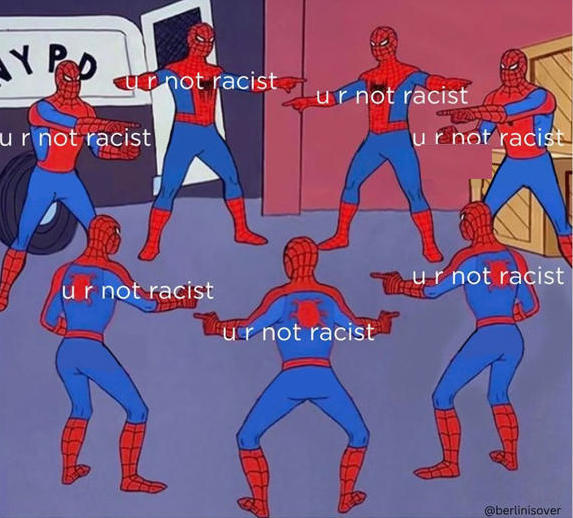
We started hearing about the cancellations within days. It was October 2023, and artists, writers, and culture workers were losing sales, residencies, fees, and even jobs for expressing solidarity with the cause of Palestinian liberation. In the ensuing months, it became clear that an especially large number of these cancellations were happening in Berlin, a city that has served as a haven for the counterculturally inclined since the 1980s. Despite decades of post-Cold War transformation and gentrification, Berlin has remained a privileged destination for culture workers from across the European continent and beyond. In the 2010s, amid the displacements and disappointments of the Arab Spring, the influx of Middle Eastern exiles — Syrians, Egyptians, and Palestinians, among others — made Berlin feel like the “Arab capital of Europe.” It was this population that bore the brunt of the cancellations in Germany, where prominent politicians and media outlets deployed hoarily racist tropes in the name of anti-anti-Semitism.
The narrowing didn’t come out of nowhere. It reflected decades of postwar German policy that had made unwavering support for Israel a moral and political obligation. Former chancellor Angela Merkel described this tendency as one of the Federal Republic’s core tenets: Staatsrason, or “reason of state.” In this paradigm, even the mildest expression of concern for Palestinian life could be categorized as anti-Semitism. While institutional censorship around Palestine is common throughout the West, there has been a uniquely hysterical backlash in Germany, particularly from within an intellectual and cultural class that privileges its own survival — and that perceives in the calls of “Free Palestine” an alien postcolonial discourse that threatens to upend its hegemony.
We reached out to four artists and writers of varying ages and nationalities whose names will be familiar to longtime readers of Bidoun. Each of them lived in Berlin in the 2010s and experienced firsthand the sense of excited possibility around an Arab city in the heart of Europe — and the collapse of that illusion of inclusivity. Each brings to the conversation their own distinct relationship to Berlin and its histories of activism, collaboration, and dissent.
Tirdad Zolghadr: I thought I might offer a historical anecdote to start, one that I owe to a friend. A few years ago, he visited the Buchenwald concentration camp, which is now a museum, and he noticed a letter to the local Nazi Party from the local chapter of the NS-Kulturgemeinde (National Socialist Cultural Community) that dates from the late 1930s. In their letter, the academics took issue with the name that the party had chosen for the camp: Ettersberg. Why did they take issue? Well, Ettersberg is associated with Goethe, who was said to have written some of his most iconic books under a tree that once stood in the middle of the camp.1
So these German scholars wrote an impassioned letter asking the Nazis to please name it something else, something that wouldn’t tarnish Goethe’s good name, and they came up with “Buchenwald, Post Weimar.” I was really, really struck by this, and it haunted me. At that time, I talked to someone about it, and we eventually decided that even though this letter seemed pathetic, there was a kind of modesty to it that was important. If all you can do is write a letter to change a name — if that’s all you can do as a scholar in a context such as the Third Reich — then just fucking do that. Claim that little crumb of agency in a dangerous situation. As pathetic as it may be, I saw it as a kind of soft heroism.
After October 7, I watched the ways in which my colleagues responded to what was happening, and now I see that anecdote in a very different light. At the risk of extrapolating historically, I don’t imagine that those scholars were scared as I did a few years ago, when I assumed they wrote the letter in desperation. I no longer imagine those scholars being quite confident, actually, and I see their action as a reflection of German Leitkultur — a word that’s so specific that it’s hardly translatable. It literally means “the leading culture,” which is to say the values you’re supposed to embrace as defined by the elites of the country, by which I’m referring to academics, politicians, members of the media, and those in the cultural sphere. In Germany, Leitkultur has this totemic importance that I haven’t seen anywhere else. And I think that this letter speaks to the kind of veneration that has led to the situation we’re in now, where a certain hyperprovincialized idea of what Germany must represent — what it must embody, what it must stand for — is valorized over and above anything else. And this is the spirit in which I imagine those scholars wrote that letter back then, because the fetishization, to put it gently, of the Leitkultur plays a key part in what we’re experiencing today. The self-provincialization among the elites is as aggressive and self-congratulatory as it is toxic, and it’s getting more ferocious by the day. I mean, I could go on. It’s not exactly a light conversation starter, but I wanted to get it off my chest. I know that these parallels are delicate, and I’m not really comparing the various forms of violence or the genocides of the 1940s to the present, but I do see a continuity.
Negar Azimi: That’s a bracing anecdote and a really good place to start. Thank you. At this point, it would be helpful to know how you all came to be in Berlin.
Natascha Sadr-Haghighian: I grew up in West Germany as the child of an Iranian father and a German mother. Integration meant suppressing any desire to belong to multiple realities, to be bilingual, or other markers of difference. Non-western cultural references were seen as either exotic or proof of failed integration. After all my attempts at belonging failed, I tried to run away as soon as I could, and West Berlin was the furthest place I could imagine running to. It was an island in the middle of the Cold War, full of runaways and dropouts and weirdos. Because it was controlled by the Allied forces, the city felt like a place where the state, or the nation, was strangely suspended. Despite Berlin’s strategic importance, there was a kind of absence of governance — and of interest. Nobody seemed invested in the city. It was in large part still in ruins and fairly empty. Turkish and Kurdish communities had revived Kreuzberg, a neighborhood enclosed by the wall from three sides. Squatters had done their part. The void felt like a dream to me — it was so full of wonder — because I was so anti-everything. Nobody asked where you were from, let alone your name. I arrived in 1986 and accidentally caught the last glimpse of the Schöneberg scene with lots of heroin and vodka and expats like Nick Cave and so on. Only later did I learn about Hanefi and Sepil Yeter, or Sohrab Shahid Saless, artists from Turkey and Iran who were living in Berlin at the time.
After the wall came down in 1989, that absence of governance was amplified. And while the dissolution of the GDR filled me with dread, one side effect was an abundance of possibilities for self-organization, for collective experimentation. What developed under those circumstances was extremely formative for my understanding of what culture could be. It lasted for maybe five years before a neoliberal transformation took hold. Things got interesting again only when more artists from our region started to arrive in the aftermath of the Arab Spring.
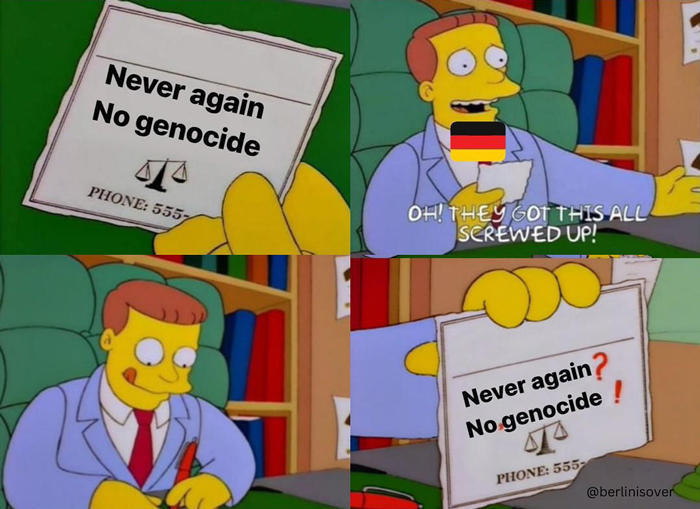
TZ: I moved there twice. The first time was, I think, in 2005 or 2006. Then I moved there again in 2017. But I started going to Berlin as a tourist in the 1990s. Two things strike me about that time. One, it wasn’t as gentrified as it is today, which also means that there was less at stake economically, culturally, and politically. The cultural and political elites and the media professionals, many of whom define Berlin today, were not as present, and those who were around didn’t dominate the landscape as much as they do now.
I really fell in love with the city. First it became a home away from home, and eventually I moved there. My love affair with Berlin hit its high point I’d say maybe five, six years ago, when the wave of intellectuals and artists began arriving from the Middle East. There was a suggestion that this could be a new New York, a new Paris. Suddenly, you had venues like Bulbul and Al Berlin. The names of close Middle Eastern colleagues dotted the landscape. Then came the arrival of very decent food and white German schoolkids saying “wallah!” I found that kind of romanticism very contagious.
Jumana Manna: My first encounter with Berlin was during my previous life as a swimmer. I was sixteen or seventeen and had arrived with my team from Jerusalem, the majority of whom were Jewish Israelis. There were only a few Palestinians. We’d been invited to participate in the German, or Berlin, championships — I don’t recall which — as special guests. They took us around Berlin and showed us the historical sites, like the 1936 Olympic Stadium. The German tour guides were basically apologizing to us, trying to prove that Germany had changed, how it had come to terms with its past, and how much they loved Israel and were excited to have us. We were taken to concentration camps in Germany and Poland as well. It was an incredibly alienating experience because I and the other Palestinians were completely invisibilized. Nobody spoke to us or even acknowledged that there were Palestinians on the team who had nothing to do with this German-Israeli affair, or rather how the Nakba and our trauma were entangled with and overshadowed by this history. I didn’t have the language to address it then.
I came back to Berlin as an artist at the end of 2012 via a residency at the Künstlerhaus Bethanien and a Norwegian grant. I had just finished my studies and was honestly a bit lost as to where to go. Going back to Norway or going to Jerusalem: neither felt like options at the time. So I moved to Berlin, and I remember stepping out of the U-Bahn in Kreuzberg on a dark, rainy day and thinking how ugly it looked, but somehow at the same time it felt like home. There were so many people who looked like me, young and vaguely Mediterranean.
I had a good beginning in Berlin. I immediately connected with a group of Arabs who were here for various reasons, not necessarily tied to the cultural scene — mostly Syrians, some Palestinians and Egyptians — and this sense of community meant a lot to me. I got to know European, American, and other expats who were involved in the arts, too, but the German cultural scene seemed somewhat impermeable to me. I couldn’t find it. Over the years, the city grew on me as it transformed into the “Arab capital of the Middle East in Europe,” as we still call it. This mix of Arabs and other Middle Easterners, in a way that’s just impossible in Palestine — this continues to be one of the best parts about living here. The occupation completely isolates Palestine from the rest of the region, making it nearly impossible for others to come visit and for Palestinians to travel. But we can meet here in Berlin.
Marwa Arsanios: I arrived in 2017. I’d started a PhD program in Vienna, but it made sense to live in Berlin because of the huge community of friends I had here, people I had known from different times and places, including old friends from Beirut. As Natascha and Tirdad noted, there was a wave of migration in the aftermath of the Arab Spring, and as counterrevolutionary forces were striking back in our region, a lot of our friends ended up here. What helped facilitate that migration was a city policy that granted artist visas quite easily. Having access to a residency permit made a huge difference. Young artists who had just started their careers could move because the administrative requirements for living in Berlin weren’t as complicated as they were elsewhere. I should also say that back in 2017, the city was still more or less affordable.
NA: From those rosy beginnings, what began to change?
TZ: Berlin has one of the largest Palestinian communities anywhere outside of Palestine; it’s in the tens of thousands. I think what’s specific to Germany is the intensity of the fear and loathing toward Middle Easterners among the cultural and political elites. Natascha can correct me with her impression, but I don’t think the average German is more racist than the average European. I don’t think they’re more passionate about their xenophobia at all. But I think the extra passion among scholars, among our colleagues, is palpable. For me, the first slap in the face was a petition from 2015 signed by German cultural workers suggesting that BDS [the global Boycott, Divestment, Sanctions program] is anti-Semitic and “enables and provokes attacks on Jews and Jewish institutions.”2 It was signed by people whom I admired, whom I really looked up to, all of these intellectual heroes of the ’90s. It felt like a rude awakening. And then, in 2019, the Bundestag adopted a resolution that described the BDS movement as anti-Semitic.3 The fact that this petition had been concretized into law was, to me, an indication of how much political influence the cultural field had.
JM: All of this is part of a longer historical erasure of Palestinians and of anti-Arab and anti-Muslim hatred in Germany. Over the past decade, Arabs have become more visible in the cultural scene, entering prominent art spaces in various capacities, participating in exhibitions, festivals, theater, film festivals, and so on. This has created resentment among those who aren’t very happy about our presence in the city. Since the anti-BDS motion of 2019, and more drastically since the genocidal onslaught in Gaza, there’s been an attempt to erase Arab presence and influence from the public sphere — especially among those who are vocal about Palestine.
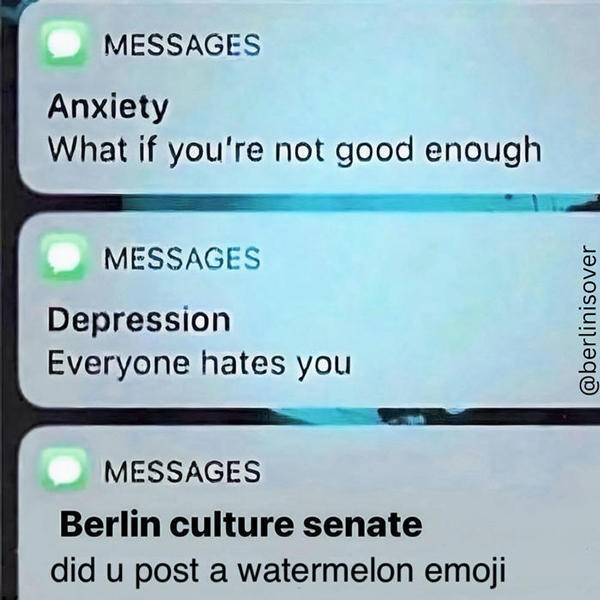
NSH: There’s definitely a class aspect that accelerates these resentments. We’ve seen years and years of structural racism toward migrant workers and shop owners — fearmongering stories in the press about clan criminality, parallel societies, and so on — as well as racist violence and even murder, much of which is downplayed or even made invisible. But then here come these self-assertive Middle Eastern expats with claims to the public sphere, to culture, and who don’t fit what Germany conceives of as a stereotypical “Ausländer.” What really triggered the Germans was the fact that these newcomers didn’t seem to know their place: they weren’t obedient and they didn’t remain at the bottom of the ladder. This provocation had started with second-generation migrants laying claim to political participation in the 2010s, but the racist backlash is felt more intensely now. If Germany responded with tokenizing gestures of liberal inclusion and goodwill in an earlier moment, we now see them in blunt-hostility mode.
As the historian Jürgen Zimmerer has pointed out, contemporary Germany remembers itself as a once homogeneous, white society, believing that’s what it was before all the nonwhite others arrived. What they seem to forget is that their country once conducted an ethnic cleansing.4 When the so-called guest workers began arriving in the 1950s to help the country rebuild from the ruins, and then more intensely in the ’60s and ’70s, the Germans imagined they would return home once they had finished the job. They formed an image of those who “don’t belong”: they work in factories, or have corner shops, or drive taxis. Middle Eastern artists and intellectuals who participate in panels and want to have a say in the cultural landscape don’t fit that image. This created not only resentment, as Jumana said, but also fear. One could feel that fear quite tangibly around documenta fifteen.5 The white German feuilleton journalists didn’t know shit about the discourses or the histories that the art on display emerged from. The exhibition, curated by the Indonesian collective ruangrupa, challenged their expertise but also destabilized their hegemony over cultural discourse. Because if they don’t know shit about that stuff, what does that mean for their future? Either they have to discredit these new voices, or they have to do their homework. Apparently, they opted for the first.
JM: I agree with you, Natascha. The class aspect is important. Since the Arab migrations of 2011, there’s been a class divide between those who run the food joints, hair parlors, and supermarkets in Neukölln or Wedding and those who arrived through artist or student visas and who circulate in both local and international cultural and academic institutions. These two groups meet in at least two contexts: around food and in the protests for Palestine. Otherwise, my impression is that there’s not much overlap between these communities.
On October 7, the media reacted hysterically to the sight of us protesting, realizing, “Oh my God, these intellectuals affectively feel like those uneducated Arabs in Neukölln!”6 It was a eureka moment for Germans. It blew their minds. They thought we were integrated, civilized, Europeanized Arabs, but as it turns out, no, we’re also excited about Palestinian liberation. This terrified them because we’re now inside their institutions, so maybe we’ll bring along some of that “street affect,” or what they call “Agro-Araber,” a racist slur that translates to something like “the aggressive Arabs.”
TZ: The emotionalization of Arabs has reached a degree that’s hard to describe to people outside of Germany. The Berlin police’s press releases actually speak about Arab emotions without any irony. They will say, you know, that a demonstration is forbidden because the demographic is likely to be angry or overly emotional. Their fixation on the supposed emotiveness of Arabs is embarrassing. I mean, a good friend of mine went to the airport to pick up his girlfriend, and he was wearing a keffiyeh. Her flight was late, so he was just hanging out, waiting. He went outside to light a cigarette and was suddenly surrounded by police, who fined him five hundred euro and escorted him to his car for disturbing the peace — and all he was doing was wearing a keffiyeh. The police’s response might be hysteria, or it might just be cold cynicism. Either way, they get away with a lot.
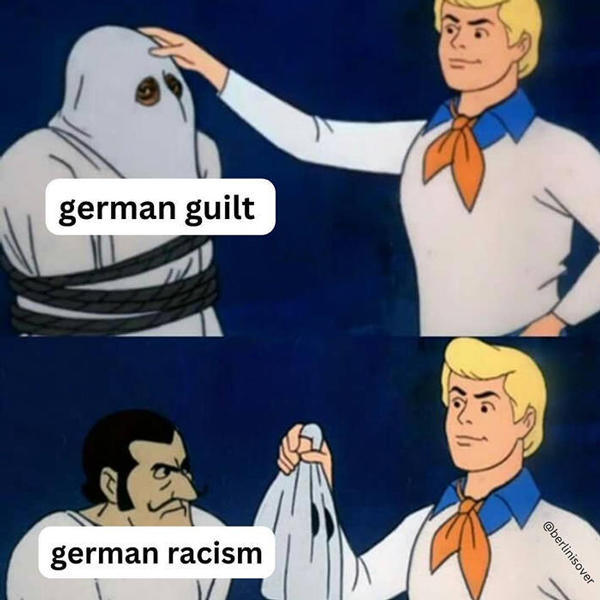
NA: Can you four help periodize this ongoing moment? This story didn’t begin with October 7. You’ve already mentioned the anti-BDS letter of 2015 and the resolution of the German Parliament in 2019.
JM: Yes, and another case that was quite revealing was a festival cocurated by Pary al-Qalqili and Anna Esther-Younes in 2016 called After the Last Sky, which was the first event in Germany that brought together artists, activists, and academics dealing with “the im-/possibility of being Palestinian” in this country. The plan was to make it a recurring festival in an alternative theater space in Kreuzberg that’s known for hosting left-leaning, migrant-led political and cultural events. But given that it was attacked by the media, the theatre said it would never host it again, suggesting that it couldn’t risk losing its funding.
I bring this up as a reminder that this climate existed well before Parliament’s anti-BDS motion, but after its passing, we started seeing a more distinct wave of repression. In 2020, Achille Mbembe was scheduled to give the keynote speech at the Ruhrtriennale, which caused an uproar among some people because he openly supports the BDS movement and in his writings had compared Nazi Germany and South African apartheid to Israel’s treatment of Palestine.7 At the time, it was surprising that Germany would go so far as to embarrass itself by protesting a prominent African philosopher. Then, weeks later, the city of Aachen rescinded a €10,000 prize that had been given to the artist Walid Raad, accusing him of being anti-Semitic.8
Perhaps the next turning point within the cultural scene was when the magazine Texte Zur Kunst published its “Anti-Anti-Semitism” issue in 2020, which linked the Palestinian solidarity movement to anti-Semitism.9 If it might have seemed like cancellations were happening due to pressure from the right-wing press and politicians, it was something else when Germany’s leading journal on contemporary art proved itself equally ignorant and racist, reproducing state policy in the guise of critical inquiry, with little editorial review or intellectual rigor. That’s when we realized the degree to which anti-Palestinian hatred existed within our ranks.
A few of us started a blog to respond to Texte Zur Kunst.10 I think the publication was slightly threatened, or it took it as an opportunity to enter into a kind of dialogue, because it issued a postscript in response to the criticism.11 That was a moment when we felt like we could still help shape the discourse. There was a feeling that we could reach out to our German colleagues and make them aware of the dangers of equating Jewishness with Zionism and of how its methods of protecting Jewish life in Germany were a gateway to fascism and crackdowns on the freedom of expression. We tried to raise awareness about the importance of BDS as a pressure tactic against apartheid.
Later that same year, the Weltoffenheit (“world openness”) conference took place, an attempt by a couple of dozen German institutional directors to push back against the anti-BDS motion because it was an impediment for them as supposedly worldly institutions. It’s not that they supported BDS. On the contrary, they were also against BDS, but after the demonization of Mbembe and all the other cancellations, it was difficult for them to work; there were lots of people they wanted to engage with whom they now couldn’t due to their sometimes tangential affiliations with Palestine or the artists’ refusal to work with with German institutions that took part in censorship. So all these institutional directors released a statement in which they expressed their disapproval of BDS but also suggested that a counterboycott from the German state was not productive.12 It was a complete flop. The whole initiative fell apart.
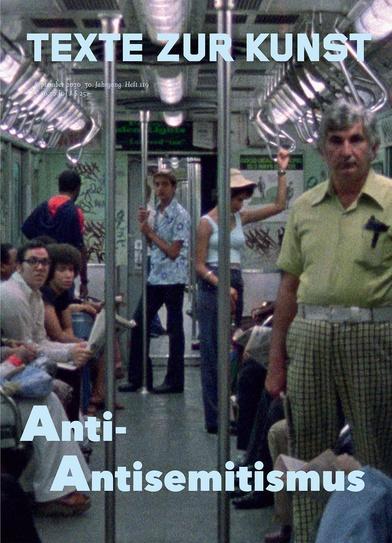
MA: That Texte Zur Kunst issue was, for me, an introduction to a certain German cultural elite that wanted to be gatekeepers and protect their institutions and their legacy. They were threatened by the phenomenon that Jumana and Natascha have already mentioned: the increased presence of a certain class of international cultural workers from the region inside their institutions. There was also a deeply embedded, Antideutsch ideology that was prominent — I would even say dominant — among a certain generation that had top positions in cultural institutions, including the Texte Zur Kunst editorial board.13 What we saw being played out in academies and universities after October 7 is the reinforcement of this ideology through the ejection of anything that could be a threat or a glitch in the production of their discourse.
TM: What’s your current relationship to the feeling that you can help shape the discourse?
MA: Given their response, or rather nonresponse, to the genocide, it’s over.
JM: There are no communication channels anymore or even much of a desire to communicate. There’s a severe divide now between the cultural establishment of Germany and those who understand Palestine as the core issue of decolonial struggle and position themselves against white supremacy and German hegemony.
NSH: We should add that the state’s policing and criminalization of solidarity with Palestine has also worked very successfully as a divide-and-conquer tactic. It ripped the fabric of solidarity among different migrant communities and decolonial movements and created a ton of alienation. That’s maybe the most painful part of all of this. Long-established migrant-rights groups, protective of their achievements and the structures that took them years to build, were not willing to destroy everything in the blink of an eye. They knew that expressing solidarity with Palestine would cost them. These include groups that are struggling for the recognition of the German genocide in Namibia, for example, and for the restitution of stolen ancestral belongings in the various former German colonies. At the same time, a large number of integrated migrants have been silent over Palestine, simply because they felt they couldn’t afford to lose ground in an already hostile environment. It has caused a huge rift.
TM: In the cultural sphere, I’ve noticed that Iranian artists are quietly being used as a cudgel against other artists from the region who support Palestinian liberation.
NA: How do you mean?
TM: There’s a presupposition that Iranians in Germany — as people who have chosen to leave Iran — inherently affirm a liberal European civilizational supremacy that is in opposition to Islam and all of its accompanying connotations, e.g. resistance or Palestinian liberation. It’s almost irrelevant if the Iranian artists explicitly support this idea or not; their position is enough.
TZ: I would agree with what you said except for the phrase “almost irrelevant.” Artists have agency, and the Iranian artist community is particularly polarized. Many have gone out of their way to support Palestinian liberation, while other Iranian artists did their utmost to attack and denounce their colleagues in pernicious ways as anti-Semitic.
TM: I added “almost” to acknowledge the exceptional cases, but my inner materialist generally disagrees. Here in the US, culture is controlled through an invisible apparatus of reward more so than punishment, which is reserved for other sectors of society. This apparatus has a very high tolerance for individual agency. Jackson Pollock was supposedly “left wing,” but he was still a CIA tool, you know? It’s not a negation of people’s agency; it’s just the reality of the terrain we’re operating inside of.
NSH: You’re right, Tirdad. A large part of the Berlin-based Iranian community stands in solidarity with Palestine; the polarization is more nuanced. In fact, it’s irrelevant what Iranian artists think as long as they behave and keep their mouths shut. There’s also the tokenism I talked about earlier. German institutions are obsessed with platforming anything related to Woman, Life, Freedom as a feel-good way of filling the void that de-platforming Arabs — and especially Palestinians — has created. It allows them to show that they do engage with critical voices from the region. This has been the case not only for liberal institutions but also in German feminist circles.
MA: About the self-preservation that Natascha speaks of: people who have jobs are generally scared, and I understand that. It’s their livelihood, right? I mean, they might have families. Let’s not forget to mention that people are scared of getting doxed in the mainstream press. This is not to excuse them or to judge them, but in the end what it produces is self-censorship. They start speaking in a language that’s neutered, affectless, or something that sounds two-sided and pretty “scientific” to fit the German parameters. Or more often than not, they avoid speaking of politics altogether. They might use the term “war” instead of “genocide,” “conflict” instead of “occupation,” or call it “settler colonialism,” opting for “humanitarian” language. People also started speaking up more once the German government made the performative, hypocritical brief move to stop the export of weapons to Israel that could be used in Gaza once other European governments, such as the French, spoke up.14 Of course, the main cultural institutions, such as HKW and KW and Neue Nationalgalerie, remain completely silent up until this day.
JM: The limits of possible solidarity and organizing across identitarian divides became evident in 2021, when Natascha, Marwa, and I were involved in the protests against the opening of the Humboldt Forum.15 The Forum is basically a reconstruction of a Prussian castle that was destroyed during World War II. The GDR had built the Palast der Republik in its place, which stood for forty years or so as an architectural landmark and home of the East German parliament. After reunification, West Germany began demolishing symbols of the East, including the GDR Palast, after which plans to rebuild a fake copy of the Prussian palace were put into motion.
TM: Who paid for it?
NSH: The building itself was fully funded by the state after successful right-wing lobbying. The state decided to move contested ethnology collections to this fake Prussian palace — in other words, it wanted to indulge in colonial fantasies of empire. One fun fact: the dome of the palace carries an inscription demanding the living and the dead kneel in front of Jesus Christ and declare Christianity the only religion.
JM: As it happens, the facade was almost entirely funded by right-wing groups and by individuals invested in the idea of Prussia being revived and remembered as the “good empire” before the Nazis came along.
NSH: A broad alliance of decolonial activist groups came together to protest the opening of this abomination. The limits of solidarity Jumana mentioned occurred exactly along the lines I described earlier, but this was 2021, so around the time of intensified evictions and violence against Palestinians in Sheikh Jarrah. The opening of the Humboldt Forum marked the beginning of an era. The handshake between conservative lawmakers and right-wing think tanks had now boldly materialized in the very center of Berlin.
TZ: I want to add that Berlin has a deeper colonial history than the rest of Germany. It’s inscribed in the city’s DNA, predating the nation’s adventures in Africa. There was a time when western Poland was considered something like a European Amazon. It had a very rich landscape of rivers and marshes, and the Prussian aristocracy drained it. According to historian Simone Hain, the repercussions of this disastrous adventure informed the foundations of the modern state in Prussia.16 It was a violent and costly undertaking, and all of the tropes that we know well from the history of modern colonialism were present: the myth of the empty land; making, in this case, the marshes bloom; the desperation of the early pioneers, who weren’t really there because they wanted to be there. Today, there’s a slow emergence of discussion about German crimes in southwest and southeast Africa, but that previous chapter, as you were saying earlier, is very much sanitized, even glamorized.
NSH: If we’re talking about crucial historical moments and how they’re inscribed in the present, I’d also go back to September 11, 2001, and the “Global War on Terror.” I was in Istanbul when it happened, and when I returned to Berlin, I was shocked to find the discourse reduced to “You’re with us or you’re with the terrorists.” At that time, I couldn’t talk to my German friends, and their ignorance about the history of Afghanistan or Iraq or US imperialism in the region reminds me of the ways in which Germans insist on their ignorance about the history of Palestine today.
TZ: I agree with Natascha that 9/11 was the end of a certain ’90s-era happy-clappy belief in the possibility of dialogue. For me, it was the beginning of a disenchantment and the beginning of the normalization of certain violent forms of governance. But to finish the timeline we started: I realize now that when Documenta was unfolding, I still kind of clung to the idea that things are — I don’t know. I suppose I saw it as a problem of German provincialism. I thought, What do you expect? This is Germany. I saw addressing their provincialism as part of the remit of cultural workers, that this was something we could engage with, that we could fight and think through and rethink, etc.
But everything changed after October 7. Suddenly, people were being fired, censored, their bank routes checked. Their apartments were ransacked, or they couldn’t get into them because their doors were sealed. Kids who said certain things in school had their names reported to intelligence services. A friend of mine had the police knock on her door one evening because of something her kid said about Israel in school. An associate of Cabinet magazine went to a party in Berlin, where there were a lot of Americans and a few Palestinians and Israelis known for their anti-Zionist positions, and police trucks showed up at the door. It was their way of saying “We’re watching you,” because this was not a public event, so the only way they could have known about it was through surveillance. The police violence at demonstrations was beyond the pale. You had headlines like “‘Free Palestine’ is the new ‘Heil Hitler,’” which the newspaper Die Welt used for a podcast episode.17 An acquaintance of ours tried to knock a camera out of the hands of a photojournalist and was photographed with his arm raised. The paper put his image on the front page and suggested that he was doing the Hitler salute.18
Our colleagues’ support for this kind of thing — shrugging in some cases, very passionate in other cases — I was really not expecting it. They were ironically the kind of people that Natascha was describing earlier. Germans use the term Zivilisationsbruch, which means “a break in civilization,” which has been used to describe how civilized society uses its tools and technologies for genocide. Germans also use the word to describe Islamists who are beyond the pale, beyond what we consider civilized. At first, I found it useful to describe the shift to the post-October 7 paradigm, but now I don’t believe there has been a break with an idea of the civilized — just a slap in the face that awakened me to the fact that this was, all along, a really desperate fantasy and that the progress that had been made was circumstantial rather than based on a deeper recognition of what human dignity is. There are certain laws, certain freedoms, and they should be taken advantage of to the extent that they can be, but the question to me is: to what degree was my desperate liberal fantasy of a progressive Germany really the farce that it’s turned out to be all along? To what degree was there crumbling, and to what degree was there already a fissure? I think I’ve had to toughen up and admit to myself something that I didn’t want to accept: that European culture really is indebted to half a millennium of colonialism.
MA: I would add to Tirdad’s list a new law that allows the police to secretly install spyware in homes, among other things.19 I also want to say something about the already-existing fissures, and the crumbling of the so-called liberal order after October 7. The once useful human rights discourse has proven useless when we witness western democracies using sanctions against “their own” institutions, like the International Criminal Court, to defend their outpost colonies in the region and their imperial projects. It only widens the fissure, and I don’t think there’s a way to close it anymore. It’s more than twenty years after September 11, which inaugurated the War on Terror and its harsh tools of surveillance and repression. After October 7, we’re witnessing an amplified wave of the same tactics. So I guess, yes, it was always a farce, but the material realities of this farce shift with every event as the empire crumbles. As the death machine does its work in Palestine, it occasions a stronger and more radical resistance. That’s probably why we’re seeing people go back to the radical Marxist politics that was dismissed in the 1990s.
JM: I don’t know if they even believe their own lies anymore. It’s plain racism. I mean, when there are proper German anti-Semite xenophobes in government… like Hubert Aiwanger in Bavaria, or others like Beatrix von Storch, the granddaughter of Hitler’s finance minister, who stood in front of parliament and said that “Muslim anti-Semites” would be sent “back home aboard an aeroplane.”20
NSH: Weaponizing anti-Semitism has proven a very effective right-wing strategy to claim the success story of German atonement and remembrance culture while carrying out a racist agenda at the same time. They simply declare anti-Semitism to be a problem imported from Muslim countries via Islamist indoctrination so they can silence protests against the genocide, deport Muslims, and still claim their moral high ground. It’s a successful formula because none of the liberals, no one from the German left wing, will say a word against it.
TM: It’s a very transparent displacement of all their genocidal impulses — a one-to-one reproduction of their racial structures. It reeks of desperation.
NSH: One concept that has been helpful for me to understand is willful ignorance — knowing enough to know that it’s better to not know more. It’s something that I’ve been trying to think through across the longer trajectory of structural and institutional racism in Germany. We can observe how willful ignorance is cultivated. Most Germans don’t know anything about Palestine because it’s not taught in school. Their history of Israel starts with the Holocaust and German guilt. They don’t learn about the British mandate, they don’t learn about Zionism — and they are okay with that.
NA: Marwa, you were part of the contested documenta 15. What was that like from the inside?
MA: I suppose it was a chance to see how the machine works from up close. Documenta is huge. A million forces collide in this exhibition. It’s like a microcosm of regional and national politics. For them, the stakes are high. This is their biggest exhibition. So much money is put into it, and it generates a lot of income, too. The clashes and controversy at documenta 15 happened on many levels. To begin with, there was the media doxing of the Palestinian artists involved. So much for freedom of speech! They wanted ruangrupa, the show’s curators, to import artistic practices without the attendant politics. All this talk in Europe about decolonizing the institution was just a facade. There was also the question of what constitutes “art.” Documenta 15 also quite bluntly challenged the question of form. For many critics, what they saw there wasn’t art at all, and the critiques that emanated from the participating collectives represented a threat and a misunderstanding. Finally, the work at documenta 15 wasn’t market-oriented, and that was also a huge provocation. In many ways, my participation was a crash course in German integration. Another participant joked that after having gone through documenta, we should be given citizenship.21
NA: Natascha, you are an actual citizen and have been in Berlin the longest. Can you take us back in time…
NSH: In 2001, Berlin went bankrupt as a result of nepotism and corruption. After the state bailed out the city’s largest banking house, draconian austerity measures were put into place that had long-lasting repercussions.22 Berlin was rebranded by its mayor as “poor but sexy” in the process.23 As part of the austerity measures, most state assets were sold off, and international banks and hedge funds bought up large portions of the city’s real estate.24 After the hedge funds came the fintech start-ups, and artist studios and small manufacturers were pushed out of the inner city. Berlin eventually ceased to be affordable. Then in 1991, the city was declared the capital of Germany, so government buildings had to be built, which brought in a lot of people. The Federal Intelligence Service (BND) alone has more than 3,000 employees, who all more or less moved to Berlin after 2018.25 You can’t underestimate what this demographic shift did. All these people vote. I wouldn’t be surprised if they brought the conservative party to power two years ago. Meanwhile, a lot of the people we care about don’t have the right to vote.
NA: How has this moment affected your personal relationships with friends, with people whom you previously thought you were allied with?
MA: There have been a lot of breakups. We all lost a lot of people that we thought were allies. I personally was immediately cancelled by certain public institutions because of some Instagram posts I made in October 2023. Since then, my friendships have been reconfigured. The divide was clear: people who spoke up and people who didn’t. Of course, this brought with it many new friends too.
JM: My God, there have been so many relationships that have been destroyed, and others that have been strengthened. The most consistent letdown has been with German colleagues. Like, sure, we’re not friends, but we are colleagues. It was alarming, the degree to which so many were completely silent about the genocide due to fear, opportunism, and racism. Some went so far as to publicly distance themselves from me and others who faced defamation or cancellation.26 There are statements written on websites of German institutions that showed my work, distancing themselves from me because of the allegations.27 Today, we can laugh about it, at just how low and insidious this behavior is, but in that moment it was traumatic.
TZ: I would second what Jumana said. On a personal level, I have two white German friends whom I had been close to for many decades, and those friendships have fallen apart in painful ways. On the other hand, other friendships have strengthened, because I learned to appreciate certain solidarities that I maybe took for granted earlier. I was never in love with my job, but I did assume that there was a certain progressive consensus that I and my colleagues could build upon — but that turned out not to be the case. A month or two after October 7, I joined a student demonstration and was spotted by the president and vice president of the university where I taught, who promptly gave my name to one of the biggest newspapers in Germany. The paper in turn named me an anti-Semitic leader of a violent student mob. This story circulated throughout Germany and was even discussed in policy circles as further proof of the crackdown needed on universities. It was… I mean, on a personal level, it was hard to take, because it led to a whole chain of really humiliating, infuriating events, backstabbing and name-calling and that kind of thing. In Iranian circles, one blogger framed me as a stooge of the Islamic Republic. This whole media circus laid the foundations for me being thrown out of the university. And, by the way, that article named two other people: one Jewish Israeli and one Afro-German. So the media had the perfect triad.
NSH: I think I had already given up on most of my white German friends a long time ago, so not so much changed for me in that respect. Having organized around the NSU complex, the anti-racist struggle, and migrant rights in Germany, I had already become disenchanted with the politics of the German left.28 But there were definite challenges in creating an understanding between what some might call the “expat community” — the people who had arrived in Berlin more recently — and the nonwhite people who grew up in Germany as immigrants. October 7 also made tangible the different experiences of the first- and second-generation immigrants and the newly arrived. It has been painful to learn that solidarity is not a given, but acknowledging these different experiences is, I think, really the work that needs to be done. Some of the biggest obstacles are the violent regimes of integration, which create friction between second-generation immigrants and the newly arrived.
NA: Berlin is also living with the specter of what they call “budget cuts,” which will completely reshape the city’s cultural landscape.
NSH: Yes, a lot of institutions stand to lose all their funding. Of course, these institutions tend to be progressive, decolonial, and anti-discriminatory, working with youth and trans and queer communities. When you look at it, it makes no sense. The German government is destroying the very thing that Berlin stands for. But then it makes total sense because all the things Berlin stands for are exactly what it wants to destroy.
In late 2024, Spore hosted an event to addressed cancellations and budget cuts, and someone there suggested that we shouldn’t call them “budget cuts.”29 Instead, we should think of this moment as a complete reorganization of the cultural landscape, a phenomenon we can see in other places. But I have to say, it’s difficult to stand in solidarity with endangered institutions when they stay silent about Palestine. We’ve basically stopped going to state-funded institutions since October 7.
NA: Where do people go?
NSH: We’re back to self-organizing! The turnout for events around Palestine solidarity in studios or other small venues is huge. We’re back to informal and clandestine spaces, like in the 1990s. While I can’t say I enjoy this situation, because it’s tragic, there’s a sense of community, something powerful about it, at the same time.
MA: We started having gatherings at Natascha’s studio and in bookstores and small spaces. It feels almost euphoric at these moments because you can say whatever you want to; you know that no one is there to judge or surveil you. No one is waiting for you to say something “wrong.” Speaking openly has been possible only in these small places. So something collapsed, and something else was born.
You asked about friendships earlier, and, of course, it’s harder to trust people. It’s almost like living in a dictatorship. This period has taken me back to the ’90s, when the Syrian secret services were in Beirut and we weren’t allowed to talk about politics in public. Our parents would say, “Don’t talk in front of everyone. Just talk here at home.” When people wanted to talk about politics, they would simply lower their voices. There was a quite similar feeling here in 2023 and 2024. You’d be careful about what you said and in front of whom.
JM: Today’s self-organization might in some ways hearken back to the past, but the difference between the ’90s and now is that Berlin is unaffordable. The option to live off 200 euros a month in a squat is completely unavailable. The rents are high, food isn’t cheap anymore, and we don’t all have jobs. The chances of receiving artist grants or film funding from Medienboard are quite slim. We rarely receive support or grants from Germany, and yet we pay income taxes to this country that is sending weapons to Israel and bars Palestinians and their allies from public space. Perhaps the strength of staying in Berlin now is realizing that we might represent the majority. It seems like our alternative events are better attended than those at the Neue Nationalgalerie or other major art institutions. There are people regularly queuing outside whenever there are self-organized, Palestine-related events, and they’re eager to listen and talk about what is being denied and suppressed. The desire for an alternative or an underground scene is felt. But again, the financial reality is that Berlin has become just another big city, like Paris, like London. So this little underground utopia is vital, but it’s hard to say how much longer it can go on or what form it will take.
TM: How are you all feeling about Berlin currently? Tirdad, I know you’ve left Germany already. Anecdotally, I’ve heard of others leaving as well. What are your plans?
JM: When it comes to our plans, maybe we don’t want to disclose too much, as our enemies might be listening?
NSH: Yep.
TZ: Absolutely.
Marwa Arsanios is an artist, filmmaker and researcher.
Jumana Manna is a visual artist and filmmaker based in Berlin and Jerusalem.
Natascha Sadr-Haghighian works as an artist and organiser committed to diasporic infrastructures and conditions of collectivity.
Tirdad Zolghadr is a curator and writer, currently working with the Mathaf Arab Museum of Modern Art in Doha.
1. Letter dated July 24, 1937, from Theodore Eicke to Heinrich Himmler, Thüringisches Hauptstaatarchiv Weimar.
2. See “Challenging Double Standards: A Call Against the Boycott of Israeli Art and Society.”
3. For more on Germany’s designation of BDS as anti-Semitic, see: here, here, and here.
4.Poe, Marshall, host. 2026. New Books Network. Episode 153, “Jürgen Zimmerer, ‘Memory Wars: New German Historical Consciousness,’ January 3. Podcat, 1hour, 2 min.
5. For more on the experience of Palestinian artists at documenta 15, see: here.
6. For examples of German media coverage of the protests, see: “Whole Streets full with Hamas-Sympathizers — The police disengages an Anti Isreal Demonstration;” “Hardcore Propaganda for Hamas, Palestine demonstrations in Berlin — Police are arming themselves;” “Violence escalates at pro-Palestinian demonstration — Scholz calls for solidarity with Jews;” “Survey at the largest pro-Palestinian demonstration in Berlin — Almost two-thirds would vote for the Left Party”
7. For more on the backlash against Mbembe’s keynote address, see: here.
8. For coverage of the rescinding of Raad’s prize, see: here.
9. Texte Zur Kunst 119, September 2020.
10. Reply to postscript invitation.
11. “Afterword to the Postscript to Texte Zur Kunst’s ‘Anti-Anti-Semitism’ Issue.”
12. “Statement by German cultural institutions on the parliamentary BDS resolution by the Bundestag,” e-flux, December 12, 2020. See also: this.
13. Antideutsch is a fringe movement within the German and Austrian left characterized by antagonism to German nationalism, critiques of anti-capitalism and to anti-Zionism. Members of the movement are fervent supporters of Israel.
14. For more on Germany’s suspension, then reinstatement, of arms export licenses to Israel, see: “Germany halts its military exports that Israel could use in Gaza,” See also, “Germany: Resumption of arms transfers to Israel reckless, unlawful and risks complicity in Israel’s international crimes.”
15. For more on the Humbolt Forum, see: “Is the Humboldt Forum Shying Away from Colonial History?” DW, August 14, 2017; “Why are Activists Kicking Up a Storm Against Berlin’s Humboldt Forum?” Frieze, September 2, 2020; “Berlin’s Controversial Humboldt Forum opens,” DW, July 20, 2021; “Why Germany’s Newly Opened Humboldt Forum Is So Controversial.” Smithsonian Magazine, July 23, 2021.
16. Simone Hain, “To Conquer a Province Peacefully”: How the Seizure of Land on the Rivers Oder, Netze, and Warthe Drove a Government to the Brink of Ruin,” in REALTY: Beyond the Traditional Blueprints of Art & Gentrification, Tirdad Zolghadr, ed. Hatje Cantz, 2022.
17. “Free Palestine is the new Heil Hitler,” December 2023, produced by Die Welt.
18. See: “Hitler salute at Palestine demonstration: A snapshot of contemporary history.” beck-aktuelle.
19. See: “The Federal Criminal Police Office (BKA) should be allowed to secretly enter and search apartments in the future,” Der Spiegel, August 15, 2024; “Berlin Approves Controversial Law Allowing Secret Home Entries for Spyware,” Sri Lanka Guardian. December 6, 2025; “Federal Trojan: BND to be allowed to enter apartments to install spyware,” Heise online, December 20, 2025.
20. Kasia Wlaszczyk, “On 21 April, German will deport me — an EU citizen convicted of no crime — for standing with Palestine.” The Guardian, April 9, 2025.
21. Since documenta 15, the organization has adopted a new code of conduct regarding anti-Semitism as defined by the International Holocaust Remembrance Alliance. For more, see: “Documenta Adopts Widely Criticized Definition of Anti-Semitism,” Hyperallergic, Februyary 5, 2025; “Documenta adopts antisemitism definition in new code of conduct,” ArtReview, February 6, 2025.
22. For more on Berlin’s bankruptcy and the fallout, see: “The End of Old Berlin,” Der Spiegel, May 27, 2001.
23. For more on Klaus Wowereit’s description of “Berlin as “poor, but sexy,” see “Berlin Party over for Mayor Klaus Wowereit,” BBC News, December 11, 2014.
24. Haghighian, Natascha Sadr. “What’s the Time Mahagonny?” e-flux, June 2010.
25. For more on BND and its move to Berlin, see: here and “Germany opens huge new spy HQ in Berlin,” DW, February 8, 2019.
26. For more on the defamation of artists at this time, including Jumana Manna, see “Artists’ blitzkrieg: Criminalised, cancelled, fired, censored,” Mail & Guardian, December 20, 2024.
27. The term “NSU Complex” describes the collusion, as well as institutional and structural racism, that allowed the neo-Nazi terrorist organisation, National Socialist Underground (NSU), to commit numerous murders and bomb attacks across Germany for more than a decade.
28. Michael Rothberg, “Statement on the ‘Postponement’ of ‘The Art of Memory in Times of Trauma and Grief’ in Leipzig”
29. For more on the Spore Initiative, see: here. For more on tax cuts and their impact on the cultural institutions of Berlin, see “Berlin announces huge €130 million cuts to culture budget,” Euro News, November 27, 2024.