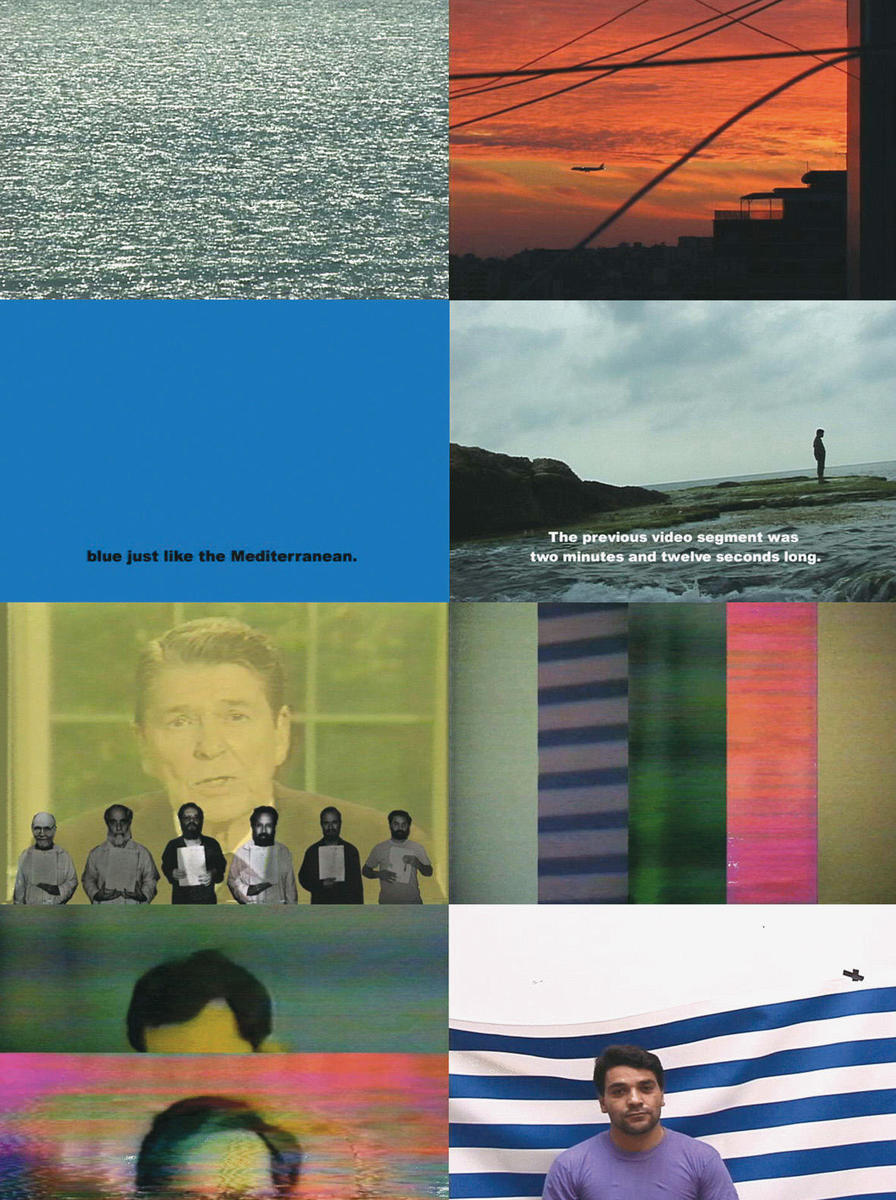
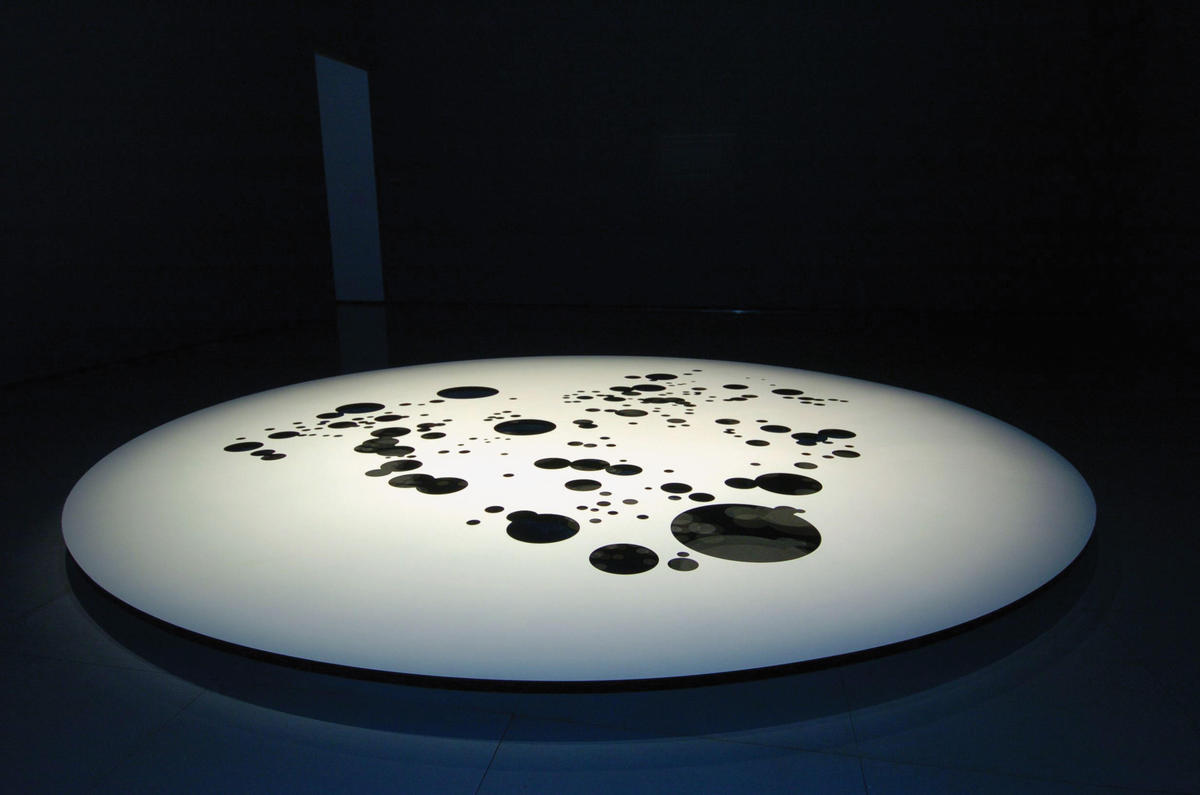
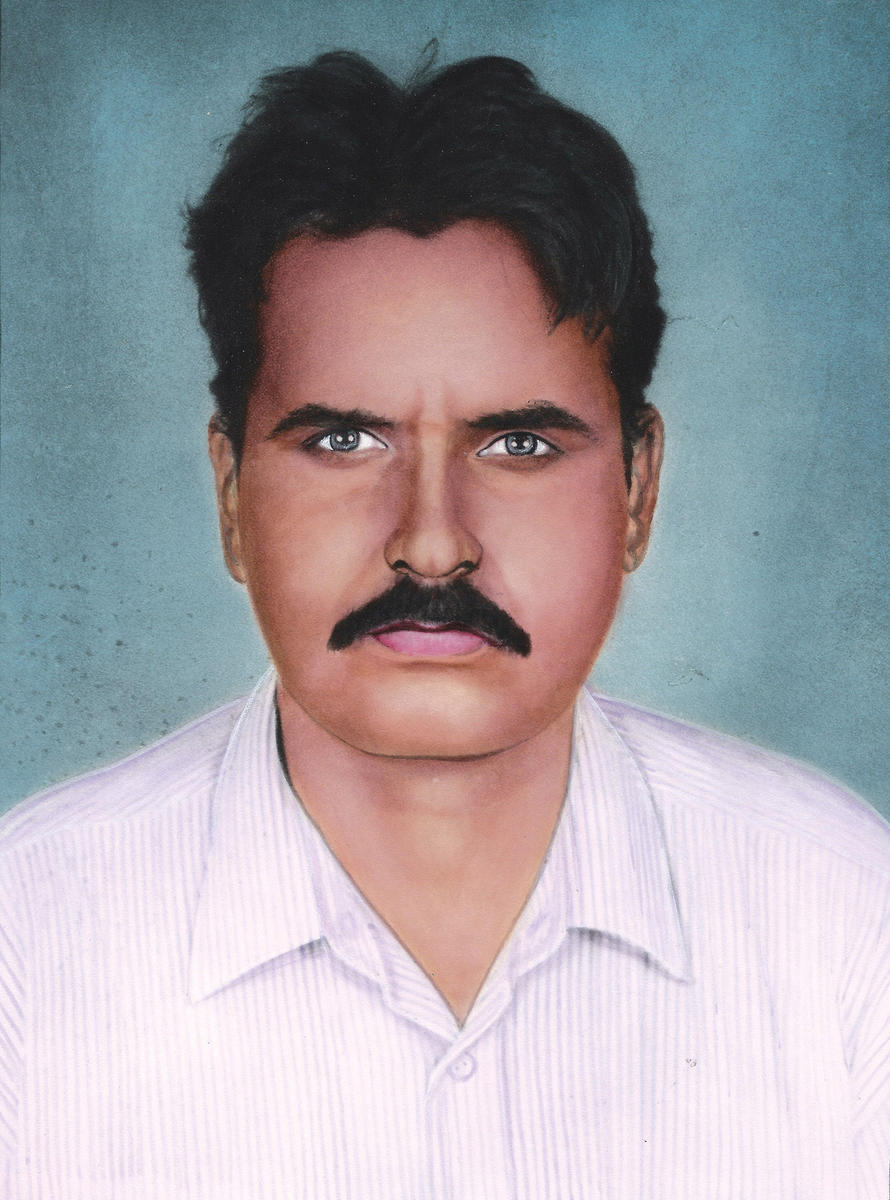
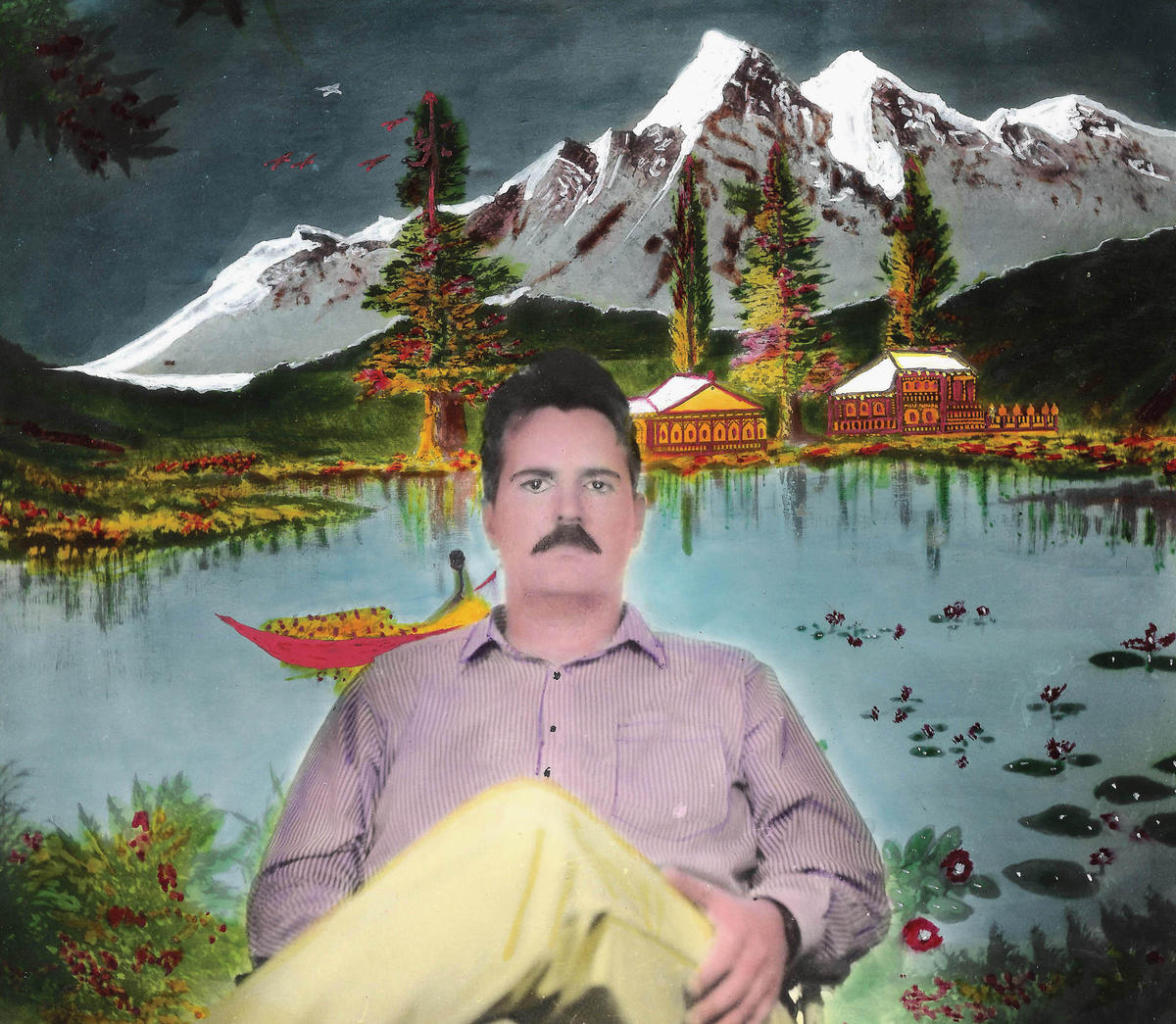
In this issue of Bidoun, we take on shifting notions of tourism, the tourist, and travel in general as starting points for a larger discussion about the intersection of experience, representation, desire, and voyeurism.
The cynical view of tourism is that the carefree days of being lost in another place, space, and time are long gone. Those with enough money are the recipients of carefully controlled experiences edited for easy consumption. Visitors are told to look here, stand there, photograph this, and stand solemn before that. Some skirt traditional tourism by participating in alternative tourist economies-eco — tourism, ethno-tourism, and helper tourism among them. Others obsess over accessing the newest, often most bizarre attractions — traveling halfway around the world to ski in Dubai (in August), to check into the latest boutique hotel in Micronesia, or, alternatively, to gaze down into the site of the former World Trade Center in New York.
Nevertheless, crowds still flock to the typical destinations: Caribbean shores, European monuments, and the sites of antiquities in the Middle East. They go through the motions, making mini-pilgrimages in pursuit of pleasure or History (usually filtered through the lens of a digi-cam), leaving lots of money behind in the process.
You may find that at times we gloss over the actual destinations, instead looking at the people and economies servicing them and the ideas that inspire trips (loosely defined) in the first place.
It’s not the two-week trips to the Andes to build latrines that concern us, but rather, the context that created the possibility of taking those trips, the instinct that drives people to sign up. In the end, our relationships to tourism define not only our sense of self, but also how we conceive of leisure, representation, and privilege.
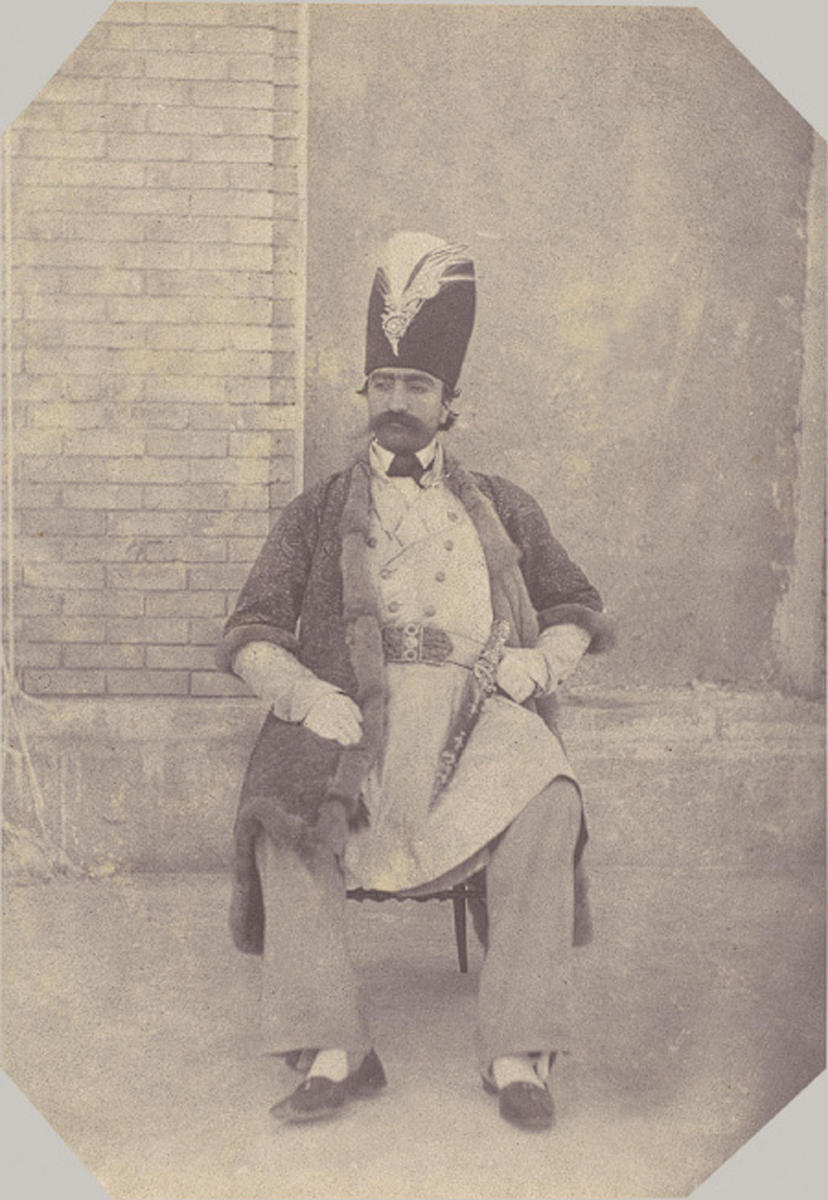
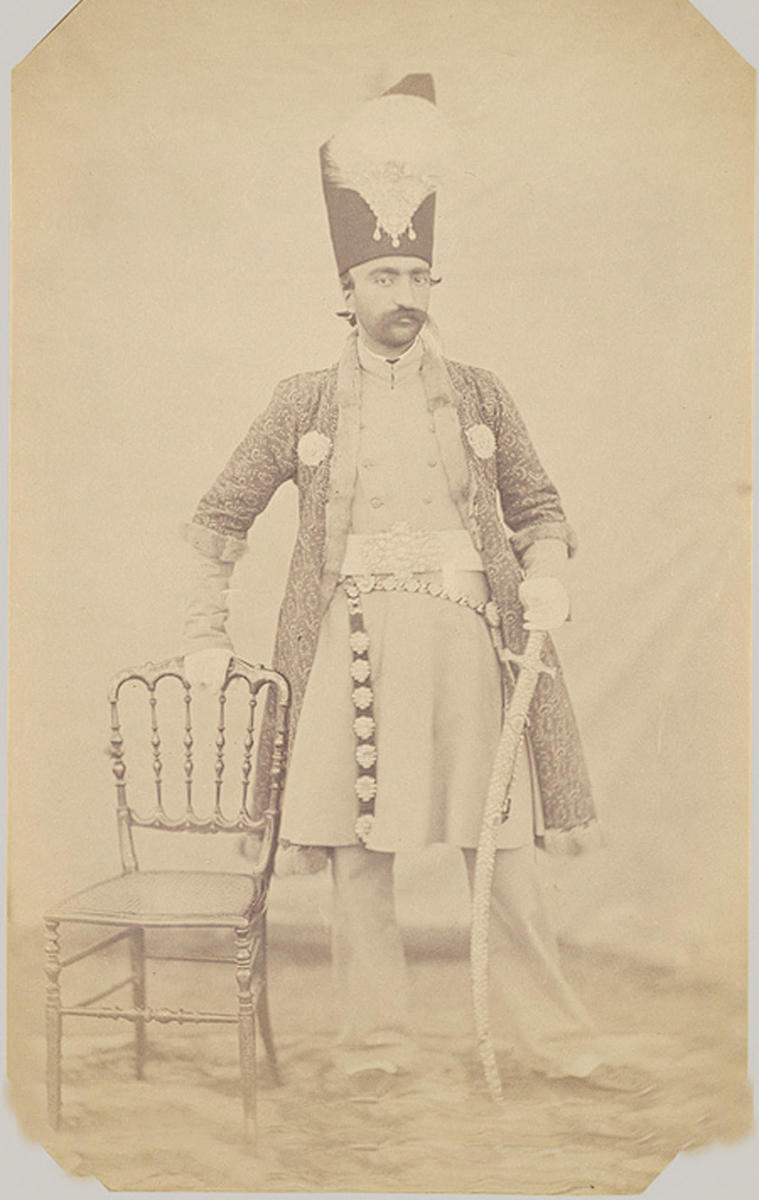
Finally, we explore issues related to tourism that are intimately linked to the Middle East. A series of impressionistic reviews document a number of the region’s airport and hotels — some more off the beaten track than others. Serge Michel considers the journey of the kidnapped and Nagmeh Sohrabi inverts the traditional accounts of us being viewed by them — recounting Nasir al-Din Shah’s first tour to Paris in 1873. Also within, George Pendle sketches a historical path from pilgrim to tourist to artist, while Tirdad Zolghadr unleashes his critical wrath on guidebooks past and present. For our artists’ commissions, Yaron Leshem probes the universal appeal of war paraphernalia with his photographs of tourists posing on the Intrepid in New York City, and Laleh Khorramian recounts the tale of a ship voyage gone awry.
Like a Burning Heart World Cup, Germany 2006: Tunisia, Iran and Saudi Arabia reach for the stars
Do you enjoy rooting for the underdog? Does your bleeding heart go out to the losers while the winners are cheered on by a roomful of happy jocks? Then here’s your chance to revel in kindness, to show off your own, private brand of compassionate sportsmanship. Tunisia, Iran and Saudi Arabia have made it to the number one entertainment event worldwide. Billions watching. Billions of dollars made. Women screaming, men weeping, countries crushed, nations reinvented. Hip hip hurrah. It’s the FIFA World Cup, kicking off in June of 2006.
It’s actually the third time the Saudis are participating, though they have yet to win a match at the Cup. Last time, Saudi Arabia served as a therapeutic punching bag to Germany and its ailing team when it lost 8 to 0. This time round, the Saudis have raised eyebrows by firing their fairly successful Argentinian coach in favor of a Brazilian one, only six months before the event. (“Yalla, get the Brazilian.”) Of course everybody wants a Brazilian. But coaches aren’t car engines, and football teams are not mindless machines. On second thought, perhaps they are.
Saudi Arabia is in Group H, together with Tunisia, Spain and Ukraine. As it happens, Tunisia, have a comparably good chance of getting somewhere if they beat the Saudis (they will), and outsmart the Ukrainians (they might). In this case, they would shamble on to the next round, where they would play the first ranked in Group G — presumably their old friend and colonizer, La France.
The Iranian team, would you believe, still has Ali Dayi hobbling around like a demented rooster. Isn’t Persepolis enough by way of primeval mascots? Do we really need one as team captain? Why is Iranian football always about symbols? Once again, the Team-e Melli will have to shoulder the responsibility of psychopolitical bonding for Iranians the world over, with the Cup being the only time expatriates and patriots rally together for, well, for anything whatsoever. Tellingly, the German Green Party wants to ban the Iranian team from Germany and thus kick them out of the championship, to teach Ahmadinejad a symbolic lesson. Berlin is opposed, however, with a leading Social Democrat muttering that it wasn’t the team’s fault it has a “nutcase for a president.” Iran is grouped with Portugal, Angola, and Mexico. Angola? Perhaps. Mexico or Portugal? No, not really.
Funnily enough, Turkey was kicked out of the qualifying round by the Swiss, after which some Turkish players kicked the living daylights out of the Swiss in the locker room. But as for the above qualified teams, all in all, the Saudis have the slickest uniforms and a Brazilian coach, the Tunisians are arguably the most handsome and play the best football, and the Iranians are the most dramatic. So much for anti-essentialism.
Jesus Theme Park in Purgatory
Americans love a good pilgrimage — as long it’s to Disney World. Understanding this, one fringe religious group is attempting to give American Christians something that would really appeal to them: a Jesus theme park. American Evangelicals have begun planning their Christian Heritage Center, which supplants the Magic Kingdom’s messiah, Mickey, with the original messiah, Jesus. The center is to be built near the Sea of Galilee in Israel where the son of God is said to have lived and preached. The plan includes an amphitheater, auditorium and multimedia education center as well as gardens and a nature park on a 125 acre site offered free of charge by the Israeli government. The complex, masterminded by prominent televangelist Pat Robertson in collaboration with the Israeli Tourism Ministry, also includes a complete broadcast studio linking Robertson’s popular television network, the Christian Broadcasting Network, with the theme park. Both parties hope that the $60 million tourist center would establish the region as a Christian pilgrimage site and draw millions of tourists a year.
But all of those people looking forward to noshing on loaves and fishes, taking in the Sermon on the Mount laser light show, or watching Robertson live and direct from the Holy Land, may be disappointed because it looks like the project is on hold indefinitely. Hopes were all but dashed in January after Robertson told the one million viewers of his 700 Club television program that Ariel Sharon’s recent stroke was the punishment from God for pulling out of the Gaza Strip. He claimed that God was attempting to smote Sharon for giving “God’s land” to the Palestinians and threatened “woe unto any Prime Minister of Israel who takes a similar course.” Government officials did not appreciate this backhanded support for the Israeli state and pulled the plug on their dealings with Robertson. Despite an immediate apology from Robertson, they maintain that they will only do business with televangelists who do not share Robertson’s views. They have yet to find any.
Middle Eastern Art Market
At London’s Frieze Art Fair in October last year, the Middle East had its fifteen minutes. A report by Bidoun in the Art Newspaper’s daily edition about Middle Eastern collectors at the fair caused a momentary stir: such is the thrill of a mash-up of the most contemporary of art markets with what is apparently the most traditional of societies. And of course news of a “new” market, is always a good excuse for another glass of champagne.
With something of a frisson, Frieze Art Fair VIP manager Daisy Shields told Bidoun that this was “the first year we’ve had calls on behalf of Sheikhs.” The Fair had worked with Galerist’s Murat Pilevneli to invite and host Turkish buyers at the Fair, and Pilevneli was confident that this first step would encourage greater investment in international and local artists by Istanbul’s growing numbers of collectors, and ultimately “force up the local market.” London darlings Haluk Akakce and Hussein Chalayan sold well at the Fair.
In our last issue, Bidoun included news of Ebrahim Melamed’s plans for his 5,000 square-meter Honart museum, scheduled to open in 2008 on the outskirts of Tehran. Home to his extensive collection, which includes works by Anish Kapoor, Ugo Rondinone, Shirin Neshat, Parviz Tanavoli, Julian Opie, and William Kentridge, the museum will play a significant role in the region, which has few public spaces with active collecting policies — and few galleries that put local and international artists on a par. “We curate as we buy, taking our time and working with gallerists and artists to collect major pieces of museum quality,” Melamed told Bidoun. He was infectiously enthusiastic about one key purchase: a set of three major works by Monica Bonvicini from London’s Max Wigram Gallery.
While Sharjah is known for its public museums (Sharjah Biennial director Hoor Al Qasimi was at Frieze, considering works for the museum collection), Dubai rarely makes headlines for cultural eminence. But in late December came the announcement that the emirate had commissioned Zaha Hadid to design an opera house complex on an island in the Creek, followed by the revelation of vague plans for two museums, one dedicated to art.
A few months earlier, the nascent contemporary art scene in Dubai was invigorated by the opening of The Third Line, a slick, warehouse-style space in the industrial Al Quoz area. Local gallery devotees, many of whom are new collectors, buy work by first-time exhibitors such as Raghda Bukhash, Lamya Gargash, and Amna Al Zaabi, and regional hotshots Youssef Nabil and Farhad Moshiri.
The Gulf states have also been instrumental in keeping Beirut galleries going during a politically and economically grueling year. As Agial Art Gallery director Saleh Barakat told Bidoun, “We suffer from the force majeure like any other market, but let’s say that the art market in Lebanon stumbles but doesn’t fall. The burgeoning economies of the Gulf have encouraged collectors to come to Beirut on buying sprees. The Lebanese diaspora, visiting from the US and Europe, and accustomed to buying art, also equilibrates the situation to an extent.” The opening of the Sfeir-Semler Gallery, with its roster of high-profile international artists, and the success of Homeworks III helped Beirut’s art scene remained relatively buoyant in 2005.
The Third Line also runs a consultancy, tasked is to build a corporate art collection for the Dubai International Financial Center (DIFC), which aims to be Wall Street’s UAE equivalent. The DIFC is focusing on regional and international contemporary art. Its first commissions for the two lobbies of The Gate building are due for completion this spring: huge numbers and letters canvases by Tehran–based artist Farhad Moshiri and abstract landscapes by Bahraini Balqees Fakhro.
When Christie’s launched its first Arab world office in the Dubai Metals and Commodities Center in April 2004, the local art world assumed it would be relying on jewels and other typical Middle Eastern interests. Indeed, its first foray in the region was the Camel Caravan Gala Auction, a charity sale of kitschy fiberglass camels decorated by local artists and enthusiasts, which grace the roundabouts and expressways of the city.
A pre-sale exhibition of Orientalist art in Dubai in May 2004 saw a subsequent increase in interest from Gulf buyers at the June sale in London. (The growing importance of the Gulf market for Orientalism is illustrated by a show opening this March at the Majlis Gallery, Dubai: London’s Mathaf Gallery, specialists in nineteenth century paintings of the Arab world, are bringing their wares directly to their Gulf clients for the first time.)
Meanwhile, other Christie’s departments reportedly noticed a rise in interest in twentieth century international art in the region.
Perhaps it’s not so much of a surprise that on May 24, Christie’s will be holding their first official auction in the region at the Emirates Towers Hotel — and that it will be of international modern and contemporary art. Alongside a handful of big international names, including Damien Hirst, Hiroshi Sugimoto, and Shirin Neshat, the sale will offer a mix of works by artists from across the Arab world, India, and Iran, including Chant Avedissian, Mahmoud Said, Dia Al-Azzawi, Parviz Tanavoli, Hossein Zenderoudi, and Shadi Ghadirian.
Kutulug Ataman, 99 Names, 2002, five-screen video installation, dimensions variable, courtesy the artist and Lehmann Maupin Gallery, New York
New York
Without Boundary: Seventeen Ways of Looking
Museum of Modern Art
February 26–May 22, 2006
Wither geography. Questioning the relevance of the Islamic heritage of artists in the content, presentation and consumption of their works is the ambitious goal of the Museum of Modern Art’s ‘Without Boundary: Seventeen Ways of Looking.’ Showcasing artists ranging from art world staples Mona Hatoum and Shirin Neshat to more emergent figures (though already established) such as Emily Jacir and Raqib Shaw, curator Fereshteh Daftari hopes to question the collapse of biography with content, meaning and philosophy. Look out for freshly commissioned sculptures from Shirazeh Houshiary and Pip Horne, as well as new paintings by Y.Z. Kami. Interestingly, works are included from artists who have precious little to do with the Islamic world — namely Mike Kelly and Bill Viola. Other artists featured in Daftari’s lineup include Jananne Al-Ani, Ghada Amer, Kutlug Ataman, the Atlas Group/Walid Raad, Rachid Koraïchi, Marjane Satrapi and Shahzia Sikander. Here, the question will be whether simply lumping these artists under the same rubric will serve as a means of marketing them as an identity group, question mark
or not. But then again we should be talking. The exhibition is accompanied by a catalogue with essays by Daftari, Harvard’s postcolonialism guru Homi Bhabha and Turkish novelist Orhan Pamuk.
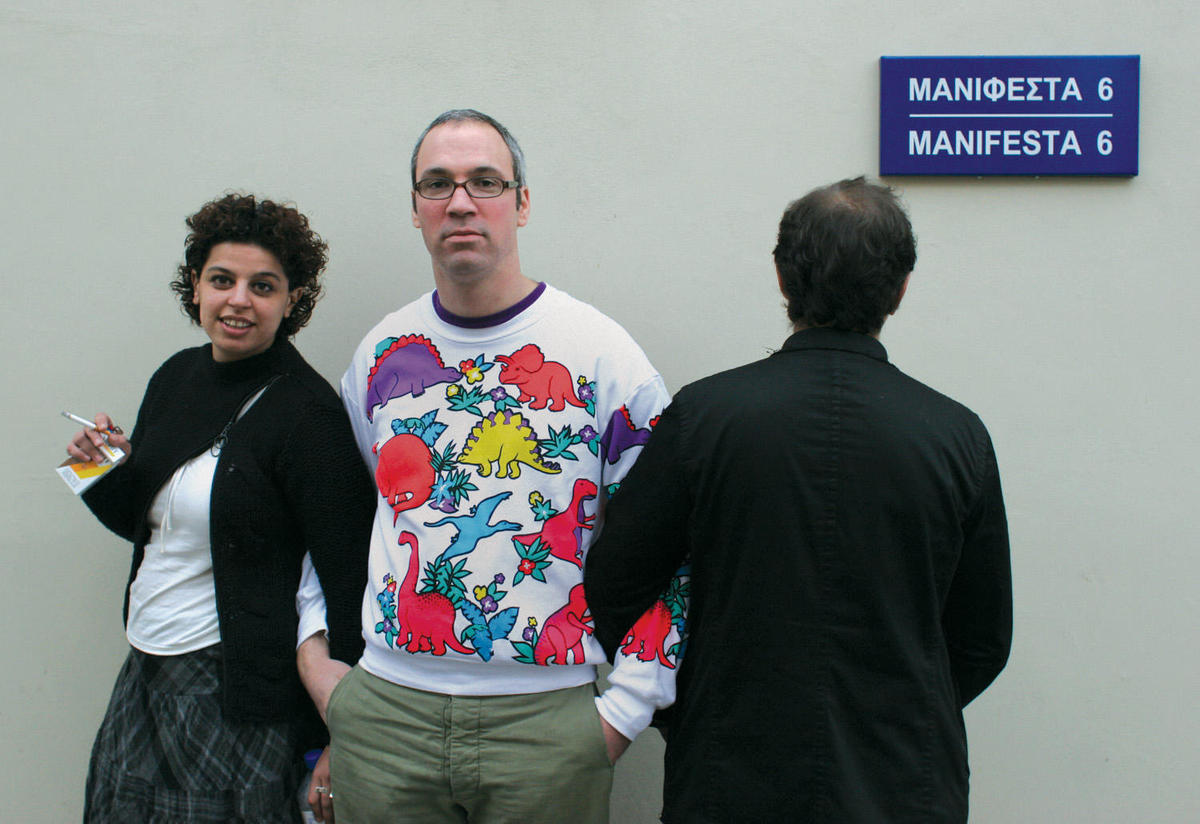
Pictured left to right: co-curators Mai Abu ElDahab, Florian Waldvogel and Anton Vidokle, photo: Jihan Ammar
Nicosia
Manifesta 6
September 23–December 17, 2006
The curiously divided state of Cyprus will serve as backdrop for the sixth installment of Manifesta, the European Biennial of Contemporary Art. Taking a cue from the storied Black Mountain College, a cultish North Carolina-based experiment in zany intellectualism founded in 1933, co-curators Mai Abu ElDahab, Anton Vidokle and Florian Waldvogel propose to challenge the conventional large-scale exhibition format by establishing an art school in the capital city of Nicosia for a period of three months — from September 23 to December 17, 2006. Inviting cultural producers of all varieties to propose novel works — from visual artists to writers to architects and curators — the school’s aim will be to produce a series of site-specific works via both short and long-term residencies. Biennial project advisers include Liam Gillick, Boris Groys, Walid Raad, Martha Rosler, Jalal Toufic, and Tirdad Zolghadr. Cyprus, and Nicosia in particular, serve as apt metaphors for linking East and West. Engaging this idiom without the characteristic pitfalls of trite multiculturalism and token exchange initiatives will be the ambitious goal of the school, and the event at large.
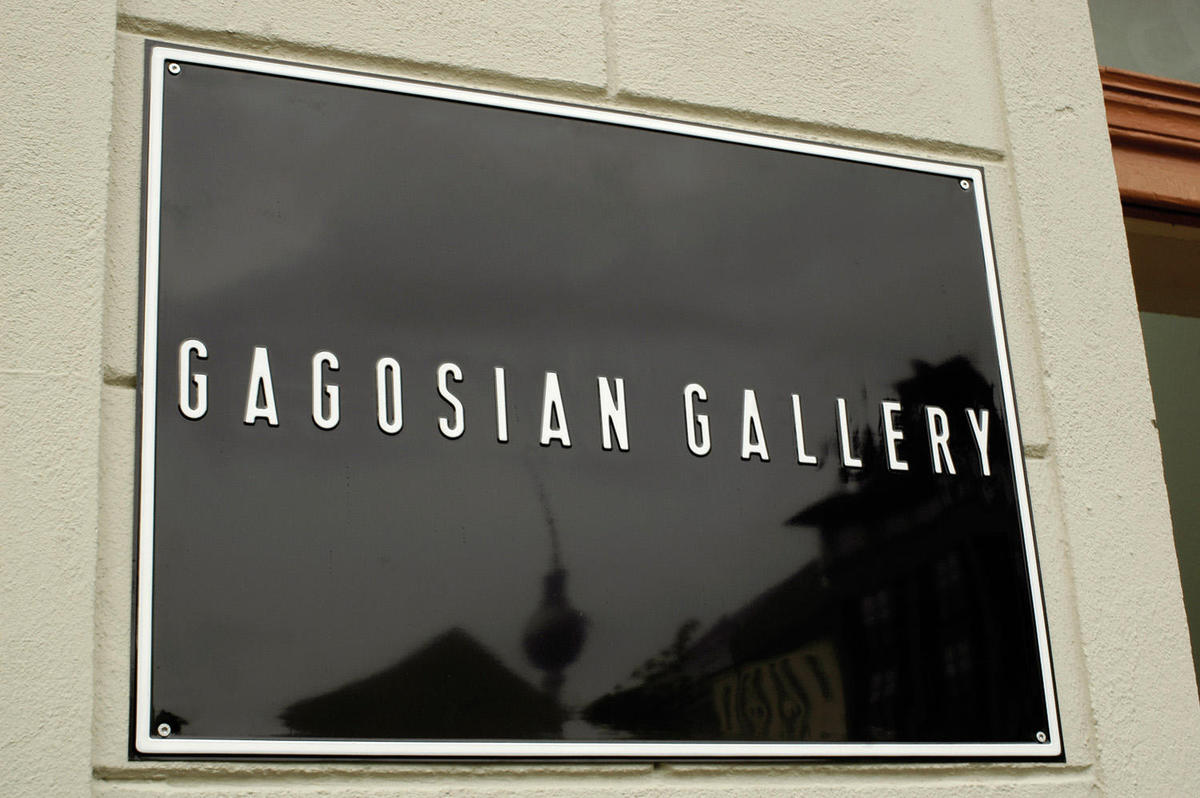
Sign outside Gagosian Gallery, Berlin with reflected Alex TV Tower, photo: Karl Bongartz
Berlin
4th Berlin Biennial: Of Mice and Men
March 25, 2006–June 5, 2006
A fake, albeit functioning Gagosian Gallery, a series of self-proclaimed “gestures” and the occasional non-event marks this year’s Berlin Biennial — an ode to subverting the biennial form masterminded by Wrong Gallery founders and routine pranksters Maurizio Cattelan, Massimiliano Gioni and Ali Subotnick. In full swing since last year via a series of interventions — in the local German press and beyond — the biennial assumes the curiously morbid title of John Steinbeck’s ode to the predatory nature of human existence, broken dreams and the ravages of
(yes) mental illness. While it may be too early to assess the cohesiveness of theme and intent, there is reason to be excited. Some of the event venues are “rad,” as one biennial employee put it, and the event seems to have much of usually dark and broody hipster Berlin talking. In November, the biennial published Checkpoint Charly, featuring works by 700 artists engaged in research for the project — a virtual “memory stick” of the biennial. Though it is rescheduled to “open” this spring, what organizers seem to have done here is to render the act of curation a performance in and of itself — with little beginning or end to speak of. And that’s pretty cool. So is ripping off Gagosian.
West Bank
Chelsea-Palestine virtual studios
April 2006
Artists from the West Bank, Palestine and Chelsea College of Art and Design, London, are currently collaborating on two exhibitions, making work together without actually leaving home. Curators Samar Martha and Richard Bradbury matched pairs of artists and commissioned them to develop ideas and “make” virtual works over a period of ten weeks, between January and March 2006, via the Internet. Come the exhibitions in Palestine and London in April, the artists will swap practices — the Palestinians implementing the Londoners’ works and vice versa. At the time of writing, the venues are to be confirmed; see artschool palestine.com for updates and details.
Farhad Moshiri and Shirin Aliabadi, Shoot first, make friends later, 2005, c-print, courtesy of the artists
London
Entourage
Counter Gallery
March 29–May 2, 2006
April 19–25, 2006
Facing a perpetual representational dilemma as a platform for arts and culture from the Middle East, Bidoun is now quite happy to re-delegate the curatorial mandate to others in the field. In collaboration with Counter Gallery, Bidoun is organizing a five week exhibition, in which three teams of practitioners have been invited to host three distinct installments. Each group has been offered carte blanche in terms of content, and are also free to behave as artists or curators in absentia. It is up to them to de-regionalize, re-regionalize, or seize the opportunity for discussion or self-promotion. The interest thus lies in the tensions between various delegates, and not in a hypothetical bridge between the Middle East as a referent, and a gallery as its showcase.
The first installment will be hosted by Shirin Aliabadi & Farhad Moshiri. The Tehran-based duo is known for their curatorial work (for example the group exhibition ‘Welcome’ in Chelsea, NY) as well as installations, paintings or videos that have been exhibited internationally. For the two week exhibit at Counter, the duo proposes the new project Operation Supermarket, a series of posters alongside a small number of supermarket commodities, mixing, in the words of the artists, “poetry with detergent.” The emphasis here is on the commodification of mainstream media traits of the Middle East, but also on a wry parody of the mythical hopes still pinned on the commodity itself as a capitalist agent for change.
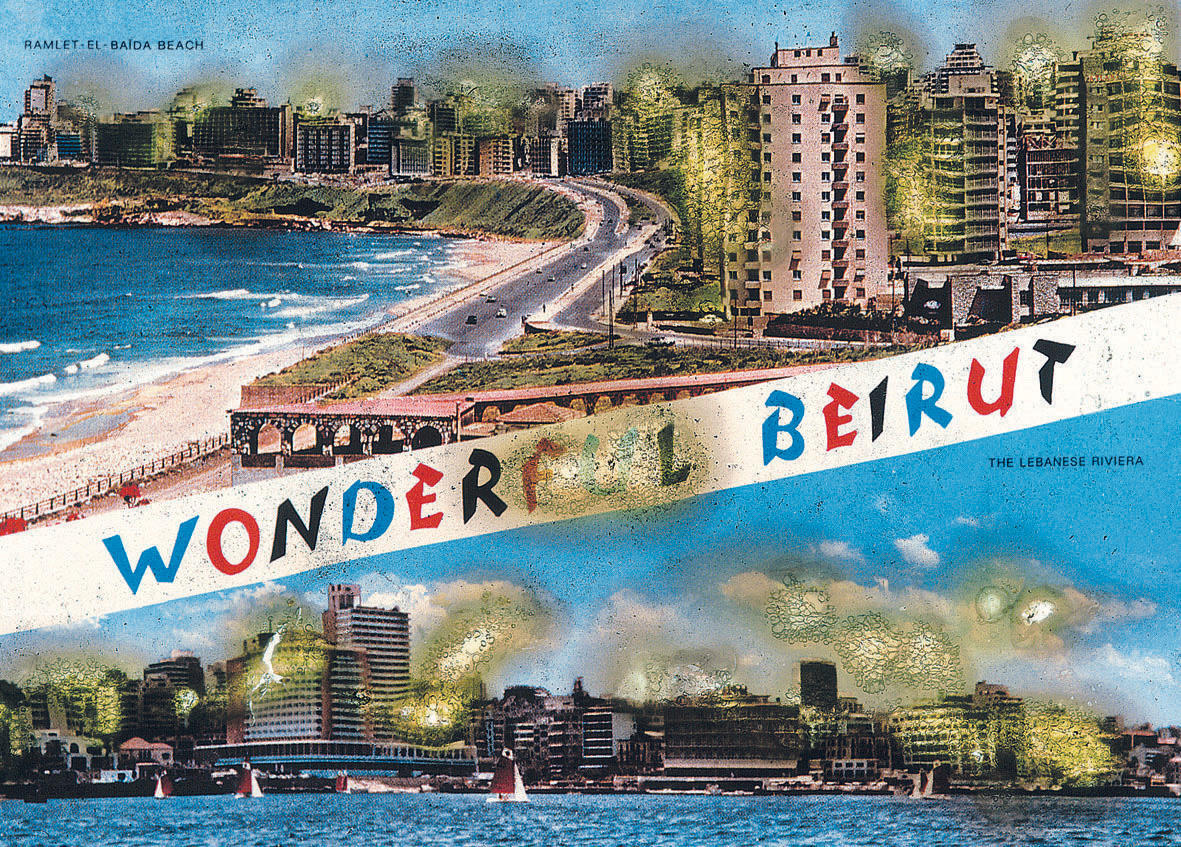
The second installment will be under the auspices of Beirut-based Joana Hadjithomas and Khalil Joreige. The two are known for their video and photo installations, films and publications addressing the question of how to represent a city after a devastating event such as a civil war. For the London show at Counter, they propose to exhibit their installation Circle of Confusion, which consists of an aerial picture of Beirut cut into 3000 pieces and stuck onto a mirror. Visitors are invited to peel off the fragments, revealing the mirror underneath, and the phrase “Beirut n’existe pas” on the back of the photographic shred in their hands. The piece is shown alongside an extract from a video by artist Akram Zaatari, This Day, which, among other things, peruses persistent Orientalist patterns through the history of desert photography.
Faouzi Rouissi will host the final installment. A writer born in Algiers and barely known in the West, Rouissi has been writing for Bidoun since Issue 6, and is widely appreciated in select circles for his outspoken style and undaunted prose. Living in exile in Paris since 1994, Rouissi travels widely, publishing everything from travel guidebooks to critical anthologies of pop art, all in his native Kabyli. Here, Rouissi proposes a selection of paintings and drawings focusing on what he terms “the contagious poetics of envy.”
Joana Hadjithomas & Khalil Joreige, Post card of war #1/18, Wonder Beirut: The story of a pyromaniac photographer, 1998-2006, courtesy of the artists
Oxford
Out of Beirut
Modern Art Oxford
May 13–July 16, 2006
Over the course of 2006 and into 2007, the UK is ostensibly celebrating a Festival of Muslim Cultures via a packed calendar of literary, academic, film, art and museum events (muslimcultures.org). Glasgow City Council is even giving its traditional May Day bank holiday an “Islamic theme.” While obviously well intentioned, the overarching gala spans all disciplines, several continents and a fair few religious bents in its quest. It’s like the 1990s — the decade that for some debunked the notion of cheesy smorgasbord multiculturalism — never happened. We look forward to attending a Festival of Christian Cultures in Baghdad some day soon.
Incidentally, up now are several shows that may be geographic in nature but nonetheless attempt a more specific and significant curatorial inquiry. Modern Art Oxford’s ‘Out of Beirut’ has been in development for over a year. MAO curator Suzanne Cotter, working in collaboration with Ashkal Alwan’s Christine Tohme, has included the usual suspects — Walid Raad, Akram Zaatari, Joana Hadjithomas and Khalil Joreige, Tony Chakar, and Rabih Mroué, and Lina Saneh — plus some newcomers, such as sculptor Ziad Abillama and young filmmaker/ performance artist Ali Cherri, who shone at Beirut’s Homeworks III (October 2005).
Starchitect Bernard Khoury is slated to join some of the artists in a symposium, titled “Travelling and Translation” (May 2526). In addition to subjects synonymous with postwar Beirut, such as an examination of the role of city space in reconstructing the social sphere, the daylong talkfest intriguingly turns inward, examining “international and geographically-focused exhibitions from the perspective of the curator and the artist.” Discussion should fly at the session titled “Curating Out of Context,” chaired by Bidoun editor Negar Azimi, which pits Christine Tohme, artist-curator Akram Zaatari, Irish artist Phil Collins and curator Catherine David against one other. Combined with a program of performances and film screenings at other venues around Oxford, and the publication of an accompanying book, the exhibition is perhaps the most high profile outing for Beirutis in the UK to date.
London
Word into Art: Artists of the Modern Middle East
The British Museum
May 18–September 10, 2006
The British Museum’s small yet healthy collection of modern art from the Middle East gets to see the light of day this summer, supplemented by loans from elsewhere. Curator Venetia Porter has honed in on artists’ relationships with Arabic script and the way artists “have sought to express subjective and political truths through a medium that they themselves have transformed.” The exhibition considers contemporary calligraphy (from Islamic Sudan, Japan and China as well as the Arab world and Iran); the influence of poetry, from medieval Sufi writers to contemporary verse and livres d’artistes; abstract art from the 1950s on; and paintings, photographs and books that relate particular political narratives. A conference (May 19-20), book, study days, lecture and film series, music, poetry readings and children’s events round out the exhibition.
Ian Genzken, untitled (maquette for wall painting), 2005/6, cotton and mirrored perspex, courtesy of the artist and Galerie Daniel Buchholz
Bethlehem
Wall Painting
The Peace Centre
May 23–July 31, 2006
Wolfgang Tillmans, Douglas Gordon, Rosalind Nashashibi, Damien Hirst, Simon Periton, Mauricio Guillen, Pawel Althamer, and Richard Wright, among others, are making work for a major international exhibition in Bethlehem — or at least Palestinian artists will be making work on their behalf. Aware of the logistics of mounting a large-scale exhibition in Palestine, and keen to explore the role of the artist-as-traveler, curators Charles Asprey and Kay Pallister have asked these hotshots to contribute artworks for others to construct in situ, on their behalf. Each artwork is sent to Palestine as a set of intricate instructions by email or fax; local curator Samira Hassassian is currently recruiting artists in Palestine to aid in realizing the concepts of Hirst et al. The curators also have a strategic aim: “Simply by existing, we hope the show will go some way to opening up Palestine as a cultural venue in the minds of the Western art community who currently assume it is a no-go area.”
Tangier
Cinemathèque de Tanger: Grand Opening
May 29, 2006
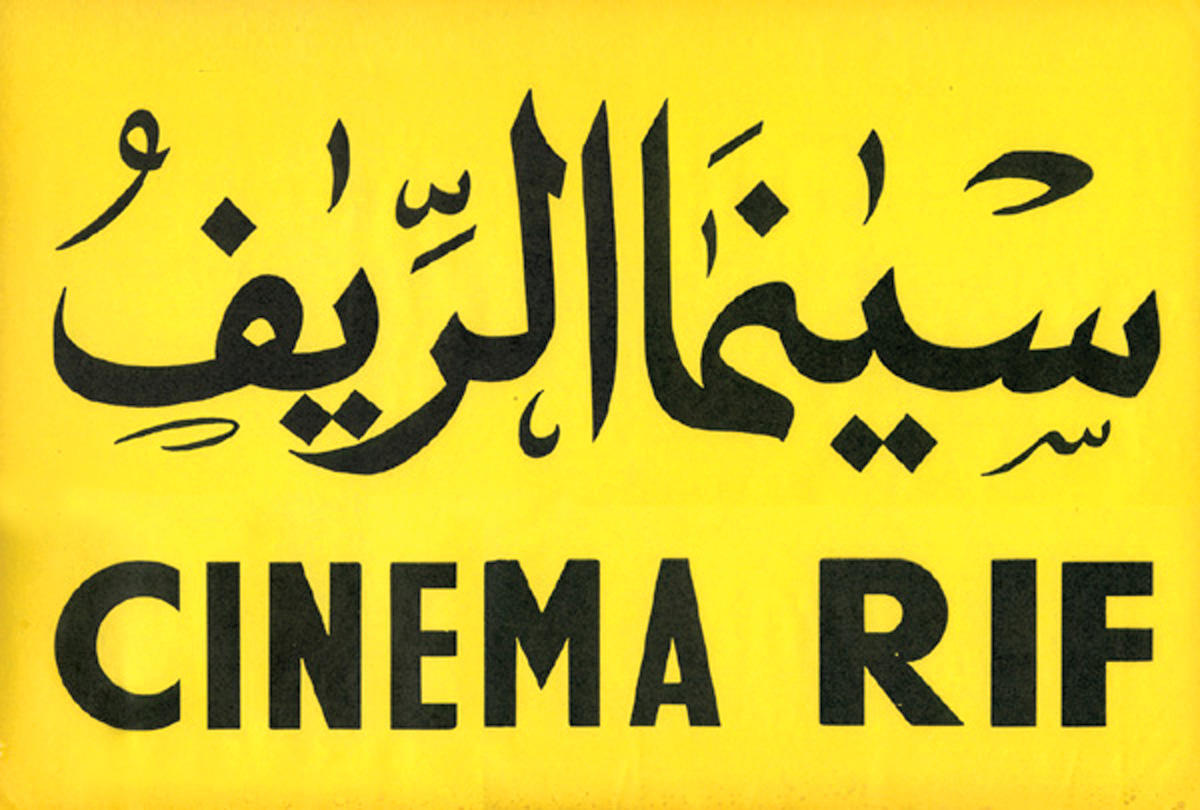
Tangier’s long-awaited Cinemathèque will open on May 29, the day after the Cannes Film Festival ends. Located in the city’s Grand Socco, which is undergoing a makeover from car park to a paved, fountained pedestrian area, the cinema and film center is set to transform life for Moroccan cinephiles. The Rif Cinema was one of a handful of active cinemas in Tangier, mainly devoted to B-grade Bollywood flicks. In its new incarnation, courtesy of photographer Yto Barrada, the 1940s building will house a cinema showing noncommercial world cinema, documentaries, shorts and Moroccan films; editing suites; an archive of 35mm and amateur film and video (recent additions include twenty 16mm Scopitone films from the 1960s that play on jukeboxes featuring rear projection screens); a library; and cafe.
Riza Abbasi, Khusraw Slaying a Lion, c.1565-1635, ink, gold, and colors on paper, Iran (Safavid), Isfahan, courtesy of V&A
London
Jameel Gallery of Islamic Art
Victoria & Albert Museum
Opens July 2006
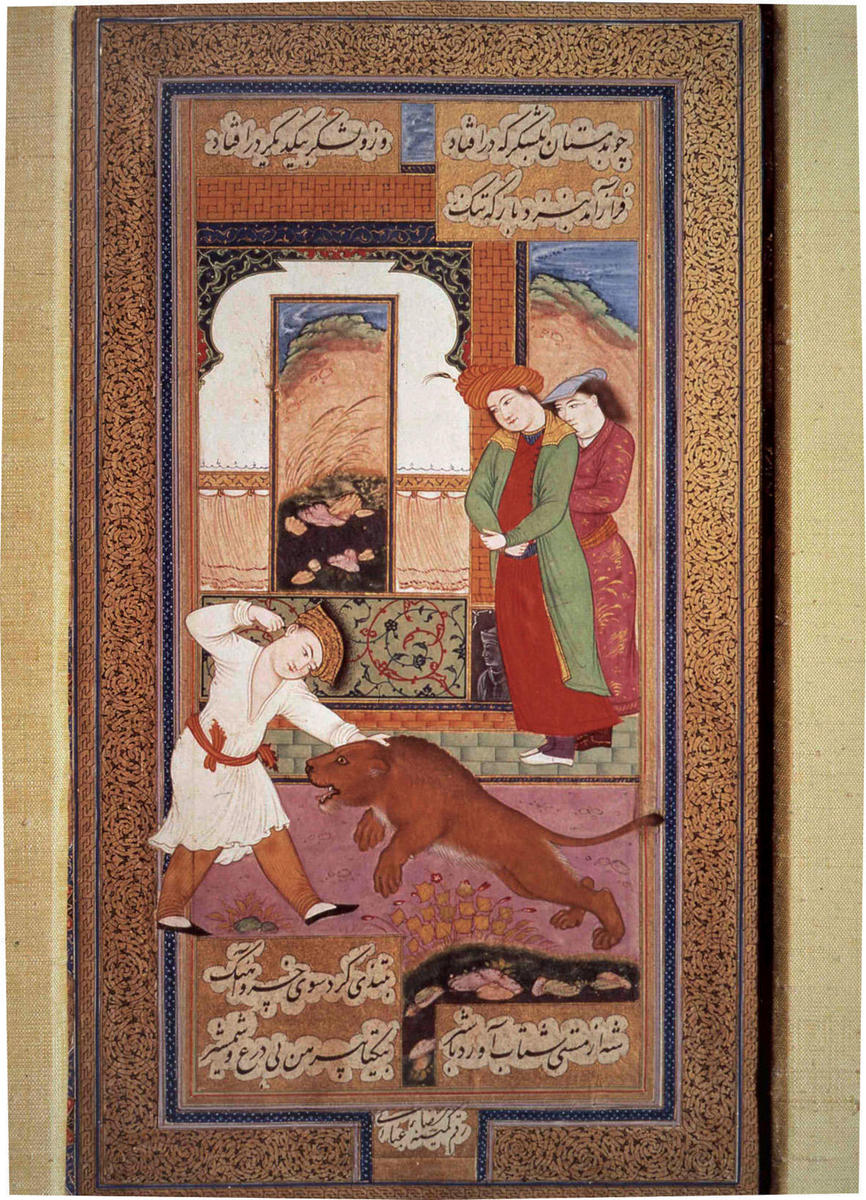
Since 9/11 and the Iraq war, combating negative news stories about the Middle East with accounts of a noble, tolerant past has become big business: one upshot sees European and American major museums making over their “Islamic art” galleries. The V&A’s long-planned Jameel Gallery, housing “art from the Islamic Middle East,” gets there first, launching this summer thanks to a £5.4 million donation from Hartwell PLC, part of the group that sells Toyotas to the Saudis.
Dedicated to the memory of Hartwell’s founder, Abdul Latif Jameel, and his wife Nafisa, the V&A is not alone in relying on a little help from its Eastern friends. The Louvre’s new Islamic wing should open its doors in 2009, thanks in part to Prince Walid bin Talal — whose dollars were snootily turned down by Rudy Giuliani after the 9/11 attacks — and his $20.5 million donation, nearly a quarter of the total budget. (Meanwhile, from March 30 to July 10, the Parisian museum is showing ‘From Cordoba to Samarkand: the birth of the Museum of Islamic Art Doha’ — a collection amassed by the now-disgraced Sheikh Saud Al Thani for Qatar’s IM Pei-designed museum, opening later this year.)
Last summer saw the announcement of the Prince Sultan Bin Abdul Aziz Al-Saud gallery at Oxford’s Ashmolean Museum; the Saudi defense and aviation minister’s donation contributes to doubling the size of the existing museum. The UK in particular has long had its generous Middle Eastern benefactors; following years of speculation, Nasser David Khalili opened his Khalili Research Centre (KRC) for the Art and Material Culture of the Middle East in Oxford last summer.
The V&A’s new galleries are designed by Softroom, the architectural firm better known for innovative retail and dining spaces such as Selfridge’s department store and Virgin Atlantic’s upper class cabins. They should give a clean, contemporary edge to the 150-year-old museum, which began life as a home for objects bought by the government from the Great Exhibition of 1851.
The Islamic Middle East wing will be home to the Kensington Museum’s collection of 10,000 Islamic objects, including the legendary Ardabil carpet — one of the largest in the world — from sixteenth-century Iran. Dating from the eighth century, the collection spans Spain, Egypt, Ottoman Turkey and Iran.
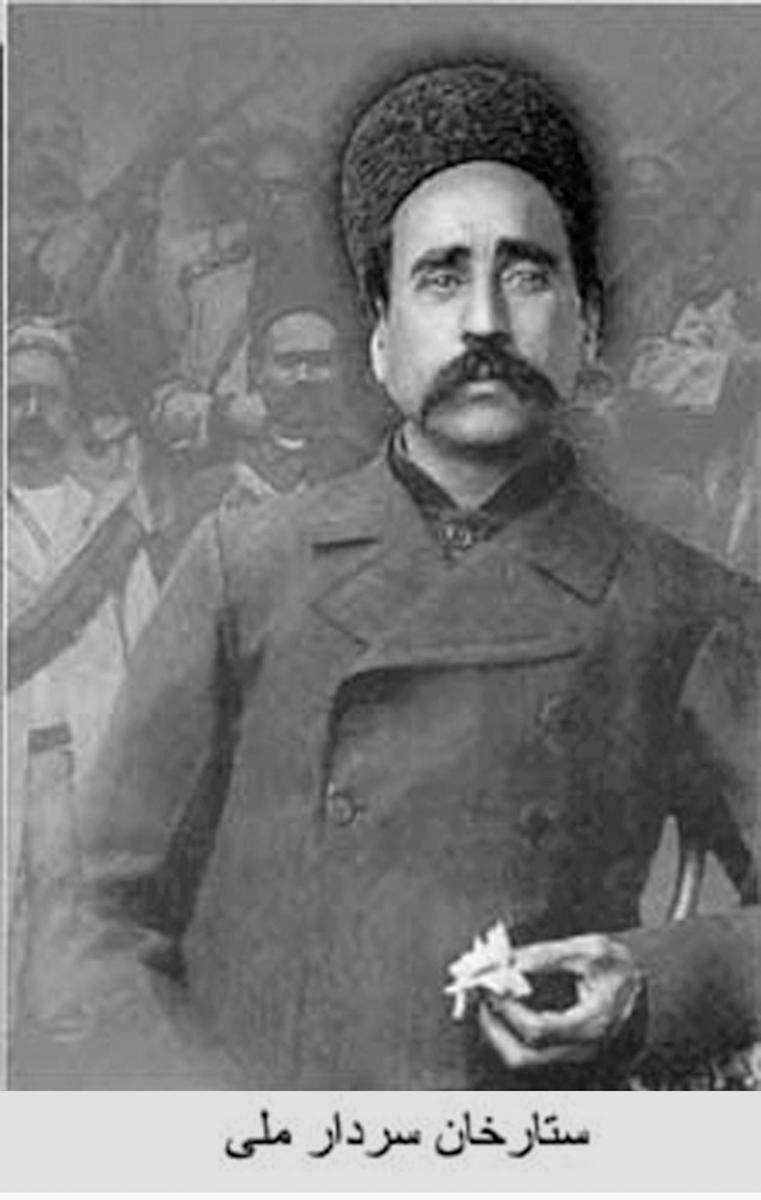
Photomontage of Sattar Khan, courtesy Tavakoli Collection
London / Oxford
The Iranian Constitutional Revolution 1906-1911
Conference: University of Oxford
July 30–August 2, 2006
Play: Lyric Theatre
August 3-6 and October 1-20, 2006
Concert: University of Oxford and University of London
August 1, 4, 2006
Exhibition: University of London
October 9–December 8, 2006
The Iranian Constitutional Revolution of 1906 was epic in proportion. The revolution, simply referred to as Mashrooteh in Farsi, miraculously united clerics, businessmen and secular intellectuals who had tired of the endless cronyisms of the Qajar era; therein was an extraordinary indigenous push for social and political reform that continues to be a reference point in Iranian politics to this day — whatever side of the fence one stands on with regard to the Islamic Republic. Besides ushering in a new parliament, the constitutional revolution brought with it a flourishing of the press, the arts and beyond. This summer, on the one hundredth anniversary of the revolution, Farhad Hakimzadeh and his team at the London-based Iran Heritage Foundation, in cooperation with the University of Oxford, will host an extraordinary conference program bringing together academics, cultural producers and beyond to revisit the revolution’s broad impacts in a multidisciplinary manner — from its effects on Iranian identity or notions of modernity to the situation of Iran vis a vis the surrounding world. A play written by Mehrdad Seyf entitled The Persian Revolution presents the revolution via diverse perspectives; a musical concert performed by Farshad Mohammadi and his ensemble will recreate the musical innovations of the period, and a photographic exhibition by Russian Alexander Ivanovitch Iyas, a one-time officer in the Tsar’s Lithuanian regiment who travelled to Iran at the turn of the nineteenth century, will round off the summer’s program. The latter exhibition is curated by John Falconer of the British Library and John Tchalenko of University of the Arts London. In the end, this multidisciplinary look at Iran’s “other” revolution is bound to bring fresh insights to the study of a country that continues to defy facile definitions.
Copenhagen
Images of the Middle East
Various venues
August 12–September 20, 2006
Taking Place
Charlottenborg Exhibition Hall
August 19–October 15, 2006
Farhad Moshiri and Shirin Aliabadi, Freedom of Choice, 2005, poster, courtesy of the DCCD
Two years in the planning and ultimately spread over a period of eighteen months, this juggernaut of a festival covers pretty much every possible artform, presented everywhere from state museums to cafes and supermarkets. There’s even a street basketball/DJ tournament combo currently touring Cairo, Beirut and several Danish cities. Under the woolly title of ‘Images of the Middle East’ are programs to please nostalgists (Googoosh in concert, Mahmoud Darwish readings and lectures), autograph hunters (Orhan Pamuk, Natacha Atlas) and those looking for the Next Big Thing (Clotaire K, Solmaz Shahbazi).
In addition to calligraphy, video art and two photography exhibitions included in the festival, Charlotte Bagger Brandt, curator at the Charlottenborg Exhibition Hall, is putting together a show that focuses on artists who work with the stuff of the everyday, including Joanna Hajithomas and Khalil Joreige, Emily Jacir, Seifollah Samadian, Khalil Abdul Wahid, Sharif Waked and Bülent Sangar, among others. Touching on the current vogue for documentary-based practices, ‘Taking Place’ takes the Middle East as its starting point in an investigation of “the logic of place, postulating that it is often the detail that defines the whole.” It opens with a one-day conference involving the artists, other curators and scholars (August 19).
Office and government buildings in Copenhagen, Odense and Ärhus will feature gigantic outdoor prints by Tarek Al Ghoussein, Lara Baladi, and Peyman Hooshmanzadeh, among others. In the wake of the cartoon debacle symposia and public lectures will debate the relationships between the host and the various countries of the Middle East, and embark on some soul-searching by examining misconceptions of the region within Denmark itself.
In December of 2005, I participated in a symposium organized by Bob Storr at the Venice Biennale with the appealing title: Where Art Worlds Meet: Multiple Modernities and the Global Salon. It meant what it said. There were “different art worlds” trying to become one big art world, people talking about different versions of modernities, the global and the global salon itself. Like many other symposiums, it was an excuse to create meaning around an exhibition, and the level of incoherence was accordingly very high.
When the term postcolonial was said for the 7,487th time, establishing a record — surpassing the number of performances of The Phantom of Opera, and even Cats, the two longest-running shows in Broadway history — I searched desperately for my 44 Magnum to randomly shoot a couple of speakers and a few nodding listeners. Unfortunately, I’d left the gun at home that day. So I decided that I no longer give a fuck about colonialism, precolonialism, postcolonialism, neocolonialism, hyper-colonialism, homemade colonialism, organic colonialism, low-fat colonialism or semi-colonialism. I really don’t. Not to say that we cannot change the world we live in, but we cannot do so before accepting that the world we live in is just that — not some kind of fiction with multiple endings.
In fact, Venice, as a city and a former colonial power, is the perfect example of how power can eventually rot, molder and putrefy, how colonial hubris can be transformed into a mass rape of tourists. Venice is the best example of postcolonial malaise. Sustaining power requires modernity. A city needs cars, not gondolas; taxis, not a transportation mafia. Yet modernity is only One; the plural that has been used and abused so often during the last decade is a delusion. One modernity, that’s it. One fucked up modernity, for sure, but one and the same. One could paraphrase the title of one of Matthew Barney’s works here: a “modern incline” exists as well as a “modern decline.” There are countries, institutions, artists, critics and curators who experience the incline of modernity, and those who live its decline.
There are other places, but not other realities, at least not in the artworld. Too bad Homi Bhabha declined his invitation at the last moment, preferring to stay in the golden cocoon of Harvard, the
ultimate example of an auto-colonial, supermodern cultural organization. Whoever blames him for doing so is a hypocrite. The privilege of the last-minute refusal is a result of modernity. The only possibility of finding another way to be modern is to create a modern way to relinquish privileges, or to try to invent new modern institutions and organizations elsewhere — to detach ourselves from the modern center to which, in one way or another, we are all gravitating for accreditation, self-celebration and recognition.
As long as we haven’t abandoned the idea that the postcolonial is the last surviving global underground, the last laboratory for a possible revolution of the mind, we will continue to sit around a long table farting theories on the Darkness of our Modern Hearts. We are at best post-colloquial; we’re no longer listening to anything but our own theories. We refuse to cope with the fact that we are either in a modern world gone berserk or in a world that never succeeded in being modern in the first place. I care exclusively about art that speaks to the world — be it the local, the marginal, the center or the bottom. Anything else is completely irrelevant. Bad art exists everywhere, for every reason. Bad taste, lack of ideas, colonialism, corruption, religion, incinerated modernity, stale modernity, whatever. Bad is bad, good is mostly good. Heraclites was convinced that we become who we are. And so am I. I would simply add that we are what we are. A dwarf is a dwarf, Kate Moss is Kate Moss. And we cannot change any of the above, but we can make the best of it instead of conducting a “discourse” that is a cheap fiction. The Venice symposium was basically that: a fiction about and mockery of ourselves. Would you like to know where art worlds meet? In one and the same world, in the very same places, with more or less the same people. Multiple modernities? No way! And the global salon? Considering the mess going down these days, it’s more of a Global Saloon, with swinging doors, the pianist, the good guys and bad guys all playing poker together.
Mustafa Hulusi, Untitled (White Lily and Hand), 2005, oil on canvas, 7 ft x 10 ft, courtesy of the artist and Max Wigram Gallery, London
Reading the arts coverage in the papers, or doing the rounds of the galleries, it often seems as if all contemporary artwork produced in Britain is the consequence of an evening the artist spent down at the pub with a few mates coming up with outrageous or just plain stupid ideas — then actually making good on them despite the next day’s hangover. The yBas represented the pinnacle of this pub culture iceberg, and some of their work is proof that the results can be truly brilliant.
Post-yBa generation Londoner Mustafa Hulusi seems to abide by this working practice and to prof it from its occasional brilliance. His performance Shouting at the Television (2005), realized with the writer JJ Charlesworth, resulted from one such evening. The work is self-explanatory: Hulusi and Charlesworth provide armchair commentary on the television, which for the most part is as silly and insubstantial as it sounds. However, the feed of media images, which ranged from a documentary on West Point Military Academy to Eastenders, proves a neat counterpart to Hulusi’s other, better-known body of work, a series of large photorealist paintings. (The video documentation of the performance was installed alongside the paintings in ‘The End of the West,’ Hulusi’s 2005 solo exhibition at Max Wigram Gallery, London.)
These reproductions of photographs, taken by Hulusi in Northern Cyprus and blown up billboard-size by a professional illustrator, examine spectacle culture with greater nuance. A girl’s hand — that of the artist’s niece — reaches out to touch a series of indigenous flora: a white lily, an apple and a lemon tree. (Hulusi visits the island frequently, and his practice is increasingly defined by an investigation of his Turkish Cypriot background.) The paintings look bright, vivid, real. However, their lack of obvious promotional subject matter confounds attempts to read them quickly, and their shiny quality elevates them from mere swashbuckling statements on spectacle culture to complex objects in their own right. In a previous series Hulusi made a more blatant comparison by juxtaposing photographs of models lining up to hit the runway with rusting old tankers, as if to suggest that both images carried equivalent meaning, or lack thereof.
Hulusi also creates sculptural versions of his comment on the aesthetics of propaganda and advertising by silkscreening the photographs onto steel. The combination of shiny metal and pixelated image creates a gauze effect that makes the steel look transparent. These “gauzes” are supported by a billboard-like wooden structure — laying bare the propping up of the artifice.
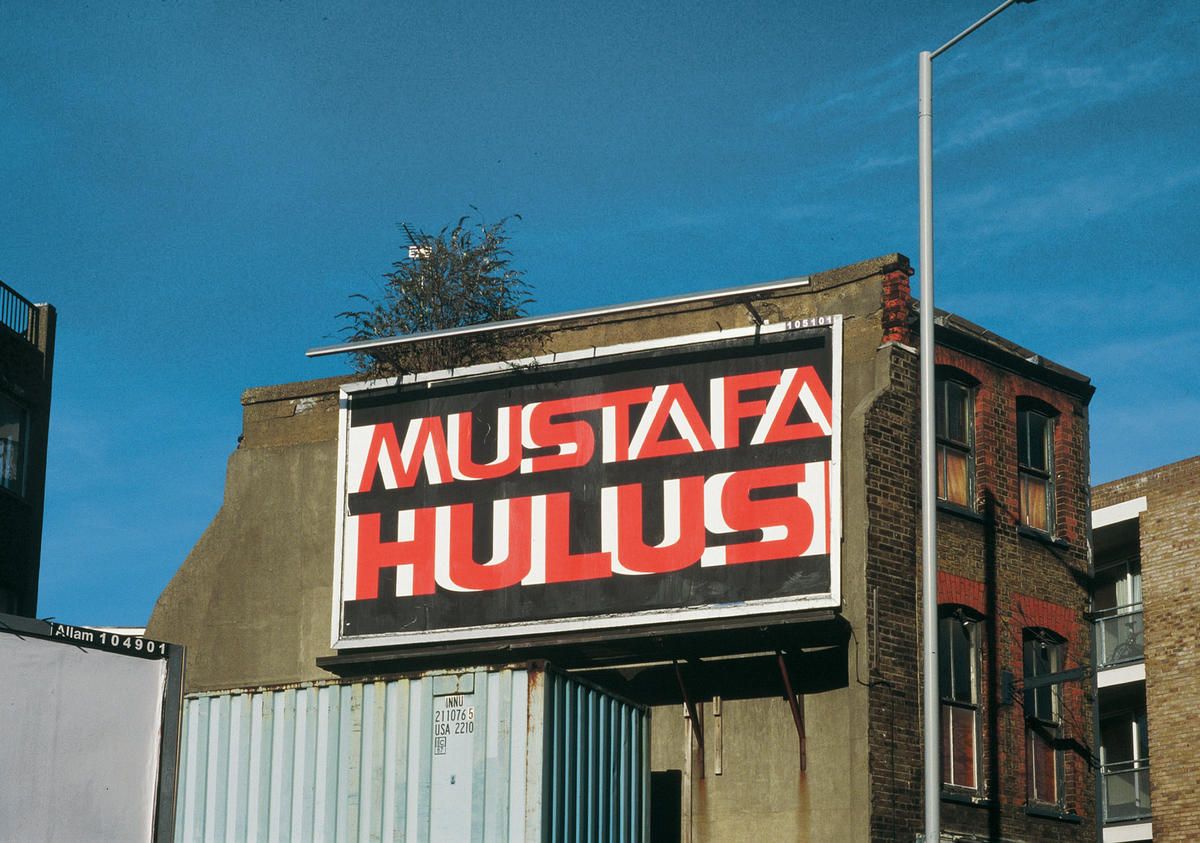
Hulusi worked in (what he terms) “billboard real estate” — buying and selling billboard advertising spaces — after graduating from Goldsmiths in 1995, only resuming his art practice after starting his MA at the Royal College of Art in 2000. He speaks about how advertisers set out to change the way people think about products with palpable admiration, and he mimics their strategies fluently in his own work. However, his goals aren’t always clear, a position that Hulusi would insist is actually intentional: in an ongoing street poster project begun in 2004, he covered the Hackney area of London with billboards bearing his name. The simple block lettering of the design is extremely catchy, and Hulusi’s trained eye for location ensures that the ads look fantastic against gray, sexy Hackney, while his vaguely Middle Eastern name imparts the necessary gravitas.
The lack of instant content in the Hackney project encourages the viewer to fill in the blanks and, according to Hulusi’s press material, “imagine an idealized product.” Hulusi shares a critical engagement with advertising with several artists, including Angus Fairhurst and Shirana Shahbazi. What unites their practices, which seem quite different, is that they don’t use pre-existing images as their source material but instead create their own. Hulusi makes politically charged imagery from his pictures of his niece’s hand; Shahbazi sends her photographs to be writ large on gallery walls by a sign painter; and Fairhurst, whose earlier work consisted of removing the imagery and text from advertisements before installing the resulting collages in lightboxes or straight onto the wall, has recently done away with advertising copy altogether in favor of fabricating his own ads for the lightboxes. This common strategy — if it can even be given such a coherent label — marks a possible step away from appropriation art toward a new critique of spectacle culture that doesn’t depend on abstracting images from their meaning but rather invests them with new meaning.
But to draw more than a tentative comparison might be pushing it: Hulusi himself doesn’t see his work as in dialogue with that of any of his contemporaries. He is, however, deeply involved in the art world in other ways, acting almost as a one-man art impresario: he has curated a number of shows in the UK over the past few years, notable for their inclusion of a vast range of younger artists, at the Royal Academy and the Northern Gallery for Contemporary Art, among other venues. He also works occasionally as an art advisor, and is on the acquisitions committee for the Arts Council England.
Hulusi has come a long way from his excruciating The Mustafa Hulusi Performance (2000), documented in a series of framed photographs with text, in which he went on holiday to Casablanca and slept with eleven prostitutes on eleven consecutive nights. (Hulusi paid each prostitute forty dollars for the night, “a fortnight’s wage for the average factory worker,” which, by insinuating that Hulusi was thereby sparing the prostitute two weeks’ worth of labor, served only to compromise the situation further.) Some ideas are best left in the pub, as Jorg Immendorf showed us in style. Refining his focus from Third World countries in general to Cyprus in particular has tightened Hulusi’s practice. However, he still seems to be casting around dilettanteishly for the right approach, working through art and theory trends in the meantime.
But perhaps art’s interest lies partially in its potential for failure. ‘The End of the West’ was up at the same time as Richard Prince’s exhibition of new personal check/joke paintings and sculptures at Sadie Coles HQ. In terms of technique, bright spark Hulusi could learn a few lessons still from the grandmaster of appropriation, who fuses craft with blinding critique into gorgeous objects that often function independently of their critical message.
Mustafa Hulusi, 48 Sheet billboards, 2005, in-situ intervention, c-prints, 7 x 5 in.
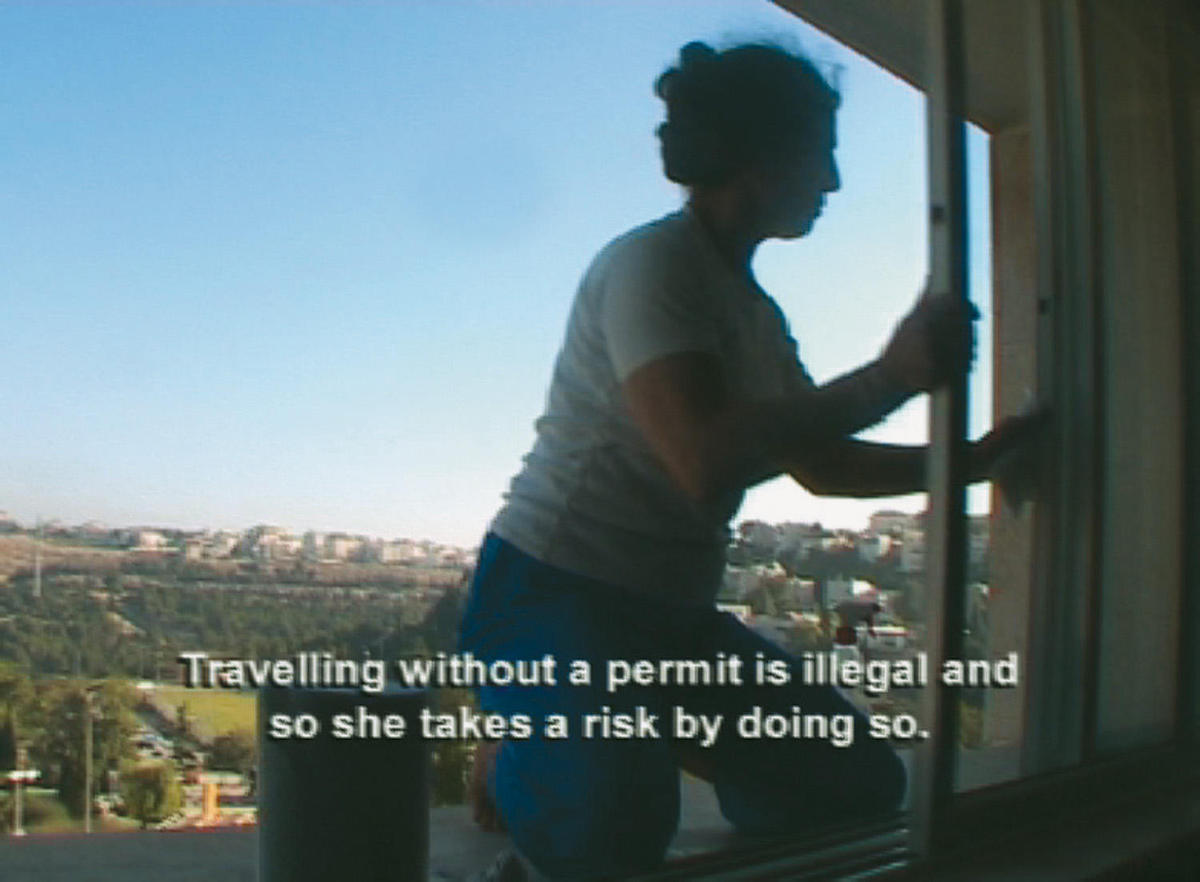
Oreet Ashery, Travel Diary, 2005-, video, courtesy of the artist
“If the reality of time spent among — not with — the Palestinians resided anywhere, it would survive between all the words that claim account of it,” wrote Jean Genet in Prisoner of Love (1986), his fiercely brilliant struggle to describe the Palestinian situation in prose form. Oreet Ashery, an Israeli artist who moved to England in the 1980s, ends the video that documents her own journey to Palestine with some of the writer’s finely wrought words. Her account was clearly influenced by Genet’s battle with how to narrate such a politically sensitive and subjective experience.
In the spring of 2005 Ashery posted a notice on the Art School Palestine website in hope of contacting a Palestinian artist. Eventually, she met Sameh Abboushi, an architect living in Ramallah. As a result of Israeli military presence there (namely tanks blocking the entrance to his office), Abboushi had to close down his practice and became an artist. They established a firm email friendship, and Ashery’s necessary journey, funded by Arts Council England, enabled her to travel to Ramallah a few days after the withdrawal from Gaza to meet Abboushi.1 The two are filmed as they walk through the city, buy some grapes and return to Abboushi’s house, where Ashery interviews him and his wife. The eighteen-minute video also includes a tour of Jerusalem with Ashery’s father and a trip to Pkiain, in northern Israel. Ashery plans to develop the short into an hour-long film that delves deeper into her journey.
This was Ashery’s first trip to Palestine and her first back to Israel in many years. The video opens with a striking shot of the Palestinian maid illegally employed by her parents, perched on a ledge and washing the windows of their Jerusalem apartment. The narration, all in subtitles, explains that the maid is unable to obtain a travel permit. With this opening scene, Ashery acknowledges her own implication in this horrifically absurd apartheid; later she notes that, as an Israeli citizen, she can only enter Ramallah illegally. When she does so, she is genuinely astonished by the Wall, the checkpoints, and what she calls the “half-baked” state of Ramallah. From Ashery’s reaction it is clear that this is a personal account, and indeed the emphasis of the Necessary Journeys project is on individual experience. She accepted their open-ended invitation to dwell on personal history, but uses her individual version of events to initiate a broader, more nuanced project.
Ashery said the hardest part was deciding what to leave out, and she is a generous interlocutor. Abboushi and his wife offer a sharp analysis of the current situation, and they call the lack of opportunities that causes Palestinian youth to leave the territories “an indirect form of deportation.” Still, the video ends on a hopeful note, conveying optimism about the possibility of Palestinian/Israeli coexistence. And Ashery’s journey has indeed borne fruit: it enabled her to meet not only Abboushi but also Reem Fadda, a Palestinian curator and director of the Ramallah-based Palestinian Association for Contemporary Art (PACA). Her Travel Diary was screened there this spring, and she will curate a film program with Fadda in June for London’s Performing Rights festival.
1 Necessary journeys, an initiative of the Arts Council England, takes its cue from the Black World initiative, exploring the ways in which art connects with film and the moving image.
“Christianity is the chief purveyor of tourism, and one travels only to visit churches” writes Roland Barthes in Mythologies (1957), mocking the narrow-mindedness of the French tourist who sees only the achievements of his own Catholic Church everywhere he goes. Yet if we trace the tourist’s genealogical tree back far enough, we do indeed find the pilgrim. Though few would associate this asceticism with a Club Med holiday, it is in these sacred journeys, old as human culture, that we find anything approaching the scale of contemporary mass tourism. For centuries, some of the greatest regular assemblies of human beings have been those of pilgrims — for Holy Week in Rome, Passover in Jerusalem, Dhu al-Hijjah in Mecca or the Kumbha Mela in Allahabad.
Could there be something of the sacred left in the tourist’s experience today? As well as the similarities in scale, modern-day mass tourism maintains some of the metaphysical connotations of the pilgrimage. After all one does not actually purchase anything physical when planning a trip, rather its a means by which we can acquire experiences. Thus the sheer intangibility of the modern-day holiday (and one should not forget the religious provenance of this word) hearkens back to its spiritual predecessor. Similarly while a secular world may allow tourists to create their own holy places, sanctified by natural beauty, good weather or physical challenges, the idea that one returns from sacred journeys with a changed perspective is still implicitly the case. Tourists, like pilgrims, seek recreation in the fullest sense of the word.
It may seem absurd to view a sightseeing tour of Versailles or the Pyramids as a kind of pilgrim’s progress toward spiritual fulfillment-or it may seem entirely appropriate. For one thing, the pilgrim of yore had more in common with the present-day tourist than many suspect. One of the first books printed in English, Informacion for Pylgrymes unto the Holy Londe (1498) is a sort of primitive Rough Guide, advising pilgrims on how to negotiate with ships’ captains, obtain the best berth once aboard and find the strongest horses upon arrival. What’s more, many of the vices that today’s tourists are accused of in Ibiza or Las Vegas were also leveled against pilgrims. The sixteenth century Dutch theologian, Erasmus, condemned pilgrimages as little more than excuses for dissipation, accusing pilgrims of merely seeking adventure and a chance to boast of their exploits upon return.
More importantly, the pilgrim and the tourist are linked by the inevitable gap between the physical site they visit and the experience they seek. For both, exultation is transient and subject to skepticism. The Hiroshima Peace Memorial Park in Japan marks the spot where the first atom bomb fell on August 6, 1945. In its midst stands the Genbaku Dome, a tangled mass of concrete and steel that was the only structure to remain standing in the area after the devastation. Each year, this ruin draws thousands of international visitors to stand in silence before it. According to UNESCO, which has labeled it a World Heritage Site, it “acts a stark and powerful symbol of the most destructive force ever created by humankind.” It is one of the most visited tourist sites in Japan. It is also a fake.
When weathering threatened to destroy its already fragile facade, the Genbaku Dome was carefully reconstructed so that it would forever appear as it did immediately after the atomic bomb was dropped. Those who go to pay their respects are paying their respects to a facsimile. Does this matter? The mere fact of the reconstruction need not invalidate the doubtless deep and genuine feelings of thousands of tourists. When a human becomes a tourist, a substantial and almost mystical transformation is undergone. A union with place occurs that surpasses its inherent qualities.
Existing between states of transcendence and self-consciousness, it is little wonder, when the contemporary artist sees the contemporary tourist as something of a kindred soul, for the tourist these days, whether in museums or out of them, is forever communing with representations. Perhaps nowhere has this relationship been better explored than in Francesco Bonami’s ‘Universal Experience: Art, Life, and the Tourist’s Eye’ exhibition, a suitably movable feast, first seen at Chicago’s Museum of Contemporary Art in 2005 before traveling to the United Kingdom and Italy. Here the very essence of modern tourism was laid bare by the coolest of observers.
The dislocated angst of the modern tourist, comparable in many ways to the self-flagellating conscience of the religious fanatic, was most terrifyingly evinced in Martin Parr’s day-glo snapshots of British holidaymakers in The Last Resort (1983-86). Here the dismal reality behind the promise of the travel brochure is revealed: refuse fills the water, sand has been replaced with concrete, and the faces of the tourists show the intense ennui of those in the Inferno, damned through their own volition.
Meanwhile Andy Warhol’s film Empire (1964), an eight-hour endurance piece of the Empire State Building, shows how the tourist site itself can be dulled and blunted by the imprint of our communion with it. So successfully has the building’s image been incorporated into the global imagination that it is hard to grant it any specific attribute. As Barthes wrote of the Eiffel Tower, “its simple primary, shape confers upon it the vocation of an infinite cipher.” The Empire State Building becomes a void not through the lack of signs attached to it, but because of the very multiplicity of symbols that it holds.
Similarly desolate, yet with hints of transcendence, was Jeff Carter’s sculpture Great Circle (Mecca) (2002), which consists of an illuminated arrow pointing toward Mecca. With its bright neon aluminum shell and Plexiglas cover, the arrow doesn’t look too dissimilar from a sign in a cinema or airport, and this similarity contrasts with the intensely personal spiritual journey to which it refers. Pointing the way toward the distant sacred, the arrow invites viewers to experience Mecca there in the gallery. At the same time, of course, it illustrates the dichotomy between the holy pilgrimage and the modern tourist, between the search for historical authenticity and the fundamental modernity of the world we inhabit.
Perhaps most intriguing of all was Dennis O'Rourke’s Cannibal Tours (1988), a film of European and American tourists traveling through Papua New Guinea in search of the world’s last cannibal tribe. We see the tourists posing with the indigenous people, and haggling with them over “traditional” artworks. Yet these artworks have been produced by the locals specifically for tourist consumption. The tourists realize this yet play along with the game. They are complicit in the essential fakery of the situation, just as the locals are. Who are the tourists? Who are the cannibals? Who is consuming who?
It should come as little surprise that the very word “tourist” derives from the Latin “tornus,” which in turn came from the Greek word for a tool describing a circle. For as tourists it seems we are constantly running in a circular quest, chasing after authentic dreams or genuine fakes. At the end of O'Rourke’s film the tourists paint their faces in the manner of their “savage” hosts, and sail away from the island aboard a yacht, dancing to the incongruous sounds of Mozart. As they drift away they seem to transcend time, revealing an enigmatic link between person and place that goes beyond comprehension. It seems to answer the question “why do we travel?” with another question: “why do we live?”
Egypt’s arts and arts education system is in crisis. The divides between students, their teachers and the various activities of the professional art world seem deeper than ever. Students rarely attend arts events or engage with the professional artworld, teachers deplore the quality of their students and for a nation of over 77 million people, there are very few practicing artists. From the outside, the situation appears opaque and bleak. A view from inside reveals a slightly more nuanced system as well as a perspective on certain cracks and interstices that may offer some promise for change. The following notes on the state of contemporary arts education in Egypt are drawn from a conversation with Cairo-based arts educator and artist Shady El Noshokaty.
A brief history of the systematization of arts education in Egypt would begin before the Nasserist revolution and trace the subsequent evolution of a wide-reaching and exclusively state-run system. The College of Fine Arts was originally established for expatriates in the first decade of the twentieth century; the Applied Arts College was developed in the 1930s to train creative professionals outside of the fine arts such as graphic designers and architects; the Faculty of Arts Education, founded in the early 1950s, began with a yearlong degree program for students from the other two arts colleges. All three institutions, located in Cairo and operating under the umbrella of Helwan University in Cairo, currently hold a central position in the country’s advanced arts studies system. In addition, Alexandria University opened an arts faculty in the 1960s and the universities of Minya and Luxor launched their own programs in the 1980s. The American University in Cairo offers one of the only private fine arts programs in Egypt. Smaller arts colleges are common in midsize towns throughout the country. Most primary and secondary schools run arts programs.
An intensive exam taken during the last two years of high school determines the program and field of study for which students may qualify. The arts component of the exam allows students to choose from two tasks. The tasks usually involve painting an image in reaction to a theme, such as “the quiet serenity of the ocean,” and drawing a perspective study. The arts track is assigned to relatively noncompetitive students, although each educational institution within the arts system differs in terms of academic prerequisites. Art school graduates go on to work in a variety of fields, including graphic design, primary and secondary arts education, and skilled crafts; their education seems to provide an adequate preparation for work in local markets. Other graduates become professional artists. Yet arts institutions often fail to offer students the opportunity to develop the independent thinking, critical resources, and creative skills necessary for an artistic practice capable of engaging audiences outside of the narrow bounds of Egypt’s state-run arts system.
El Noshokaty refuses to place the blame on arts educators, who face daunting working conditions. The starting salary for an art teacher in a primary or secondary school is generally a 100 to 150 Egyptian pounds (approximately $17-26 US) per month, forcing many to take a second job just to cover basic expenses. Grade school administrators for whom arts education is a low priority are often happy to cancel art classes to allow students additional time to prepare for a math or science exam. Teachers receive very limited art materials; even when rare resources do exist such as at the university-level, students are often denied access to them. Only in the past two years have students at the Faculty of Arts Education received training in arts management, although many graduates accept management positions in small arts colleges or become arts managers in museums and government exhibition halls.
Rather, the general crisis in arts education stems from a widescale stagnation of creativity within state institutional systems and a co-option of “artistic authority” by an aging generation of arts professionals. The unwieldy size of Egypt’s civil service sector contributes to an enormous and often inefficient government bureaucracy organized to support job creation and stability rather than flexible and dynamic civil institutions. Weak and overstaffed government systems have bred widespread cronyism and the lack of a strong independent sector in the past meant that state-run arts institutions dominated the terms of artistic production and reception. Teaching positions at important arts colleges and faculties are staffed by artists whose work doesn’t offend official sensibilities and is accessible to older generations of professors. In the 1960s, the new Alexandria University absorbed a number of artist/ teachers who had traveled to the US and returned to find that their ideas, aesthetics and lack of connections barred them from joining the faculty at more well-established schools. Alexandria’s program flourished and was attended by a number of today’s strongest contemporary artists. However, in most cases, artists already outside the state system lack access to supportive institutions or networks.
Noshokaty also places no blame on the students attempting to navigate the system. Creative despondence is produced when students are faced with rigid curricula inherited from the 1950s, restricted materials and facilities, and limited creative freedom. Early on in their studies, students are assigned to a professor under whom they study for the duration of the program. Often, students are expected to emulate their professor’s artistic aesthetic and are given no exposure to a diversity of practices and traditions. These students are working as artists within a framework that champions uncritical reproduction.
Students who take their artistic ambitions seriously must go to great lengths to explore opportunities outside of school for developing skills, obtaining resources, and pursuing an independent practice. El Noshokaty recounts stories of students going to the traditional potters’ quarter of Fustat to avoid bans on student-use of kilns and teachers’ refusal to give lessons in throwing and glazing. Another story involves students organizing figure drawing sessions with models other than those provided in class, who were usually the same models their professors had drawn from in the seventies, now considerably older and sometimes covered from head to toe.
Some alternatives do exist. Noshokaty points to the private secondary schools popping up around Egypt’s urban centers; they provide an alternative to the state-run approach to arts education. These institutions follow less-centralized model than government schools and offer strong electives as part of their programs.
Noshokaty’s ongoing Experimental Workshops for Contemporary Art at the Faculty of Arts Education is an example of a forward-looking initiative launched “within” the established system. The series offers talented students support to explore their own approaches outside traditional classroom conventions, as well as access to and training in new media. The most recent workshop focused on video art. A screening of the students’ work was held at the newly established Contemporary Image Collective (CIC), an artist-run forum dedicated to images. The event was packed, and students stayed on afterward to discuss their work with established artists and one other.
The development of an arts education field committed to critical awareness and independent thought can only occur with the support of teachers, students, artists and arts managers. This, in turn, depends on promoting mutuality in place of relationships too often defined by mutual exclusivity. In the end, strengthening ties between these groups beyond the sphere of state-sponsored activity is Egypt’s hope for a truly sustainable independent arts sector.
On a wall in Damascus a bush is burning. Suleiman, in his wisdom, advises the butchering of children to solve maternal disputes, and Abraham heads off up the hill to sacrifice his only son. Moses, meanwhile, has taken his shoes off and is breaking the golden cow before floating slowly along the blessed banks.
“All the colors are original,” says Rahsh Rahsh, aka Abu Mustapha, the man who for six years has watched over one of Damascus’s best-kept cultural secrets.
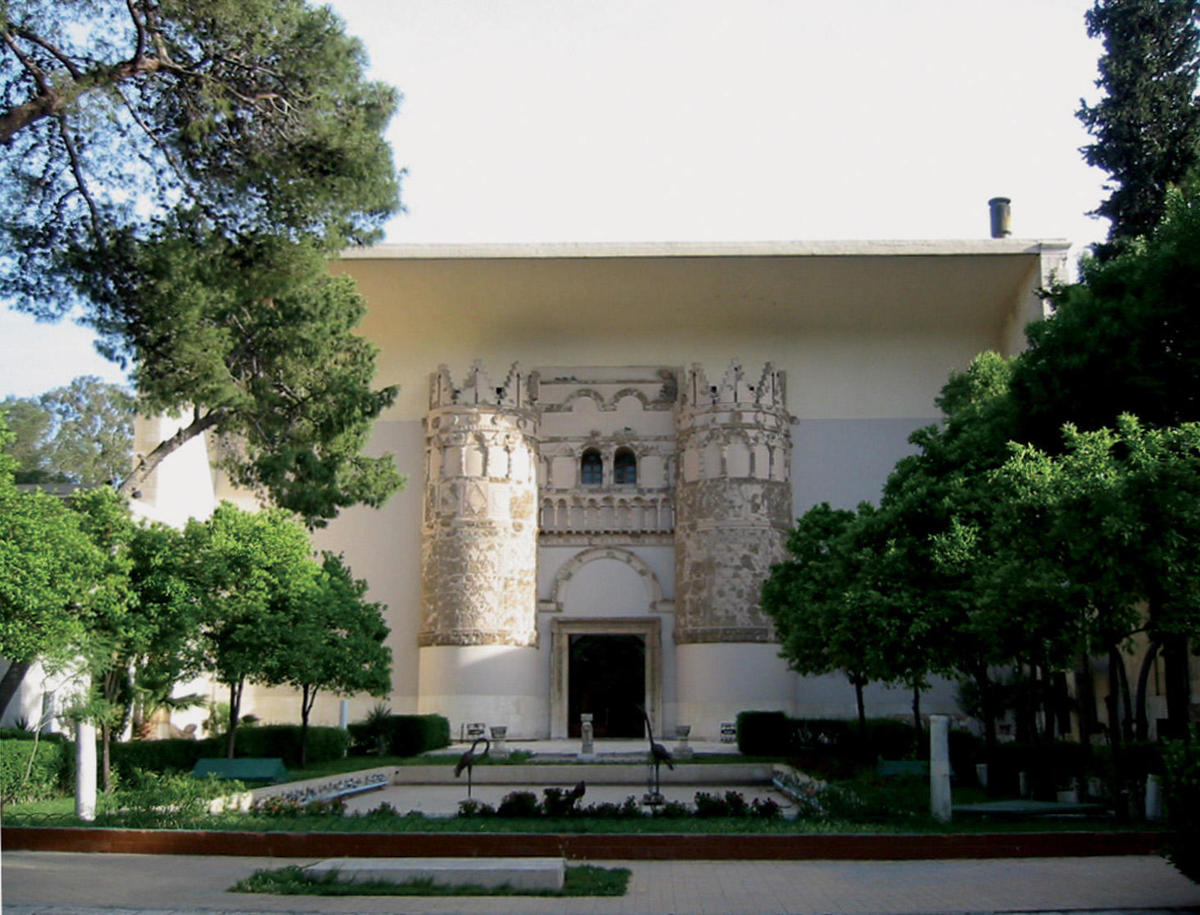
“In all the time I’ve worked here, not a single person has ever been allowed to take a photograph,” he says as we discuss the huge second century AD frieze tucked in a back room of Syria’s National Museum. The frieze was recovered from the ruins of a Jewish synagogue built at Doura Europos (now DeirEzzour), close to where the Euphrates flows into Iraq, and brought to the Syrian capital in 1935 by a team of French archaeologists.
Sensitivities aside (Syria is still technically at war with Israel), as with the majority of this maddeningly magnificent museum, the extraordinary frieze — an early example of the Christian impulse for graphic representation on Jewish religious art — remains entirely uncelebrated.
With no signs to point the way, no label on the wall, and no light to illuminate it, we had only discovered the treasure by chance.
“Do you want to see the temple?” Abu Mustapha asks as we shuffle around the classical galleries, awaiting the return of the museum’s head curator, Monam al-Moathen. I needed her guided tour, for there are virtually no labels for any of the approximately five hundred artifacts on display and no reasonable guidebook to the museum’s varied delights.
“I can explain an artifact from the Mamlouk era, but not how our museum is going to become famous in the world,” says Moathen. “The museum is not free to publicize itself. All promotion is taken care of by the General Directorate of Antiquities.”
Perhaps the Syrian state is suffering an image problem abroad because it is not making the most of what it has at home. In the case of the National Museum, the wealth is almost limitless.
The entrance itself is the gate from the south facade of Qasr al Heir al Garbi — a huge castle built during the Omayyad empire — rebuilt from thousands of tiny fragments over fourteen years.
Inside are classical mosaics: Apollo at his harp, singing the glory of the earth, and Philopolis dispensing truth. Also within are ceramics that were recovered in perfect condition from Shahba, an ancient Roman city founded by Emperor Philip the Arabian that is a half hour drive south of Damascus.
From the south are prehistoric statues, including one of Minerva, goddess of victory, carved from the famed volcanic basalt of the Huran. There is a second century marble Venus, its original gold necklace still hanging delicately from her neck, and large red ceramics from Greek potters who traded along the Syrian coastline.
Down some steps: a reconstructed underground burial chamber from the days when the warrior Queen Zenobia of Palmyra led her armies against the mighty advances of the Roman Empire.
Up the stairs and back in time two millennia, we find a skeleton from a grave in Syria’s eastern desert. Along the corridor is another hunk of basalt, actually a treaty drawn up between rival kings and carved into the stone in Aramaic, the language of Christ, which is still spoken in Maloula, a mountain village north of Damascus. There are gold, silver and copper coins from when Damascus was the capital of the Islamic Omayyad Empire, which stretched from Spain across North Africa to the western border of China.
Perhaps the highlight of the museum is a tiny clay tablet from the fourteenth century BC. Written on it are the thirty cuneiform letters of the world’s first alphabet — Ugarit. The letters run left to right, and the tablet is small, perhaps the world’s first pocket dictionary.
Moves are underway to improve the museum’s presentation and publicity strategies. Photographer Nicholas Randall has shot fifty of its finest artifacts from four eras — prehistoric, ancient, classical and Islamic — and a full-color guidebook is due out in the spring.
The museum is also teaming up with Paris’s Louvre, dispatching a French team to assist in the rejuvenation of the Oriental arts section of the museum.
This kind of barter deal, Moathen admits, is necessary — revenues generated by the museum can be used for the museum itself rather than swallowed by the state Directorate.
Despite these efforts, the journey out of the wilderness for Syria’s National Museum will require something on the scale of a Biblical sea change.
“I ask many people in responsible positions in the country whether they have been to the museum,” says Moathen. (Admission to Syria’s national treasure trove costs the equivalent of $0.30 US.) “They say, ‘Yes, I came with school one time.’”
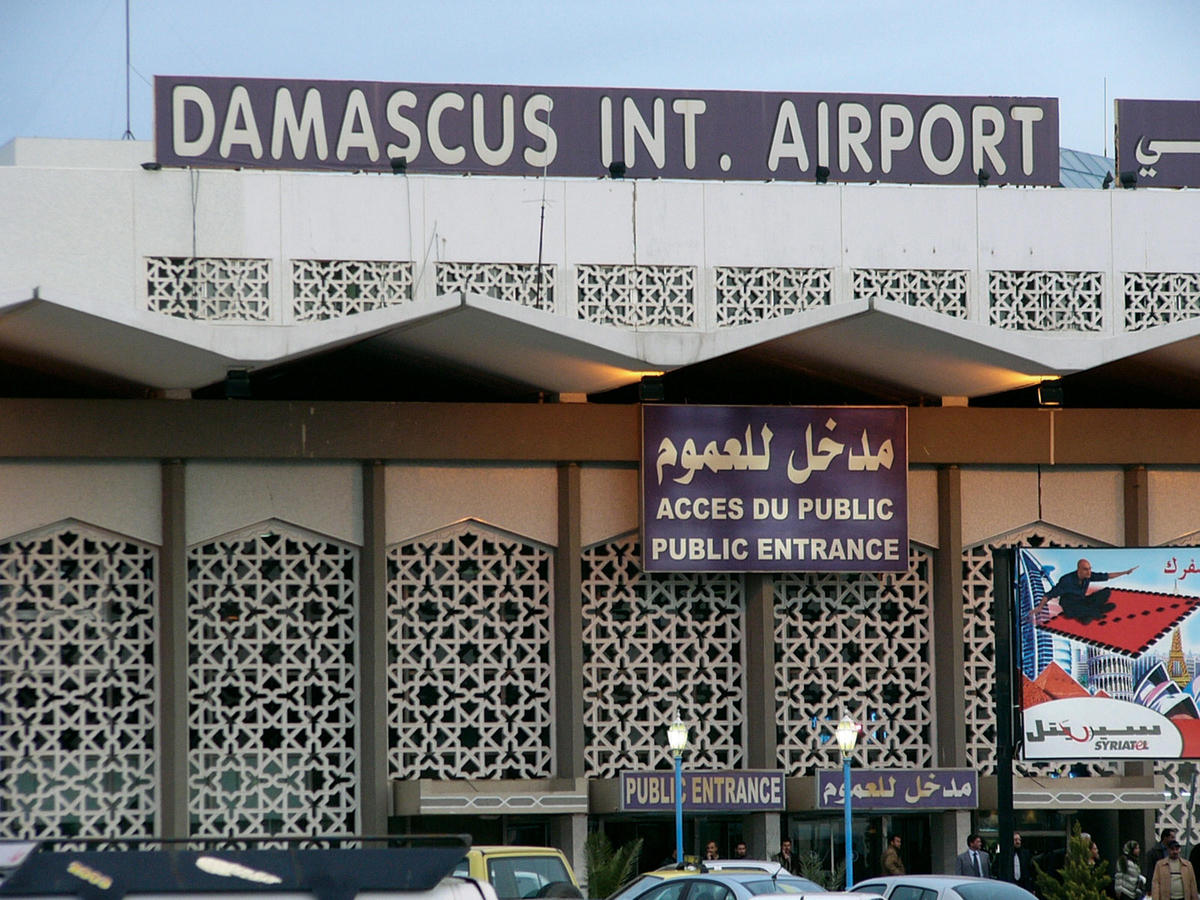
The airport experience begins on the road, a thirty minute straight burn from the city center, lights of black BMWs flashing down rickety Lada as it struggles to make it past 90. I wonder who’s jetting off where as the sleek tail lights disappear slowly. It’s the same every time: the same queue of old ladies in black cloth with massive suitcases wedging through the first passport check, hardly moving. The same metal detector that sounds the alarm every time anyone passes through.
The desk at which the departure tax is paid — a miserly 200 Syrian pounds, or four dollars for lucky foreigners, or twenty bucks for luckless domestics — is different. It has changed from time to time over the two years that I have been using the services of Damascus International Airport. Like many things in this country of constant flux, change can be rapid. The once tatty plastic counter is miraculously replaced with a shiny LCD-lit service center in the main foyer — only to be taken away within the month.
The old is coupled with the new everywhere you look. Moustachioed military men thumb each page of every passport, lift every stamp, and review every visa with quizzical frowns, while upstairs, in the bright duty-free shopping area, glamorous ladies advise on perfume, hand luggage or Sony Cybershots, collecting hard currency for the country’s leading cousin.
“Just a perfect day” says the sign in the coffee shop: a new coffee stop, “In House,” a hint of Statue of Liberty in the backing poster. It hangs in the large, Formica-shod restaurant, cobbled together sometime in the late 1970s, where a bottle of still Boukein will cost you more than a main mezze in one of the courtyard restaurants of the Old City.
Arrival is always more tense. The first time, they say, is never the best: British Airways baggage mishandling, forms to fill out, military to advise; total despair. Since then, the line of immigration officials has seemed less a hurdle. My last time through, I achieved what I thought impossible for a journalist entering Syria on a press visa: diplomatic immunity — or at least no queue of old ladies. And the only thumbs visible were pointing up.
Emirates EK 977 flight from Dubai lands on time at 8:35 pm. Immigration is swift and rather uneventful. The building basically looks like every slightly overcrowded airport in the world, although the signs are in Farsi adds a little adventourism for those like me who are completely ignorant of the language. “Of course there is no blood fountain.” I am a little disappointed. I’d expected more history. Predominant color: chocolate.
Standing at the baggage claim, there is only one piece of luggage on the whole carousel at a time. I feel like I am trapped in a performance by Santiago Sierra. Nobody else seems to notice.
Fortunately, many women in Iran smoke. Stepping out of Mehrabad, I bum a cigarette. Immediately a number of husky-voiced women organize a prepaid taxi ride for me to the overrated Esteghlal Hotel in the swanky northern part of Tehran.
Next morning, I wisely downgrade myself several stars to the “legendary” (as Lonely Planet calls it) Hotel Naderi (see page 96) in southern Tehran for the remainder of my stay.
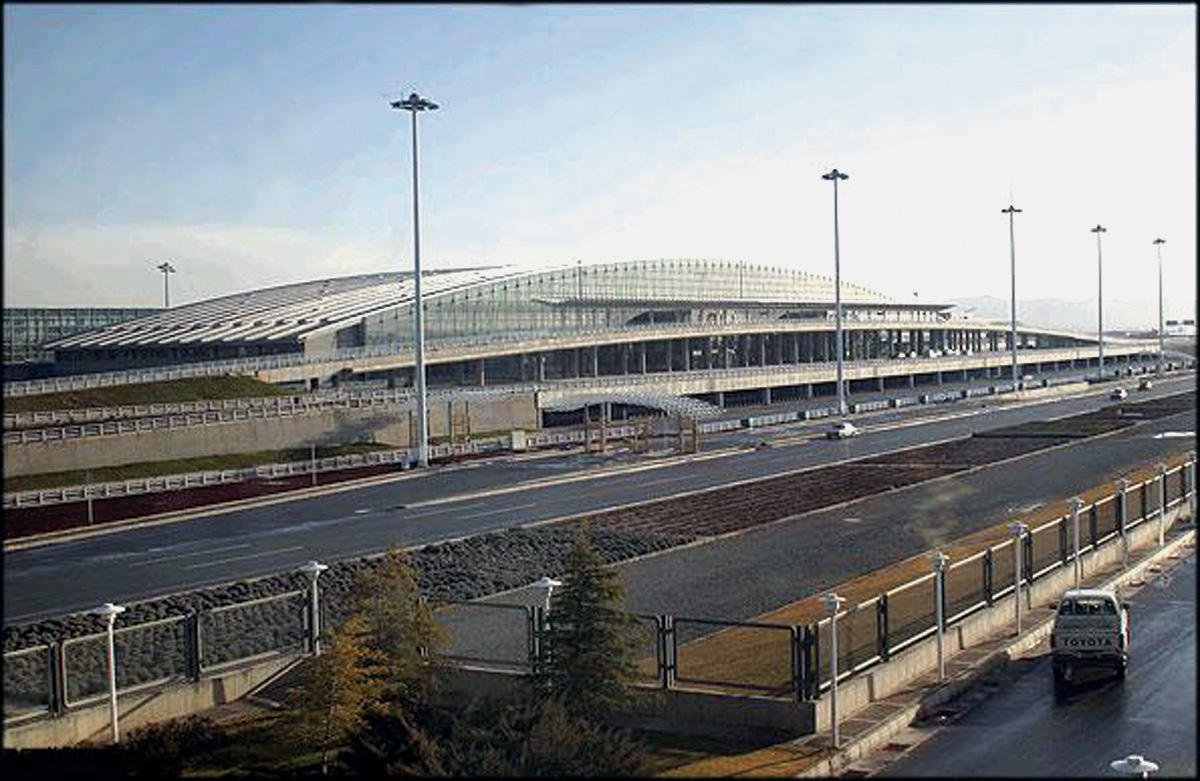
When I leave Tehran in early May, my Iran Air flight IR 655 departs from the newly opened Imam Khomeini International Airport. Construction of the airport started before the revolution. IKIA was supposed to open on February 1, 2004, marking the twenty-fifth anniversary of the return of Imam Khomeini from his exile in Paris.
He arrived at Mehrabad in a chartered Air France plane. In my memory of that 1979 event, a bearded man in an oversized coat walked down the stairs of some plane and greeted people in a Pope-like manner. He reminded me of Santa Claus. I was told that he tortured people who drank Coca Cola. (I was also told that if you put meat into Coca-Cola for a day, it would disintegrate. I became a vegetarian.)
Anyway: The opening of Imam Khomeini International is postponed to May 8, 2004. Then the Turkish-Austrian construction company TAV is asked to withdraw all staff and equipment from the airport. The government will not allow foreigners to run it. There are allegations that TAV has links to Israel. Rumors, misplaced economic protectionism and national pride boil into a sticky gunk of cause and effect. TAV clears the airport, but the Iranian Armed Forces seize the airport on May 8 anyway. By then TAV has invested over $14 million in the project. Foreign investors agree that Iran is an unreliable business partner.
After a number of rescheduled openings, the “soft” opening in May 2005 goes widely unnoticed. My flight is one of the first ever to leave. Nobody in Tehran can tell me where the airport is located or how long it takes to get there. Iranians have buried the Imam Khomeini Airport far south in the depths of their subconscious.
When I ask the receptionist at Hotel Naderi, David, where the new airport is, he offers me a piece of baguette with his mother’s apricot jam. “It is better.” He then calls a cab. It is now four hours before my departure. The cab driver strides into the lobby. David translates. “He doesn’t know where the airport is.” Let’s look at a map. “He doesn’t have one.” Extended gestures, unhappy faces. “If the traffic is bad, it will take three hours.” I do not want to miss my plane. “Don’t worry, he’s a good driver,” I am assured.
There are no traffic jams, and the driver knows very well where he is going. I hope it is Imam Khomeini Airport. The Peykan taxi speeds down the Southern Qom Highway, out of the city and toward a barren landscape. My fingers are sticky with apricot jam.
Twenty minutes later, we arrive. There is no one around except for a couple of bored military people. My driver plunks my suitcase down, and off he goes. I am the only passenger in this vast aerodrome. First impression: 80 percent Kuala Lumpur Airport, 10 percent TESCO supermarket Bangkok, 5 percent computer simulation of IKIA, 4 percent former Munich Airport Riem and 1 percent Dubai Airport. Predominant color: lettuce. Again, everything feels like a set. Contrary to the organic realism of Mehrabad Airport, I feel like I’m trapped in a huge Andreas Gursky photograph.
An hour later, the only check-in counter opens for Iran Air flight IR 655. As I pass through immigration, the security personnel proudly work the brand new X-ray machines. I am thirsty. The cafes will open “soon,” the staff reassures me, possibly even this year. Now, the soda pumps are disconnected, wires hang from the ceiling, and the empty shelves of the vast duty-free megastore are gaping, waiting to be filled with Toblerones and Ray Bans. Huge blank billboards force you to come up with your own slogan. Smiling, I close my eyes and try to think of one.
ByAir, Biennial Airways, is the world’s first official airline of the rapidly growing biennial industries. Whether you’re an art tourist, a collector or a pro, ByAir brings the artworld to you, wherever you are. We go the extra mile, offering you promotions and art counseling tailored to your location, your aspirations, your living room furniture—in short, to you. We are dedicated to making every flight you take with us something special. Your safety, comfort and aesthetic convenience are our most important concerns.
We love art and it shows
ByAir is committed to flying at least once a week to worldwide biennials, triennials and quadriennials. So join us. Relax and peruse our numerous site-specific, work-in-progress, open-ended, self-reflexive, anti-imperialist collaborations with contemporary artists. All of our pillows and refreshment towels are embroidered with clever capitalist critique by Jenny Holzer; post-Marxist pens and pencils are by Carey Young. Our in-flight musical entertainment is curated by Phil Collins, and the cabin crew is paid one symbolic Euro below minimum wage, courtesy of Santiago Sierra. Every aircraft is named after an artworld pioneer, and our cabin crew uniforms are designed and tailored by Momo, a metrosexual Iraqi who lives with his single mother in a small and completely dangerous suburb of Fallujah (go Momo!). By the way, if you open a ByAir vomit bag, you might just find a tiny sculptural surprise by our friend Paul McCarthy. Collect all matching pieces of plastic vomit debris and win a trip to visit Momo and his mother with Paul Chan next Christmas!
Artists need travel, travel needs art
In June, ByAir and several other important artworld institutions are holding an international seminar. On a transcontinental flight aboard the Okwui Enwezor Boeing 777, speakers Sally Struthers and Bob Geldof will help heighten public awareness about contemporary art, unearthing its deep historical roots in tourism, adventure and exploration. Those artists who continually discover more places to go and things to do on this rapidly shrinking planet of ours will be appropriately acknowledged.
Be creative? Be critical!
Despite our growing success, we haven’t forgotten that critical feedback is not only welcome but necessary. On all ByAir flights, please make a point of filling out the multiple choice questionnaire in our Radical Critique Pamphlet (printed on recycled paper). And don’t forget: our spring/summer bonus miles program allows you to acquire a Hans Haacke work at half price. Please contact ground staff for details.
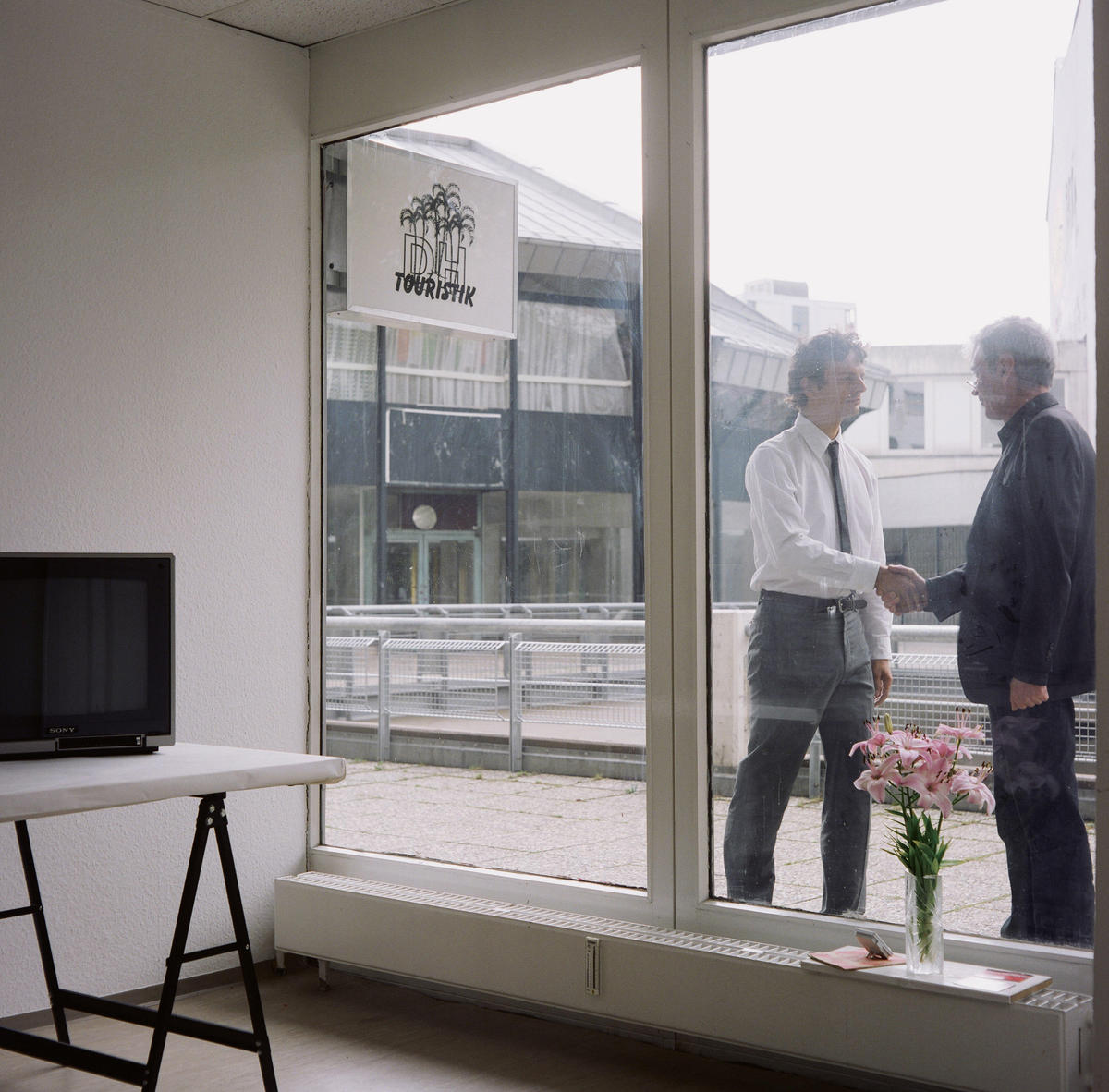
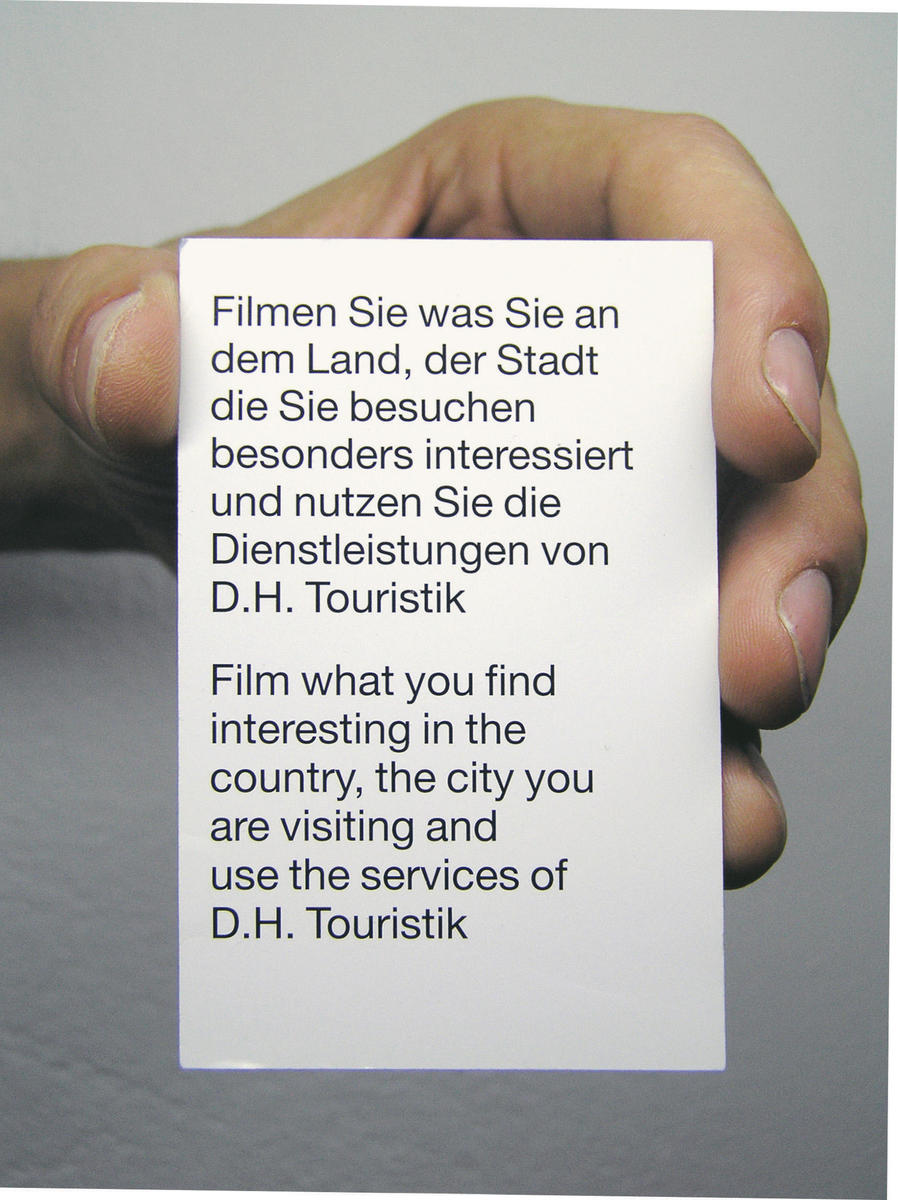
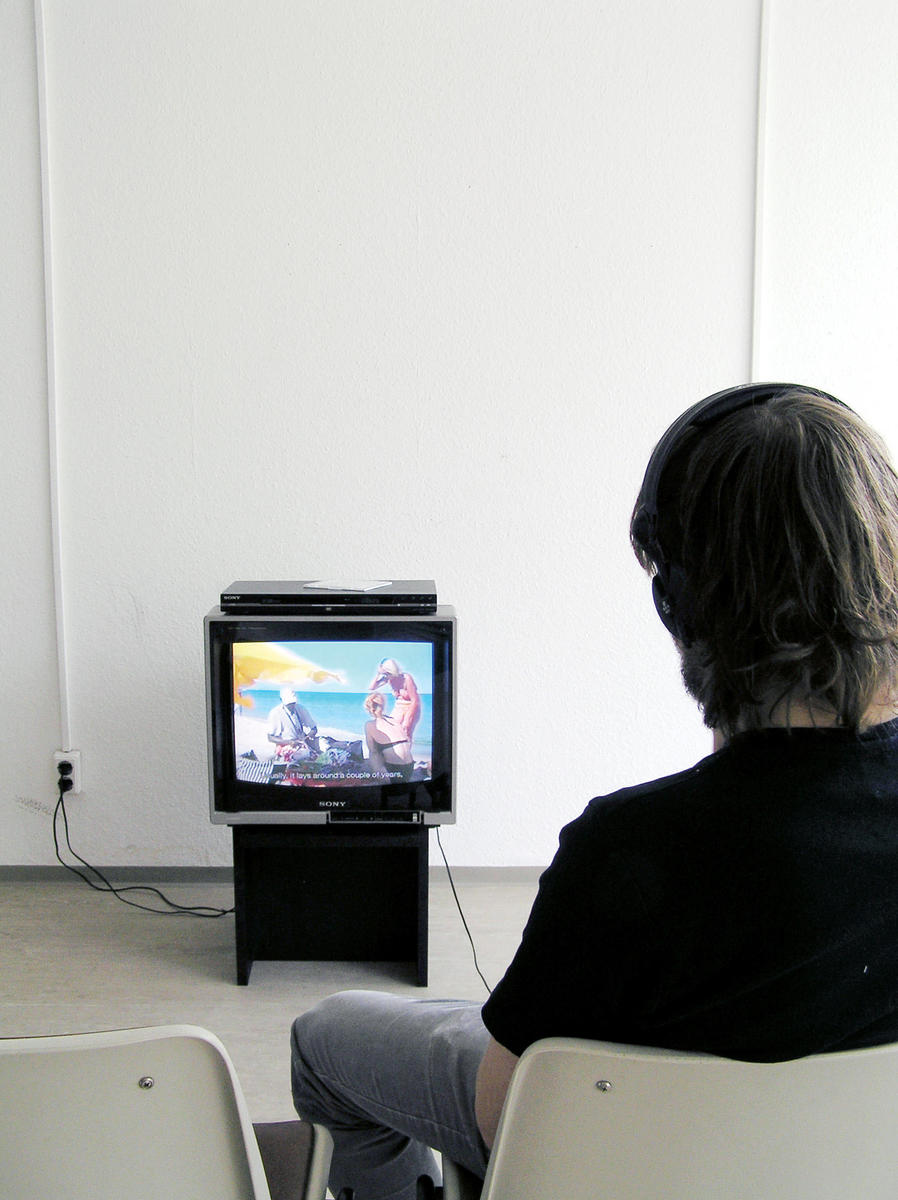
Dirk Herzog, That’s exactly as I imagined it, 2004, travel agency, courtesy of the artist
In the summer of 2004, the artist Dirk Herzog installed a makeshift travel agency in Berlin’s Kreuzberg neighborhood. In the project, titled That’s exactly as I imagined it, Herzog offered to edit his customers’ holiday footage for them. Get a trained professional to rework your digicam material, and the amateur tapes become cutting-edge art cinema you can flaunt to friends and family. So the tourist guidance here doesn’t come before or during the trip, but afterwards. The expert fine-tunes your pleasures of retrospection rather than the practicalities of your voyage. And as your trusty mnemonic sherpa, the artist-as-service-worker will not test or challenge you by opening dizzying gateways to intercultural communication; he knows that when people travel, the last thing they want is to see something new. Experiments in novelty aside, Herzog’s project has the merit of showing both what the tourists saw and what the artist thinks they’d like to remember having seen. It documents the tensions between mainstream consumer expectations, highbrow values and cultural management aspirations–tensions that are hard to trace in actual tourist guidebooks.
Tourism is still an overwhelmingly First World to First World affair, with faraway beaches and jungle treks second in popularity to the Louvre and the Empire State Building. But even when it is indeed a case of traveling to places where you’d expect your waiter to wear bangles and flip flops, the genuinely outlandish is not necessarily being sought. Dirk Herzog aside, travelographers from the precautious John Urry (The Tourist Gaze) to the outraged Dean Maccannell (Empty Meeting Grounds: The Tourist Papers) to the apologetic Jim Butcher (The Moralization of Tourism) seem to agree on the recent rise of something akin to “post-tourists”: tourists with a healthy sense of self-irony. Such tourists know very well that, at the end of the day, they’re spending hard-earned money on little more than waddling for hours through airport security, listening to museum guides peddling nationalistic half-truths in silly accents, getting into the same old arguments with their partners — arguments made more scathing by sunburn and indigestion — and watching half-naked bongo players who spend their time off listening to Sean Paul. The post-tourist guidebook has changed accordingly.
In an “exactly how I imagined it and that’s fine with me” market, a guidebook becomes a means of damage control, minimizing the harm to your stomach, your wallet and your self-respect. Far from a pocket-sized portal to an unknown civilization, it is, on the contrary, a yardstick of common knowledge. It will tell you what you’re expected to know. And it will help you play Indiana Jones, going that extra mile, hiking that extra trail, tasting that extra delicacy, and bargaining for that extra dollar–and then correcting your guidebook from the comfort of your laptop. (Dear feedback @letsgoindia.com: contrary to what you claim, the Calcutta bus terminal does NOT have a 24-hour drug store — it’s closed from 4 to 6 am.) Or you can suavely mock the mistakes in the phrasebook section. (See: the inference in Lonely Planet Iran that, in Farsi, “I’m a vegetarian” is “man sabzi kharam,” which is better translated as “I am herb donkey.”) As Lonely Planet founder Tony Wheeler himself has pointed out, many readers go a step further, using his books as guidelines on places to avoid. Rarely has distinction come so easily.
Early travel guides also sought to engineer the travel experience: John Murray’s 1854 Handbook for Travelers in Greece points out the best ways to resuscitate that Homerian je ne sais quoi in every nook and cranny of the country. “In the language and manners of every Greek sailor and peasant,” says the preface, “the classical scholar will constantly recognize phrases and customs familiar to him in the literature of Ancient Hellas.” From the sunlight to the swineherds, by way of Murray’s handbook, everything Greek is rendered a potential prop in the High Literary Time Travel Experience.1 Latter-day guides have not changed much with regard to these preemptive poetics, and the lifestyles to which they cater are perhaps similarly quixotic. Yet contemporary demands are also more disjunctive and specialized, or, to use the buzzword, postfordist in character. No longer can a single guidebook claim to cover an entire segment of the population. Today, the Hilton Hippie taking the weekend off might use a specialized reference for his macrobiotic eateries, another for his Frida Kahlo, a Rough Guide for cheap windsurfing lessons, and a Gay & Lesbian website or Time Out for clubbing and mojitos.
Dirk Herzog, That’s exactly as I imagined it, 2004-, card, 3 x 2 in., courtesy of the artist
A rather different example is Ferien für immer (Holidays for Good), by Christian Kracht and Eckhart Nickel, an inventory of sights and venues discussed with literary wit, Frequent Diner proficiency, contagious enthusiasm and pots of self-irony. It obscures the boundaries between travel literature and the handbook. Other specialists are aiming for the moral high ground of ecotourism, which is growing at five times the standard rate in the travel industry, spawning publications such as The Good Tourist, The Green Travel Guide (sponsored by British Airways), The Community Tourism Guide and responsibletourism.org. The latter reminds you to ask for permission before taking a picture, to support the local economy, to avoid buying seashells (“they destroy the coral reef”) and to learn about the local culture before going there. “Travel like Ghandi, with simple clothes, open eyes and an uncluttered mind.” Some ecoguides conclude you’d best stay home in the first place. As Jim Butcher eloquently points out, while the ecoguides themselves are hard to argue with, they’re unfortunately based on partial ideas of what inhabitants of a tourist destination might actually want. More often than not, locals adhere to a more industrialized lifestyle than what your average dreadlock warrior might recommend, and, all too often, the didactic spirit of preservation rests upon fashionable notions of fragility — ecological and cultural — rather than on scientific data or verified native desires. The ideal ecoguide, I think, would walk you through a region pretty much like museum headphones, with the landscape locked into unchanging ecological perfection and tribal stasis. “From the thatched temple, you can turn left and walk 300 steps to where you will see Old Mama Joe sitting under a small palm tree, where she’s been selling free-range flamingo feathers for twenty-two years straight, sporting the same wooly hat that was a gift from a Greenpeace intern named Jérôme.”
Top-Down tourist didacticism has old roots, reaching back to Thomas Cook himself, inventor of mass tourism as we know it. In the 1860s, Cook tried to educate The Great Unwashed with “temperance trips” to Leicester and beyond, exemplifying godliness and abstinence and braving the near-hysterical accusations of aristocratic elites that he was sullying sites of cultural heritage with his noisy multitudes.
On a more personal note, anyone who has been a guide, even for an afternoon, knows how tempting it is to abuse educative powers. When living in Tehran, guests I picked up from Mehrabad Airport would invariably inquire about the calligraphic mosaics in the highway tunnel off Azadi Boulevard, tiles announcing “God is Great,” which I’d translate as “Have a nice flight” or “Smile, you’re in Tehran.” On one occasion, when traveling with artist Rachid Izdaman to Zahedan, where kidnapping rates are notoriously high, I claimed that local police recommended that foreigners carry a fresh towel and a thick novel with them at all times, in the event they were abducted. Visibly taken aback, Izdaman enquired whether his copy of Gabriel García Márquez’ One Hundred Years of Solitude was thick enough in my opinion. I assured him that it was.
To return to serious tourist guides, the two great milestones in the history of handbooks are undoubtedly the Baedeker and the Lonely Planet. Karl Baedeker started his business in the 1820s and enjoys the status of a founding father. Over the first 120 years of its existence, the firm published almost 1100 editions on over forty countries, in three languages, addressing everything from social history to urbanism to the arts to archaeology to entertainment and tourist development itself. The political legends surrounding Baedeker books are beyond compare. The Third Reich’s General Nikolaus von Falkenhorst is said to have invaded Norway using Baedeker maps, and the Führer himself reportedly ordered Blitzkrieg pilots to bomb anything awarded “two Baedeker stars or more.” On a less atrocious note, in the 1880s, Kaiser Wilhelm would interrupt meetings at his residence to watch the changing of the guards from his window. Returning to his meeting, he would excuse the interruption by saying, “A terrible bore, but Baedeker is on record as saying that I do this every day, and I mustn’t disappoint his readers.”
Interestingly, like Baedeker itself, the Lonely Planet was originally conceived as an exclusive, almost elitist phenomenon, offering a distinguished alternative to mass package tourism. Lonely Planet was meant to be the best of both worlds: educated but cheap, democratic but different. It all began in the early 1970s, when founders Tony and Maureen Wheeler took a gap year before settling into real jobs, journeying from London to Australia and taking notes on Afghani and Kashmiri hashish along the way — notes they duly published in their first edition. The very title of the guidebook betrays its ditzy, hippie spirit: the Wheelers thought they were quoting Joe Cocker’s Space Captain, which actually tells of a “lovely planet” (through a haze of Afghani, it was ostensibly misheard).
Dirk Herzog, That’s exactly as I imagined it, 2004, travel agency, courtesy of the artist
Needless to say, Lonely Planet now marks the way of the Golden Hordes, the post-tourist mainstream par excellence, the backpacking bevies checking hotmail accounts in Timberland t-shirts and Velcro sandals. Baedeker retains the historical lore, but no other guide ever had the same power to make or break a hotelier’s career in one paragraph: The Beach, starring Leonardo DiCaprio, refers to Lonely Planet as “The Book,” and in some Iranian towns you can no longer ask for directions without getting a wary “shoma lonli pelanet nadarin mageh” (“don’t you have a Lonely Planet?”) in reply.
As the above military anecdotes indicate, guides have historically served to penetrate, occupy and discern what is useful and milk it for what it’s worth. They also incarnate a particular hallmark of Orientalism: never take the pygmies at face value, and always double check what they say with another source. And yet there’s much to be said for a creative, lighthearted approach to this very heritage. First of all, the guidebook potential for damage control is hard to underestimate. If only someone had told Izdaman and me that if you don’t check in sixty-one minutes before departure Iran Air Zahedan will cancel your reservation, we would have done things differently. Still, the historical summaries in handbooks are priceless tools of knowledge management. Lonely Planet’s Brief History of Persia still encapsulates almost everything I know about Iranian history.
Most important, use the guidebooks and you might come to understand that wondrous creature by the name of the Euroamerican subject. The manuals offer surprising insights into many a valuable territory — mythical and real, moral and financial, historical and contemporary. How else would I have learned, for example, that Iran is now strewn with guesthouses catering only to foreigners? If I hadn’t picked up the phone and dialed the number in my guidebook — then double-checked in English — I’d never have penetrated this meticulously well-kept secret. (“You’re Iranian? We’re fully booked.”/“Good evening Sir, is that a single or double?”) More concise and effective than any art project, regional arts and culture magazine, international biennial or Regional Studies syllabus, a tourist guidebook is a bestiarium of reigning Euroamerican cultures, an encyclopedic register telling you more about the authors’ use of your hometown than anyone else ever could. And it’s exactly how you imagined it. Only a little bit worse.
1 cf. Mary Beard, “Don’t Forget Your Pith Helmet,” in London Review of Books, Vol. 27, No.16, 2005.
The title of this essay was borrowed from Kairn A. Klieman’s The Pygmies Were Our Compass: Bantu and Batwa in the History of West Central Africa, Early Times to c. 1900 CE
Qasr, Dakhla Oasis, the western desert of Egypt. It’s not the end of the world, but you can get there from here with a 4 x 4 and a knowledgeable guide. The oasis is a tiny patch of green surrounded by rolling yellow dunes — a lifeboat riding the great sand sea.
It was half past nine in the morning and we were finishing a large breakfast of boiled eggs and unleavened local bread, tea and some white cheese. We were eating oranges from the trees around us. Sitting on his haunches in the grass, his white gallebeya stretched across his knees, Abdel Hamid was talking about the days when there were no paved roads in the oases and gasoline was brought in by the jerry can. He was back on his theme of choice: how things were better back then.
“Electricity came in the 80s, and television came after that,” he paused and pointed around at the garden. “People still don’t use chemicals in the gardens. They don’t like it.”
The resident manager of a new ecolodge perched on a cliff overlooking the old town, Abdel Hamid also runs a recycling program in the town itself. Every Thursday he gets the kids together and shows them how to collect, separate and package the waste thrown into the street for shipping to Cairo — 850 kilometers away — for recycling and sale.
“It’s hard to change the system,” he sighed. “It’s hard to change because it’s all about money.”
After breakfast we went for a walk. We sniffed olives and ate tangerines. Abdel Hamid showed us the traditional wooden lock on his garden gate, which has a unique toothed key that can be removed. He then took us to the neighbor’s garden so that we could peer over a mud-brick wall at a little flock of sheep and visit some cows.
“That’s not eco,” Abdel Hamid laughed as he shot the steel bolt on the door of the cow pen. “But that’s eco,” he added a moment later, fiddling with the wooden variant to get us back into his garden.
To get a little perspective on the goings on in Abdel Hamid’s orchard that morning, it’s necessary to go back a little — back to the nineteenth century — which, at least for Egypt, was when the era of exploration began to give way to the era of the tourist.
A brief history of Egyptian tourism
Until sometime in the early nineteenth century, say 1830 or 1840, tourists — at least not the consumers of mass tourism that we now associate with the term — had not yet been invented. Back then, traveling was beneficial, and not just to your tan: it broadened the mind and it served mankind (primarily the “us” portion of it) by furthering the noble pursuit of science.
Early guidebooks for Egypt contained hints of this, including reading lists that covered the likes of Herodotus and a list of questions in need of investigation and sites to be excavated. I.G. Wilkonsin’s Modern Egypt and Thebes, for example, recommended that travelers bring along their own own sextant, barometer and measuring tape. It was only later, as travel became more accessible to the wage earning classes, that the didactics disappeared and books were structured around itineraries (rather than subjects), leaving travel less arduous and cheaper rather than more enlightening for the individual and beneficial to the goals of imperial science.
Fast-forward a century and a half. Mass tourism is now operating under the sign of hedonism: a bikini-clad bust on a field of tan with twin crossed martini glasses, a little straw umbrella and a cherry on top.
Flying tourists to resorts developed like row houses by the sea — each a unique, sculpted little world of its own, where one could be fleeced of dollars and euros — was also intended to be “beneficial,” albeit not quite in the same way that Wilkinson had envisioned. In fact, the World Bank among other institutions has historically pushed this variety of tourism, encouraging “underdeveloped” countries like Egypt to invest in tourism as a way of using the self-indulgent profligacy of the western consumer to suck cash out of rich countries and funnel it into poor ones.
Problem was that much of the money ended up back in Switzerland (“leakage,” some call it; “crony capitalism” say others), and the natural environment, on which the industry was originally founded, was devastated. It is hard now for a tourist in the Red Sea city of Sharm El Sheikh to catch a glimpse of the pristine seaside landscape and Bedouin community that the sprawl of hastily thrown up cut-rate “five-star” resorts have obliterated.
Mass tourism in Egypt, in other words, is destroying its resource base. And it is doing so at just the time when biodiversity, at least in Europe and North America — the home of many a (relatively) wealthy tourist — has come out of the cafe and into the boardroom. “Sustainability reporting,” says international accounting firm KPMG, “is becoming mainstream business.”
The new universalism
A new kind of scientific universalism, quite different in some ways from its nineteenth century precursor, is being asserted. Biodiversity, rather than science, is its watchword and sustainability, not progress, its rubric.
Backed by hundreds of millions of foreign-aid dollars in the form of European Union and USAID programs, this new universalism is being helped along by a small but significant percentage of tourists. Estimates are that 10 to 15 percent of the annual 700 million of us who are tourists for a week or two every year may be counted as “ecotourists.” These ecotourists, according to Egyptian desk clerks and tour guides, are more often French or German than any other nationality, generally a little older than those who head for the beaches; perhaps most importantly, they are after experience — experience far from the hot sand and cold drink formula that the resorts are peddling.
Ecotourism plays out the old distinction between the vulgarities of mass consumption and the refinements of quality consumption. Propelled by the new imperatives of anti-consumption, ecotourism sometimes takes this distinction to its extreme, selling the experience of paying as much as possible for as little as possible.
At Adrere Amellal ecolodge in Siwa, tourists shell out $400 (US) a night for rooms in a facility with no electricity and palm frond beds. At the other end of the scale, visitors to Basata (Arabic for “simplicity”) pay ten euro to sleep in a grass hut on the beach by the Red Sea and eat food from a communal kitchen.
Sherif Ghamrway, who has been running Basata for twenty years, is happy to discuss the formula.
“From our perspective, one ecotourist equals 30 tour tourists: they use less water, less electricity, less facilities — less of everything — but they will pay three times as much.”
Less of everything except for one: the sense that they are experiencing something unique, something particular to the time and the place. Talking about the business model that means, according to him, a better return on his capital than the Hyatt, the Cairo-born Sherif is wearing a long white gallebeya and headdress borrowed from the desert Bedouin. He wears the rig to serve dinner.
This deliberate over-layering of culture with ecology is explicitly part of the ecotourism agenda as laid out by a number of organizations, from the World Tourism Organization to the Ecotourism Committee of the Egyptian Chamber of Tourism: the need to integrate local culture with the eco-facility is one of the few things that almost everyone in the industry agrees on.
Sitting in a Cairo cafe, Ahmed Moussa, operator of the Swiss-Egyptian Desert Ecolodge in Dakhla and Abdel Hamid’s boss, puts it this way: “People would like to see different cultures, different people. For me, if I go to England, France, Spain, it’s all the same. Tourists want to see, and will pay to see, different people, different cultures.”
Perhaps it should not be surprising, given the popularity of “reality TV,” that we now have reality tourism. The fact that the particularism is genuine cannot disguise the fact that it is carefully constructed and edited.
Sitting on a flat rock outside the kitchen at the Al Karm Ecolodge at Wadi Tarfa near St. Catherines, Jamil Atiya, who runs the lodge, explains that it was constructed along traditional lines.
“The only difference we made is that the doors are higher,” he puts his hand out flat, two feet above the ground. “In the old houses you have to bend over to get in the door.” He starts to laugh. Nobody builds in the traditional way anymore, he explains, because it’s too expensive. Later, walking up to an abandoned village on which the lodge is modeled, he takes us past a rock trap of the kind the Bedouin used to wipe out many of the Sinai’s hyenas, wolves and leopards.
Particularism is at the same time the hallmark of a tourist experience that relies on the richness of the experience rather than the thread count of the sheets (thus harking back to the pre-tourist centuries) and a manner of countering the universalizing power of the scientific/economic imperative behind sustainability. It’s what the tourist pays for, and it’s the means by which locals can turn globals to their own ends, negotiating a limited degree of freedom to pursue their own agendas, a pursuit that can sometimes take them off at peculiar angles.
Case in point. At 5:25 on the evening before we had breakfast in his garden, Abdel Hamid had me taking notes in the dark. We were standing on the edge of the desert and he, enthused, was pointing here and waving over there, talking about his new project, his words pouring out into the crepuscule.
“Two cows, two camels, two chickens, two bears,” he counted them off on his fingers, slapping his right hand down on his left like Noah trying to get everyone on board before the rain started. “two geese, two foxes, two wolves, two horses — every kind of animal from Dakhla will be there.”
By the time he got done, his white gallebeya, glinting in the white light from the nearby Bir Gebel tea garden, was about all I could see. I was writing by feel.
Bir Gebel is a hot spring. We had come down to soak in the sulphorous waters at sunset but found them occupied, so our host took to explaining his next project: a zoo that would sit like a chicken wire ark at the edge of the world’s biggest beach. Geese, wolves, chickens and cows all milling about in their pairs. The mind boggles at the likely reaction of German and French ecotourists to the sight, but to Abdel Hamid it all seems very natural.
The 1990s were not kind to Paul Bowles, the late American existentialist pre-Beat bohemian guru. His creative output had slowed to a trickle, The Sheltering Sky was made into a film he hated, and the Moroccan writers whose work he had translated publicly accused him of exploitation. This last hurt the most. The figure Bowles had fashioned for himself in his adopted homeland of Tangier had always been an uneasy blend of assimilated outsider, amateur ethnographer and Orientalist connoisseur, and he was highly sensitive to the charge of neocolonialism. He had first drifted into Tangier during its heyday of expatriate hedonism, following an offhand suggestion by Gertrude Stein (who felt that neither Paris nor poetry had any use for him). He stayed on and became a permanent resident of Tangier for more than half a century, becoming fluent in Moghrebi; meanwhile North Africa—at first a mere setting for a sort of fever-dream of Western exoticism—gradually came into cultural and historical focus in his work. Bowles traveled and recorded a large archive of traditional Moroccan music for the Library of Congress in the 1950s, and in the 60s began taping and translating the work of illiterate storytellers such as Ahmed Yacoubi, Larbi Layachi and Mohamed Mrabet. He was bewildered by critics who believed that “a foreigner can present a Moroccan only as a performing seal,” (as noted in an interview with Jeffrey Bailey in the fall 1981 issue of The Paris Review), but the bemusement turned to bitterness when Layachi and Mrabet accused him of stealing their stories, and an article by Mohamed Choukri titled “Paul Bowles is an Exploiter” appeared in a German newspaper. Bowles lashed out in 1997, two years before his death: “there will be no repetition of such nonsense because I shall not collaborate again with a Moroccan,” he wrote. “Now I am a true racist.”
It was an ugly end to a personal and political conflict, one that turned not merely on rights and royalties but authorship in the larger sense. Bowles’s final words on the matter—furious as they were—belie a deep ambivalence in his relationship to Moroccan literature and culture. “In some sense the translator is a traitor,” he told an interviewer in 1986. If the play on words has its roots in etymology (Latin traducere); it has its branches in postcolonialism.
The work that Bowles translated was published first in English and would sometimes then appear in French, Italian or Portuguese editions, often remaining unread and unpublished in Morocco. There were in any case no “original” Arabic versions; Bowles’s translations can be seen as a kind of extractive cultural wealth. “Moghrebi literature” was almost an oxymoron in the indigenous intellectual atmosphere of the period; Marxists and Arab nationalists were likely to “scent neocolonialism in a book translated directly from darija” (as Bowles put it), while Francophone Moroccan writers tended to see it as something bastardized. But oral vernacular storytelling had a more coherent appeal for Western audiences, who have long been romantic about untutored bards and Wordsworth’s “real language of men,” nostalgic for the warmth and intimacy that threads together a community of listeners within the radius of a speaking voice.
Bowles’s 1973 translation of Mohamed Choukri’s For Bread Alone was in this sense anomalous. Though the English edition appeared fully ten years before the Arabic, the book had in fact been written originally in classical Arabic, a language Bowles didn’t know. (The translation was collaboratively achieved by way of Moghrebi, French and Spanish—languages the two writers had in common.) Choukri was no unlettered raconteur; on the other hand, he didn’t learn classical Arabic until he was in his twenties, a fact Bowles makes much of:
It has been my experience that the illiterate, not having learned to classify what goes into his memory, remembers everything… It seems almost a stroke of good luck that Choukri’s encounter with the written word should have come so late, for by then his habits of thought were already fully formed; the educative process did not modify them. As a writer, then, he is in an enviable position, even though he paid a high price for it in suffering.
Bowles writes these words from within a rich western tradition, stretching from Rousseau to Marshall McLuhan, that idealizes preliterate cognition as less rational and classificatory and less bound by individual ego. It is more shaped by sound than sight and therefore more attuned to reality as a dynamically unfolding present tense.
This of course was the paradox of his project. Bowles prized works of oral tradition for their spontaneity, their protean immateriality, their communal and participatory setting; then he taped them, fixed, and reified them into books to be read by solitary readers. Something of the same paradox was at work in his creation of an archive of Moroccan music for the Library of Congress a decade earlier. He emphasized three things about the music he was collecting: its extraordinary range of regional diversity; the social function it served “in effacing the boundaries of individual and group consciousness”; and the vulnerability of these things to the twin encroachments of nationalism and technology. He was acutely aware that the very technologies enabling him to record this music were securing its demise as a live tradition. Bowles’s ambivalence is made imaginatively vivid in a description of one of his assistants in the archival project, a young Moroccan “militantly of his epic,” whose addiction to his short-wave radio represented for Bowles the cultural disinheritance of a life made “almost wholly abstract.”
At one point, when a particularly confused noise had for some time been issuing from the loudspeaker, I rashly suggested that he adjust the dial. “No, No!” he cried. “This is what I want. I’ve got five stations here now. Sometimes others come in. It’s a place where they all like to get together and talk at once. Like in a cafe.” For a young and deracinated Moroccan like Moulay Brahim, radio is primarily neither a form of entertainment nor a medium of information. It is a sort of metaphysical umbilical cord—a whole manner of existence, an essential adjunct to feeling that he is in contact with life.
Such “deracinated” Moroccans are a leitmotif in Bowles’s writings from that period, as are accounts of interference from government officials anxious to project an image of Morocco’s modernity abroad. The Library of Congress project had a close parallel in the ethnomusicology of Alan Lomax, although the latter dovetailed more smoothly with the needs of cultural nationalism. While the US was looking to exhume the local and indigenous, Morocco was looking to exorcise it.
“I want to carry it over the border intact, but of course that’s impossible,” Bowles said, once again speaking of translation. It is a curious image, merging reverence with presumption. There was much that Bowles wanted to carry over the border—stories, music, kif, ways of inhabiting language, states of mind both real and imagined. His reverence for Morocco was deep, but at some level he knew that nothing could be more western than the yearning that produced it.
Bowles’s one book of travel writings bears an odd title—Their Heads Are Green and Their Hands are Blue—that may be familiar to many readers. “And they went to sea in a sieve,” they might add, before wondering what a line from Edward Lear is doing on the cover of such a book. More lines may come back:
They sailed to the Western Sea, they did, To a land all covered with trees,
And they bought an Owl, and a useful Cart, And a pound of Rice, and a Cranberry Tart,
And a hive of silvery Bees.
And they bought a Pig, and some green Jack-daws, And a lovely Monkey with lollipop paws,
And forty bottles of Ring-Bo-Ree,
And no end of Stilton Cheese. Far and few, far and few,
Are the lands where the Jumblies live; Their heads are green, and their hands are blue,
And they went to sea in a Sieve.
Travel itself is a kind of ongoing déjà vu, with the familiar continually reconstellated in a romance of the strange. The traveler “finds” whatever he unwittingly brings with him: Stilton cheese, a pound of rice, a heart of darkness. Lear in his own way knew these things as well as Conrad, and Bowles looked to both as predecessors, blending the willed naivete of the one with the morbid colonial introspection of the other.
To begin, the whole point of Miami Basel is that it is nearly impossible to remember if you did it correctly. I know this not just because I don’t remember, but because in trying to piece things together I have asked a few fellow revelers and each has served to remind me that, well, I know a lot of drug addicts and alcoholics.
The opening of Art Basel was awful. There was no open bar. Instead there were lots of people, bad people who were old. I left, which took forever. I revisited the karaoke bar in the Shelborne hotel, which had been taken over by French DJs who looked hot from far away, but turned out to be short. This bar too was overcrowded, but in a much more pleasant way, by people whom, yes I despise, but who are, at least, young and good looking. Later in the week this particular party became naughtier. Two nights later I saw the breasts of two prominent fashion designers (I won’t name names). There was dancing and a good mix of the high and low, interpret that as you will.
The Yvonne Force dinner at the Raleigh was extremely fun. Yvonne looked fabulous in a white fur stole and sequins. Afterwards Sofia Coppola and Andre Balazs had an “exclusive” party upstairs. There was a hand stamp involved, but luckily this is an art fair, and I found myself attached to a resourceful painter who quickly found one of his patrons exiting the affair. Borrowing her hand (and a shot of vodka) we managed to transfer the approval mark all the way to the top. Upstairs a wicked mix of celebrities and dance floors were available. A particular highlight was being cornered by Jay Joplin, who ripped the sleeve clear off my blouse in an attempt to get his point across. I then was caught in a terrible battle with my morals; is it good for me to continue to be defiled by this man, you know, good professionally? This is a battle that I have seen lost by the best of types during art week — the very best.
I went to private dinners and collectors’ homes but really I spent the majority of my time in Miami at a dive called the Deuce Bar. Deuce Bar to start the night, Deuce Bar to end it. Deuce Bar you are across the street from the smoothie place. Deuce Bar you are the location of a ferocious face slapping, the shattering of bottles and the scarring of handsome young men’s eyebrows. Where the bartenders are washed up prostitutes who only respond to drinks ordered by a baritone, and finally, Deuce Bar, where we are reminded that, though in Miami we are treated like little princes and are spending the bulk of our time in repose in 80 degree weather basking in the reflection of Yves Klein blue pools, we can still spend hours in a dirty dive, just like home, yes just like home. Pathetic.
Lauren Hutton had a very fun drinks party at the Delano Hotel, where coincidentally, I spent all my days recovering. In Miami if you want in to a hotel that you aren’t staying at, all you need to do is dress slutty, look bitchy, and they’ll let you in anywhere. They’ll even offer to give you a full body Evian spritz. I love Miami.
A party at Nikki Beach was filled with locals, who, P.S., no one ever sees for the whole art week so it is quite cute when they turn up. There were free airbrush tattoos and make-out tee pees. Gavin Brown had a dance party. It took maybe a million years for other people to bring me my drinks from the bar, but the jams were extreme and I did shake my laffy taffy.
Lessons:
My first year at Basel I was told by a total fag, “Guuurl! Every time I come to Miami, I hook (insert snap) it (snapping again) up (final closing snap).” Point taken my good man. My best friend hadn’t gotten laid in months, got off the plane, and I do not exaggerate when I say, within four hours she was getting down in a better hotel room than she had checked into.
Miami is not for boyfriends. (See above.) Year after year I have seen people making the silly mistake of bringing their significant other. Don’t be stupid.
Do not bring someone you did in Miami home — this will only lead to heartache and embarrassment.
Miami is not for eating. Do not expect to be fed but there are many open bars, don’t waste them.
No, it’s not weird that all the parties are in hotels. It is very awesome.
Swimming at night is the best. It’s a great way to meet new friends. Works off your hangover like nothing else. People you’d never expect are out there, and they aren’t wearing their clothes.
Foreigners are fun! They call New York a melting pot, but what brings people together better than scum tans and lycra?
Really famous people are completely great to see and talk about, not so much to talk to.
People are liars. Don’t believe anything you hear down there, everyone is wheeling and dealing. Check for tan lines on ring fingers.
I overheard a certain artist peering into her purse and exclaiming, “All I want is a cigarette, and all I have are lollipops and cocaine.” Just saying.
If you do something really embarrassing or wrong, people at home will find out about it.
Stephen G. Rhodes, Xample #3 (pink), 2006, 30 x 23, print test, courtesy of the artist
My body somehow managed to shift from Disney World, New Orleans, and Disneyland all within a contained timeframe. It traveled to Disney World to perform research. There, I attended lectures at The Hall of Presidents on the half hour. On my way to and from Disney World I visited New Orleans. This was not really for research. I was visiting home. Covington, Louisiana, that is. It’s just across the twenty-four mile bridge. Upon returning to California I waited about a week before deciding to investigate the original park in Anaheim, Disneyland. I did this in spite of the fact that Abraham Lincoln would not be giving his usual lecture until the park’s eighteen month-long anniversary party was over. There were rumors also that Walt himself might reappear from his frozen slumber.
Many who have visited both Disney World and Disneyland have described the process as repetitive if not futile. Although repetition is always a worthy object of study, I nevertheless was partially surprised that the Magic Kingdom in Orlando might be a carbon copy of the one in Anaheim. Of course, this is not true. It is more true to Disney’s form to have something appear repetitive only to realize that some things remain unfamiliar. Walking through Disney’s environments is an exercise of the uncanny. Magic, is the word Walt preferred. One of the most striking distinctions between Disney World and Disneyland is city planning. What I was most surprised to find in Disneyland is that there exists a piece of French Quarter. Thus, I was now, not only recalling my Disney World trip, but also Louisiana.
These locations might seem disparate, but one immediate connection is their emphasis on spectacle. Costumes, spontaneous musical performances, and parades can be expected, all amid a mise en scène of historical nostalgia. Also the distinctions between the places often form dichotomies. One example is the location of labor. At the Disney Resorts much of the labor that goes into producing the Magic takes place below the ground. In New Orleans, much of the labor or the struggle to survive happens above ground but below sea level. A distinction also exists in the proposition of pleasure that awaits the tourist when visiting Disney or New Orleans. Indeed, the tourist expects or demands (it’s been paid for) a certain amount of pleasure to be manifested. In New Orleans, the expectation of pleasure is far less calculated than in Disney territory. Let’s just say that some quality of a Dionysian experience is pursued in New Orleans that is not in Disney, unless perhaps one wants to argue for the child’s experience. There’s is a familiar phrase that New Orleans, or more specifically, the French Quarter is a Disney World for adults. Perhaps this makes sense. Yet I find the possibility that New Orleans is something of an adult Disney World to be quite haunting. Clearly, this implies a space where adults feel comfortable getting wasted. But couldn’t this happen in any city or anywhere, for that matter? The question remains, why is it New Orleans that has become the Disney World for adults? The conceit is that not only is New Orleans a great place to get wasted, but it is a historically loaded place to get wasted. It’s fun to forget.
Walt Disney understood this dynamic and stole the strategy from New Orleans by promoting a historical fetish that erodes historical memory in favor of the hallucination of the Historical. Sadly, post-Katrina New Orleans will now add another hallucination to its tourist industry. Many tourists are coming, camera in hand, in an attempt to record the trauma of widespread destruction and its detritus that has reshaped the region. Yet this is as futile as photographing Disney’s environment where the picture becomes a disappointing fragment of an impossible and terrifying landscape. I’ve already mentioned that a French Quarter exists in Disneyland. This French Quarter occupies a curious corner in the park as it is not quite a full-blown attraction but merely a passageway to the Haunted House — a Louisiana plantation recast as an amusement. When Disney took the opportunity to repeat and transform Disneyland into Disney World, the French Quarter was edited out and the Haunted House lost its Louisiana specificity. Perhaps Disney feared the connections to the subterranean. We’ll see what happens when New Orleans gets another chance.
Due to a deep faith in the metaphysics of Helvetic safety standards, my parents invariably flew Swissair during my youth, and the flights on Swissair aircrafts are one of my few consistent childhood memories. This is what I remember: a Heimatgefühl engulfed in a vague but luscious aura of privilege, embedded in a carefully composed symbolic universe. I recall the adorable little cross on the tailfin, the marineblue vomit bags, the comic-strip emergency regulations, the Cailler chocolate before landing, the sturdy women and tender men in ink-blue uniforms, cautioning and thanking the passengers in the many marvelous accents of the Confédération Helvétique.
Any country as tiny as Switzerland, packed with communes and cantons, multiple languages, celebrated design traditions, émigrés famed and unexceptional, petty regional contentions and ruling government coalition partners is indeed the perfect starting point for any cutting-edge sense of habitat. It’s as liberating as it is synthetic, a product of historical circumstance and meticulous risk management, rather than any deep-seated psychosymbolic consensus.
Sitting next to me on my flight from Tehran to Zurich is an elderly couple talking in a Swiss-German dialect I cannot understand, but I make out the terms “Shiraz” and “prostitutes.” “Moll, Shiraz isch huara-schön gsii. Chash nüd sägä. Moll moll.” Both of them are wearing baseball caps, LA Gear sneakers and Michel Jordi wristwatches.
The inflight entertainment package offers an audio “punk rock retrospective” that includes not only Sammy Hagar, Boston and Oasis, but also the Red Hot Chili Peppers, a band I find more revolting than ever these days — perhaps because they remind me of teenage years of armchair existentialism and beatnik bravado. I try to concentrate on the Neue Zürcher Zeitung, but end up listening to the Chili Pepper tracks from beginning to end, immersed and attentive.
Chili Peppers aside, I rarely turn away from whatever I find mildly repugnant. I always stare, transfixed, every time I come across magazine close-ups of medical anomalies, particularly acute skin diseases or body parts with cysts, crusts and craters. I’ve never been able to resist the sight of zoographic blowups of fleecy invertebrates devouring oozing insects.
The Swiss Airlines stewardess slowly approaches with a tray of transparent plastic cups of Coke and orange juice.
“Coke or orange juice?” The flight attendant looks very much like Leonid Brezhnew, only shorter. I wonder why she’s addressing me in English, despite my speaking to her in flawless German only minutes before, when I asked for an additional refreshment towel, and before that, as I was, incidentally, hesitating between the Frankfurter Allgemeine and Neue Zürcher Zeitung.
“Orangensaft, danke, vielen Dank.” When she returns with the food, I cannot help but hold the Neue Zürcher Zeitung demonstratively aloft, like a courtly insignia at a medieval jousting spree. “Chicken or fish, sir?” “Huhn oder Fisch? Huhn, danke.”
Later, just before landing at Zurich airport, she says, “please put your seat in the upright position.” I ignore her and pretend to stare out the window at the vast, murky fog of blinking streetlights below. She reaches over to push the button on my armrest, yanking up the back of my seat without comment.
Do not talk about your work.
Tell me how you spent your vacation and I will tell you who you are. —Michael Chadefaud
Aux Origines du Tourisme dans les Pays de l’Adour, 1987
Walter Pinkus is the CEO of a New York-based hedge fund. His only previous relationship to charity was a fetish for Jerry Lewis. He has had a remarkably easy time in life, having inherited his father’s business, university legacy, club membership and other associated privileges. He routinely spends a chunk of his summers on the Caribbean island of St. Thomas, scuba diving, getting his fingers manicured and reading John Le Carré novels by the beach. This summer, however, the fifty-two-year-old Pinkus is departing from his usual travel routine. He and five friends, also corporate types, will take a small charter plane to the village of Tiquipay in Bolivia. There, high up in the Andes, they will build latrines fashioned from mud for the entirety of two weeks.
It used to be that a vacation was about leisure. It was the one time of year that you could turn your gaze from the banalities and brutalities of the world and let your days be dictated by pleasure, fancy and even sloth. The gospel according to BBC and The Economist did not matter so much, and you could stay remotely in touch with the intellectual world, loosely defined, by taking the informational tour of say, the Eiffel Tower, or learning that Marie Antoniette did this or that by perusing the historical section of your Lonely Planet. For those with an inkling of social consciousness, trips to Robben Island or Alcatraz could leave you feeling that you had done something of vague social value. And there you had it.
Today, however, a growing proportion of travel packages are undergoing a paradigm shift in style and substance. Suddenly, trips are less about getting (tan, exercise, rest) and more about giving. Herein is the onset of what some refer to as a “post-tourism” phase, the realm of self-contempt for the tourist and derision of the canonical “idiot on tour” that in the 1950s marked what French political geographer and social critic Andre Siegfried referred to as “tourism de serié …organized, almost mechanized, collective, and above all democratic.”
In this peculiar vision of post-tourism — let’s call it “helper tourism” — intrepid vacationers may very well find themselves knee-deep in latrines, building homes in Mexico, herding rare breeds of sheep in Bulgaria, giving a hand at horse grooming in Mongolia or taking part in rhinoceros conservation in Swaziland. Here, service is the primary component of the touristic experience and its central draw.
On a recent visit to the bookstore, I found the eighth edition of Volunteer Vacations, by Bill McMillon and friends. The book’s cover, marked up with jacket quotes from Angelina Jolie, boasts, “Inside, you’ll discover ways to rehabilitate sick and injured wild animals in South Africa, organize community health events with the Sioux in South Dakota, or even protect sea turtle nests in Greece.”
What is perhaps most phenomenal about the content of this book in particular, and this novel brand of tourism in general, is that one pays exorbitant amounts to take part in “helping.” Helping becomes a privileged enterprise, reserved for the moneyed classes who can afford to make work a form of leisure. UK-based Biosphere Expeditions, for example, asks $1500 of participants to erect bird nests in the Ukrainian Black Sea Coast or the Namibian Savannah. One pays up to $6000 to World Teach for the privilege of teaching English in locales as far flung as China or the Marshall Islands.
With enough cash, there seems to be little limit to how much of a difference one can make. Saving the world is only a check away — here is one’s chance to be a Mother Theresa or Bono. And few restrictions apply: New Rochelle-based Cross Cultural Solutions announces in its promotional material that “no special skills are necessary.” For a fee of $2200, the group enables travelers as young as fourteen to participate in such ambitious tasks as “women’s empowerment” and “humanitarian initiatives in education” — and all in a period of two to three weeks! Kansas City-based Transformational Journeys sends participants to Kenya, Guatemala or Brazil and promises, well, just that — transformation — for $3000.
At times, there is precious little humility in the scope of the help offered. Care of US-based Christian Peacemaker Teams, for example, one may pay something in the neighborhood of $2000 to travel to conflict zones, such as Chiapas or Palestine, to participate in nonviolent direct action, speaking, dialogue or documentation. The International Solidarity Movement (ISM), founded in 2001 by a group of US and Palestine-based activists, recruits civilians from around the world to participate in acts of non-violent resistance against the Israeli occupation of the West Bank, the Gaza Strip and East Jerusalem. Participants usually pay their own way.
While there is undeniable value in such manifestations of solidarity and everyman diplomacy, they are occasionally problematic and often perilous. British ISM activist Rachel Corrie, for example, was tragically killed in 2003 as she attempted to block an Israel Defense Forces (IDF) bulldozer conducting military operations in the Gaza Strip. The problematic side of helper tourism is evident when the credibility of one who literally parachutes into a conflict situation — and speaks authoritatively about possible remedies — is called into question. And this is to say nothing of the dilemmas of representation; almost without fail, editors will tend to focus on the story of the European girl who told the Occupation to go home — to the exclusion of others. The message here appears to be that the value of a life, as defined by the arbiters of mainstream western news outlets, can be intimately linked to geographic origin.
For students — particularly in North America and Europe — service learning became the prevailing pedagogy of the 1990s, a means of giving students “real life” and “authentic” experiences during summers or gap years. The literature extolling the benefits of service learning is extensive. Teachers and psychologists have argued that service learning is an effective vehicle for meaningfully engaging issues of diversity beyond the classroom. Of course, the helper often benefits more from the experience than the object(s) of the help. Helping becomes about self-improvement, or, in a very narrow, utilitarian sense, about refining one’s CV.
The Peace Corps is arguably one institutionalized extreme of helper tourism. Founded in 1961 in the US by President Kennedy, the Corps sends volunteers around the world to do everything from teaching English to engineering irrigation ditches in water-poor environments. Its Cold War origin in the battle against mounting Soviet and Chinese influence in the Third World exposes the links between notions of “helping” and politics, as well as a deeply entrenched vision of us and them (read: the Great White Hope).
The logic of mainstream helper models such as the Peace Corps is seldom challenged. Peace Corps volunteers, members of humanitarian organizations such as Save the Children and members of the vast corps of various agencies of the United Nations are generally hailed as heroes, do-gooders and saints. Enormous contributions have certainly been made, but the absence of critical discourse surrounding such work is troublesome all the same.
Along with the companies that market helper tourist packages, humanitarian organizations and human rights groups often capitalize on the instinct we have to serve, offering us the possibility to make a difference, and mostly with minimal effort. In the mildest cases, such help may simply involve writing a letter to a Congressman or donating money. The extreme is taking part in a protest, or by extension, traveling to the site of an atrocity. But there are dangers tied to appeals to people’s helper instincts. Social marketing of such campaigns runs the risk of misrepresenting the diversity of peoples and issues involved; reducing them to caricatures. Nonetheless, representations of suffering — from iconic images of matchstick thin African children to slogans that aestheticize victimization — have been and continue to be put to use for getting people to donate their time, money and attention to “good” causes.
Perhaps an extreme manifestation of the danger of such appeals for help is the ongoing campaign against slavery in the Sudan waged by several groups, with the Swiss-based Christian Solidarity International (CSI) in the forefront. The awareness that there are well-meaning foreigners armed with money and willing to pay for redemption (a mere $33 per slave through the CSI) has fueled a slavery industry — aggravating the problem and, by extension, funneling money into an ongoing civil war. Suddenly, being an (instant) abolitionist is not as simple as it seems.
More recently, the reaction to the massive Indian Ocean tsunami exposed another problematic aspect of helper tourism. A January 2005 article in the Times of India profiled volunteers who “come in hordes with truckloads of relief material and a newfound urge to serve.” Often not familiar with the mores of the region, lacking relevant skills and poorly prepared, writes the unnamed editorialist, “their presence is doing more harm than good in many areas hit hard by the tsunami.” Some of these do-gooders have gone on a spree to “adopt-a-village.” Says a relief worker from Mumbai who is working in Tamil Nadu, “Often that means they take care of one afternoon meal for a village, spend perhaps a day and disappear, leaving giant banners to advertise their deed.” The writer continues, “More often than not, [helping] is like the act of washing one’s sins.” Complicating matters, both independent actors and the humanitarian agencies that send in their representatives to such zones are rarely accountable to anyone.
So, you may ask, why volunteer at all? Service is ingrained in the tenets of the great religions and has served as the bedrock of most great social movements, but is the world better off steering clear of the quick fixes that helper tourism and some forms of everyman humanitarianism seem to promote or facilitate? Probably not. Volunteerism usually does more help than harm. Perhaps it is time, however, to create a space for a critical dialogue about the nature of the help on offer — because not all helpers are created equal.
And what of the Walter Pinkuses of the world? His flirtation with latrines is likely more about his receding hairline than it is about the residents of Tiquipay, Bolivia. And that’s OK. He’s certainly not threatening anyone — not this time around anyway.
Photos of the World Trade Center site in New York, 2001-2, by Olivier Culmann
For many tourists, traveling to New York City is a voyage inside the TV. It is a pilgrimage to the mise en scène of countless television series and films — indeed to the physical space of fantasy. Certain tourist attractions literalize this feeling: Good Morning America, and Total Request Live invite you to wave, for an instant, out of the screen. In New York City, everything can become charged with a televised memory.
It’s like it was happening on TV, like it was a movie, like it wasn’t real. So many New Yorkers echo the same feeling about the events of September 11. The events — all of our language, every way we try to retell it, the narration becomes epic and filmic — and, by now, saccharine, generic, mythic. That looping image of the towers exploding — everyone, everywhere, was watching, over and over.
Nearly five years later, tourists still flock to Ground Zero, squinting in silence at informational placards attached to the “viewing fence.” A woman sobs as she stands with her three-year old daughter in front of the heading: “No history is without its heartache.” Her daughter dutifully looks up at the sign like it should be speaking to her. Her mother seems to misrecognize the vacant expression as the shock, the sadness of patriotic reality. She squeezes her daughter’s already tightly clenched hand even harder.
All cameras are pointed up. How do you photograph an absence? Tourists also zoom in on well-known images printed on the “historical” placards: memorial candles encircling a photo of the towers ablaze, “The Heroes” — you know the rest, as everyone does by now.
I look down into the concrete pit. It’s bizarrely vacant. The only person I see is a security guard walking up and down the temporary metal stairways. Gazing through the “viewing fence,” past the I-beam cross, I try to locate the site of the escalator I only ever stumbled upon by chance. Looking into this memory ditch, I try to remember what it was like to go up that escalator, tucked away behind, or in front of…it was always in shadows, there was a bridge, cars honking, around a corner the escalator opened directly onto the sidewalk, floating up the tunnel, an automatic revolving door, a series of vacant sky-walks, and then — all of a sudden — a shopping mall coliseum with palm trees and a stage and immense windows framing the glorious Hudson River. I used to love the way this space made everything seem totally containable. It was when the aesthetics of corporatism still held a secret awe, when it seemed sort of cool that even air and water were being commodified.
The palm trees, the stage, the shopping mall and the corporate village is still there. The World Financial Center is a survivor. But the approach, that wandering into sublime disorientation, is gone. Over there, I think, it was over there; no, over there. Over there is as precise as my memory gets, pointing into this pit. I too am sucked into a hazy void of nostalgic non-communication. Like the tourists I deride, I have been standing at Ground Zero hushed, traversing the foggy path of memory charted for us each day on Fox News or Oprah. We may not all be traveling through the same details, but the destination, a sacralized silence, is the same.
Susan Sontag, just days after 9/11, was able to write her notoriously incisive words because she was away, in Berlin. The words still ring true, even if they no longer seem so explosive: “We have a robotic president who assures us that America stands tall…The unanimity of the sanctimonious, reality-concealing rhetoric spouted by American officials and media commentators in recent days seems, well, unworthy of a mature democracy.” Upon her return home to New York, one month after penning those words and two weeks after they were printed in The New Yorker, she blamed her polemic on a TV “overdose,” from watching “CNN for 48 hours straight” directly following the attack. In a subsequent Salon.com interview with David Talbot, Sontag disengaged from her previous critique with zingers such as, “I’ll take the American empire any day over the empire of what my pal Chris Hitchens calls ‘Islamic fascism.’” While traveling from the alienating comfort of the American Academy in Berlin to an assaultive public in a glitched-up New York City, Sontag swung from a caustic attack on the hollow rhetoric of American pseudo-democracy to an apologia for imperialism.
What happens when disaster strikes at home while you’re “away”? Why do all of these people make this pilgrimage to visit my home, my Manhattan, in stagnant shambles? Tourism is supposed to be about escape, about skimming a location — a dream that flutters in the space between projection and materiality. At Ground Zero, disaster and tourism collide for reasons more spiritual: the diffusion of political dissent.
When Bidoun suggested I write an article on kidnapping as a form of travel, I assumed they were joking. In addition to various colleagues, my wife has been kidnapped, along with photographer Paolo Woods, with whom I’ve worked on two books. In fact, he has been abducted several times. I do, however, think that kidnapping is well worth studying from a fresh angle. Particularly since kidnapping is treated with such sentimentality, it’s hard to be openly critical of it as a media industry phenomenon.
In the good old days, when our planet was divided between the Free World and the Evil Soviet Empire, an Eastward traveler could expect a warm welcome from a remarkable variety of individuals provided he observed certain simple rules of behavior and avoided major cultural blunders. Today’s world of the War on Terror has little in common with days of yore. From Yemen to Afghanistan, Iraq to Dagestan, old-fashioned tribes have been usurped by groups of insurgents very different in character, and the threat of kidnapping lurks around almost every corner. In some places, it’s no longer a matter of overstaying your welcome, but of sheer survival.
And the advice given to travelers has changed. If, for example, you wear contact lenses, you must be sure to pack extra solution, or, even better, a pair of eyeglasses. It’s bad enough to be locked up in the dark, but you’ll want a clear view of your captors when they bring you food, escort you to the toilet or beat you up. And if your life is threatened at the point of capture, yell, “French! Paris! Paris!” or “Journalist! Press! Press!” This will immediately jack up the ransom, and it will also lessen the likelihood of your being shot in the head.
As for journalists: we too mourn the halcyon Cold War days! Once upon a time, a few weeks spent alongside a Third World guerrillero was the spice of life. Oh what joy to slip unnoticed into a totalitarian state, to traipse across a jungle to a guerrilla camp! Some of these jungle groups were called “freedom fighters,” and they’ve disappeared for the most part. The Chiapas Zapatistas are still around, of course, but for an international journalist, a week by their side is as exciting as a stay at Club Med.
Nothing compares to getting kidnapped. Many have lived it and come out unscathed — even when it comes to the work of the infamous abductors in the Musab al-Zarqawi network — since abductors have proven far more gentle with journalists than with other types of mercenaries. A journalist’s knack for speedwriting makes a book launch six weeks after liberation a realistic possibility.
But kidnapping is not reserved exclusively for holders of a press card. For the traveler looking to experience the pleasures of abduction (the tourist, the aid worker, the businessman) I will lay out the pros and cons of three destinations, in ascending order of risk. If you allow me a sporting metaphor familiar to the downhill skiers among you, the following inventory comprises the blue, red and black runs of kidnapping.
The blue run is undoubtedly Yemen. The first point in its favor is its magnificent landscapes, which means your time will not be wasted if it takes a couple of days to be kidnapped — or if you are not kidnapped at all. The second advantage is that almost all abductions in Yemen so far turned out OK in the end. The Yemeni ancestral code of honor guarantees their abductees first class treatment.
For our Red Run, I nominate the Caucasus, particularly if you go seeking kidnappers on its southern flank (Georgia, Azerbaijan). The northern flank of this awesome mountain range (from Chechnya, North Ossetia and Kabardino to Balkaria and Dagestan) has a more daunting reputation. Take the Pankisi Valley, north of Tblisi, which is renamed “the Pankisi Gorge” by the international media every time someone is kidnapped there. Arjan Erkel was freed in April of 2004 after 607 days of captivity during which he lost eighteen kilos, and cost the Dutch government 1 million dollars. The Netherlands are now seeking reimbursement from his employer, Médecins Sans Frontières. At the time of writing, the case is before a Geneva tribunal. Here, as in the rest of the region, kidnapping is an ancient industry, well documented by the Russian romantics of the pre-revolutionary era.
It was here, in the south of the Caucasus that my wife was kidnapped a few years ago. Luckily, she was working for a humanitarian organization whose aid programs had guaranteed it a good reputation in the region, helping to bring about her release after two weeks, as did her employer’s skills in negotiating with her abductors and in mobilizing the south Caucasus government in question. In the meantime, however, she was sold from group to group. Her captors became less and less gentlemanly and, as it were, more and more Chechen. My wife, who is short sighted, is the source of the aforementioned contact lens tip.
The black run is, of course, Iraq. Iraq is in its own special league. Approximately one in two hostages are executed here, and it is appropriately a destination that I recommend to no one.
An armed escort from the airport to the center of Baghdad now costs $5000, though you are quite likely to die before you are kidnapped. Moreover, the Iraqi route makes for bad writing. Testimonials from hostages are either comedies à la Florence Aubenas, Cowboy and Indian stories like those by Aubenas’s predecessors Georges Malbrunnot and Christian Chesnot, or conspiracy theories such as Juliana Sgrena’s, the communist Italian journalist convinced that President Bush gave the order to kill her on the day she was freed.
Before I conclude, a few words on homecoming. During the Cold War, the major risk faced by returnees was diarrhea. This risk lives on, but has been compounded by another: Stockholm syndrome. Symptoms include a deep attachment and nostalgia felt for one’s erstwhile abductors. Only recently, German ex-hostage Susanne Osthoff declared her love for her Iraqi captors on Al Jazeera. Her chosen attire, a suicide bomber costume, failed to win the hearts of her German compatriots. A quite different example of attachment is that of Yvonne Ridley, a former Sunday Express reporter kidnapped by the Taliban. She became a devout Muslim upon her release.
It is of course in Yemen, where kidnappers display such excellent manners, that Stockholm syndrome is most common. But I have a word of advice for the lonely ex-hostages among you. Remember that if your feelings for your captors were mutual, they would never have let you go.
Sophie-Therese Trenka-Dalton, Parvo, 2004, object: MDF, lacquer, 60 x 60 x 60 cm, plot: digital plot, 70 x 45 cm, courtesy of the artist
I walk into the conference room at the Zurich headquarters of OSEC, a state-funded institution trying to open doors for the Swiss business community by fettering it with contacts, legal know-how and cosmopolitan refinement. Today, OSEC is hosting a seminar, “Doing Business with the Arab World,” held by Intercultural Consulting Inc (ICC), a two-man agency based in Geneva that specializes in the hairy challenges underlying international joint ventures (“Business with Indians” is also on offer).
In the conference room this morning are some two dozen men and women, remarkable only for the fact that they all look perfectly and utterly inconspicuous. I feel a small, irrational pang of guilt for remembering that they — or their respective companies — have paid several thousand euros each for the privilege of being here, while I myself have been granted free access as part of my research on “ethnic marketing.”
The man standing at the front is Malek El Khoury. He’s dressed in a discrete dark gray suit and tie, tasbi prayer beads swinging from one hand. When everyone has taken his or her seat, El Khoury suddenly points at me, frantically rushes across the room as if my hair had spontaneously caught fire, and grabs my hand in both of his. With a huge smile on his face, his eyes open wide in ecstatic surprise, he exclaims, “We know each other!”
“We do?”
“Yes, of course! I’m positive! But from where?”
“I wouldn’t know.” I smile sheepishly at the other participants, who are now watching us, pleased.
“We must discuss this! We must get to the bottom of this!” “Now?”
“Yes. Now. Absolutely. Come.” He leads me out of the room, shuts the door behind us, and explains that this was just a role-playing exercise. Then he leads me back inside, where the paying participants are still smiling pleasantly at the door through which we’d exited. “Ladies and gentlemen, this was an exercise! And what was the point of the exercise? The Arabs prioritize friendship over everything else.” He pauses. “What else did we learn?” Someone raises his hand.
“They don’t kchare abaut pankchtchuälity?” a Helvetian offers hopefully.
“Exactly. Doesn’t matter if a meeting is about to start. The most important thing is the friendship.”
Over the course of the two-day seminar, El Khoury’s ruse is used as a hook to prove that, for better or worse, the Arab business world relies on personal trust far more than on specialized skills or personal track records. Although this suggests an age-old, racial cliché, at least this and other “cultural traits” are discussed in a manner that is rather blunt, neither reproving nor charmed. At times, the seminar resembles a freshman introduction to cultural studies. What is cultural determinacy, what is free will, what is hybridity and where does intercultural perception fit in?
“Don’t forget that YOU,” El Khoury hollers, “just as much as THEY, are part of the problem.”
Several exercises consist precisely in pulling the rug out from under our feet: we’re made to sit in groups of four and list “Arab attributes” we believe to be appropriate. When the results of our brainstorming sessions are duly presented to the instructor, he scoffs, “Everybody in this room has one thing in common: the amazing capacity to sum up 250 million individuals in ten minutes.”
I later question El Khoury on his occasional use of stereotypes. “Of course, the picture of Arabs I draw for my clients is like the folkloric painting above my grandfather’s couch in Beirut,” he says. “But if the aim is cultural rapprochement, how do you confront the issues in two days? What’s the strategy?” His colleague, Yves Lagier, founder of ICC, is even more candid.
“A young Iranian like you might object, and say that my representation of his countrymen is antiquated, that the last generation to be so traditional was that of his great-grandparents. And from an Iranian point of view, the progress made since then is indeed enormous. But from a western one, it’s actually quite small, which is why we never take transformations as a point of departure. We don’t start with the hybrids.” Before becoming a business consultant, Lagier had a career in NGOs. The business world, he argues, had the advantage of being the only one open to true change, and that faced up to harsh realities, simply because it was a case of sink or swim. Culture and education, by contrast, were all about gratuitous self-importance and wishful thinking.
For ICC, it seems that business is good for the moment, but neither interculturalist predicts a rosy future. The world, they maintain, is becoming more uniform; one can always find an English-speaking hotel with a business center, no matter where one is. As a result, the business world is starting to see the seminars — where employees from Delhi and Zurich sit together to discuss feedback glitches, after-hour bonding mishaps and national traditions — as a luxury more than anything else.
For all the hair-raising essentialism, the question is whether such consultants ultimately do more good than harm. If only by raising issues of stereotypes and perceptions that, hopefully, someday, somehow, are taken to more subtle conclusions in the minds of the participants than the deductions on offer in the hurried seminars themselves.
As it turned out, Mr. Malek El Khoury and I really did know each other. El Khoury runs a Middle Eastern spice shop in downtown Geneva, where I would buy my saffron and turmeric when I was a university student. For some reason, I used to think he was Greek.
Luigi Pesce’s portraits of Nasir al-Din Shah, 1852-55, Iran, salt prints, courtesy of the Metropolitan Museum of Art, New York
“In the spring of the year 18-, the Shah-in-Shah, the great exalted and holy monarch, the absolute ruler and overlord of all the lands of Persia, began to feel a sense of malaise of a kind he had never experienced before.” Thus begins The Tale of the 1002nd Night (published in 1939) by the Austrian novelist Joseph Roth (1894-1939), a re-imagining of the famous European tour of Nasir al-Din Shah Qajar in the spring of 1873. In the novel, the Shah of Persia seeks a cure to his malaise in the beauty of Vienna and Viennese beauties, and in Roth’s novel the monarch’s visit becomes an excuse to extol the grandness of Vienna and the Hapsburg Empire, then on the brink of destruction.
The historical version of Nasir al-Din Shah’s first visit to Europe (he subsequently took additional European tours in 1878 and 1889) was both less exotic (and erotic) and as strange as its fictional counterpart. Historians have speculated that the 1873 journey to Europe occurred at the behest of the Shah’s grand vizier, who in his zeal for reform believed it necessary for the Shah to see Europe with his own eyes. Nasir al-Din Shah seemed rather hesitant about this trip, despite being a great traveler (and travel writer). He writes in the first entry of his travel diary: “It has now been a year of planning for the journey to farangistan. So it’s obvious what we’ve seen and endured in terms of the chatter of the public and the andarun, inside the harem, the women’s quarters and the men’s, both inside and outside up to now when we must put on our boots and set off.” Despite his early reluctance, as the trip unfolds from the Caspian sea to Russia and through Prussia, Belgium, England, France, Switzerland, Vienna, Italy and finally back to Iran, Nasir al-Din Shah’s curiosity, humor, and perception kicks into full gear. His travelogue presents the image of a man well informed about many of his destinations and curious about the people he encounters and the various sights and spectacles that Europe had to offer at that time.
Roth used the Shah’s visit to Vienna in the nineteenth century as an excuse to eulogize a city lost to Hitler in 1938. But what stands out in the Shah’s own account of his journey is not so much Vienna but Paris, which in 1873 stood in ruins after the Franco-Prussian war of 1870-1871 and the Paris Commune of 1871.
Baedeker’s 1872 handbook for travelers, Paris and Northern France, warns travelers to Paris that “since the restoration of peace the city has in many respects resumed its former aspect, but in others it has sustained such irreparable losses that it must necessarily again pass through a protracted period of transition.” Nasir al-Din Shah’s travelogue records many of the capital’s iconic sights, creating a bizarre tableau of a ruined city as seen through the eyes of a first-time tourist.
Nasir al-Din Shah arrived in Paris on July 7, 1873 by train, and was taken immediately to the Arc de Triomphe for an official reception. The Arc, as described by the Shah, was “a very excellent building, but in this most recent war with the Prussians had received many bullets and parts of it are destroyed. They had covered over those sections so as to hide them from view and placed rugs and chairs between its pillars.” After he is taken on a walking tour of the city, he writes: “Today I saw the French in a strange mood. First of all, they still have that feeling of mourning after the war with Germany, and in general, from old to young, they are sad and melancholic.” It’s not just the postwar destruction that riles the king: “In the alleys and streets, every twenty steps they have built a column, not very tall, which has a hole inside. It’s for people’s urination. People stand up in front of each other, without any shame, [dick] in hand, peeing. The stink of urine is in all the alleyways.” By the time he visits the Tuileries (in ruins) and the Vendome Column (also in ruins), Nasir al-Din Shah is frustrated: “In sum, the city of Paris is without splendor, without chiefs, without nobles, and without a king; it’s obvious what a place without a king looks like.”
Despite the visible scars on the city, Nasir al-Din Shah enjoyed himself in Paris, famously labeled by Walter Benjamin as the “capital of the nineteenth century.” He visited the theater, the circus, schools, the parliament, and the mint house. His itinerary was similar to the one suggested by Baedeker’s guide for (European) travelers: The Louvre, Bois de Boulogne, the Luxembourg gardens, Palais Royal, Trocadero, and Napoleon’s grave in Les Invalides. He even met with the Baron de Rothschild, in response to whose request for the humane treatment of Iran’s Jewish population he famously suggested that the Jews should “buy a country, gather all the Jews of the world there, and be in charge of themselves so as to get some peace of mind and not be scattered around the globe like this.”
Nonetheless, there was a certain absurdity to the trip itself. The first visit of any Persian monarch to the mythical city of Paris occurred at a time when the city’s own image of itself — like many of its monuments — staggered between destruction and reconstruction, monarchy and republic, revolution and conservatism. These oscillations informed Nasir al-Din Shah’s observations; he calls the panorama, a painted cylindrical surface that was viewed from the inside, a “very strange industry” and notes how its subjects were not only historical French victories but “France’s defeat and its misery in the hands of the Prussians.” The fact that Paris seemed almost to revel in its war wounds seemed quite strange to the Persian monarch.
More than a hundred years later, during the Iran-Iraq war of 1980-1988, Iranian humorists captured the absurdity of touring a war-torn city in a completely different context. Hossein-Ali Montazeri, current reformist darling and ex-nave of Iranian popular culture, was taken on a tour of parts of Tehran that had been hit by Iraqi missiles. As the entourage went from one destroyed house to another, Montazeri would raise his head and say al-hamdu l'illah, thanking his lord for what he had seen. Confused, an advisor asked him tepidly why it was that every time he saw a destroyed house, he would give thanks to god. Montazeri responded, “I’m thanking god for guiding the missiles to places already lying in ruins.”
Nasir al-Din Shah and Muntazeri seemed to share a scorn for popular Iranian culture and an image of an incompetent and at times naive leader, an image that in neither case does justice to the actual person. But I’d like to think that had Nasir al-Din Shah heard this joke, he too would have chuckled and remembered his own first visit to Paris, a city that was not able to hide its war wounds from the inquisitive traveler. It’s little wonder that the next time he traveled to Europe, in 1878, he bypassed most other cities and headed straight to Paris.
At the 2005 Sharjah Biennial, artist Peter Stoffel attempted to get himself banned. Taking inspiration from the notices placed by employers in local newspapers, featuring the names, nationalities, passport numbers and mug shots of ex-employees, Stoffel requested that the biennial’s organizing body fire him and announce his occupational demise in the same way. Other potential employers — presumably those organizing another biennial in the UAE — would be hiring him “at their own risk and responsibility.” At the same time, the biennial would write Stoffel a recommendation letter “acknowledging his reliable services as an artist,” which would be freely available to visitors to the biennial.
The artist’s conceit turned out to be more potent than the proposed work itself. In keeping with the generally taboo nature of discussion surrounding the rights of the Gulf ’s underclass of foreign maids and laborers, the biennial organizers declined to go along with Stoffel’s ruse. During the exhibition, he showed two panels of text — one a narrative explaining his concept and the outcome, the other a page from a local newspaper with advertisements placed by “sponsors” of Sri Lankans and Pakistanis who had “absconded from duty” and were therefore now outside the employer’s responsibility.
For Gulf-based biennial visitors, Stoffel’s project was audacious in its attempt to query the region’s strict racial and financial hierarchy of workers’ rights. (Since the biennial, new legislation has begun to address both the rights of the employee in the transferral of sponsorship and the prerogative of sponsors to impose the customary six-month ban — from the country, and/or from working for a competitor company — on some employees.)
As he describes it, Stoffel attempted to establish a connection between the smallest minority in the UAE, that of the immigrant artist, and the largest, the immigrant laborer. (About two-thirds of the UAE’s work force comes from abroad, and about a quarter of all expats work as unskilled laborers for construction companies.) Stoffel concluded that the “two parallel lines of the biennial artist and the Pakistani worker never cross, and that is the paradox of the paradox: that even at an imaginary point, within an artwork, it’s impossible to establish a connection.”
Despite being the largest segment within the UAE population, the foreign working class remains by and large a faceless majority, known only to the wealthy minority through increasingly ballsy local media stories. Every week, the usually self-censoring UAE newspapers detail gory tales of trafficking, suicide, and rape; of false promises made by dubious foreign employment agencies and mounting debts; of dehydration while working in extreme summertime heat and humidity; of industrial accidents and loan sharks; of depressed, desolate labor camps. The Indian Embassy’s official list of its functions includes such grisly tasks as “processing applications received for providing free air tickets by Air India/Indian Airlines for transportation of dead bodies of destitute/stranded/ absconded Indian nationals.”
In many ways, the situation faced by the Gulf ’s legions of indentured laborers is mirrored worldwide, from Chinese cocklepickers in the UK to Mexican meatpackers in US abattoirs. But the particular state of affairs in Dubai, with its rapid growth and surface profligacy, takes a microscope to what’s vaguely termed globalization.
Photos of laborers in Dubai by Celia Peterson, 2005, courtesy of Celia Peterson and arabianEye
Even the most casual of holidaying sun-seekers, unversed in Naomi Klein, cannot fail to notice the twenty-four-hour building sites and the lines of identically dressed laborers waiting for dilapidated yellow school buses to ferry them to and from their crowded desert accommodations. The Consulate General of India in Dubai estimates that about 60 percent of the 1.2 million-strong Indian community in Dubai and the Northern Emirates, more than half of whom come from Kerala, are blue-collar workers who live in (what are unashamedly called) labor camps. The situation is floodlit by the contrast between, for example, the messy, raw process of building a five-star hotel on $100-a-month wages and the buffed exclusivity of the end result.
Equally hard to miss are the gangs of maids, mostly hailing from the Philippines, Sri Lanka and Indonesia, who mind Emirati and expat children, most visibly in parks and malls. The tradition of employing domestic staff is prevalent throughout the Middle East, but the volume of and reliance on foreign labor in the Gulf is astounding.
In a speech at the Pravasi Bharatiya Divas conference in January 2005, Shri Vinod Khanna, India’s Minister of State for External Affairs, highlighted the unique position of Gulf Indians. Numbering approximately 3.5 million, this group forms the “single largest interest group within the diaspora.” As “naturalization of aliens” is not permitted in the Gulf, they retain Indian citizenship; their earnings are homeward-bound and their wealth and property (and usually family) remain in India. Globally, remittances by foreign workers have doubled in the past five years; according to India’s Economic Times, Gulf Indians now contribute around five billion dollars a year to the Indian economy. (As expats are known to exclaim in cases of maidor gardener-guilt, “You know they go back to their villages as kings!”)
The minister noted the recent proliferation of Gulf government policies to replace foreigners with national workers (“Emiratization,” “Saudization” and so on), but it seems that this will have little impact on the need for domestic help or construction fodder — particularly in Dubai, which has one of the highest per capita construction spending rates in the world, according to the Middle East Economic Digest.
Permanent visitors, locked into a state of perpetual victimhood, the working classes’ poverty compounds their expat liminality. Many middle class Gastarbeiter enjoy the trappings of stakeholder status by engaging in communities, schools, and, since 2002, the capacity to buy property in selected areas. These days, wages may be no better than they are in their home country, though the lifestyle can be classic Country Club, and the winter weather kind. But the male-dominated foreign laboring classes aren’t permitted the same level of engagement with society. With their precious few fils flying directly home to their wives and children, they are divorced from the commercial hubs of a city where the mall is the majlis for the masses. Any sojourn in Dubai is an entirely transient, financial transaction.
It should be noted that within this invisible majority is huge diversity. The domestic workforce ranges from freelance cleaners, at the mercy of a “sponsor” who obtains their visa but does not necessarily become their employer, to supernannies with cut-glass references who are able to dictate the nationality of their employer and standard of accommodation and tickets back home. Many taxi drivers, multilingual and better traveled than the average gap year student, can indulge in urbane comparisons between taxi driving in Dubai, security guarding in Riyadh, and waiting tables in Bradford, for example.
When reading the horror stories, it’s easy to deny this amorphous mass of faceless workers their agency. Yet over the past year, a small laborers’ rights storm has been brewing in Dubai. Aided by an emboldened local press, workers have faced fears of deportation to confront construction company bosses who have denied them their salaries for months at a time. (Rather than take out adequate or further loans when in between mega-projects, these companies have squeezed the very bottom rung of the property ladder.)
The workers, even those whose companies have (illegally) retained their passports, have become cautious radicals, organizing sit-ins on Sheikh Zayed Road, Dubai’s main highway, and laying down tools in protest on the vast construction sites that pepper the emirate. In December 2005, thousands of taxi drivers followed suit in a series of strikes, refusing to budge until labor officials had promised to review rents, working conditions, and fine-based salary deductions. Now a subject of daily debate in the local press, the picketers’ plight has even started to creep into the international media, piercing a hole in the great PR bubble that is Dubai.
Spurred on by negotiations with the US over a free trade pact, and international pressure to conform to International Labour Organization standards, the UAE has begun amending its laws and has started to allow workers to set up trade unions. Even though many construction companies are ultimately owned by the Gulf ’s powerful trading families, the government has formed a committee to address complaints and promised to “name and shame” offenders. “We are very concerned about our country’s reputation,” Labor Undersecretary Khalid Alkhazraji said, tellingly. “If they [construction companies] don’t care about our country’s reputation, we don’t care about their reputation.”
According to the Indian Consulate, the UAE Labour Minister has given the go-ahead for a “workers’ city” to be built, and one Ministry-authorized agency established to exclusively supply Dubai’s 4,500 major contracting companies. In November 2005, Dubai Police initiated a “labor hotline” to deal with complaints; on its first day it received more than 1,300 phone calls from workers who hadn’t been paid their salaries.
While Peter Stoffel’s disappointment cannot be compared to the hardships of the average laborer, it says something that he found his status as an itinerant artist, traditionally privileged and above nationality and society, compromised and his biennial project curtailed. It’s more ironic that the UAE’s übervictim, the laborer, perhaps is doing more to influence society than the artist-intellectual, traditionally seen as the instigator of, or at least commentator on, change.
Stoffel found his project hampered by a system inclined to maintain the status quo. Likewise the clutch of Emirati artists participating in the biennial, including Hassan Sharif, Mohammed Kazem, Khalil Abdulwahed and Ebtissam Abdulaziz: unusually, their conceptual work critically documents the rapid changes within the UAE, but they are yet to receive the country-wide recognition and accompanying public debate that their inquiry deserves.
Rawi Hage, Developing the underdeveloped, 2004, c-prints, courtesy of the artist
On May 14, 1964, Egyptian President Gamal Abdel Nasser, flanked by Soviet Premier Nikita Kruschev, exploded a charge near the Nubian city of Aswan to inaugurate the construction of the Aswan High Dam. The dam, or El Saad el Aali, as it is known in Arabic, was a colossal public works project conceived by the architects of the 1952 revolution to usher the nascent Arab Republic of Egypt into the industrial age. They realized early on, however, that the dam would displace millions of gallons of water upon its completion, creating a massive reservoir that would submerge Nubia’s vast array of ancient monuments and leave the region’s native Nubian population homeless. For the tourist who visits Egyptian Nubia today, the High Dam, the salvaged temple of Abu Simbel and the Nubia Museum map an itinerary for a terrain inundated by displacements both literal and figurative. In the shifting of water, people, mountains and monuments, we can read the entangled representational legacies of colonial, national and universal claims to Egypt.
“We dug the Canal with our lives, our skulls, our bones, our blood, but instead of the Canal being dug for Egypt, Egypt became the property of the Canal! …Does history repeat itself? On the contrary! We shall build the High Dam and we shall regain our usurped rights!”1 Speaking in Alexandria in the wake of his nationalization of the Suez Canal in 1956, Nasser imagined the proposed dam as a bulwark against western imperialism, a symbol of Egypt’s political and economic independence. In the national imagination, the High Dam became the very image of Egyptian modernity. Egyptian songstress Umm Kulthum, a singer so popular she was known as the Voice of Egypt, sang:
The Dam is no more a fantasy
but an unprecedented fact.
I gaze with overwhelming joy
at an all-enlightening future
with flourishing factories,
and the color of green covering the arid land.
Life of tranquility in abundance for all people
and a pleasant journey to the top.
However, history shades this rosy popular vision of the dam to a darker tone. “The color of green” has been muddied by pervasive soil erosion downstream and the agglomeration of nutrient-rich sediment in the reservoir, the promise of “abundance for all people” is left unfulfilled given stark economic disparities between Egypt’s rich and poor. The prospect of “an all-enlightening future” is dimmed by the violent squelching of political opposition. Yet despite its actual economic, political and environmental legacy, the High Dam persists as a symbol of Egyptian progress, the first stop on its ever-imminent “journey to the top.”
For the tourist arriving at the dam by minibus, it is nearly impossible to escape some variation on the following observation by scholar William MacQuitty: “The dam itself rivals the pyramids, and will require fifty-six million cubic yards of materials, enough to build seventeen pyramids the size of Cheops’s great monument at Giza.”2 While the engineers of Egyptian modernity sought to end centuries of foreign rule and look to the future, the discourse of modern Egyptian monumentality is consistently articulated in terms of Egypt’s ancient past. Here, the modern dam is aggrandized at the expense of the diminished Great Pyramid, which is merely 1/17 the size of its modern counterpart. Moreover, in many accounts, modern monuments are inserted into ancient monumental discourse, a smuggling of the signs of modernity into the language of Egyptology that is so excessive that the future constantly threatens to spill over into the ancient past. Walter A. Fairservis writes:
A miracle is to happen in a truly antique land — a miracle that may in its way revive the glories of the pharaohs. For a great dam is being built on the borders of Nubia, ancient gateway to Africa, a dam that will dwarf all dams that seek to chain the waters of the Nile. Not since the Pleistocene have the mudladen waters of Africa’s mightiest river met such a barrier. Neither the granite-toothed cataracts nor the great desert cliffs of the Nubian plateau have offered the challenge to the river’s might that this new man-created, all-controlling High dam hurls at the water gods.3
What is to account for this displacement? What sort of Egypt could contain such a spectacle of ancient modernity? Perhaps Egypt’s investment in the modernity of the High Dam recapitulates western patrimonial claims on ancient Egypt. In the late eighteenth and early nineteenth centuries, while the country was invaded by France and colonized by England, the vestiges of ancient Egypt were exported to Europe and systematically appropriated by the West as a part of its own patrimonial mirror. As Napoleon’s scholars and draftsmen completed the encyclopedic Description of Egypt, and as the halls of the British Museum were filled with plundered Egyptian artifacts, a particular image of Egypt formed in the heart of imperial Europe, one that was pumped out to its citizens in literature, museums, simulations and exhibitions. Egypt became the laboratory in which Europe fashioned a vision of its own eminence. European travelers to Egypt sought out not a “real” Egypt, but rather the Egypt of antiquity that was precisely imaged as a reflection of European progress. Western travel accounts from this period invariably either bemoan the Arabs and Turks who “clutter” their views of ancient monuments or denigrate them in order to aggrandize ancient Egypt and, by extension, their authors.
Investing modern Egypt with ancient monumental value renders Nasser and other Egyptian nationalists the inheritors of an imperial representational legacy. They sought to exclude the western presence from the High Dam by instrumentalizing the very means by which Arabs were excluded from the western picture of Egypt. And while Egyptian nationalist discourse was forged in the fire of anti-imperialism, it is resolutely hybrid, an alloy of colonial and national strategies for signifying progress. This desire to both break with the recent imperial past and appropriate the grandeur of an ancient one attests to the complexity of monumentality in modern Egypt. With the waters of Lake Nasser threatening to rise in the 1960s, the United Nations Educational, Scientific and Cultural Organization (UNESCO) spearheaded an international effort to salvage Nubia’s monumental heritage. Abu Simbel quickly became an object of international appropriation under the aegis of universal world heritage. The entire structure, from the four enormous colossi of Ramses II that form the facade to the colonnaded antechamber to the inner sanctuary, is carved from a mountain that sits on a remote bank of the Nile. In fact, the orientation of the structure, which dates to 1270 BC, is so precise that it is only at sunrise on two days of the year — February 23 and October 23 — that a ray of light penetrates the innermost sanctuary of the temple, illuminating three of the four deities seated inside and leaving Ptah, the god of darkness, in the shadows.
When faced with the challenge of preserving such a site-specific monument, UNESCO elicited proposals from member states around the world, proposals that ranged from the practical (the creation of another coffer dam protecting the temple) to the absurd (jacking up of the entire mountain and filling its underside with massive inflatable balloons on which the entire temple would float) to the fantastic (surrounding the temple with a filtration dam that would permit only pure water and chemical agents to strengthen the rock and building glass elevators for tourists to navigate the underwater temple). What was eventually agreed upon was the so-called “Humpty-Dumpty Scheme,” in which the entire mountain, temple and all, was carved up into twenty-ton blocks that were assembled and fit into a concrete dome disguised as a natural hill at a site sixty-five meters higher.
At the ceremony to mark the completion of the preservation in 1968, René Maheu, Director-General of UNESCO, addressed Ramses II directly:
Using means unimaginable to you, but ever mindful of your intentions and your rites, we cut away the mountain, hewed in pieces the statues, pillars, and walls hidden beneath the earth, and then rebuilt in the light what you had hollowed out of the darkness and raised over it the strongest protecting dome ever built by the hand of man. The dome we covered with the very rocks in which you had built your mysteries.4
By directly addressing the pharaoh, Maheu razed the dam between ancient and modern monumental discourse. No effort was made to sanitize the displaced monument, render it more authentically ancient, or repress its elaborate simulation. In fact, the dome is an integral part of the guided tour. After a walk through the temple, one is led through an inconspicuous doorway off to the side of the facade and swallowed by the yawning mouth of the concrete dome rising sixty feet above. Faced with the ghostly presence of the temple cast in concrete, one’s fragile belief in the spectacle unravels like the denouement of a Hollywood mummy movie. But Abu Simbel is more like Frankenstein, a hybrid of ancient monument, modern spectacle, and postmodern simulation, cobbled together and animated by the proliferation of claims on Egypt. The dome does not inspire; instead, one sees the place in its fullness, as a modern supplement to a strange tour of Egyptian identity.
The late Edward Said wrote in a 2002 essay, “everyone who has ever been to Egypt or, without actually going there, has thought about it somewhat is immediately struck by its coherence, its unmistakable identity, its powerful unified presence. All sorts of reasons have been put forward for Egypt’s millennial integrity, but they can all be characterized as aspects of the battle to represent Egypt.”5 Put your ear to the cracks that persist in fragmenting Abu Simbel and you can still hear the echoes of this battle — from the explosion that consummated Egypt’s marriage to the project of modernity to the scream of the first drill that pierced Abu Simbel’s sandstone surface, to this account of the completion of the temple’s reassembly: “It was an unforgettable event, and a moment of triumph for all those who had fought for the cutting scheme.The only persons unmoved, at least visibly, were some Nubian workers clinging to the immense legs of the God-King, filling the joints of the blocks.”6 In the Nubia Museum, close to Aswan, one can find these Nubians, unmoved still, in the frozen dioramas that simulate the manners and customs of a people displaced by the waters of Lake Nasser. Tourists can find the real Nubians resettled in villages manufactured by the Egyptian government or in the halls of the Nubia Museum itself, giving tours of a culture that has been mummified alive alongside the pets of the pharaohs. Here, they work to fill in the cracks that attest to the price of modernity, dissimulating the violence of how this coherent Egypt was indeed put together.
1 Al-Ahram, July 27, 1956.
2 William MacQuitty, Abu Simbel (London: Macdonald, 1965) 141.
3 Walter A. Fairservis, The Ancient Kingdoms of the Nile and the Doomed Monuments of Nubia (New York: Crowell, 1962) 2.
4 René Maheau, “Abu Simbel: Address delivered at the ceremony to mark the completion of the operations for saving the two temples” (Paris: UNESCO, 1968) 35-36.
5 Edward Said, “Egyptian Rites” in Reflections on Exile and Other Essays (Cambridge: Harvard UP, 2002) 154-5.
6 Temples and Tombs of Ancient Nubia: The International Rescue Campaign at Abu Simbel, Philae and Other Sites, ed Torgny Säve-Söderbergh (London: Thames and Hudson, 1987) 121.
From left to right: Sacha Baron Cohen as Borat Sagdiyev, Bruno and Ali G., illustration: Hope Gangloff
If you’re not a fan of endless semi-arid steppe and decaying industrial cities, Kazakhstan may seem bleak, but those who enjoy remoteness, wide open spaces, lunar landscapes, long hypnotic train rides and horse sausage will definitely be in their element.
—Kazakhstan “At a Glance,” www.lonelyplanet.com
If Kazakhstan has a reputation, it is one of being random. The country is cursed with a name that, for reasons that are buried in linguistic evolution, sounds foreign to the Anglo-tuned ear and gets thereby lumped with the other “Stans” of the region. If you were to ask just about anyone anything about Kazakhstan he or she would likely draw a blank. Accordingly, if you were to present someone — say a tall, spastic television reporter — as a Kazakh, they would have no reason to believe that he was not a Kazakh. Enter Borat Sagdiyev.
Borat is ostensibly the number two television reporter working for a Kazakhstan state-run network on assignment to report on life in the UK and later in the “USandA.” The man is outrageously backward. His other job is gypsy catcher; he is a card-carrying anti-Semite, and he explains his world thus: “In Kazakhstan, we say: od, man, horse, dog, then woman, then rat, and then small ‘kruksolli,’ like a little ‘tck tck tck.’” In fact, Borat is the comedic creation of Sacha Baron Cohen on his satirical Da Ali G Show.
The character is a mishmash of signifiers that in one way or another point to the idea of “foreign.” The transformation into Borat starts with Cohen growing a shaggy mustache and donning an unfashionable suit that, apparently, lends him an overpowering odor as it’s never been washed. Vaguely Eastern European-sounding catch phrases such as “Jagshemash!” and “chenqui” (almost “How are you?” and “thank you” in Polish) pepper Borat’s heavily accented speech. And to deflect any stray glances at his notes during his interviews, Borat writes them in Hebrew. A peculiar awkwardness also marks his character, coming across as a cultural difference via his exuberant high fives and thumbs up, or the way he can never quite navigate crossing a busy street.
On paper it may sound like a pretty flimsy ruse, but by combining the force and totality of his performance with the hypnotic qualities of a TV camera, Cohen is able to bulldoze his unsuspecting interviewees into going along with anything that he says. They calmly nod their heads at such revelations as “in Kazakhstan we have many hobbies: disco dancing, archery, rape and table tennis” and entertain Borat’s inappropriate questions. Their polite interest and earnest answers are a foil to his buffoonish antics. Borat blends the ubiquitous television interview, the classic comedy formula of straight man and clown (think Dean Martin and Jerry Lewis), and a twist of reality TV (no one except for Cohen and his television audience are in on the joke). The show plies the power that television has over people; they dutifully confide in whoever sits next to the camera pointing at them. Swept up in the absurdity of conversing with someone who’s ignorant and secure in the knowledge that it will only be aired in far-off Kazakhstan, people often let their guards down even more than usual.
In the best bits, Cohen works this combination of camera lust and condescension to elicit candid responses that reveal an underlying abomination, usually racism or anti-Semitism. In Borat’s interview with US Congressional candidate James Broadwater, a far right Christian conservative. Broadwater states that because Jews do not follow the Christian Bible, they will go to hell when they die. In another story, about the lifestyle of southern gentlemen, Borat, bumbling, pretends to be unable to understand how to hold a wine glass for almost two minutes, then proceeds to gulp down glass after glass while the others swirl and sniff. Later, a black waiter delivers a fresh bottle of wine, and Borat asks one man, “He is your slave?” “No, no, no. We don’t have slaves here anymore.” Which sets up Borat to ask, “Why you stop?” The response:“Well, it’s a law that was passed that they can no longer be used as slaves. Which is a good thing, for them.” Borat pounces on the slip: “But not so much for you.” And the gentleman concedes, “Right.”
Lambasting the contradictions and exploiting the xenophobia of Americans is all well and good, but is it done at the expense of another culture? The government of Kazakhstan thinks so, and as Borat’s popularity increases they become more and more serious about taking Cohen on. The tensions began after the show moved from the BBC 4 in the UK to HBO in the US, where the freedom afforded by premium cable enabled the Borat segments to become even more lewd, racist and manipulative. Kazakh government officials first responded negatively to a sing-a-long filmed at an Arizona country-western bar that featured a catchy tune called “Throw the
Jew Down the Well,” which Borat claimed was popular in Kazakhstan. Now, with a movie in the works and Cohen’s recent hosting of the entire MTV Europe Music Awards as Borat, the Kazakh government is feeling increasingly victimized by Cohen’s character. They have begun a campaign to counter the image of Kazakhstan that Borat presents by threatening legal action against Cohen and pulling the plug on the Borat website, www.borat.kz (which they apparently had the authority to do based on his use of the “.kz” designation). In a press conference last January, Foreign Ministry spokesman Yerzhan Ashykbayev even went so far as to suggest that Cohen is “serving someone’s political order designed to present Kazakhstan and its people in a derogatory way.” Borat’s website immediately resurfaced as www.borat.tv with a video in response to the charge, in which Borat claims to have no connection with Cohen and states that he “fully supports my government’s decision to sue this Jew.”
Yet as the Kazakh government’s fear and paranoia increases, Borat himself seems to be at a crossroads. With his audience broadening and the scale of his antics expanding, he is beginning to move away from the surreal situations that he can control using the hypnotic camera, his magnetic personality and accommodating stupidity. There have been several events in which his satire has been drowned out by the reaction to Borat himself. No longer just a smelly, awkward television journalist whose offensiveness can be explained as “cultural difference” (because, after all, he seems to have good intentions), he is now a symbolic representative. Within this new dynamic he is codified for his fans, yet in accessible to those he is trying to entrap. Playing to the knowing MTV crowd, who are ready to laugh at every last “Wawa wee waa” and “I like,” he is all shtick and catch phrases. But commending the US’s war on terror by declaring, “may George W. Bush drink the blood of every man, woman and child in Iraq” to a stadium full of rodeo fans in Virginia last year missed the mark and provoked immediate anger that could easily have escalated into violence. The original edge of the satire has worn down, making it less effective, both for those in on and those outside the joke.
The government of Kazakhstan might rest easier if only it were to examine the trajectory of Cohen’s career. The character won’t have much of a future after the Borat movie comes out, and there will be few left who take him seriously. After all, Sacha Baron Cohen is headed for bigger (if not necessarily better) things, such as a movie about NASCAR racing coming out this summer, in which he plays a flamboyant French driver challenging co-star Will Ferrell, followed by a role portraying the real life Hasidic Jewish punk rocker from Williamsburg, Brooklyn, named Curly Oxide. And there is an upside to the controversy: Borat’s publicity has opened up a forum for the Kazakhs to set the record straight and promote their national heritage. They are able to tell us that kumys, the national drink made from fermented horse milk, is delicious, and that, yes, Kazakhs still enjoy a good round of kokpar (goat polo played on horseback, in which the object of the game is to capture a headless goat carcass). The ancient tradition of bride kidnapping, however, is now illegal.
The key to Ali G’s success is quite simple. While very obviously a fake, a flimsy impersonation, Ali G succeeds in making everyone treat him like the real thing. Ali G is a lad, a white British suburban dude wearing hip hop clothing and jewelry, claiming to be black despite his lily-white face and using slang expressions that exist only in his private vocabulary, showing fancy gang gestures signaling nothing at all, to anyone whatsoever. Under the pretext of his show`s supposed educational value Ali G has interviewed countless influential politicians, pop celebrities and experts of one bent or the other, including onetime UN Secretary General Boutros Boutros Ghali.
Although Ali G’s questions are, without exception, utterly stupid and ineffably inappropriate, most interviewees react with surprising patience and magnanimity. Often regarding Ali G as an authentic representative of “youth culture,” his guests eagerly try to understand his unfathomable slang and sometimes even pretend to succeed in doing so. Aside from never questioning his claims of being Black, they indulge in lengthy answers to persistent questions such as: “And why isn’t Disneyland a member of the UN?” Sometimes, they agree to send out “a message for today’s youth,” to the sounds of Ali G beatboxing in the background: “My name is Boutros Boutros Ghali — put down your gun and listen to Bob Marley.”
Reconsidering the Disneyland question, one might ask oneself whether this really could be the UN view of the world — over a hundred nation states represented through harmless, exotic peculiarities. Although different, they do not embody alternative ways of life. In other words, the UN, just like Disneyland, is an institution reflecting and consolidating globalization. And while in Disneyland, the nations unite on the playing field of a global company, in the UN, they do so not in a universal mode, but under the auspices of one particular cultural frame; later on in the show, Ali G recognizes the fact that the prevailing seating order follows the English alphabet.
So who is Ali G? He is a creation of Sacha Baron Cohen, a Brit whose family is of Alexandrian origin. Baron Cohen’s thesis at Cambridge, bearing the title “The Black-Jewish Alliance: A case of mistaken identities,” analyzes the civil rights movements of African-Americans and Jews, two struggles that were united in the 1950s but grew apart in the 1960s. The disintegration of the common dynamic was due to certain political achievements (for example universal suffrage was introduced in 1964), but also to the rise of Black Pride on the one hand, and pro-Israeli sympathies in the wake of the Six Day War on the other, that is the emergence of ethnic consciousness on both sides.
If the “black-Jewish Alliance” has yet to materialize in any political arena, it has persisted in a completely different field since the 1930s. In showbiz, the alliance between blacks and Jews has a long tradition stretching back to the days of “blackface,” to a time when no blacks were allowed onstage — or, later, on television — without their faces being (re)painted black. Among the “whites” who would sometimes play “black” roles, many were Jews. This is arguably the black-Jewish alliance Ali G — a Jew impersonating an African-American rapper — is restaging.
When comparing the two versions of the Black-Jewish alliance, we might catch the gist of Ali G’s political program. In the first case, the aim of Blacks and Jews alike was to be integrated within American society. This would be the model now pioneered by globalized care of the UN. In the second case, the outcasts insist on their marginal position, abandoning the ideals of ethnic emancipation and multiculturalism. The latter version, incidentally, leads us right back to Ali G vs. Boutros Boutros Ghali.
Just south of Tehran’s Ferdosi Square and deep in the city’s traditional Armenian quarter is Hotel Naderi, Iran’s very first hotel, or so its proprietors claim. The brainchild of an Armenian immigrant (arrived via Baku) who went by the name Khachik, Hotel Naderi opened at the turn of the twentieth century to cater to the itinerant Orientalist, the occasional Iranian businessman, and the somewhat more occasional philandering husband. Today, Naderi and its adjacent café, restaurant, and patisserie live on, a tribute to classic cool and a stubborn rebuke to the newer-is-better tendencies of the capital as we know it today.
Step into Naderi’s lobby and little seems to have changed. The original lime green wallpaper is still there, as are a set of delicate French chairs, along with an antique wooden telephone. Where there was once a fully stocked bar — before revolution came — is a sitting area and a view to the hotel’s pleasant back garden. Behind the front counter sits Mr. Badaghi, welcoming guests and manning the clunky and ancient German switchboard that connects him to the hotel’s twenty-four rooms. Mr. Badaghi has been working at Naderi since the age of 20 — well before the revolution, he announces, though he will not reveal much more.
Despite the impeccable conservation of the lobby, much of the hotel and the surrounding neighborhood has changed irrevocably. Gone are most of the Armenians, the businessmen who lived and played well during the Shah’s reign, the American tourists and the alcohol hawkers next door, as well as the cosmopolitan air that made the place an emblem of a Tehran in which East and West seamlessly mingled.
Before the revolution, the hotel’s courtyard hosted a resident band from Italy, which played jazz numbers every night. Revolutionary thinkers, artists, and intellectuals held court at Naderi, each with a corner to call his own — Jalal Al-e Ahmad, Mohammad Ali Jamalzadeh, and Sadeq Hedayat among them.
Today, a room at Hotel Naderi costs $15 for a single bed and $30 for a double — a good deal in comparison to the inflated prices at uptown hotels. No breakfast is included, though the adjoining restaurant is open all day and through the evening. Rooms are clean and simple, and if you’re lucky you may find an Art Deco phone or Frigidaire. Most of Naderi’s guests these days are young, and certainly not fussy — adventurous Europeans, along with the rare Japanese or American. Gone is Mrs. Kakoubian, a slightly off-kilter, perfectly coiffed Armenian who made her home in the hotel for fifteen years before the revolution, or the retired general who also wandered the hotel’s halls as one of its permanent guests.
Some things are more resistant to change. At Café Naderi, the Turkish coffee continues to run delightfully thick and the crème glace is delicious. Brooding young side-burned boys toting works by the deceased Iranian literary goddess cum cult figure Forough Farokhzad cavort with cute girls sporting Tajik headscarves (all the rage) and contemporary art books in translation. Tweed-clad, aging artists, poets and self — appointed authorities on a variety of topics are staples, and émigrés and exiles occasionally pass through Naderi’s smoke-filled boundaries — back in Iran for the first time since the revolution and usually pleased that at least one corner of the city remains somewhat familiar. Café Naderi’s waitstaff seems to have hardly changed in years — uniformly geriatric but looking sharp all the same in their wrinkly, mauve serving uniforms. The original menu also remains; while the beef stroganoff may be tough and the veal suspiciously slimy, the chicken and meat kabob rarely go wrong.
In the end, Naderi is a portal to the past, a haunt well suited to the perpetually nostalgic, an ode to an era long, long gone.
572 Jomhuri Avenue
Between Ferdosi and 30 Tir Street
Tehran, Iran
tel +98 21 66708610
Photo: courtesy of Four Seasons Hotels and Resorts
The nicest thing about the Four Seasons Istanbul is that the building once housed a jail, and the off-white pillars in the hallways still show graffiti etchings from the prisoners. I took my time to look really closely and read them all, except the one behind the huge mahogany hardwood buffet in the breakfast room (it’s really hard to reach, and I was embarrassing my wife by trying to get to it). My wife’s sister, who was spending her spring holiday with us, said this “type of architectural allegory would have made Foucault proud,” but I’m not sure she always knows what she’s talking about. Most of the etchings on the pillars were in Turkish, but some said things like “Lima,” or “John Boulos, Class of 1980,” or “Duran Duran Fuck You.” This last I found rather rude; no matter how hard the circumstances of imprisonment, I have my doubts as to whether Duran Duran had anything to do with it.
The time was late April, which is actually my favorite time of year in Istanbul. Fittingly, our hotel room had romantic terracotta walls and Jugendstil wrought iron tablelamps with matching bedposts. I quite liked it, even if the carpeting looked like vomit.
Later, I asked the tall, mustached man at the reception desk for directions. “We want to go for a walk. Just tell me which direction is north,” I told him. “Once I know where north is, I’ll find my way around.”
The man took a while to think, gently caressing his left eyebrow with his thumb, then pointed straight ahead and said, “That’s north.” I was about to thank him and leave when the receptionist slowly pointed to his right and said, “And down there, that’s south.”
“North, straight ahead; south, to your right.”
“Yes,” he answered, and offered a smile, shy and frisky. A true Virilio this man was. “Temporal cross-dissemination of spatiality,” as my wife’s sister might put it. Virtual densities of space-time. I gave him a stern look, and instead of going for a walk I decided we should all go and visit the roof.
Unfortunately, we were the only ones at the rooftop cafe. The sun was blinding, my wife kept claiming the receptionist looked just like Bashar Al-Assad, and I was in a bad mood since my sister-in-law had a larger room, with an extra window. She also had a Chagall reproduction on the wall, whereas we had what I took to be a painting of a desert landscape, with a small clown standing on his head. I remember that, as I was looking at the artwork, my wife said, “What is this supposed to be? A truffle pig?” I guess the strong point of this talented young artist is that he leaves everything open to interpretation. Yet another genius from the suburbs.
We later went back to the lobby, patiently waiting for the mysterious, post-spatial receptionist to finish his shift. My wife was commenting on the small marble sculptures, saying things like, “If you throw this at a person it will kill the person,” while I tried to concentrate on finding new etchings on the pillars. Finally, Bashar left, and we asked the new receptionist to recommend a nice quiet place somewhere.
She directed us to a restaurant that resembled a Dubai design fair serving Italian cuisine in petite French portions, with disco salsa playing at a volume that would have made Metallica cringe. None of the staff spoke any English, but by virtue of the “mi amor, mi morena, me gusta tocar guitarra,” for once I didn’t really care. I decided to make a rude remark to the receptionist when I got back, something about her ancestry perhaps, but she was not at work when we got there. I decided to etch something about her on the pillars, but I couldn’t find my pocket knife.
Photo: Courtesy of Four Seasons Hotels and Resorts
The recently opened Four Seasons Hotel in Damascus took eight years to build, has a royal suite charging more per night than the average Syrian will earn in nearly a decade and was referred to as “My Baby” by a president implacably opposed to the Israeli state in whose spiritual capital the Jewish boss of the famous company hopes one day to take his brand.
In a country where anomalies rule (probable assassination of “brothers” in Lebanon, information ministry with no information, Benetton-chic etc), the $100 million, 297-room luxury hotel just became king.
But if the story of the hotel’s construction — the massive investment from the House of Saud’s Prince Waleed, rumors of presidential intervention to maintain peace in the deal as the country’s business mafia descended on it, the heat on management as US-made air conditioners were unable to be serviced due to Washington trade sanctions — is not enough to grab you, then the service should be. For the Four Seasons is both a unique and potentially devastating gift to the established order of the Syrian capital.
Rising high above the Damascus skyline, the huge, blocklike building clad in Damascene marble and green glass has managed to carve out a distinct space for itself in the tourism sector, unique within the tight confines of Syria’s Soviet-era, centralized economy: it can both hire and fire its own employees.
With the other big hotels in town partly controlled by the government — meaning their employees are considered public sector workers and only to be fired by personal decree of the prime minister himself (that is, never) — the motivation of Syria’s service industry staff to excel has been somewhat lacking over the years.
In the Four Seasons, however, service is attentive to the point of obsession. Sipping scotch in the thickly-carpeted Old Bar beneath the curious gaze of Victorian-era portraits of desert kings, we find our ashtray is replaced fifteen times in half an hour.
But if the staff is a little over-eager, the feel of the hotel’s interior is not. Rooms are chic and modern, with just the required hint of Arabia, each one providing surprisingly verdant views across Damascus or the park below, with its purpose-built mosque and series of apartment buildings.
The lounges are airy and light — watch out for the piano player hitting a bum note as he gawks at the most recent batch of wedding guests to arrive in style. There’s a swimming pool, a gym, a business center and high-speed wireless Internet access in every room.
The successful launch of the Four Seasons has undoubtedly taken Syria into a new era of twenty-first century hotels, and there are high hopes that a trickle-down effect could transform the country’s slacking service industry.
But with pressures and politics steering the country’s future into limbo land, the question every craning neck in town is asking is: Who is going to stay there?
Shukri Al Quatli Street
Damascus, Syria, PO Box 6311
Tel +963 (11) 339 1000
Tucked away in an alley between 26th of July Street and the busy Tawfakeyya market lane is the Hotel Carlton, a prime old-timey destination should one have the time or inclination to traipse about Cairo’s downtown quarter. Built in 1935 and facing the Cinema Rivoli, the Carlton, like other buildings of Egypt’s belle époque, is an ode to turn of the 20th century European chic. 26th of July Street — named after the opening day of the revolution and known as Avenue Fouad when Egypt was still ruled by a boy-king — was once the most cosmopolitan part of town. Greek, Italian, French and Armenian could be heard on the street as much as Egypt’s native Arabic. Cinema Rivoli played both Hollywood staples and classics of the Egyptian screen. Dashing Armenian portrait photographer Van Leo, who immortalized the likes of Omar Sharif, Farid El Atrache and Dalida, lived just around the corner. Adjacent L'Americaine was one of the most popular restaurants in town, while the Groppi café was where couples met in the evenings to flirt and dance.
Today, this corner of town has about three times as many people making their way through its streets at any given moment. Covered in a layer or two of dust, the quarter’s marble staircases have been worn down by use, fez-clad doormen with old world manners are all but a distant memory. A hefty dose of neon and a surfeit of synthetic leather shoe shops are an eyesore. Here there are also an abundance of furnished flats for the lustful lot who seek a midday quickie, along with a number of seedy alcohol shops. The Tawfakeyya market, just behind the hotel, is stocked with mini stalls of fresh produce, fish and meats. And amid all of this, there’s the Carlton, somehow frozen in time though its surroundings are impossibly changed.
The Carlton’s interiors are best characterized as a meeting of the Art Deco and the Orientalist. Rooms are large and have impeccably preserved furniture of the era. Downstairs in the wood-laden lobby, a very mini bar serves Stella beer and Egyptian wine. A respectable menu serves “negresco” (a fancy word for spaghetti) as well as myriad other variations on the theme of spaghetti, such as “the bolognaise.” There are some local favorites, too. If you’re lucky, the bartender may chat you up, or the Nigerian evangelist who has just arrived from Abidjan to spread his gospel to the willing. An exceptionally small Japanese man is also sitting in the bar on this particular day, recently arrived in Egypt as part of his personal mission to free the pigeons of the world from all manner of captivity.
If the mini bar is too claustrophobic for your taste, a roof bar, closed for the better part of a decade as far as we can tell (the staff was not generous with information, but we will not hold it against them), will be open by the spring of 2006 and doubtless should be a treat for guests or anyone really who wants to perch above it all for a view of the city below. The Cinema Rivoli is still playing films, and on one recent evening, a film poster depicted a star who looked oddly like debonair, Bogart-esque Egyptian heartthrob Rushdie Abaza — long dead. For a fleeting moment, it was 1955, and for all we knew, Abaza could have been sitting in the hotel bar, sipping a martini.
My appropriated nostalgia, nonetheless, swiftly came to an end. Our Japanese friend from the bar below had followed us up, clad with his binoculars and pigeon-gear. He was running about wildly, and I knew then that there was no film star. The era of Rushdie Abaza had passed, and the Carlton was now playing host to a new set of visitors.
21 26th of July Street
Downtown Cairo, Eygpt
Tel +20 2 575 5181
If you really want to go to Sudan as a tourist be forewarned — not about the violence consuming Darfur, not about the repressive policies of the government. Rather, prepare for death by a thousand paper cuts. Bureaucracy you thought had died with the Soviet empire flourishes in the deserts of Sudan with a smile and tea. But there is hope if you’re really determined to go, care of the Hotel Acropole and the Pagoulatos family. Born and bred in Sudan during the British occupation, these three zen-like Greek brothers and their Greek wives can solve all your problems with the government — whether it’s a simple matter like registration with the police, or sorting out travel permits you have gotten from one ministry that are rejected by a checkpoint soldier from another ministry, or even getting you out of prison for photographing a man playing cards.
The Acropole is the oldest hotel in Khartoum, founded by their father in 1955. It’s a simple, inexpensive two-story affair, with Mediterranean style blue-painted shutters and tiled balconies, free wireless access in all the rooms, a friendly staff of Sudanese and Filipinos, and three buffet meals a day included and served in a communal dining room where you will meet archaeologists, missionaries, aid workers, journalists, tourists, and an assortment of businessmen selling security, oil technology, cars, brand names and tours. The Acropole is right in the middle of town, near markets, fish restaurants, businesses. An added attraction is the OHM electronics shop next door, which is owned by the brother of Sheikh Musa Hilal, the tribal leader of Darfur’s notorious Janjaweed. Several journalists and members of human rights organizations have managed to interview Hilal in that shop. The key to the calm of Thanasis, George, and Mike Pagoulatos lies in their history with Sudan. Having survived coups, revolutions and bombs, they’ve always found friends in each successive regime to smooth things along. They’ve watched their Greek community dwindle from 12,000 at the turn of the last century to less than 100 now. Their original hotel across the street was blown up by Hamas, along with the Sudan Club in 1988, and with it went the roof garden where they once showed Friday night movies. When Numeri imposed Sharia law in 1983, their bars and wine shops were shut down. And under Bashir, the son of the Sudanese owner of the Acropole was hung by the new president for carrying foreign currency. And though Thanasis still has trouble hearing from a Hamas bomb, you will never see him without a smile or hear him complain.
The brothers love the Sudanese people, consider the country their home, and will do their best to make you feel the same, taking responsibility for you from the moment you make a reservation until you are safely on the plane home. When notorious filmmaker Leni Riefenstahl’s helicopter crashed in the Nuba mountains, the Pagoulatos brothers found her a Sudan Airways captain and plane to rescue her and the crew, and had an ambulance waiting at the airport. During the famine, when provisions were as scarce as rain, the Pagoulatos family and their Sudanese network scrounged up goods for Oxfam and Save the Children to get to the camps. As long as your whims are within the law, they’ll satisfy them — even the dodgy, nearly impossible camel desert expeditions their British clients favor.
Zubeir Pascha Str.
Khartoum, Sudan, 11111
www.acropolekhartoum.com
Hotel MIR has just opened exclusively to tourists. Until recently, it was used only for official purposes and state visitors. Sure enough, from my room, I would have had a clear shot at the American Embassy — or vice versa, of course.
In the hotel entrance, I encountered a group of women who seemed rather excited about something. They were all dressed up, a bit over the top for 2 pm. There were quite a few of them. Some were dressed rather well, others less so. They had their hair lovingly piled up into huge towers and were running back and forth, some wearing freshly ironed dresses, and others running back to their rooms to retrieve things they’d forgotten. I tried to find out what the fuss was about. A beauty contest? Not young and beautiful enough. True, we do know how special the melancholic Russian Girl is, in all her wonderful simplicity. The cashier effect. But these girls weren’t quite right. Their dresses were uninspired, and although they’d clearly put in quite some effort, their self-made hairstyles failed to convince. Appalling lipstick, nervous airs.
When I later inquired at the reception, I was told: “Yyeeesss, yyeeesss, Miss, Miss.”
“Miss, Miss?”
“Miss Meyl! Meyl!”
“Oh. Male. They’re men.”
“No no no, Meyl — letter — Miss Potshda — Miss Post Office.’
The Postal Service Beauty Pageant. I was satisfied that Russia was exactly as I wanted it to be: sad and simple.
My room was furnished with a single piece of furniture surrounding the whole room. It served various purposes, starting as a bed, then becoming a make-up table, a group of seats, and, finally, a cupboard. With the carpet, the wallpaper, and the curtains, the room offered an endlessly nuanced variety of shades of brown, broken only by the occasional blue dot on the wallpaper. The one thing that did add some interest and beauty to the room’s rather monochrome color scheme was the fact that the patterns and stains on the seats and wallpaper clashed in every respect. The bed was made with loving severity. The linen was embroidered with the logo Hotel MIR. The bedsheets were perfectly ironed, with clearly visible creases in all the right places, making it all the easier to notice that they were coming apart at the seams.
The first thing I did was lie down on the bed by the open window. It’s not very difficult to get into the mood of “Now I’m so far away and alone, how melancholic, I should write a book.” All you need to do is open the window, let the wind play with the curtains, lie on a hotel bed in the afternoon and look at the ceiling.
At five o’clock, I was woken up by church bells. They played for quite a long period of time. Beautiful. It lasted for at least ten minutes, a perfect snooze function. At some point, I got suspicious, for it was just too bizarrely beautiful. I looked at the church and saw a man high up in the tower, playing the bells with sticks, with much stamina and verve. Picture many bells in various sizes, and a man dancing back and forth between the bells, beating them with large drumsticks.
The phone rang, and a young woman asked me to come to room 217 on the second floor, where I was supposed to pay for my entire stay in advance. I tried to respond with a sassy reply to make clear how impertinent I found her request, but then decided that I shouldn’t take myself and my ways so seriously. So I went to room 217 on the second floor, and found a young girl in a turquoise t-shirt sitting in a hotel room that had been reconfigured as a travel agency. She sits there every afternoon, looking from the TV set to the trees outside the window and back again. Underneath the table lamp was a fishbowl with a little turtle, for whom the clerk had lovingly arranged an underwater plastic nature reserve. I looked at the turtle and smiled. Outside, the bells were tolling again.
Hotel MIR Moscow
9 B. Devyatinskiy Pereulok
Moscow, Russia, 121099
Tel +7 495 290-9150
Pirates, statisticians and orgmen, cruise ship directors and offshore gambling operators-these are the protagonists of Keller Easterling’s new book, Enduring Innocence: Global Architecture and its Political Masquerades, a text that examines the relationship between politics and architecture in contemporary culture. Why is it now snowing in Dubai? Why is The Love Boat so popular in North Korea? According to Easterling, an analysis of these phenomena — parsing through tourist itineraries and marketing literature, venture capital portfolios and tourist guidebooks — teaches us something not only about the current state of popular culture, consumption, and trade, but also about the nature and function of architecture in our neoliberal age and the patterns of urban growth that are likely to define the twenty-first century. A critic of both the wide-eyed idealism of the anti-global left and the opportunism of the laissez-faire right, she is especially interested in how the tax attorney’s search for legal loopholes, for instance, or the speculator’s quest for exotic new investment instruments, might also guide the designer, architect or planner in his or her ambition to analyze and design new terrains — ones that could, in some small way, promote positive social and economic outcomes.
Nader Vossoughian: Where does the title of the book, Enduring Innocence, come from?
Keller Easterling: It was a play on both Operation Enduring Freedom, the military campaign in Afghanistan, and “the enduring spirit of freedom,” which is carved into the cornerstone of the World Trade Center. Both the military campaign and the building embodied a righteous entrenchment, competition, or aggression. Declarations of absolute righteousness and innocence commonly accompany violence. A self-reflexive belief in one’s innocence is essential to the chemistry of the just war. Innocence is similar to ignorance in that it must banish contradictory information to remain intact. The title also suggests that innocence, in its very purity, is something to be endured.
After September 11, Bush and bin Laden were the perfect embodiment of this kind of violence. It was symmetrical, competitive, and escalating. The more violent it became, the more each side claimed absolutely snow-white innocence.
NV: It seems that one of the things you’re trying to question in your book is the perception that globalism acts as a unifying force in the world. You seem to be interested in how it actually promotes division, disruption and corruption. Is that an adequate description?
KE: I wanted to talk about not one world, but multiple worlds, multiple currents and multiple seas. I wanted to look at segregated domains of logic and power that have taut boundaries. The fallout between these worlds of logic identifies a site for resistance, a site for contagions that perhaps disrupt what longs to remain intact.
NV: What would be an example of a contagion?
KE: You can see very specific architectural formats, programs, suites of programs, building types, legal envelopes and building technologies acting as contagions. A simple detail for a high-tech greenhouse that starts slowly in the 1970s and spreads in the next one or two decades over two hundred square miles in El Ejido — that’s a contagion. Or a legal envelope like an export processing zone, which someone tried out in Shannon, Ireland in the 1960s, becomes a widespread instrument of global development — that’s also a contagion. The “zone,” whether it is an export processing zone or a free trade zone or a special economic zone, is the aggregate of a new form of the global city. Since they are usually exempt from taxes, labor restrictions and laws concerning materials and environment, these zones are units of aggregation that demonstrate the character of self-reflexive regimes or apolitical lacunae. So the question is: “Might resistance sometimes take the form of a counter-contagion here?”
NV: Do you agree with thinkers like Michael Hardt and Antonio Negri, who say that capitalism, technology and globalism are helping spawn interesting pockets of resistance in contemporary society, that Empire can serve positive as well as negative ends?
KE: Empire, counter-empire — they’re both swimming in the same water, using the same tools, and one needs to use many different kinds of instruments. Many political consequences, even if they are the result of deliberate intentions, are rarely vetted through official political processes. Resistance, too, might operate in these unofficial channels of pirates and other non-state actors.
NV: Could you tell us something about the orgman? Who is he? He seems to play a big role in your book.
KE: Orgman was Harold Rosenberg’s nickname for William Whyte’s “organization man.” Described in his 1956 book The Organization Man, Whyte’s organization man was a technocrat and team-player. Today’s orgmen are not docile Rotarians in the grey flannel suit, but another kind of can-do character who operates in the realm of logistics and organization. The orgman is the guy who went to a school of hotel management and is now planning cruise ship schedules and developing time-shares. Or he is doing high-tech agriculture or handling trans-shipments in a free trade zone.
NV: In your chapter on North Korea, you talk about modern-day communism’s “adventures with capitalism,” that is, how gambling and tourism are making significant inroads in communist-bloc countries. In your analysis of the work of Maharishi Mahesh Yogi, meanwhile, you discuss how marketing and management have blurred the boundaries between worship and profit to unprecedented degrees. Could you perhaps say something more about these developments?
Interior of the Floating Hotel, North Korea, courtesy of Hyundai-Asan
KE: They’re perfectly beautiful, the North Koreans. Like the Maharishi group, they continually refresh their power with new stories and obfuscations. One of the things that I wish had become more central in the book is the notion of stupidity. Stupidity has the ability to act as a narcotic that includes everyone. Stupidity can simultaneously evade any reckoning. Its perfect, and, of course, it’s also innocent and pure.
It seemed that the Maharishi and a lot of other ad campaigns and marketing strategies also have this idea of refreshing a series of lies. Stupidity is a very successful political strategy. North Korea, for instance, adopts laissez-faire capitalist ideas one minute, free-trade Dubai-style urbanism another, and mid-century agro-Soviet ideas the next. It doesn’t matter. Consistency is not the point.
NV: When I think of the orgman, I think of workers following strict rules and protocols. But the notion of stupidity — that to me seems to be at odds with what the orgman represents.
KE: I know what you mean. The thing that surprised me about a lot of these organizational formats — or spatial products — is that there is this kind of undergirding of logic, rules, schedules, stats, logistics — all of that. But those formats are also the vehicle for the most incredible myths and fairytales. Cruise ship tourism is a perfect example. How many people are likely to show up for aerobics on the cruise deck? How many people are likely to have veal parmesan on Italian night? This kind of management is what makes the cruise ship work. But it must also maintain changing sets of fantasies about any number of things like luxury or exotic locations. And the two together — the combination of rules and fantasies — creates the somewhat irrational quotient of value. Here, one wants to reference Pierre Bourdieu’s formulations about symbolic capital, the cultural stories that are crucial to the status of economic exchange. Of course, techniques of marketing allow the value of these seemingly irrational fantasies to be fully tabulated and capitalized. They offer not an ineffable aura but a bottom line.
NV: What is a spatial product, exactly?
KE: I use that term because I once saw, looking at a lot of industry literature, something called a “real estate product.” I kept seeing these formulas for space that developers were able to define and sell even in the absence of a location or a building. There are many such recipes and formulas that naturally index qualities essential to the formula. So a tourist resort is looking for a certain temperature and color of sand. Such conditions mesh with a marketing profile and a number of other parameters to create “the package.”
NV: What was your recent trip to Dubai like?
KE: Dubai is the global city’s global city. It is trying to be in the world before it is in the Gulf. So I think the thing I enjoyed most was traveling between the Emirates. Going between Abu Dhabi or Sharjah, you feel as if you are quickly traveling through the ancient and recent history of the Gulf, traveling through slightly different tinctures of modernism, suddenly jumping up in scale, forward or backward in time.
Similarly, the entire federation acts as a provocation. What looks like an Uber-version of anything else in the world camouflages a very different political structure and chemistry. All of the West’s political theorizing about democracy as an ultimate goal can potentially be seen through a disruptive lens. The underlying governmental structures that regulate labor, trade and investment are sometimes fascinating inversions of our own approaches to the same issues. The regulations may, however, be no less corrupt or abusive.
NV: How would you characterize the state of tourism in the world today? You seem to see it as intimately linked to war and strategies of military defense. Could you say something about that?
KE: Because the question is broad, my thoughts bounce between Dean MacCannell’s discussion of the tourist as the new cultural subject (instead of the worker) and Zygmunt Bauman’s discussion of the tourist and the vagabond (the itinerant laborer refugee) as alter-egos. These seem tantalizing enough to be also insufficient somehow. Certainly, the notion that tourism is just the third-way threshold to a new form of multinational colonization is uninformed by what is really going on in the world. Snide, elitist cracks about tourism as low culture are the tip-off to this kind of ossified position. In Dubai, the tourist is the perfect citizen who, rather than paying taxes, simply comes for two weeks, deposits a lot of money, and leaves with no further demands. Tourism is probably not what we think it is. Tourism no longer assumes the diplomacies of the state. The state borrows techniques from tourism. It is how the state has learned to float multiple stories and fabulous stupidities over a revenue stream.
From the early masterpieces, “the road” has often been used as a metaphor for the transformations that traditional narrative films rehearse in the characters of their protagonists. Today the genre has also found a home in the context of Iranian cinema.
The logic of the road movie, as set out in early works such as Fritz Lang’s You Only Live Once (1937), is tied closely to the romance of the automobile, and in the American context the genre can be tracked against the rise of the auto industry, the expansion of the highway system, and the new social relations such changes brought to the US. The winds in the road follow the three-stage structure of the narrative film, and along the way, the protagonists fall in love, fight for justice (mostly in vain), or struggle against the other vicissitudes of modern life.
When Henry Fonda’s character in You Only Live Once is framed for murder, he hits the road with his lover to try to prove his innocence. He enters an America where the Great Depression has driven many others to criminality; with its tragic climax, the film exposes the structures of social injustice in Depression-era America. Preston Sturges’s masterpiece Sullivan’s Travels (1941) does much the same, but with a rich and famous Hollywood director who is also falsely accused. In Sturges’s film, the director Sullivan travels between different social landscapes and classes, hoping for inspiration for an important film he means to make, a film about the true America not seen in Hollywood. Eventually mistaken for a vagrant, then criminalized and imprisoned, he only learns his essential responsibility as a filmmaker when he sees a comedy film in prison: there, this “socially-engaged” director realizes that people don’t want to watch films that are about society and its problems …no, they want to be entertained.
His “Damascus moment” arrived at only through his experience on the road, leads him to understand that through entertainment, cinema affirms the essential humanity of its audience. Sturges is unmatched at constructing these sorts of ironies. He creates a road movie that deals with social injustice, but which also critiques itself by confirming Hollywood’s fundamental maxim: cinema is best as escapism, even when it claims to instruct.
The apparent fascination with the road film genre among Iranian filmmakers follows the rough framework of these and other American antecedents but extends in different directions in disclosing the threads that both bind together and divide the social landscape. The Iranian romance with the automobile has, perhaps, no greater poet than Abbas Kiarostami, a preeminence initiated by his simple decision to frame a film camera against the outline of a car’s backseat window for stretches of Zendegi va Digar Hich (Life and Nothing More, 1991). The car’s movement sets in play a tableau where scenery of the devastating Gilan earthquake of 1991 scrolls past the window before the impassive eyes of a young boy. Denuding the images of their tragic content — the piles of rubble, the crowds of people digging to find survivors or bodies, survivors carrying their last possessions over a hill — all accumulate around the theme of resilience, without resort to cliché or false sentiment. But it would be in Taste of Cherry (1997) and Ten (2002) that Kiarostami moved the outlines of the road film into another register entirely, charting the claustrophobic, even paranoiac, urban atmospheres of Tehran through seemingly destination-less trips around different areas of the city. Through a similarly simple framing technique, Taste of Cherry brings the outside realities of the city (and its outskirts) to bear on the suicidal protagonist, while Ten turns the cameras inwards, cutting the city out almost entirely and using only the barest references to the familiar tropes of the road film.
Outside of Kiarostami’s more rarefied sphere, however, the road film has also survived in its more essential forms in more popular Iranian cinema. Tahmineh Milani has always worked within the melodramatic formula favored by Iranian audiences to set in motion feminist critiques of Iranian legal and social systems, and her film Vakonesh-e Panjom (The Fifth Reaction, 2003) is no different. In popular Iranian cinema, no less than in the classic Hollywood films that initiated the road film, the genre is most often used to explore social questions and crises. Centered on a conflict between a widow, Fereshteh (played by Niki Karimi), and her father-in-law over custody of her children, the film critiques the patriarchal legal interpretations of Shari’ah law. Where the film differs from a wide range of other films exploring similar issues (like another Niki Karimi vehicle, Hezaran Zan Mesl-e Man, or A Thousand Women Like Me, 2000, directed Reza Karimi) is in its use of the road film structure to tell the story. When the protagonist decides to escape with her two children, she flees from Tehran to Bandar Abbas. The film follows her journey as she is chased the entire way by her supremely powerful father-in-law. Recalling another milestone of the American road film, Thelma and Louise (1991), Vakonesh-e Panjom is built on the realization of the impossibility of the situation, and the expectation that Fereshteh will never escape her fate. Indeed, the road ends in the southern port city, and she is eventually caught and imprisoned for the crime of being a mother. But Milani leaves the last scene ambiguous, rather than following the usual formula of killing the transgressive female protagonist (a recipe that has been used again and again in Iranian “women’s” films).
Melodrama Sham-e Akhar (The Last Supper, 2002 directed by Fereydoon Jeirani) indulges no such temerity — in its last scene the transgressive female protagonist is done away with in brutal fashion, after her journey of escape from Tehran to the north. And worse yet, her murderer is her own daughter. Although Sham-e Akhar is less of a fully formed road film than Milani’s Vakonesh-e Panjom, it ends with the protagonists hitting the road in search of freedom. Here, too, the intention is escape from social restrictions; but rather than focusing on the question of mothers’ rights — inarguably an issue of great importance in Iran — this film instead examines the question of desire, particularly intergenerational desire. A successful university professor has her hands full holding off a pathologically jealous ex-husband, then finds her life infinitely more difficult when her daughter’s beau begins to show an interest in her. Love ensues, but it’s a passion that is impossible from any number of pragmatic perspectives. They escape, travel to the north, and are killed, echoing the tragic end of the protagonists of You Only Live Once.
Parviz Shahbazi’s Nafas-e Amigh (Deep Breath, 2003) takes the possibilities of the road film in still another direction. Rather than using the genre to explore the nation in general, the film navigates the urban terrain of Tehran with two disaffected young men, Kamran and Mansur. In other road films, the criminalization of innocents is a common narrative, but Nafas-e Amigh concerns two petty and thoughtless criminals, nihilistic young men with no apparent ambitions. The two spend most of their days driving around Tehran, ripping off mobile phones, doing drugs, and generally spiraling downward. Coming across a peculiar, wayward young woman to give a ride to one night, Mansur finds away out of his rut. Again, the film ends with a sequence of Mansur on a journey to escape Tehran with the young woman. In the final scene, authorities find a car that has been plunged deliberately into a lake,an ambiguous ending that leaves us wondering whether they too elected suicide to solve their problems.
Sometimes a film can reflect the questions raised by a road movie without actually embarking on any journey. In Mani Haghighi’s Abadan (2003), there is a hint of the road film in the promise held out for the film’s persnickety old protagonist Amir’s journey to the city of the film’s title. But here, waylaid by numerous obstacles in Tehran, no trip occurs — instead, the film ends with a sort of aborted road film, cutting short Amir’s hope of reaching his dreamed-of destination. Perhaps this sentiment, the frustration and disillusionment of not reaching Abadan best mirrors the present political predicament in Iran. (The film was made during the second Khatami term of off ice, a period of relative frustration for many though perhaps less so than now.) That Abadan was banned from screening in Iran and has had few screenings abroad only reinforces the sense of stagnation it evokes. It’s a cogent metaphor for the hopes of a population whose recent history sometimes seems like a journey on a road to an unknown destination.
1.Saw Syriana as part of a two-part Clooneyathon a friend and I curated, impromptu, when we agreed to forego braving “Bareback Mounthim” opening day because it was playing in Los Angeles only at the nightmare “Art Deco-inspired” Pacific Theaters fourteen-screen cineplex in the middle of an “urban shopping village” called The Grove. (We hate The Grove.) Instead: a matinee of Good Night and Good Luck, the black-and-white period drama about Edward R. Murrow’s reporting, as part of his popular 1950s documentary news show, See It Now, on Senator Joseph McCarthy and the hearings to expose American “subversives” (Communists and their sympathizers), which Clooney directed, co-wrote, and in which he co-stars; and then Syriana, written and directed by Stephen Gaghan and starring Clooney, who is also one of the film’s executive producers.
2. What to say about Munich? Not much hope for a movie whose “moral complexities” (?!) are bookended with the opening words “Inspired by real events” and a closing pan of downtown New York, long hold on CGI-reconstructed Twin Towers. Steven Spielberg couldn’t possibly trust his audience to remember the event by just situating his closing scene with the actual New York skyline in the background, unmanipulated.
3. The McCarthy hearings were the first-ever American federal hearings broadcast on television. Murrow, with the help of his See It Now staff and his producer, Fred Friendly, investigated and reported on the worth of these hearings and the Senator’s misuse and abuse of legislative power. Admirable perf. by David Strathairn as Murrow. Solid perf. by Clooney as Friendly. Moody, careful art direction and, as a worthy sign of its “adult” perspective, lots of cigarette smoking.
4.Munich wants us to empathize with Jewish pain, Jewish injustice. Fine. But while praised for its supposed dealings in moral complexity, the character development for any of the Palestinians in the film is scant and peripheral (daughter of a Palestinian to be assassinated plays the piano, etc), while the Israeli characters are given a lot of detailed backstory and emotive space-time. It’s as if Black September acted randomly, out of the blue, unprovoked. The audience is meant to feel the struggle of Eric Bana’s character, Avner, the head assassin — his righteous duty, his patriotism and heritage, and then his questioning of his entire raison d’ être. With Munich, essentially a first-person Xbox game, Spielberg fancies himself the equal of Hannah Arendt.
Syriana, 2005
5. Good to pair Good Night, and Good Luck with Syriana. Good to see a Hollywood star using his clout to try to effect, well, something — political cogitation, actual commentary (if not searching critique), and/or even a fairly complex acknowledgment that not every American thinks the global havoc wreaked in “our” name and national safety is swell or isn’t metastasizing economic and racial strife “at home” (insert pic of Hurricane Katrina “survivors” lined up, surviving, in the filth of the Lousiana Superdome). The Murrow flick operates as an allegory for the current condition of the fourth estate in America, with Murrow as a symbol for the responsibilities and duties of journalism, actual reporting, and probing investigation, as well as for the dire consequences should the media abandon its purpose for entertainment, convenience, cowardice and profit. The darkest point of Clooney’s allegory is how long ago the abandonment, devolution, and cowardice began-basically, at the inception of television. There’s a dryly amusing and bittersweet moment when Murrow — under pressure from higher-ups at CBS to “make up” for his steadfast belief in the reporter’s mission and his tenacious focus on the Senator, which doesn’t always tally with entertainment “value” and market share — must do an “at home” interview with Liberace. Rather than spinning on allegory, Syriana constructs a web of seemingly unrelated interrelating tales to rally some notion of what’s at stake and who’s in control of Operation Freedom. Syriana’s strength-in its writing and direction — is not to reduce its conceit or argument to anything as consoling but simple-minded as “blood for oil."1 Neither astonishing nor groundbreaking, these two Clooney films-his production company commandeered both and their casts overlap here and there-nevertheless become more interesting and powerful than most other Hollywood productions by not offering solutions but attempting, with almost Brechtian zeal, to affect their audience. Witness the scene where Clooney’s CIA operative character is "interrogated” with the help of the removal of each of his fingernails.
6. I survived Munich. It should have been called Supersexy Sabra Assassin. Eric Bana is always the best (and sexiest) thing in any movie he’s (yet) made. If you don’t believe me, rewatch Troy, a waste of available male flesh ready to rumble nude for any reason whatsoever. In Troy, Bana’s actually sexy; Brad Pitt’s hyperbolically worked-out physique is merely anatomically illustrative. There should have been, at the very least, equal time for Bana’s bod as there was for Pitt’s — an elaborate bathing sequence or full-frontal in the climactic scene in which Bana dons battle gear. As I said, a waste of celluloid and Steve Reeve — like potential for Classical beefcake. Steven Spielberg, although vaunted as a great director, is ham-fisted, afraid of complication and of not leaving his audience satisfied, gratified, even stroked. The film repeats and repeats the awful moment when Black September assassinate the Israeli Olympic team at the airport-as if in a film entitled Munich that runs over two-and-a-half hours, someone might forget. In one of the worst closing sequences of any film I’ve ever seen, Bana is made to fuck his wife while flashing back to the gunning down of his Israeli compatriots. Not sure how to read this: Jews should best fight terrorism by having more babies? Avner’s sperm is bulletlike, lethal? The cycle of life and death, terrorist aggression and retaliation, goes on? This is moronic. But then Spielberg has never trucked in thinking. Who could find A.I.: Artificial Intelligence anything other than ridiculous? Let me nutshell it for you, Steven. Is it morally dubious to assassinate people? Yes, it is, which isn’t to say it hasn’t been done, in various manners, by any government with the means. “Eye for an eye” is justification for the death penalty.
Munich, 2005
7. Both films are about the discontents of masculinity, even the failed communications and relations between fathers and sons. In Syriana, there are troubles and misunderstandings between George Clooney’s character and his son; between Matt Damon and his two sons; between the dying Emir and his two sons who vie for power; between the character who becomes a suicide bomber and his father. In Munich, Avner strives to gain the respect or answer the call of duty of a father who is never seen, a kind of ghost. Neither film broaches the dynamics of homosociality and possible homosexuality at work in the current conflagrations, although Gaghan paints the son who becomes Emir with a delightfully lavender brush. Only Syriana tries to situate its goings-on in relation to what might be called feminist concerns, to consider or acknowledge the lack of women in positions of power in both the US and the Middle East: Syriana’s opening (establishing?) shot is of an Iranian woman changing outfits, from her tight Cavalli-esque top and patent Manolos into a chador and sturdy, dowdy work shoes. This transformation could be seen as unresolved, uninterrogated, and yet central to understanding (if not solving) the entire sequence of events about to unfold, to the representation of the situational mess.
8. With Munich, Spielberg makes a weak attempt to link Black September’s terrorist actions at the 1972 Munich Olympics to the Israeli government’s response to the events of today — thus the CGI Twin Towers that end his film. Other than, I assume, unintentionally making America and Israel phantasmatic stand-ins for one another, securing a psychic relation between them perhaps deeper than any actual one, this is miserable. While Syriana isn’t as complex — in narrative structure or in political analysis — as it’s purported to be, it is more complex than most US television news coverage in coming to terms with representing how complicated and capital-driven the situation is.
Munich, 2005
I’m convinced that the US will pull most of its troops out of Iraq around the time the number of American soldiers dead equals the number of those Americans who died on 9/11. I know this makes no sense, but I also know that doesn’t mean such poetry won’t come pass. (I know that this equation takes no account of the tens of thousands of Iraqis killed; that is part of the point of its fucked up mathematics.)
10. A text too rarely mentioned in terms of the West’s confrontations with the Middle East is Jean Genet’s final novel, Captif Amoureux (Prisoner of Love). Soon after having “smuggled himself across the Canadian border into the US to speak on behalf of the Black Panthers at Stony Brook in March 1970,” in the autumn of that year, as Ahdaf Soueif writes in her introduction to the New York Review of Books edition of the novel, Genet “turned up in the Palestinian bases in Jordan. He was to stay until the end of May 1971 and then-intermittently-through the end of 1972.” But it would be another ten years until he started to write what would become Prisoner of Love. As Soueif continues:
[I]n September 1982, Genet (at the request of his Palestinian friend Leila Shahid) visited Beirut and found himself in the middle of the Israeli invasion of the city. He was, it seems, one of the first foreigners to enter the Palestinian refugee camp of Chatila after the Christian Lebanese Phalange, with the compliance of the Israeli command, tortured and murdered hundreds of its inhabitants. There, pushing open doors wedged shut by dead bodies, Genet memorized the features, the position, the clothing, the wounds of each corpse till three soldiers from the Lebanese army drove him at gunpoint to their officer
Good Night, and Good Luck, 2005
On the first page of Prisoner of Love, Genet writes, “Reading between the lines is a level art; reading between the words a precipitous one. If the reality of time spent among — not with — the Palestinians resided anywhere, it would survive between all the words that claim to give an account of it. They claim to give an account of it, but in fact it buries itself, slots itself exactly into the spaces, recorded there rather than in the words that serve only to blot it out. Another way of putting it: the space between the words contains more reality than does the time it takes to read them. Perhaps it’s the same as the time, dense and real, enclosed between the characters in Hebrew.”
11. “Our” responsibility is to see and to try to understand the space between the images, which just may contain more reality as well, between what is shown and what isn’t.
Good Night, and Good Luck, 2005
1 For anyone still committed to the “blood for oil” argument, read Afflicted Powers: Capital and Spectacle in a New Age of War by Retort. While the book never offers any solutions or theories for moving beyond the given, dismal state of things, its analysis of the phrase “blood for oil” provides some of the book’s most cogent thinking. “American empire cannot forgo oil: its control is a geopolitical priority. But these strategic and corporate oil interests cannot, in themselves, credibly account for an imperial mission, however ineptly prosecuted, of the sort we have witnessed over the last two years. Rather, what the Iraq adventure represents is less a war for oil than a radical, punitive, ‘extra-economic’ restructuring of the conditions necessary for expanded profitability-paving the way, in short, for new rounds of American-led dispossession and capital accumulation. This was a hypernationalist neo-liberal putsch, made in the name of globalization and free-market democracy. It was intended as the prototype of a new form of military neo-liberalism. Oil was especially visible at this moment of extra-economic imposition because, as it turned out, oil revenues were key to the planning and financing of the military exercise itself, and to the reconstruction of the Iraqi 'emerging market’ (page 72).
Out of the volley of praise and remerciements aired at Marrakech International Film Festival’s closing ceremony came one recurring, fluffy sentiment: “Morocco is a beautiful, hospitable country where the food and people are nice.” These words, invariably repeated to a predominantly French audience, were not disingenuous but symptomatic of the absence of Morocco in its own festival — at least in any form other than a shallow showing of folkloric resplendency (men hired to sit on horses Fantasia-style, lining the entrance to the opening night party, and so on).
From a political standpoint, the festival seeks to secure Morocco a favorable reputation in the global glare. Unfortunately, this means a festival with the number one priority of looking outward rather than encouraging reflective cultural growth, which is particularly important for a local industry growing so rapidly. Perhaps the problem is also that the primary organizers of Morocco’s most visible international events hail from elsewhere.
The competition section and sidebar programs spanned many countries, and included a Bollywood section catering to the tastes of local audiences. The Grand Prix went to Saratan (2005), a playful and descriptive film by Kyrgyz director Ernest Abdyshaparov that thoughtfully depicts the inhabitants and economic struggles of a small mountain town. Jean-Marc Vallée’s C.R.A.Z.Y (2005) and Mohamed Malas’s Bab El Makam (2005) shared the Jury Prize.
Running alongside the festival was a filmmaker exchange program, organized in collaboration with the Tribeca Film Festival, which included masterclasses for sixteen young Moroccan and American filmmakers with Martin Scorsese and Abbas Kiarostami, who were honored with retrospectives at the festival.
The official selection by the French contingent included one Moroccan film made with French backing, Le Gosse de Tanger (2005), directed by Moumen Smihi. While it played to packed houses, the film was a studied but lazy stereotype of international zone Tangier. This period piece relied on still shots of cafe signs, chipped and faded leftovers from the 1950s that still hang, to evoke a bygone era. The audience gasped, then laughed, at the more daring trespasses of decency on show.
Besides a poorly publicized retrospective of Moroccan films that took place at a venue far from the festival center, other homegrown films tended to crop up in private screenings: Khalil Benkirane’s documentary The White Thread (2005), a fusion of traditional chanting and new beats; Ali Essafi’s Ouarzazate Movie, a 2001 gem that depicts the life of the unknown extras in the epic foreign film productions on which Morocco is becoming increasingly dependant; and Hakim Belabbes’ Threads (2003), a disturbing depiction of an émigré revisiting strong familial and traditional bonds. Unfortunately, the festival failed to encourage local and regional distribution of Moroccan films.
Still, great strides have been made since last year: marquees around the city announced screening times, and the Moroccan media was for the first time admitted to the same hotel as the international media and afforded the same opportunities for interviews and press conferences. But some things almost farcically remained the same: those who looked or spoke French were admitted to screenings without a badge or even a second glance, while security for Moroccans was stringent; at the official ceremonies, Arabic translations were butchered, having been inverted, left to right, by a French word processor.
Still, a few good men and women are fighting hard to bring Morocco to Moroccan cinema. The year 2006 will see the opening of two new independent film endeavors: the Cinemathèque de Tanger, a new arthouse cinema and film center in Tangier, and the Ecole Supérieure des Arts Visuels, a film school in Marrakech. These laudable initiatives should help in bringing Moroccan filmmaking home.
Cairo
Before the internet and satellite television, the Cairo International Film Festival (CIFF) was a chaotic affair marked by storming crowds and raging hormones — often perceived as the last refuge for the criminally repressed. People weren’t fussy when it came to details like film titles or plot summaries. More interesting to the average viewer was a film’s country of origin and the number of scenes promising nudity in these uncensored films. “Four scenes, Netherlands,” for example, became shorthand for A Good Time.
The festival is less hotly anticipated these days, but just as faithfully frequented, although the good-timers are joined by other life forms: aging intellectuals and bohemian artistes, plus a smattering of younger art students and earnest foreigners. These are the same devotees who congregate at the experimental theater festival and haunt cultural centers in hopes of seeing serious films (and thus alleviating a year-long diet of Hollywood blockbusters and shoddy local fare).
While better organized than previous years, the twenty-ninth CIFF (November 29 – December 9) showcased a mystifying grab bag of special selections: biopics of political leaders, new Lebanese cinema, four films by a Russian director and a tribute to a deceased Egyptian actor. Egypt’s only entry, The Night Baghdad Fell (2005), was a political farce that toyed with disturbing “what if?” scenarios such as the US invasion of other Arab countries. The film failed on both political and comic fronts, and was coolly received by audiences and critics.
The largest special selection — twenty-five of the 130 features — belonged to China, festival guest of honor. These films boast an aesthetic sensibility and ethic light years away from Hollywood — dreamscapes populated by spiritual warriors, balletic action and that peculiar Chinese brand of cinema impossible, in which people simply …fly!
The American offerings were largely disappointing: neo-noire Sin City (2005) was overly stylized, all body and no head; the creatively bankrupt Million Dollar Baby (2004), an uninspired female Rocky; and the pretentious “adult” film Closer (2004) echoed another failure of the genre, Eyes Wide Shut (1999). One can only wonder how Kinsey (2004), based on the unconventional life of a pioneering sexologist, played in the local context. Alfred Kinsey sought to liberate 1950s America from the kinds of sexual repression and misinformation that, unfortunately, are still alive and (un)well in contemporary Egyptian society.
Another standout, For Bread Alone (Italy/Morocco, 2004) based on the autobiography of Moroccan novelist Mohamed Choukri, presented an author from the Jean Genet school of literature — a street-wise, whoring, petty criminal. Charting Choukri’s sexual, political and literary stirrings, this film of awakenings saw its wellheeled audience erupt into applause when the real author (who died during the shooting of the movie) appeared on screen.
Palestinian Hany Abu-Assad’s controversial Paradise Now (2005) bravely explored the makings of suicide bombers in two hopeless, humiliated youths, desperately seeking heaven and believing that only in death is there hope. It played to packed houses, audiences sympathetic to the indignities of occupation.
The Cairo International Film Festival remains detrimentally self-congratulatory, billing itself as “the only Category A festival (on par with Cannes and Venice) in the Middle East and Africa.” In truth, it faces serious competition from the region’s younger festivals, some of which possess budgets rumored to be almost twenty times that of the festival in the old capital of Middle Eastern cinema.
Dubai
When it comes to hyperbole, the PR machine that is Dubai can put even Cairo to shame. Relentlessly brandishing its tagline “Building Bridges, Meeting Minds,” and aided by a cheerleading local press, Dubai International Film Festival (DIFF) appears to imply that it’s changing the world and rivaling Cannes and Toronto to boot.
DIFF’s sheer audacity — not to mention its advertising dollars and lavish resort setting — has seen it rise to rival Marrakech and Cairo. Still, in typical Gulf style, the festival relies almost wholly on imported labor: of the eleven star programmers, only Masoud Amralla Al Ali, curator of the Arabian Nights section, lives in Dubai, and even the box office staff are shipped in from North America.
The management have their eyes firmly glued on the international stage, bagging the world premiere of Albert Brooks’s Looking for Comedy in the Muslim World (2005), which scored some ironyfree chuckles among audiences but was described as lackluster by the critics — and, based in India rather than the Arab world, as a UScentric cop-out.
Dubai’s commercial cinema chains claim that their audiences prefer easy entertainment, but here it was the boldest that sold out first — Massaker, which chillingly records accounts from Forces Libanaise veterans of the Sabra and Chatila massacres; A Perfect Day, Khalil Joreige and Joana Hadjithomas’s study of an arrested Beirut; and Niki Karimi’s meditative One Night (all 2005). Audiences eagerly seized the rare opportunity to talk politics in public at emotional post-film Q & As with these directors Raed Andoni attending with his sincere documentary Improvisation (2005) — and Hany Abu-Assad — whose Paradise Now opened the festival among others.
With thirty-seven Arab features and shorts in the program, regional cinema was spread thin, and the cracks showed. Rashid Masharawi’s perceptive Waiting (2005) had great promise, given its subject, and the director’s previous offerings, but was ultimately disappointing due to a clunky script. Billed as the first Yemeni feature film, Bader Ben Hirsi’s A New Day in Old Sana’a (2005), an award-winner in Cairo, was a traditional tale of love and marriage, with some accomplished filming of the Yemeni capital. Unfortunately, the central character, an Italian-British photographer, narrates his story with such wide-eyed naivety that it renders the film gratingly Orientalist. Emirati filmmakers, represented by a selection of five shorts, face an entirely different kind of challenge — establishing a genuine, native art film tradition in an overwhelmingly commercial and increasingly international environment.
Despite DIFF’s efforts to become a destination forArab cinema, there were clanging pointers to its love affair with American celebrity, from the programming of Hollywood turkeys such as the Orlando Bloom/Kirsten Dunst vehicle Elizabethtown (2005) and Edison (Morgan Freeman/Justin Timberlake, 2005) — a gala in Dubai, straight-to-video in the US — to the catalogue’s cover shots of various invited idols (Cameron Diaz, Sharon Stone et al). For the second year running, the festival’s guest star was workaholic Morgan Freeman, who now seems fully fluent in Dubai PR patter.
DIFF will be judged in the future on whether it can impact on the Gulf film scene year-round. None of the four “arthouse” films picked up by regional distributors at the 2004 festival were actually seen in UAE cinemas, due to the double whammy of government censorship and the commercial rule of the multiplexes. Meanwhile, regional filmmakers are waiting to see whether Dubai Studio City, due to launch its first studios at the end of this year, will hold some promise for them.
Michael Winterbottom’s latest film, The Road to Guantanamo (2006), is set in Afghanistan, Pakistan and Cuba. But due to finance or politics, extensive filming in any of these locations was reckoned too tricky, so the British filmmaker chose instead to film in Iran’s southeastern province of Baluchistan. Iran is waging its own unsung war on drugs in the province, and this hub for heroin heading west from Afghan poppy fields is not a recommended holiday destination. But Winterbottom had been to Iran before, for his 2002 film In This World, and mustered some useful friends: “The Iranian army kitted us out with guns and machinery. They couldn’t have been more helpful.” The Road to Guantanamo script won over not only Iran’s army but also its censor, the Ministry of Guidance and Islamic Culture. “They provided total backup; we had no problems at all,” said Winterbottom’s codirector, Mat Whitecross.
The Road to Guantanamo tells the story of a British trio who were captured in Afghanistan in 2001, incarcerated in Guantanamo for two years, and later freed. Winterbottom almost seemed to relish working with the Iranian army on a film about human rights abuses. I imagine that his visa application to the Ministry of Guidance didn’t include a DVD of 9 Songs, his 2005 film that explicitly details a couple’s sexual relationship. Or 24 Hour Party People (2002), his “rockumentary” set in 1980s Manchester, England, which offers a pretty graphic depiction of where the parcels passing through the Baluch desert wind up. If the irony was lost on the Iranians, it was more than clear to Winterbottom and his producer and collaborator Andrew Eaton.(Indeed their last release, A Cock and Bull Story (2006), a film of a film of a film, revels in such twists.)
Boyhood friends Asif Iqbal, Ruhal Ahmed and Shafiq Rasul — named the “Tipton three” by the British media, after their quiet Midlands home — were in their late teens and early twenties when they left the UK in September 2001 to attend the marriage Iqbal’s parents had arranged for him to a woman in Faisalabad. Ahmed was to be best man; Rasul hoped to do a computer course after the wedding. When it became clear that Afghanistan was going to be attacked, they crossed the border to offer what they insist was “humanitarian aid.” They were imprisoned by the Northern Alliance as Taliban suspects and later interrogated in Kandaharby US forces. Next the three men were shipped to Cuba’s Camp X-Ray, where they remained for two years before eventually being released without charge and returned to the UK. “In 2001 they were naive kids who couldn’t name Britain’s prime minister under pressure,” said Whitecross. They returned home devout, angry Muslims. “It’s like something out of Gulliver’s Travels, or Candide,” he added. “There they were, caught in the middle of World War Three, just three stoners from Tipton.”
Though he hopes for a subsequent cinema release, this is Winterbottom’s first film made for television since Family in 1994. I met Winterbottom two weeks before the film’s premiere at the Berlin Film Festival, and he still had two days of filming to go (having made twelve films in the past ten years, the director didn’t seem fazed by the rush).
The Road to Guantanamo was first envisioned as a blend of news footage and talking heads interspersed with reconstruction, a kind of In This World meets Touching the Void. When the crew started work, however, they found that the reconstructions were more potent than the documentary material. Of the film’s three actors, only one, Riz Ahmed, is a professional. The cast and crew all spent weeks living with their subjects. Digital film seems tailor-made for Winterbottom, who often records hundreds of hours of footage to be carved up later in the editing suite. Films like A Cock and Bull Story, In This World, and even 9 Songs play with notions of fiction and reality; Melissa Parmenter, Guantanamo’s co-producer, reckons that they have struck the right balance with this film.“We just screened a version for Ruhal, who’s the quietest of three. I was really nervous to see his reaction. Afterward, he sat there in silence and then just said one thing: ‘Spot on.’”
In Sex and Philosophy, Mohsen Makhmalbaf focuses on a dance master who plans a last tango with four of his mistresses. Avoiding any psychological depth or relevant philosophical insight, the film attempts to make some clumsy statements on the importance of being earnest when in the holy shrine of love and human relationships. Unfortunately, it’s not the pretentious style and fake characters that are most disturbing, but the simplicity and naivety in treating narrative and subject. Perhaps that’s what a certain festival director meant when he quipped that the film was “neither about sex nor about philosophy.”
Once very much the film festival darling, Makhmalbaf’s glory days seem to have come to an end with Sex and Philosophy, which premiered in the summer of 2005 at the Montreal World Film Festival, went on to the London Film Festival and has since more or less disappeared. Even Makhmalbaf ’s most loyal supporters refer to the disappointments his films have yielded since he began working outside Iran. While his “escape” abroad was hailed in the Western press as an act of brave defiance against the censorial powers that be in Iran, it’s the total dissatisfaction of his fans with his work, rather than any political pressure, that’s considered the reason for his solicitation of foreign audiences, as well as foreign settings, for his films.
(Interestingly, the period between the fully-ignored 1998 feature Silence and the humiliation of Sex and Philosophy, both shot in Tajikistan, saw one of Makhmalbaf’s festival milestones—2001’s Kandahar. I beg to differ with the foreign critics who hailed this film as a masterpiece: for me, it was yet another case of success-by-political-coincidence, set against the boom of breaking news in the era of satellite channel domination.)
No one can deny that, after launching his career with propagandistic films such as Boycott, a scathing parody of the Iranian Left, Makhmalbaf once had many more admirers in Iran than he has had of late in the West. The bold beauty of The Peddler, The Cyclist (both 1987) and The Marriage of the Blessed (1989), for example, make his gradual decline in popularity all the more depressing. The narrative brilliance of these films, which were all made in Iran, also highlights what he lost in turning to a new place for the sake of international success. The turning point came when, in Salam Cinema!, Makhmalbaf attempted to imitate Kiarostami’s highlyacclaimed Homework (1990), using a documentary style based on interviews with vulnerable, real people. While a stalwart of “world film” events, the film was simply rejected by Iranian cinemagoers
for its insulting depiction of Iran and its “country” people, who were rendered as puppets instead of critical cinema-lovers and trapped by a set-up that was billed as a public audition.
Iran’s Makhmalbaf fans—who even tolerated long, crowded queues, in a chilly Tehran February, and then broken legs and arms following a scrummage for tickets to Salam Cinema! were left disillusioned with their hero.
But some things haven’t changed since Salam Cinema!; they’ve just become more noticeable in recent years. Take color composition, for example. Ever since Gabbeh (1996), which played at Cannes Film Festival in 1996, Makhmalbaf has relied on a palette of saturated, postcard colors. (As Danish director Carl Theodor Dreyer once wrote, in order to get away from the abyss of naturalistic filmmaking, some directors end up deceived by color like children presented with a box of pencils.) And raw symbolism. Remember the artificial legs falling from the sky in Kandahar? The scene was a fake, fanciful symbol for underdeveloped lives in neighboring Afghanistan. Such flagrant imagery leaves the viewer stumbling out of the cinema sedated by allegory. Never a master at depicting the absurd, since Turn for Love (also known as Time of Love, 1991), Makhmalbaf ’s own expressions resemble those of a naive character in an absurd play.
Finally, encouraged like many other festival favorites by the popularity of “simple filmmaking,” Makhmalbaf has failed to develop both narrative and characterization in his recent films. Everything in these films concerns reality, yet the vulnerability of the real is brushed over and ultimately lost.
Eugene Hütz is the leader of the gypsy-punk band Gogol Bordello and a staple of New York’s underground music scene. He has held court as DJ at the Bulgarian Bar for six years running where he has amassed a cult following. One of his longtime obsessions has been Rootsman, a UK dub producer. Over his twenty year career, Rootsman has drifted from roots rock reggae to a more experimental dub style incorporating music from the Middle East, the Balkans, Africa and Asia. Despite owning dozens of Rootsman’s records, the man behind the International Dub Revolution largely remained a mystery that Hütz was determined to unravel. The two sat down for an interview and discovered that they had more than a few things in common, while discussing international dub, Muslimgauze, touring Eastern Europe, and Hütz’s recent starring role in the film Everything is Illuminated.
Eugene Hütz: So, I was just doing my DJ scouting, probably about five years ago and I went to a store, a reggae store in New York, Jammyland, and they had a big section of yours. So I picked up an album called Rootsman Bloody Rootsman.
Rootsman: Oh right, cool.
EH: So that’s how I started. I listened to it for a while and I think ‘La Trevida’ [sic] was on it.
R: ‘Ta Travudia?’ Yeah, that’s correct. The Balkan tune.
EH: Yeah. I started with that and listened to it for about a week and then I went back to Jammyland and bought your whole fucking section.
R: Alright, wicked. (laughs)
EH: So I brought it home and started dissecting it, you know, cause I’m also a DJ, and I was just like, for me ‘La Trevida’ was, like, almost a custom-made track. Your music speak so much to me, and I think also to progressive-thinking youth in general. I started getting more and more curious about your work, and so I’m excited to do this interview.
R: Yeah. It’s always good to meet people who like the stuff.
EH: So let’s just start. Here are some of my questions. And now
your actual name is …John Bradford right?
R: No, Bolleton. I live in Bradford.
EH: Okay, because somebody told me it was John Bradford.
R: No, it’s Bolleton, my name.
EH: Most of your sounds, correct me if I’m wrong, they are, to my ear, like the digital dub school of direction. Where are you with analog and digital sound?
R: Well, somewhere in between really.
EH: You’re mixing it up, huh?
R: Well, I mean obviously I can play, to a degree, instrumentally — otherwise I wouldn’t be making music. But I don’t, like, play a drum kit, for example. But I’m kind of against people who just make music, whether it’s dub or whatever, and everything’s inside of a PC, because everything then sounds the same. When I started really producing seriously in the early 90s, my setup was the typical setup of a UK dub producer — an Atari ST 1040 computer, running a very primitive version of Cubase, and a number of sound modules, drum machines and outboard effects. I still record and produce in the same way using a mixture of some live samples, especially vocals, that I’ve collected and sounds from sound modules and drum machines and so on. It’s pretty primitive by today’s standards. I’m still producing on an Atari ST 1040.
EH: Well it sounds ahead of time to me man.
R: (laughs) It’s still rough. I came out of the UK dub scene as a producer/artist, but I was never just interested in digital dub. I mean reggae’s my number one music, and I follow mainstream reggae. I don’t really listen to UK dub or anything like that. I came out of that scene, but I was interested in a lot of music from around the world, music from the Middle East in particular. I was interested in making something that was where I was in terms of a scene, but going outside of that, taking other stuff to try and make a new kind of sound that was original in terms of my own identity rather than just having samples going “Jah” or something in it. You know, not the typical, obvious stuff.
EH: I really like the Dub Revolution direction. I’m really into dub myself, from the original stuff to the very modern stuff. But your stuff strikes me a very progressive futuristic kind of dub. Particularly titles like International Language of Dub and the whole aura of your body of work is very future-ward.
R: Yeah. I mean, to me, I’m an internationalist, you know? I’m a grandson of a refugee myself.
EH: Refugee from where?
R: From Ukraine.
EH: No way! Are you kidding me? I am from Ukraine.
R: Ah, fantastic! My grandfather was from Ukraine. He was Jewish, so he left the Ukraine because of the pogroms in Ukraine against Jews, and he came to the UK in 1897. I went to Ukraine one year ago for the first time.
EH: Yeah, I grew up there, and I know the whole scene. All my friends went on becoming musicians and DJs too.
R: Okay, wicked. I was staying in Obolon.
EH: That’s the district where I’m from!
R: Do you know Obolon Prospect? I was staying on that road.
EH: You’ve got to be kidding me. I mean this is — if I was a hippie, I would say it’s cosmic. But I think it is cosmic. I cannot believe this. You know Obolon is like the Bronx of Kiev. It’s like the outskirt of working class, where if rap would come from Kiev, if hip hop would’ve originated, then it would come from there. There is actually a CD that my friend has just sent me called Obolon Dub, and I think you’re perfectly qualified to hear it.
R: That’s amazing.
EH: Man, for me your whole world of sounds, and visual imagery that you include, is in perfect harmony. That’s what’s very attractive — an artistic sense to stumble into a perfectly created world. You want to discover a different world and here is one. Here is one where everything is cross-referenced. That’s very much advanced level.
R: But not always so seriously. Sometimes it is deliberate to make people react or feel in a certain way, maybe if there was some kind of political aspect, and sometimes not. But maybe in some other ways it is almost to confuse. Some people say I do Arab dub. I just did a lot of tunes with an Arab influence or Middle Eastern influence. It was never Arab dub, I never would’ve called it that. And I just did a lot of stuff like that because the Middle East is a place that’s very close to my heart. Especially when it comes to the Palestinian conflict.
EH: Well that’s interesting though, that for you the interest in Middle Eastern music was purely adventurous …it wasn’t really a quest for roots or identity. It was really just an adventurous, free spirit kind of approach: “Ok, this is what I like. This is what speaks to me. This is the passion, and so I work with it.”
R: Sure. I mean, wherever you are, we’re never just like a people who are one dimensional like, “I’m from a certain place and that’s me and that’s my whole story.” We’re people who live on the planet, aren’t we? So sometimes who you are is where you are now. I’m a quarter Ukrainian, but I don’t feel Ukrainian. I don’t speak Russian or Ukrainian and nothing of my culture is Ukrainian. But it’s somewhere that I wanted to go just to have some idea of that part of me or my family line that was from there, just to see what it was like.
EH: Homo sapiens are what they call us.
R: (laughs) I’m not on any mission to make my identity any more valid.
EH: One time when I was in Jammyland talking about your work to one DJ and he told me that you converted to Islam.
R: That’s right, yeah.
EH: And I thought, well, knowing your music, that makes sense. So I thought perhaps there is a further significance in that whole aspect.
R: I was heavily influenced by what was happening in the Middle East. I believe that all religions are just a different road to the same place, which is to God, you know. As a Muslim, I’m very unorthodox. I have my beliefs, but I don’t see a Muslim being any better than a Christian or a Jew or a Hindu or anything, cause at the end of the day we’re all people. All that matters is people being good people.
EH: What made you convert?
R: From my teens I started to be interested in the situation in Palestine. That’s something I always followed closely up until now. I don’t know how I can answer your question. I mean, yeah, I’m a Muslim, I’m very influenced by the Middle East, but at the same time I don’t see myself as part of that or blindly following any one thing.
EH: Do you think that maybe partly it’s, say, a romantic gesture of supporting the underdog?
R: If it were the Jews in the same place, I would fight for them, I would believe in them. But I don’t believe in creating a romantic picture of the struggle. One reason being because I worked a lot with a guy called Muslimgauze.
EH: Yes. I was going to get to that.
R: Well, here is the best example. Muslimgauze was an artist who was really pro-Palestinian. So he was putting out album after album with pictures of women with their heads covered holding AK-47s, and that was his right to do so. He used to say he hated the Israelis. And I used to say to him, “The position of a Muslim is that we can never hate the children of anybody.” A child grows up, it has no choice where it’s born. Only when the person becomes an adult can they make the choice between right and wrong or oppressing a person or not. I would say, “If you continually put pictures of people with guns on your records, you’re making a stereotype of Arabs.” At the end of the day he and I believed in the same thing. I’ve made records that have been pro-Palestinian, we did one together called Al Aqsa Intifada. It’s not about demonizing one side. Nothing in the world is black and white.
EH: It was a quite amazing collaboration.
R: Muslimgauze — I’ll say this and I’ve said it many times — was an absolute genius. He did things in music that nobody had ever done before.
EH: Such as…
R: He did crazy shit like he would take a loop and rather than looping it at 4/4, he would loop it in some other time structure. Or he would just suddenly pull out the music for no reason and then put it back again, like, a split second later. So you could never sit and listen to what he was doing comfortably, it was always uncomfortable. He made tunes full of distortion. He was doing this kind of Middle Eastern stuff with Middle Eastern drums and samples through distortion pedals, and it was very original. Other people have come since then, and to me they sound like a poor copy of Muslimgauze, but he was the first. He was the real originator.
EH: He’s definitely of the pioneering mind, there’s no doubt. When I found him, it was one of those times when, and it happens rarely, when you think, “This has got to be the worst thing I’ve ever heard.” And then, like, two days later you’re like, “Man, that was the fucking shit. I think that was the best thing I’ve ever heard.” And you go back to it. But one thing — you keep referring to him in the past tense?
R: Yeah, because he is dead.
EH: Oh! My plan was to interview him for the next issue.
R: Well unfortunately now it’s not possible. I remember the last time I saw him alive we did a long session in my studio, so this was in 1998, and I said, “What have you got coming out? What’s next?” And I remember him saying to me he’s releasing a nine CD box set.
EH: (laughs)
R: And I said, “That’s completely insane! That’s what the Beatles would do, bands who’ve sold millions of albums.” He was sometimes selling like five hundred copies of a record and now he’s putting out a nine CD box set. In his short life he released over one hundred CDs. It’s incredible.
EH: One hundred CDs? That is completely insane.
R: I know. The first one was released when he was twenty or something. Just seventeen years later, he’d released around one hundred and twenty five albums. And some of them might have been double albums.
EH: I love people like that, when their creativity is so uncorrupted they’re not even thinking about format. Just like, “What fucking format? This is it man!”
R: Yeah. We did a whole album together but it’s not released yet. EH: Aha, well that is something to look forward to. Where was he from?
R: He was an English guy.
EH: Really?
R: Yeah he wasn’t a Muslim or anything. I think his parents were from Wales or something. But you know his name, Muslimgauze, is like muslin gauze. It’s a pun. And he was into all these kind of punning titles creating this ambiguity. So there was a real humor underneath it all, which is quite similar to me because if you look at a lot of my titles, there’s puns or double meaning or ambiguity as well. I think we had a similar kind of style.
EH: You also have titles like “Balkan Blues” and things like that. When you get the chance to check out our work you will see that it’s very much in a similar aesthetic realm. It’s just exactly what we do. We do this kind of a Ecuadorian hopak — hopak is like the Ukrainian national dance you know. But do you listen at all to Balkan gypsy music?
R: I love Balkan music. I don’t know if you know this band “Mostar Sevdah Reunion” at all. They’re from Bosnia. Sevdah is the type of traditional music, sometimes called sevdahlinka. They’re one of my favorite bands in the whole world.
EH: No, this one I don’t know. I want to get my hands on that band right away — I like to think that I’m pretty much an expert on that territory.
R: The music, the strange timings and stuff like that. I love it. The funny thing about “Balkan Blues,” is that the vocal samples were from Bulgaria and the music was originally sampled around John Lee Hooker. So it was just Balkan blues. I just took the two things that don’t f it, like your Ecuadorian Ukrainian, and forced them together to make some strange funny kind of hybrid.
EH: Sometimes it really works.
R: Yeah. One of my favorite memories of touring as a DJ was when I played in Belgrade in 2002. I played in the old castle there, outdoors in the summer. I mostly played DJ dubplates, exclusive tunes from Jamaican artists, from my sound system. I have an artist from Jamaica who I was working with a lot so I took a piece of Serbian music, something with trombone, and I voiced the Jamaican artist on the rhythm and I took it to Belgrade. So I was playing the show, and it was a nice show and everything was cool. There were like four hundred people there outside. I said, “Ok, I’ve got a nice surprise for you, a special treat.” I put this on and the place just erupted. Suddenly all these guys jumped up onto the stage and were leaping around — the place went crazy. Because I had brought out their original style but with a different flavor: with a reggae artist on the top. I did the same thing in Croatia and in Slovenia and people just went crazy for it.
EH: Yeah, the crowds there are just amazing.
R: Yeah, fantastic. I love the East. It’s changing a lot because as the East becomes more West they’re becoming more blasé. They’re not so hungry anymore. But if you go there before people get tired, then it’s amazing. It’s so fresh and it’s just a completely natural reaction.
EH: I know. My favorite memories of touring actually come from Zagreb.
R: Yeah I have such great memories of Zagreb and Ljubljana and Belgrade.
EH: It’s always interesting to, like you’re saying how you throw in a Balkan tune in the mix, it always provokes this interesting reaction because it’s like a gesture of sharing, the gesture of the fact that you are sharing their culture.
R: I think it’s also a gesture of solidarity. You know, we have this culture in the West that we’re better than everybody else. We see the cultures that used to be part of the Soviet Union as backward and primitive. It’s a very skewed vision, mainly because of people’s own views of the Soviet Union. Generally you find the people are very warm. They’re hospitable, they’re open. They like it if you take an interest in them and their country and their culture, like everybody does.
EH: Instead of bashing them with fucking MTV.
R: Yeah sure.
EH: Have you ever heard this band Mano Negra?
R: Yeah I’ve heard of them. I don’t know if I know their stuff though. EH: Well, you’ve probably heard Mano Chao.
R: Yeah, yeah.
EH: Mano Negra was his previous band, late 80s, early 90s. They were from France, basically, and they did this whole salsapunk-Arabic-dub crossover. They were doing really good, talking about being a famous rock ‘n’ roll band, and then they took it totally somewhere else. They took it to South America, playing in Ecuador and Peru, Bolivia, all these incredibly poor countries where they were playing for poor students and tribal people and a bunch of sheep, you know? And they didn’t just do it for two weeks or three weeks, they did it for an entire year. And so I was always really fascinated. There was really no band like that. The culture influence of that is so enormous. They didn’t make anything out of it except experience. But the new generation that comes out of this. There is a new guy in our band, he’s an Inca Indian from Ecuador, but the guy grew up with the spirit of Mano Negra, the band that came out of France.
R: And they put the seed there.
EH: Yes, made an effort to share their music. Because they came there not with French music, they came there with Spanish-Arabic crossover. They hit people with sharing that solidarity. There was solidarity with their Spanish music and something new at the same time.
I wanted to ask you about this other amazing collaboration you did, which, I must say, I don’t know if I ever listened to an album more than to that.
R: Is it Union of Souls?
EH: No, it’s Old School New School.
R: Oh really? (laughs) Okay.
EH: We tune up our sound system to that album. We went on tour for four years, and we played it every sound check, maybe with some rare exception when the album was so beat to death and scratched that we had to go get a new one.
R: That was my least successful project.
EH: No way. How can that be? That is an unbelievable album.
R: Because basically it’s not reggae enough for the reggae people and it’s too reggae for everybody else. Probably.
EH: But you know literally everybody I played it for, who would be from the reggae scene, or people who liked dub or jungle or drum ‘n’ bass, I would say, “Listen this is the best dancehall dub crossover” and they would say, “Yo, this is the best dancehall dub crossover ever!”
R: When I made the album and I played it for certain people everybody said it was brilliant and I really liked it. But commercially it was a flop. It was a big flop. It didn’t sell. It was a really great album. The whole album was voiced in a day.
EH: You’ve got to be kidding me. It’s an Olympic shape mobilization performance. It’s like the ultimate alertness.
R: A one day album. (laughs)
EH: How did Old School New School come together?
R: I mean the title explains it all really, because Daddy Freddy’s from the old school, from the mid to late 80s DJ school. He’s the old school and I’m the new school, because I’m a relatively modern, recent addition to the music scene. But in reality I am also the old school.because I was around in his days, in his era. I know about that era but I’m also from the old school in my head, you know. What I was trying to do was take him and his style in a kind of modern yet different direction.
EH: What other artists would you like to collaborate with? What do you have cookin’?
R: There are a lot of artists I could collaborate with but at the moment I’m not actually doing any musical production, as I speak. I moved so I had to take my studio down. My studio’s in pieces in my new house at the moment. But I imagine I will rebuild it sometime this year. So what I’ve been working on is a continuation of my last album that I released, which is called New Testament. I don’t know if you know that one?
EH: I have it.
R: Okay, so that was a kind of change of production style where the music was more influenced by mystical hiphop, in particular people like RZA from Wu Tang Clan. There’s a new album that’s going to come out, I think in March, which is called Tales from the Hood. It had a very limited release in Germany last year. It’s the same kind of style, kind of slower, moodier beats but with a variety of Jamaican artists, no Daddy Freddy on it, but different artists.
EH: We will send you our new album, which has it like the way it should be.
R: I really want to hear your stuff, now that we’ve been talking and everything. I mean, you know what it’s like, sometimes you’re doing your thing out there and you kind of know that there’s similar people, and suddenly you stumble across somebody and you realize that there’s a whole world that you never knew existed. Now that we’ve been talking and I know something about you and everything and your background and your band, I really want to hear some of the stuff you’ve been doing, definitely.
EH: Yeah, similar here. I like to think that I’m an expert and know-it-all on Balkan music, I mean, I really am, and you’re just naming me bands straight off the bat that I’ve never heard about.
R: Maybe we’ll meet in Obolon.
EH: Ha! That would be … I don’t even know if hippies have a word for that. (both laugh) That would be, like, off the map, man. That really would kind of flip my friends out because for so many years I promoted your work and put it on everybody’s mixes. So thanks for your time man.
R: What’s your name again?
EH: Eugene.
R: Eugene, yeah of course.
EH: Yeah, Eugene Hütz.
R: You’re not the guy from the film?! Everything is Illuminated.
EH: Yes I am.
R: That is amazing! I can’t believe it. I went to see that film one week ago.
EH: No way. So what did you think?
R: You know when we started the conversation, and I was listening to your voice, I thought you talk just like the guy in the film.
EH: (laughs)
R: You are brilliant in that film, honestly …you and the guy who pretends he’s blind…
EH: Yeah the grandfather.
R: But you in particular, absolutely brilliant.
EH: Thanks man, thanks a lot. It’s funny how we’re connected in so many different ways.
R: So now you can call me Johnson.
EH: (laughs) Well I’ll do that man. Well, I’m glad you enjoyed the film. Maybe we can sample some lines and throw some dub in there.
R: Well definitely if you’re coming over to this country again, I’ll definitely make a big point of taking some time to meet you.
EH: Yeah man. I would love to hang out.
R: Yeah, you’re very welcome, if you want to come here or come to my house or something.
Hisham Bharoocha is a sonic citizen of the world. No sound, rhythm, or volume is too foreign, abstruse, or loud to keep him from digging into it, looking for the common human denominators of hope and joy. He boils down death metal, minimal techno, West African ritual drumming, and Hindustani classical music — among other ingredients — into a potent tonic he peddles as Soft Circle, a one-man trance band in a solo mystical medicine show. With a drum set, a seven-string guitar, a pile of pedals and a headset microphone strapped across his shaven dome, Hisham beats and bleats out mashed-up theme music for an enlightened cosmopolity with one foot on the dance floor and the other in Nirvana. Formerly a member of both Lightning Bolt and Black Dice, Hisham is currently working on a new album with his group Pixel Tan, playing shows with the acoustic trance trio USUN, and making new work for group art shows in San Francisco (Yerba Buena) and New York (Deitch Projects).
Nathan Salsburg: What are we doing? Why is Bidoun interested in you?
Hisham Bharoocha: Probably because I come from a background with a similar experience in western culture — people who aren’t central figures in the culture but who are in a position to influence or add an interesting element to it.
NS: Do you feel like you present yourself differently than other people making art or music in New York, or in the United States?
HB: People have their own logic, but there’s always a reason for it, and in trying to appreciate where people come from you can understand yourself and the way the world works a lot better. A lot of Americans, and especially a lot of people in New York, seem resistant before they even hear or look at or feel something. I concentrate on not having that resistance, on listening before I formulate an opinion. Some New Yorkers I’m around are always looking to find something they don’t like instead of something they like. Why would you put yourself through the misery of disliking something? It’s a defense mechanism. I do that also — I’m human, too — but I try to avoid it as much as possible.
NS: But you tend to negotiate all kinds of cultural realities. Your musical and artistic influences are from all over the place: Japan, California surfer culture, weird upstate New York meditation shit (laughter). Is that expansiveness something you’ve cultivated?
HB: Growing up, I listened to Top 40 and Michael Jackson, but my mother was really New Agey at the time, and would listen to kitaro at home, blast it so loud, the same thing every day. She had a Native American guitar cassette that I was obsessed with. When you’re a child, the only question is whether you enjoy an experience, and I was lucky to always have something to enjoy. My dad died of cancer when I was young, so I got really into thinking about why we live this certain amount of time, what our goals should be, and what the best way to enjoy your life is. Yet I totally love pop culture; it’s so fascinating. Pop music is a great place to see what kinds of recipes people have come up with for dealing with contemporary existence, for seeing how people get out of their heads and try to enjoy things. Producers in alternative rock, like the Matrix, or in hip hop, with the Neptunes — they know the chemistry, what can be absorbed into people’s minds most easily.
NS: Aren’t folks always trying to find a way to make something that’s both contemporary and transcendent? Consider how people are turning again to hippie culture, or psychedelia, or folk music. You know your influences in a much less self-conscious way than a lot of folks; you’re not just forcing two sounds or styles or traditions together to somehow legitimize what you do. What about your interest in traditional music? You seem to have pop music on one end of your spectrum and African ritual drumming on another…
HB: Or metal.
NS: Yeah. Metal.
HB: When I’m observing the way my mind reacts to certain types of music, or the way it makes me feel physically, it seems like I’m always going for the same thing, which is to really enjoy the experience. If I listen to this (Vishwa Mohan Bhatt is playing in the background), I get a feeling of being home. I feel the same way when I listen to death metal. It’s so rad to imagine these kids trying to come up with the most brutal riff they can think of and for me the comparison between metal and Indian classical music is obvious. It’s a drone so intense that it puts you into a trance state where your mind becomes less linear. I look for the same thing in pop music, like a really good loop in a hip hop song that you want to hear again and again. That’s when you know it’s working.
NS: That’s the transcendent moment, right? We expect everything to be progressive, but a drone doesn’t take you anywhere. It just is, over and over again. That explains the description you give to your other band that no one has heard yet, Colossal Caves — you call it “life metal.”
HB: Yeah, that’s from my childhood desire to be in a metal band, concentrating on the drone of metal that gets you in a really excited, entranced, adrenaline-rush sort of state. It’s just really fun–– it’s like home sweet home. I want to make Colossal Caves an art project. Conceptually it involves this drone, but it’s also a humorous reference to what death metal kids take so seriously. Colossal Caves will be costume-based. A big part of music is performing, and I want to embrace all the beauty in all those stupid poses you do when you’re playing. It’s funny to look at all the parallels sometimes, why certain things relate to others.
NS: Soft Circle is a good example of that. You’ll finish some super heavy song, all heavy drumming and singing and guitar, and right away say some goofy thing to the audience, and it catches people off guard. It’s good, it’s disarming.
And with Black Dice — you laid an organic, rhythmic element underneath an assault of noise. You made it much more accessible for a lot of people, like me.
HB: That’s such a key element in making something experimental. You can make your most conceptual visual art or music and if there’s nothing that anybody can latch onto, then who are you trying to communicate to? I don’t want to communicate only with a very limited audience with a very specif ic education and the experience to understand what I’m doing. If you’re going to fight the battle, you have to look at who you’re fighting it for. Like in punk rock, there’s the visceral experience of rocking out (laughter) that makes the kids intrigued. I like being the conductor. I grew up playing bass, and I like being the person who plays the trance-inducing part of the music.
NS: The organic part. It sounds like that was a big part of your interest in Vipassana meditation.
HB: Definitely. The concept of meditation — having an experience without extreme desire or attraction, or extreme aversion or fear––definitely influences my music. I got into meditation and yoga to keep a balance and to enjoy myself. I’m trying to fill my music with all the human elements, trying to be as thoughtful and humanitarian as possible. I’m just trying to communicate to people to be in your happiness and in your love and for everybody to get along on the planet! (laughter.)
NS: I feel like that adds a little unspoken political element to your music. Woody Guthrie said he was sick of music that beat you up and put you down, and that he wanted to make music that built you up and made you feel good about yourself. That’s not a kind of music that our culture puts a lot of stock in right now.
HB: There’s a lot of blues in hip hop, talking about the hard times. I relate to that because of where I am right now — I’m not able to pay for things easily or live a comfortable life, and I feel that struggle. That music gives hope to kids out there saying, “Fuck this, man, we’re gonna have a good time. We’re gonna get out of this — we’re gonna keep working hard to get out of this.” I like that element of motivation in music that comes from people who struggle — it’s the most charged music there is.
I love this guy’s flow, it’s so rhythmic, funny and abstract. The placement of his words blows my mind. I am a fan of Dipset and after Cam’ron this guy definitely comes next. I like his album _What the Game’s Been Missing but this one has some stuff he couldn’t put on the album and I love the out tracks, they are so sick. He’s the David Chappelle of rap for me, he just cracks me up. You can still buy it off some dude on the street so go find it, it’ll make you smile ear to ear. Dipset all day every day. A!
2. Bobby Brown The Enlightening Beam of Axonda
This is not Whitney Houston’s husband but a one-man band with the same name from the 1970s. Bobby Brown built all his instruments and plays by himself. He sounds like a surfer who spoke to some dolphins while waiting for the next wave about the reason we’re on this planet, and they told the man to go make some trippy-ass music. Om Shanti, dawg.
3. Milton Nascimento Lo Borges-Clube Da Esquina
This is a classic. I listened to this so much I had to take a long break from it. All the songs sound positive and have a mysterious structure. If you haven’t listened to much Brazilian music, this is a good place to start.
4. Music of Indonesia 20 Indonesian Guitars
This is one of my favorite Smithsonian Folkways Recordings. Very gentle sounds, like lullabies sung by your parents before you fell asleep. Go get it and listen to it before you go to sleep.
5. Pan Sonic Osasto EP
I was sad when they had to change their name to Pan Sonic from Panasonic, which seemed like the perfect name for this duo. This music has always inspired me because it doesn’t sound like electronic music, it sounds like electric music — like pure electricity powering primal rhythms. It’s the first EP they put out; it’s heavier than later shit and makes me move.
6. Slayer Seasons in the Abyss
Slayer is the Michael Jackson of speed metal — you can’t deny that you like it. Their riffs are so damn catchy, but no one can rip the style: it seems impossible to get that gnarly guitar tone, to copy those fucked up guitar solos. It’s a solid listen all the way through. Get this and be glad you’re not caught in the mosh pit.
7. David Crosby If I Could Only Remember My Name…
This album is so beautiful. It has my favorite elements of Notorious Byrd Brothers, but it sounds like David Crosby got all his friends together and just jammed.
8. The Band Self titled
“The Night They Drove Old Dixie Down” is one of my favorite songs ever. I like to imagine that these guys are still best friends who drink whisky on a porch and talk about good times. Even though I know for a fact that this is not the case, I’ll imagine that situation and wish I was there with them, watching the sun go down over a dusty field somewhere in the countryside.
9. Cryptopsy Whisper Supremacy
This is one of my favorite technical death metal albums to this day. I think it’s the best Cryptopsy album ever, even though Flo Mournier’s drumming is incredible on newer albums. This one still has the head-banging drive that one needs, and the compositions are complexly driven by low-end guitar phrases and undecipherable drum patterns.
10. Young Jeezy Let’s Get It: Thug Motivation 101
I love Jeezy’s flow; it’s so trippy. Shit’s so gangsta I get scared just listening to it, like the dudes are going to jump out of my headphones and start heckling me for wearing tight jeans. You can’t lose buying this album.
Ayreen Anastase, Pasolini Pa Palestine, 2005, video, 51 min., courtesy of the artist
Beirut
Homeworks III
Various venues
November 2005
Simply put, Homeworks is a perfect meeting place for curators, gallerists, academics, artists, and critics. To speak of Homeworks is to evoke not only the work but also its particular blend of gossip, networking, and shoptalk soaked in Al Maza beer and peanuts. The nighttime bonding is an essential ingredient, whether the epicenter is the tiny Chez Andre (Homeworks I), the boisterous Barometre (Homeworks II), or the clunky Captain’s Cabin (Homeworks III), all of which are unassuming, even drab, which is in itself interesting in a city with as many swanky, sophisticated hangouts as Beirut. But nightlife consistencies aside, Homeworks has changed over the years. The first was a pleasant surprise, the second equally surprising in that it was as engaging as the first (if less gung-ho, more halting, and almost melancholic in disposition), while the third combines the maturity of the second with the hoomph of the first, albeit with the smiling poise of those who know they’re now an international reference in their own right. This dialectic characterizes many an international success story, from Star Wars to the Rolling Stones.
This year kicked off with an opening at the new Sfeir-Semmler gallery, an imposingly beautiful space — if almost impossible to find, no matter how often you change taxis — harboring an enjoyable group exhibition that was just a little too varied for its own good, although the stronger examples, such as the archival presentation of the Fondation Arabe pour l’Image, were absorbing enough to stand on their own. Joana Hadjithomas and Khalil Joreige’s Distracted Bullets showed a Beirut night sky panorama punctuated by gunshots, the reasons for which (political events, New Year’s, etc) were indicated respectively. This fits quite nicely with Homeworks, an event which, as organizer Christine Tohme points out untiringly, is enmeshed in violent national history (this iteration of Homeworks was postponed twice due to the tensions with Syria particularly in the wake of Hariri’s assassination). But Distracted Bullets is a good example of art engaging with politics, conveying that odd sense of urgency beautifully rendered and spoiling the fun with an explanatory blurb both too literal and too dramatic (“Beirut is aflame with the fires of victory”). Still, it raised important questions of historical documentation and credibility, as the audience ultimately has no way of knowing the true value, nor even the truth value, of the political matter in question.
Back at the main venue, the Masrah Al Medinat, Rabih Mroué’s performance Who’s Afraid of Representation? juxtaposed the beginnings of western performance art with the political history of Lebanon, exemplified by the story of a man who massacred his office colleagues for unclear reasons. Much of Mroués politics was lost on me, and I wondered whether it was unbecoming to sit through a performance when you don’t understand half of what is being argued; but as I listened to the audience reacting in a myriad of different ways, hooting, applauding, gasping and whooping — I decided that I was fine. But I still don’t know what to make of a dichotomy such as this, with Beirut art endowed with the self-congratulating ontology of This Shit’s Real, and iconic 1970s performance artists — deceptively easy to ridicule — looking like idiots with nothing better to do than artificially inflict violence on themselves.
In the lectures, by contrast, the horizons of expectation were not as pleasantly muddled. Some — Roger Buergel’s Documenta, Jacques Ranciere’s Efficacité de l’art, Walid Raad’s Post-9/11 admonitions — were universal in that they bespoke Euroamerican preoccupations that by virtue of the tilted global playing field, become those of the world. Some, however, like the panel on city politics moderated by Bilal Khbeiz, were all but impenetrable to me.
Allow me to mention the screenings of two extraordinary films: Ayreen Anastas’s Pasolini Pa Palestine is a shrewd and brilliant, if long-winded, analysis of Pasolini’s visit to what he considered the Holy Land of Palestine. And Akram Zaatari’s In This House is a more slick and self-confident but equally unpretentious, rumination on the history in former war zones. Another memorable video experience, finally, was Jalal Toufic’s The Lamentations Series: The Ninth Night and Day. That Toufic casually expects his audience to share his fascination for Shia adolescents endlessly waving their arms about in slo-mo is part of his discriminating charm. For all their self-importance, at least Marina Abramovic & Co. did not make the audience physically endure their obsessions by proxy. All things considered, the Homeworks forum is, in the best possible sense, a locally grounded event for almost any arts audience. It offers international fodder without ever letting you forget that it’s in Beirut, and it has no need to apologize, relativize or hold back.
Joana Hadjithomas and Khalil Joreige, Distracted Bullets, video number 1 of the video symptomatic series, video installation at Sfeir-Semmler Gallery, 2005, courtesy of the artists
Raed Yassin, Featuring Hind Rostom, 2005, video, 25 min., courtesy of Agop Kanledjian
Beirut
Homeworks III (Another Regard)
November 2005
We live in allegorical times: no matter how hard and relentless the efforts of the Lebanese to forget about their wars, they are faced every day with remnants of what these wars destroyed. Relics of a prewar idyllic past are everywhere: in songs, architecture, novels, television re-runs — but, like relics found in an archeological site, they act as an indication of the field of ruins on which we stand, of the field of ruins which is our present.
A field of ruins: this is precisely what unfolds in Raed Yaseen’s video Featuring Hind Rustoum.1 It shows Lebanon, or rather, Beirut, in the 1980s, the decade before cellular phones, cable TV and the internet. A decade of complete and utter decomposition, of what was termed then the “absurd Lebanese wars,” of little wars that erupted here and there for no particular reason, bringing with them an enormous amount of destruction. It was the decade that started with the first Israeli invasion of an Arab capital and ended with the invasion by the Syrian army of the Eastern regions, establishing the “Pax Syriana” (a mild term for a blunt occupation) that lasted until 2005. It was in the 1980s that the revolutionary utopias of the 1960s revealed their true faces as icons of terror; how was it possible to believe that the romantic Palestinian fighter of the 1960s was the same militia man humiliating people on roadblocks? How was it possible to believe that the Shia peasant of the south — in whose name songs were sung and poetry was written — was the same crazed gunman shooting communists in Beirut and stoning women because their dresses were too short? The 1980s was the decade in which all meaning was destroyed and replaced by fields of empty signs and undecipherable hieroglyphs.
In Yaseen’s video, the camera is fixed on an old woman sitting on her couch watching TV. We see the woman from the balcony; sometimes she gets up to change the channel or to get a snack, and sometimes her husband joins her and then leaves, but she remains — waiting and watching. She is a great metaphor, this old woman, for the hardest part of the war: not the shelling, not the destruction, but the endless waiting, the unfolding of life as TV images ruined by bad reception, broadcast on small black and white TV sets running on car batteries. This, and radios, were the only way for people to know what was going on in areas not in their immediate vicinity. Transistor radios were quite practical; they were small and hence easy to transport (to basements or lower floors of buildings, erroneously, or maybe sarcastically called “shelters”), they ran on batteries (which was quite convenient considering the quasi-permanent lack of electricity), and they were a constant and almost reliable news source. In short, back in the 1980s radio was king. In the video, if the stillness of the image constitutes an empty field of waiting, the void of this field is filled with fragments of sounds — mainly from radio archives and only recognizable to those who lived through the dire years of the 80s in Lebanon — music that preceded news reports, music of news flashes, advertisements for products now appear to be from the Stone Age, names of politicians who simply faded away or who were killed by the Syrian intelligence (the correct thing to do, of course, is “to wait for the investigation”; but those who survived the 1980s know who has killed before, who is killing now, and who will kill again). In short, Yasseen’s video gave back the people who watched it, who were lucky to survive, ten years of their lives — the ruins of a catastrophe that piled wreckage upon wreckage and bodies upon bodies, the torn fragments of a whole that will never be whole again.
The Lebanese wars as catastrophe: A new Lebanese movie came out recently, and was celebrated as humorous and innovative. The director is invited to a daytime TV show. He was very confident and spoke of the need for the Lebanese to forget about the war. He said that people are sick and tired of hearing about the war and that they simply want to be amused, and so he decided to make a film about Dabkeh, the national Lebanese folk dance. Blood does dry quickly as it enters history, as Aragon said. Here’s a thought: the insistence on forgetting is a symptom of that same catastrophe — for the war, our wars, only now are we starting to talk about them.
1 Featuring Hind Rustoum was shown in Beirut during Homeworks III, A Forum on Cultural Practices, organized by Ashkal Alwan, November 2005.
Malik Nejmi, The Terrace, from the series Images of a return to the country, 2001, c-print, courtesy of the artist
Bamako
Sixth African Photography Encounters: Another World
Maison Africaine de la Photographie
November 10–December 10, 2005
Over the past twelve years, Mali’s biennial ‘African Photography Encounters’ has become a key fixture on the global photography calendar. Since taking over in 2001, curator Simon Njami has brought in diasporic and other international photographers to show in Bamako and multiplied the number of sidebar exhibitions; this year, the biennial included work from approximately sixty countries. In addition to master classes in Mali, workshops are now held in Burkina Faso, Congo and Gabon. Njami seems aware of the potential pitfalls of the “international exhibition” held outside of what is typically assumed to be the “international world,” and maintains that the festival must first and foremost be “anchored to Bamako.” ‘Another World’ aimed to confirm the status of the city as the capital of African photography and the event as a survey that crosses both geographical and artistic boundaries.
In the 2003 biennial, ‘Sacred Rites, Profane Rites,’ several notable female photographers, in particular Gabon artist Myriam Mihindou, attained international recognition. Mihindou’s 2003 series The Relic for a Domestic Body was a moving collection of images of sculptural icons that explored the particular tension that precedes violence. Nigerian Fatimah Tuggar, who received the 2003 Jury Prize for her digitalized pastiches of postcolonial Africa, here exhibited a video, Fusion Cuisine (2000), in which she pursued her “critical meditation on the reproducibility and the effects of globalization.” Together with Jane Alexander, Lien Botha, Malala Andrialavidrazana, Fatima Mazmouz and Sarah Sadki, Mihindou and Tuggar mark the emergence of a generation of female contemporary photographers from the continent. The international prize was awarded to Rana El Nemr, an Egyptian born in Germany in 1974; her images of women on the Cairo subway is a subtle study of über-urbanization.
The biennial also attempts to trace the photography of a “forgotten country,” which this year was Sudan. Images by a range of photographers, dating from 1935 to 2002, were about heritage, rather than testimony and aesthetics, and included private city and bush studios, documentary images, and art and society photography. In its sixth year, Bamako also sought to confirm its statusasthehome of African photojournalism, highlighting in particular work by South African Guy Tillim. In a more complete survey of his oeuvre than the solo show at Madrid’s Photo España in June 2005, the biennial included his documentation of Johannesburg’s inner city transformation from white enclave to a genuine “African city.” Tillim’s taut framing and remarkable use of color take his images out of the field of reportage and into that of visual art.
Among the continent’s younger practitioners, Nigerian photographic collective DOF (Depth of Field) stands out. Emeka Okereke won the African Prize at Bamako in 2003; the 2005 biennial included dramatic color images by two other DOF members, Zaynab Toyosi Odunsi and Uchechukwu James Iroha (who had already received the French Development Agency’s Elan prize for his coverage of the blood bath that is a Lagos abattoir. Among a strong selection of work from Algeria, curated by Michket Krifa, was some outstanding work by another up and coming photojournalist, Zohra Bensemra, who works for Reuters in Algiers. Her images map events in Algeria through the “hell decade” of the 1990s, including the Ain Temounchet earthquake and Kabyle demonstrations, and the local elections boycott in 2002. In a more understated but equally potent series, Nadia Ferroukhi drew parallels between Algeria’s murky, trash-filled street corners and the fate of women abandoned in social centers.
The Bamako festival highlights the diversity of African photography — once seen as the domain of the portraitist à la Seydou Keita — and the gradual acceptance of African photographers as artists. The process comes with its own irony. Take the buoyant Bamako studio photographer Mamadou Konaté, winner of the African AccorTalent prize, who has abandoned his studio practice “to crop the heads of people [in his images]” in order to “make contemporary art.” The art market for images of Africa-throughthe-eyes-of-Africans may be nonexistent in Africa, but it’s beginning to show signs of awakening, thanks in part to Bamako’s ‘Another World.’
From a family album of Bamako’s people, Polaroid SX-70, from the exhibition produced by the African Photography Center, courtesy of the Bamako Festival, 2005
New York
Tamy Ben-Tor: Exploration in the Domain of Idiocy
Zach Feuer/LFL
November 17, 2005–January 14, 2006
Israeli artist Tamy Ben-Tor’s New York solo exhibition, ‘Exploration in the Domain of Idiocy,’ at Zach Feuer/LFL has already been lovingly reviewed by several major art critics. The 30-year-old even sat on a New York Times panel discussion of feminism alongside heavy hitters such as Barbara Kruger and Roberta Smith. (Ben-Tor is emphatically not a feminist. More on that later.) The fact that the young artist has not yet graduated from Columbia University’s MFA program makes these accolades even more impressive and posits Ben-Tor as a precocious force.
The video in the main gallery, Girls Beware (2005), addresses forms of propaganda and indoctrination through short vignettes. One scene has the artist dressed as a grubby Arab man in a schoolroom reciting the kind of catcalls one might be irritated or even threatened by while walking through a street market. As the litany drones on, a blonde girl with a pig’s nose appears superimposed in the foreground, confounding the viewer’s notion of a would-be innocent target. In another scene, set against the backdrop of Times Square, Ben-Tor dons hideous buckteeth and a black wig to perform a corny version of arabesque dance, performing a kind of mock-hypnosis of the audience. As she twirls her hands the character sings in monotone about the dangers of lascivious men. Ben-Tor also plays a bored prostitute who mechanically delivers a list of epithets against Arabs, at times so uninterested she can’t quite conjure her next insult.
Ben-Tor’s many layers of bigotry and generalization are at times confusing, but by complicating the biases of her characters the artist forces tough questions: who is responsible for today’s ongoing political disasters in the Middle East and beyond? Is there a way to challenge current tendencies toward both fanaticism and apathy? In the work’s finest moments, individual viewers are not only involved or incensed but implicated as well.
This critical efficacy in Ben-Tor’s work, however, is frequently squelched by plain didactics. In the second gallery, Women Talk About Adolf Hitler (2004) offers exactly what its title describes. There’s something for everyone: a Brooklyn Jew listing Hitler’s quotidian insecurities; a holistic sentimentalist plugging her book, Healing Hitler; a silent admirer who wears the Führer’s tiny mustache and holds his gilded portrait. It’s obvious that Ben-Tor seeks to generate introspective laughs around the most contentious figure in history. But caricatures aren’t guaranteed to be funny, and funny is not guaranteed to be enlightening. (I take issue with art critics’ frequent alignment of Ben-Tor with comic genius Sarah Silverman.)
In 2001, when Ben-Tor was still living in Jerusalem performing The Tami Ben-Tur Show, the artist’s characters played exclusively on American stereotypes like the radical Christian homemaker, the Woody Allen fanatic, and the stage-mom’s little girl (think Shirley Temple or Jon-Benet Ramsey). Ben-Tor has described her early exposure to the ways of the US as filtered through the plastic smiles and trite lessons of The Brady Bunch and Happy Days. While the artist’s own characters have diversified greatly and her content has become more politically charged, often her format still reflects and relies upon the kind of moral simplicity that fueled those old sitcoms. Americans firmly reside in the “domain of idiocy” despite weekly instruction from Mike Brady, the Fonz, Jerry Springer, Jerry Seinfeld et al — clearly we’ll need more than a parade of clichés (sarcastic or not) to force extended analysis.
Sitting on the New York Times panel, undisguised, Ben-Tor explained, “This situation is for me awkward because I don’t believe in [feminism] at all. My art is about my personal interests.” She continued, “Ideology hides the truth. Once you have ideology, people have interests.” It’s certainly provocative to reject feminism (especially in the company of Barbara Kruger). In the aftermath of the panel an incendiary blog-fest questioned a female artist’s responsibility to her predecessors and the right of artists to be confusing or hypocritical. That debate is constructive, as is Ben-Tor’s contention that ideology is an agent of obscurity and special interests. Inevitably, though, anti-ideology becomes an ideology itself. If the goal is to create a more hermetic consideration of her artwork, untainted by agendas, the artist must acknowledge that the contents of anti-ideology will offer nothing beyond negation.
A less political video about art itself cuts straight to the heart of the problem. Artist in Residence (2005) shows Ben-Tor outfitted with an angular salt-and-pepper bob and a ridiculous chartreuse rain poncho, embodying the figure of guest-auteur. With the voice of a German Julia Childs on Quaaludes, the character speaks slowly and circuitously about an in situ project-without-a-project: “We have it archived alphabetically in video …they didn’t understand what we were doing …they were archived, documented and burnt …in some ways, for me …it’s more interesting.” A deadpan riff on the New York art world’s fierce but often blind reverence for conceptualists (and sometimes just for Germans at large), the work points to an overarching contemporary laziness and pseudo-intellectualism. It’s great to show that, in today’s market-driven landscape, exegesis can be jeopardized by the fear of exposing a lack of meaning and/or knowledge. But it’d be even better if Ben-Tor proved her important points about myopia and vulnerability by actually risking a little more revelation of her own.
Waheeda Malullah, Play, 2005, video, courtesy of ‘Contemporary Curves’
Manama
Contemporary Curves
Al Riwaq Gallery
December 12-22, 2005
‘Contemporary Curves’ was the third exhibition in a series curated by Bahraini artist Anas Al-Shaikh that focuses on installation and new media. Its previous incarnations — ‘Out to In’ (2002) and ‘More Darkness …More Light’ (2003) — were held at the Bahrain Contemporary Art Association in Manama. This time the work of a group of young, mainly women artists, many exhibiting for the first time, was shown at Bayan Kanoo’s recently renovated Al Riwaq Gallery. Sculpture, photography, and video work by Waheeda Malullah, Hanadi Al Ghanim, Noor Al-Bastaki, Mohsen Ghareeb, Karima Zuhair, Shatha Alwadi, Hassan Alhaiki and Anas Al-Shaikh was presented evenly and coherently through the multifarious spaces of the gallery.
Ghareeb’s sculpture, Our Woes, a metal human/machine hybrid, stood in an aggressive pose, gun in hand, sharply contrasting the more restrained video works: Zuhair’s Close Your Mouth, a poetic, abstract amalgamation of childhood memories, and Al Ghanim’s I Came to You, a short meditation on the hard path to spiritual fulfillment. In Escape, Alhaiki tackled the banality of daily life by filming the frenzy of human feet on a busy street. Alwadi and Al-Bastaki, both students, showed series of photographs: the former installed her promising work — images of a human hand stretched alongside stems and tree bark — both inside and outside the gallery space; the latter’s series pictured young men and women balancing themselves on oil pipes in the desert.
Malullah’s short film Play particularly stood out. The young artist and graphic designer exhibited recently at Cairo’s Townhouse Gallery (with Khalid Fiqi) following a residency there, and her recent work shows a marked maturity. Play is a series of deceptively simple images of a tranquil Bahraini village, featuring a young man in white (sometimes riding a dark donkey), a young woman in black (sometimes riding a white donkey) and a group of children playing with an ordinary, black and white football, in most shots placed (digitally) in a snug, high window, out of reach.
At once, Malullah explores the daily attire of men and women in the Gulf, the masculine nature of football, ideas of limitation and confinement and the social codes of the everyday. Yet her actors take on their roles with humor and Play is never heavy-handed. The work defies a single reading, and affords us the necessary space to come up with our own questions and, occasionally, conclusions.
Overall, ‘Contemporary Curves’ was more a series of works-in-progress than a polished exhibition. With time, and through more experiments such as this, these aspiring artists could really impact Bahrain’s traditional art scene. In an interview, curator Al-Shaikh underlined the crucial role of risk and the need to break down existing frameworks. (In Bahrain, painting, drawing, and sculpture are most prevalent, and the traditional divisions between media quite marked.) This series of exhibitions proves that the local art and culture scene is elastic enough to encompass other forms of expression — albeit not without some heated criticism from mainstream artists and traditionally-minded media. In addition to Manama’s small gallery scene, alternative spaces are opening up in 2004, for example, Hanadi Al Ghanim installed and performed her work in Salmanyia Medical Complex, one of the largest public hospitals. ‘Contemporary Curves’ was another vital step toward breaking existing molds and developing fresh modes of thinking.
Erhan Muratoglu, I/O Information Overbloated, 2005, video, 3 min., courtesy of the artist
Bitola
Attitude
Magaza Cultural Centre
December 24, 2005–January 20, 2006
‘Attitude’ is an unusual event in Macedonia — in terms of the country’s size, internationalism and mindset. The second edition of the festival of video, short and experimental film and photography featured more than seventy artists and art groups, from the Balkans, Europe, the Middle East, Australia and North and South America. Organized by Elementi, the Center for Contemporary Public Arts, and held at the newly opened Magaza Cultural Center, which is part of the Institute and Museum of Bitola, this unique event has a vital place on the skimpy local map of cultural events. It was also an exceptional opportunity for catching up on recent international video art and experimental film.
Elementi curators Biljana P Isijanin, Ljupco Isijanin, and Mirna Arsovska collaborated with invited artists and curators, including Luca Curci, Sasa Janjic, Alenka Gregoric, Basak Senova, and Melentije Pandilovski on a series of video projections, screened across five days and a photography exhibition with a longer run. In addition, Danish art group N55 presented their discussion program, ‘Rooms.’
‘The artist’s attitude is the most authentic expression of what is going on in the society in which the individual is rejected because of the power of the capital,’ states Isijanin in her introductory text to the festival catalogue. Yet, unfortunately one of the key problems of ‘Attitude’ was exactly the gap between this strong curatorial concept and the work on view: all too many failed to convey defined artistic attitudes toward specific social, economic or political issues — despite the wealth of material available and the importance of such an inquiry in the Balkan region.
Among the various programs, it was Senova’s ‘Vertigo Entrapped’ selection that had the best-defined approach. Senova, an independent curator from Istanbul, presented video work by Selda Asal, Hristina Ivanoska, Gülsün Karamustafa and Erhan Muratoglu alongside photographs by Osman Bozkurt and Orit Ishay. Her balanced and clear-cut selection made the rest of the program appear scattered and incidental, as though it had been curated with a more metaphoric understanding of the festival title. Art and “aesthetic attitudes” get confused with activism and social or political engagement, even though they’re often uneasy bedfellows. Perhaps subcontexts such as subtitles or a more distinctive framing of the other curators’ programs would have helped viewers map the artistic attitudes on display.
The festival highlight was former activist and political prisoner Gülsün Karamustafa’s video Making of the Wall (2003). Consisting of interviews with three women who were imprisoned in Turkey during the coup d’etat and the military regimes from 1971 and 1980, Karamustafa’s film is a dramatic, unmediated encounter with their memories and the mental and physical walls they encountered as a result of their politics. These simply-documented but striking stories from the victims of and witnesses to unspeakable cruelty prove that art can take a stand, if it can’t function as a panacea.
Unfortunately, the organizers failed to facilitate any critical reflection or theoretical summary through a conference or open debate forums still sadly lacking in Macedonia. Perhaps such a discussion, and better publicity, would have encouraged increased attendance from local audiences. N55’s Rooms project — an empty ‘shell’ offered to local artists and other individuals and groups for self-organized discussions — wasn’t a substitute for critical conversation about the most urgent issues addressed in the artworks, many of which demanded a degree of contextualization. This oversight obscured the goals of ‘Attitude’s otherwise ambitious and provocatively imagined mandate.
At Eschweiler’s mining union, Alsdorf, 1965, courtesy of DOMiT, Köln
Cologne
Projekt Migration
Various venues
October 1, 2005–January 15, 2006
Three years in the making, ‘Projekt Migration’ was a large-scale exhibition held in various traditional and nontraditional sites around the city of Cologne, with the Kölnischer Kunstverein serving as the primary host venue. Organized by a team including Kathrin Rhomberg, director of the Kölnischer Kunstverein, and Zurich-based curator and filmmaker Marion von Osten, ‘Projekt Migration’ investigated the history of postwar migration to western Europe in relation to current debates that place immigrants at the center of political contestation. Part socio-historical anthology and part contemporary art exhibition, the project was one element of an — initiative by the Kulturstiftung des Bundes (Federal Cultural Foundation) that also included screenings, a symposium, performances, workshops, discussions, music, and a catalogue bigger than any produced for Documenta.
‘Projekt Migration’s’ central concern was the state of immigration patterns and associated debates in Germany today; despite its wide resonance, it remained tied to its local context. The show was theoretically dense in nature, featuring historical photographs of the circumstances of immigration alongside the work of around eighty contemporary artists and collaborative groups. Artists ranged from those who have become well known recently for their film and video work, such as Anri Sala and Ann-Sofi Sidén,to emerging video artists such as Julika Rudelius and David Blandy. Not unexpectedly, the number of artists from the Middle East or of Middle Eastern descent was high; the selection included Gülsün Karamustafa and Harun Farocki, presumably to reflect the immigrant population that exists in Europe’s German-speaking region. There was even a Ford Transit on view, highlighting the role of vans in ferrying labor immigrants in and out of Europe, and recalling the part that the Ford company played in employing as apprentices the first Turkish group to arrive in Cologne.
‘Projekt Migration’ was easy enough to navigate; the city center venues included a hotel and office buildings. One of the most notable works in the exhibition, and perhaps the least characteristic, was the off-site commissioning of Tazro Niscino’s spectacular installation Es will mir nicht aus dem Sinn (2005) at one of Cologne’s most renowned monuments, the large statue of Kaiser Wilhelm II on horseback. A staircase up scaffolding led viewers up to a furnished domestic interior built on and around the top of the sculpture, with the large head of the Kaiser appearing like an object placed on the floor near a sofa. The work referred to the waves of immigration that occurred during Wilhelm II’s reign, including the influx of Polish migrants following Germany’s industrialization, and the nation’s early twentieth century colonial activities.
The strategies of display were varied greatly throughout the exhibition, offering some insight in to the meticulousness of the curatorial process. Frankfurt-based duo Anny and Sibel Öztürk presented their installation Rear Window (Story No. 6) (2004), an impressive reconstruction, from memory, of the Istanbul living room of theirTurkish great aunt. Though other contemporary artists have reconstructed rooms, their attention to detail here was affecting, and included 1950s furniture, a soundtrack of traffic outside accompanied by simulated car headlights, and wistful domestic odors of incense and must. The Zurich-based Labor k3000 media collective exhibited an archive of sorts, providing information on and analysis of transnational migration activities and locating them within contemporary discourse. Presenting maps, files, cabinets of documents, videos, and CDs in tandem with other forms of documentation, this research room required the viewer’s patience and time but its simple layout and participatory style made it highly accessible. One of the surprises of the show was Candida Höfer’s Türken in Deutschland (Turks in Germany, 1976), a slide projection of eighty portraits of Turkish migrant groups and families in various locations around Cologne. It was made in an era before the current popularity of practices guided by ethnography, and was far removed from the Düsseldorf School of technically precise, constructed photography, with which Höfer is now affiliated.
The ‘Projekt Migration’ curators hand led their subject with intelligence and directness, resisting the temptations of ethnophilia. The exhibition’s synthesis of socio-scientific research, documentary projects and artworks was mostly successful, if occasionally dry. Still, ‘Projekt Migration’ offered a much-needed injection of faith into the potential of contemporary art to find strategies for engaging with current socio-historical problems associated with the various waves of migration into Europe.
Concept, sound and text by Hassan Khan, A lecture that tries to speak of images but ends up being concerned with something else, Contracted Lecturer 3 x 4.25 screen, 40’ DVD, sound system, written text, performance shots from the premiere at Studio Emad El Din, Cairo, as part of the Photo Cairo Festival, 2005, courtesy of the artist and Galerie Chantal Crousel
Cairo
PhotoCairo 3
Townhouse Gallery of Contemporary Art
and Contemporary Image Collective (CIC)
December 11-31, 2005
‘PhotoCairo’ opened in the wake of one of Egypt’s most hotly contested parliamentary elections. A few months earlier, Hosni Mubarak reclaimed his title of over twenty years in the country’s first multiparty presidential election. Titled “Image Statement Position,” the festival’s self-proclaimed goal was to “explore the ways in which artists challenge, employ and re-imagine the reproducible image as a vehicle for positioning individuals and institutions within national, cultural and socioeconomic ideological contexts.”1 A series of exhibitions, panel discussions, film screenings and workshops and presentations hosted at the Townhouse Gallery of contemporary art and the brand new Contemporary Image Collective (CIC), focused on artistic practices or “art-related practices”2 that critically engaged public and/or official discourses. The relevance of the festival’s approach and goals seemed a safe bet. Interesting works by Wael Shawky, Fernando Castillo Sanchez, Iman Issa, Jean-Luc Moulène, Giovanni Carmine and Christoph Büchel, among others, were on exhibition. Audience attendance was generally respectable. There were moments of heated debate. Why then, did ‘PhotoCairo’ leave an uneasy sense of irresolution rather than a lasting impression on audiences?
The proposed aim of “transcend[ing] geographic boundaries to create an international platform for the debate surrounding contemporary visual culture,”3 emerged as problematic over the course of the two-week event. The festival provided a platform upon which to test the readability of the interventionist4 and socially, politically engaged strategic practices it presented. However, while participating artists and speakers were decidedly ‘international,’ it was the milieus of Downtown Cairo and Mounira that provided the physical and discursive context for this platform. The events that resonated with audiences seemed to be those that were closest to the terms of those particular contexts. Moreover, each of the events seemed to appeal to specif ic audiences, who were attracted by a particular area of interest rather than by the festival as a whole. Whatever discussion occurred remained within the context of the individual events. In the absence of a conversation that spilled over from one event to the next, or resurfaced repeatedly, the festival generally didn’t draw in audience members beyond the usual suspects.
Perhaps such a phenomenon was due to audiences’ prioritization of those shared discursive terms, as well as an unwillingness to engage the unfamiliar. Or perhaps this was due to the nature of the theme itself, balanced between the sphere of public activity and shared symbolics, and an artistic framework of engagement. What does it mean to critically engage a public in downtown Cairo, an area already caught up in a tight web of mutual observation, consumerism and more recently, political happenings? What constitutes intervention and performance and visibility in this setting? How is the idea of image statement position understood and what is read as publicly meaningful?
The moments of real audience engagement reflected a marked division of perspectives, defined alternately by an affiliation with, or a sense of alienation from, the festival’s cultural, linguistic and aesthetic terms of presentation. For example, an extended discussion following a panel discussion on blogging took a sharp turn from English into Arabic when the issue of language choice was raised in terms of the festival itself and of the independent cultural sphere in Egypt.
In another instance, Hassan Khan’s a lecture that tries to speak of images but ends up being concerned with something else at Studio Emad Eddin was tense as one side of the room, occupied primarily by young actors from the Emad Eddin rehearsal studio, became increasingly restless and unabashedly disengaged. An actor presented the lecture in a steady voice, reading a script written by the artist in classical Arabic. The spoken text was composed of commentary and repeated statements regarding the production or performance of meaning (and with that, difference and identity) through discourse and the intersection of image, idea and language. Images selected from the artist’s personal collection of photographs and excerpted from an instructional book on photography flashed occasionally on a large screen behind the actor. Each “section” of the lecture was introduced by the artist’s recorded voice and divided by a loud staccato beat. The actor was often cut off mid-sentence by the pre-recorded audio. The overlapping frameworks of the text, audio and visual elements, their internal repetitions, and the juxtaposition of live and prerecorded components contributed to loosen the integrity of any specific meaning, privileging instead the quality of these mediums as a kind of texture or surface wherein ideas and images came in and out of focus.
The artist held a discussion afterwards that elicited hostility from one side of the room and a defensive stand from the other, generally composed of members of a more familiar arts audience. The demand for a demonstration of meaning within a clearly articulated message arose as a decisive issue. A man stood up and declared that he hadn’t understood anything that had been said, a comment that was received with a great burst of celebratory applause. Nonetheless, the formal discussion lasted almost an hour and conversations continued as people spilled out into the foyer.
1 Excerpt from the ‘PhotoCairo 3/ Image Statement Position’ press release.
2 A term employed by Stephen Wright during his discussion entitled The Use-Value of Art and Political Art Practices.
3 Excerpted from the 'PhotoCairo 3/ Image Statement Position’ press release.
4 From the title Gregory Sholette’s presentation Interventionist Art: the Creative Disruption of Everyday Life.
Borga Kanturk & Ahmed Ögüt, Absalon, Solutions 1991-93, installation view, courtesy of Platform Garanti Contemporary Art Center, photo: Laleper Aytek
Istanbul
Borga Kantürk and Ahmet Ögüt
Platform Garanti
December 20, 2005–January 28, 2006
Only a couple of years ago you could hear people declaring advances in contemporary art in Turkey as a miracle: an Istanbul-based scene that created a critical field out of void, deprivation and political friction; a period of intense production and consequent recognition from the institutions of western Europe; the success story of the Istanbul Biennial; and a progress toward structuralization in recently opened galleries, museums and academic departments. Things should only have gotten better. Nevertheless, artistic production is now stagnant. Previous generations of artists are failing to reinvent themselves and the number of newcomers remains low.
It’s likely that the directors of Platform Garanti, one of Istanbul’s leading art institutions, recognized the deepening inertia and decided to reinvigorate the promotion of young artists from Turkey. Bringing Borga Kantürk and Ahmet Ögüt together in a single exhibition is one of the hopeful opening steps of this initiative.
In addition to their generational prominence (both are in their mid-twenties), the two artists’ earlier work shared common qualities: an almost academic devotion to mimesis, relativized by an unconcealed sense of irony; a persistent emphasis on humbleness (using “low” technology, keeping things small, short, and silent); and an openness to collaborative projects. These parallels allowed Kantürk and Ögüt to conceive a single scenario for the exhibition, merging their recent works, despite the two artists being divided between “white cube” Platform’s two exhibition rooms.
One could argue that the work of Borga Kantürk, the most active figure of the new artistic scene in the Aegean metropolis Izmir, is representative of the artistic legacy of the city. Located at the most western part of the country, relatively shielded from the cultural conflicts and political clashes that trouble the rest of Turkey, Izmir has a vital civic life. In contrast to the strong politicization of the art practices in Istanbul and Diyarbakır since the early 1990s, the Izmir scene is more limited in focus. Kantürk’s early work included laboriously produced everyday images and objects such as IDs and lottery tickets. The work that represents this early period in the exhibition is a simple replica of a mirror with a broken corner made of metallic paper, cardboard, nails and glue. On first glance the viewer mistakes it for a real mirror, then realizes that it doesn’t reflect properly, and indeed it’s suggestively titled It’s not as it seems, I can explain…
In Kantürk’s recent works, psychological effects and theatricality open his subjects to the dimension of the social. His Masters Voice, a room installation, reproduces the kitschy lobby of Istanbul’s Londra Hotel, a place mostly frequented by artists, musicians and filmmakers. The work includes old wallpaper, a dusty desk lamp and an aged turntable placed on a commode playing Turkish songs from the 50s, and clay figurines of a dog and a gramophone rotate on the record and recall the famous Victrola logo.
It’s hard to associate the work of Ahmet Ögüt with a single location; he was born in Diyarbakır, studied in Ankara, and lives currently in Istanbul. In his earlier collaborations with older artists, Ögüt exhibited his skills in drawing and sculpture …With Sener Özmen he produced a cartoon book based on a novel about contemporary art, and a coloring book about the political problems in the southeastern part of the country, and with Serkan Özkaya he translated a popular racist and homophobic joke into a sculpture. The photographs on view in the Platform show two young male figures in aggressive and confusing poses. (One of them is long haired and bearded, his hirsute appearance at odds with the army officer uniform he’s dressed in.) This tension between absurdity and authoritarianism also characterizes his other works in the show, in which the figure of the automobile operates as an allegory of power. The Death Kit Train shows a car proceeding in slow motion across the screen. After a few of seconds we see men at the back of the car pushing it, but then we realize that they are in turn being pushed by some others. Slowly, a long chain of men leaning on each others’ backs in a suspiciously ordered way comes into view, an arrangement not dissimilar to the scenes of contemporary mass torture and arrest we witness (via the media) in places such as Iraq today.
The Atlas Group in collaboration with Walid Raad, I was overcome with a momentary panic at the thought that I might be right, high density foam sculpture, courtesy of the Atlas Group Archive
Liverpool
Documents from the Atlas Group Archive
FACT
November 2005–January 2006
Art from Lebanon hadn’t been on Liverpool’s cultural agenda for a while — eight years in fact, since artist Walid Sadek’s residency in the city — and then, like the proverbial British bus, two exhibitions came along together. In 1998 Sadek commented on the dilemma an artist from the Middle East, or indeed from anywhere, faces in trying to make art about either his current locus or about his homeland: the first option would necessarily be from the perspective of the tourist, while the second might further exoticize Beirut for a Liverpool audience. Doubting art’s capacity for transcendence, Sadek remarked that “the specificity of an art practice cannot be measured in opposition to Globalization’s ravenous mobility. Rather it should operate through the notion of the ‘local’ as an already co-opted terrain.” This problematic of the local — as a context for both art’s production and reception — provides a useful starting point for approaching the two exhibitions.
FACT presented a selection of familiar and more recent installations and videos from Walid Raad’s ongoing Atlas Group project, established in 1977 as “an imaginary foundation” to research and document Lebanon’s contemporary history. Ostensibly created from the memories — real or imagined — of Lebanon’s wars, and drawn from archives whose provenance and even existence is questionable, Raad’s claim on the terrain of the local is used as a critical device.
The powerful sculptural qualities of I was overcome with a momentary panic at the thought that I might be right (2005), go beyond the dubious background provided to the work’s conception — as a replica of a model supposedly made by a Lebanese army topographer to illustrate all detonations in Beirut between 1975 to 1991, each one represented by a circular hole cut into a large disc of high-density foam — to resemble a mysterious lunar landscape. One wonders if Raad was aware in presenting the Atlas Group in Liverpool of the local irony, even prescience, of using a Liverpudlian actor to provide the voice over to one of the videos in Hostage: The Bachar Tapes (2001). In this we hear the testimony of the only Arab to be taken hostage in Beirut together with a group of Americans in the 1980s. Recorded several years before a Liverpool man, Ken Bigley, was kidnapped in Iraq and subsequently killed, his plight the subject of intense media and public debate (not least about Liverpool’s capacity to wallow in sentiment), there is a poignancy that the actor’s Scouse accent, heard in this local context, brings to the work.
Hostage: The Bachar Tapes (#17 and #31) English version, 2001, DVD, 17 mins. Gallery 2 at FACT, courtesy of the Atlas Group Archive
The thin line between fact and fiction referenced in the exhibition’s title could equally be the separation that exists between an elaborate joke and a profound meditation on what constitutes the authentic in our increasingly mediated reality. The extent to which technology invades and shapes our lives, not least through the new realities being wrought in the global language of television, is eloquently explored in this exhibition. The possibility that we might become seduced by the conceptual precision and formal seamlessness of Raad’s enterprise to the exclusion of the work’s overarching political punch is absent in ‘Beirut Out Of War’, an exhibition much rougher round the edges, though it is very much borne out of, rather than about, war.
The show was curated by Mai Ghoussoub, who invited three other Lebanese artists to respond to the reality of contemporary Beirut. Arriving at the top floor flat that is the welcoming if unlikely home of the Museum Man, it was easy to miss Rana Salam’s photo essay of daily life in the Lebanese capital, which was set out like a visitors’ book in the cramped lobby. An impressive procession of architectural arches constructed by Souheil Sleiman out of robust cardboard sheets ran the length of the hall, floor to ceiling. Similar to pit props erected in a mining tunnel to stave off collapse, the installation’s subterranean suggestion works to disorienting effect. It leads to Ghoussoub’s own installation, which similarly turned reality on its head. Fascinated by the decorative beauty of Beirut’s aging cast-iron manhole covers, which are being replaced by nondescript shiny red ones, the artist has photographed them and suspended the images from the ceiling; one was compelled to look up to see what is normally underfoot, or to observe their reflection in mirrors mounted on the floor. Rather than displaying nostalgia for a disappearing feature of the city’s fabric, Ghoussoub suggests that collective memories of a place torn apart by war are as likely to be found in the overlooked utilitarian remnants of the urban environment as in the familiar facades of buildings.
The most remarkable thing about Ara Azad’s paintings is that they arrived at the gallery in one piece. These brightly colored portraits on canvas had been dispatched from abroad by the artist without any protective packing, and the postage stamps and destination address in Liverpool were incorporated into the works — perhaps a comment on the resilience of the diasporic artist’s existence. Ghoussoub had also extended an open invitation to other artists to send postal works about global locations emerging from conflict. Among the responses, Marisa Rueda’s delicate pencil drawing of pious yet militaristic birds of prey was a potent reminder of the wounds inflicted by the junta in her native Argentina. It was appropriate, too, that the arts collective Visible had been invited to present their critique of the post-9/11 War on Terror, Disappeared in America, as part of the FACT show. By embracing other voices in different ways, both exhibitions effectively and generously opened up space to extend the scope of creative discourse from the focus on a specific, localized Middle Eastern history to a broader, critical engagement with the present.
Autopticism revisited part 1: painted photograph of Christopher Pinney in the style of a memorial portrait, Sagar Studio, Nagda, 1993
In 2003, Shah Mohammed Rais traveled to the Frankfurt Book Fair to contest the objectivity of an account of his life. Better known in the literary world by the name of Sultan Khan, he had become the central character of Norwegian journalist Asne Seierstad’s bestselling novel The Bookseller of Kabul (2004), in which she recounts her experiences of living with the Rais family for several months, after the fall of the Taliban in 2001.
Seierstad stood by her book and its truthfulness. “I told [the family] in advance that they might not like the book,” she told the Observer’s Tim Judah in September 2003, “but I think it is important to write about real life in Afghanistan …This is still a society where women have almost no rights.”
Seierstad envisions a world of competing discourses, the truth of some of which are so pressing that they demand to be told even if other competing discourses are fiercely antagonized. Her response in was fiercely critiqued by Uni Wikan and several other contemporary anthropologists who share Wikan’s unease as to whether there are “objective truths” about communities that can be so easily separated from an inter-subjective zone of agreement between fieldworker and informants.
Seierstad’s militant indifference to Shah Mohammed’s critique dramatized the extent to which many anthropologists now aspire not for inviolable objectivity but a semi-contractual, ethical relationship with their subjects of study. For most anthropologists, having Shah Mohammed turn up to denounce one’s work would be a professional and personal disaster. A century or more ago, anthropologists might well have responded like Seierstad and have appealed with a similar alibi of distance: certain things exist in the world, and if one assumes the correct viewing position, one will be able to document them as they are. This assumption, as well as the extent to which it has now changed, is clearly visible in the relationship anthropologists have had to photography. Consider, for instance, the aerial view. Edward Evans-Pritchard — perhaps the doyen of British social anthropology — credited the Royal Air Force with an aerial view of a Sudanese Nuong village in his classic monograph The Nuer in 1940. Meanwhile, the seductions of becoming what Michel de Certeau called the “voyeur-God” were addressed by the celebrated French ethnographer Marcel Griaule. He had developed a penchant for aerial photography during his first job as an air force navigator. “Perhaps,” he wrote, “it is a quirk acquired in military aircraft, but I always resent having to explore unknown territory on foot. Seen from high in the air, a district holds few secrets.” This was the lust for a viewpoint that had driven Flaubert to the top of a Cairo minaret in 1850, to a height from which the panicked bustle of the bazaar assumed an ordered serenity. For many contemporary postmodern anthropologists, however, this perspective would all now be seen as part of what Susan Stewart calls the “pornography of distance.”
Tourists may take a variety of different photographs, from those that attempt to show an untouched reality to those that picture themselves as part of an already tourist-colonized landscape. The typical postmodern anthropologist, by contrast, is likely to understand fieldwork images as revealing a self-conscious rapport between ethnographer and community, in which both parties’ awareness of the nature of the transaction is apparent and its ethical basis rendered transparent.
This desire explains a curious sub-genre of images to be found in some anthropological monographs. Consider, for instance, the images used in American anthropologists Deborah Gewertz and Frederick Errington’s monograph Twisted Histories, Altered Contexts (1991) on the Chambri of Papua New Guinea. One exemplifies what we might term the “reflexive loop” and is titled: “Still holding Deborah’s dissertation, Yarapat and his clansmen performed chants to control the water level.” The text describes how Gewertz’s dissertation itself becomes an agent in new forms of social practice.
Autopticism revisited part 2: painted photograph of Christopher Pinney in Kashmir, Venus Studio, Nagda, 1991
This trope recurs commonly. In the second edition of Steve Feld’s seminal ethnography of acoustic concepts among the Kaluli in Papua New Guinea (1982), he describes being in the field in 1982. Sitting in a longhouse, he observes costume preparations for a forthcoming ritual, just as “a young boy from another village entered the longhouse bearing a net bag of mail [including] a small box from the University of Pennsylvania Press.” As he sliced it open, his partner Shari Robertson shouted for him to smile and recorded the event on film. His Kaluli hosts seem to be more impressed by the sharpness of his pocket jackknife than the book, although one male, Gaso, becomes extremely interested in the color photograph of himself, adorned for a drumming prelude to an evening ceremony.
Feld is concerned about any accusation of narcissism; he discusses this event in the postscript to the second edition as further elucidation of Kaluli concepts of “textualism.” He also provides, as a kind of talisman, an epigraph from Isaac Bashevis Singer: “When the writer becomes the centre of his attention, he becomes a nudnik. And a nudnik who believes he’s profound is even worse than just a plain nudnik.”
Feld rails against what he terms the “cult of the author” and uses the book’s arrival to positive theoretical effect. However, he also reaps the benefit of being seen to “talk nearby.” He demonstrates that he is not “talking about” the Kaluli simply for the benefit of a distant anthropological audience. The arrival of the book serves simultaneously as a reciprocation, a gesture of good faith, and a poetic metaphor that provides a form of closure based on circularity.
It would be disingenuous to deny that similar motivations underlined the use of certain images in my own monograph on photography in central India (Camera Indica, 1997). I included certain images of myself, some labeled as such and some not; many readers will not recognize my presence in the latter. That was an attractive possibility, for it allowed me to move through a number of different positions (analyst, participant, local consumer and so on). There were also a set of practical and ethical factors: paying photographers to make images of myself facilitated a whole set of encounters under the aegis of client, and the money I paid for the images seemed an equitable way of compensating them for their time. But there was also a cruder set of imperatives at work: the images help establish the reliability of my testimony.
The ethical intersubjective loop that I hoped to record was also evident in the cover image of Ramlal, the brother of a villager named Hira with whom I had felt very close. I had once photographed Hira holding a photograph of his deceased father in a manner that is very common in the village — the physical cradling of an image for the purposes of making another image is an accepted way of showing respect and affection for deceased individuals.
About a decade after I had first met him, Hira was tragically killed by a train while crossing the railway tracks in the nearby town. Subsequently, I photographed his brother Ramlal in the same fashion, cradling the photograph I had earlier taken of Hira. I decided to use this image on the cover because it summed up many of the central themes in the book: the role of photography in social relations; a photograph’s role as memorial; and the materiality of images; I also knew it would mean a great deal to Hira’s mother. But beyond this was also, of course, a declaration of my own reliability. “Trust this book, from the pen of someone who was sufficiently intimate to participate in the production of the images circulating in this society.”
At London’s Frieze Art Fair in October last year, the Middle East had its fifteen minutes. A report by Bidoun in the Art Newspaper’s daily edition about Middle Eastern collectors at the fair caused a momentary stir: such is the thrill of a mashup of the most contemporary of art markets with what is apparently the most traditional of societies. And of course news of a “new” market, is always a good excuse for another glass of champagne.
With something of a frisson, Frieze Art Fair VIP manager Daisy Shields told Bidoun that this was “the first year we’ve had calls on behalf of Sheikhs.” The Fair had worked with Galerist’s Murat Pilevneli to invite and host Turkish buyers at the Fair, and Pilevneli was confident that this first step would encourage greater investment in international and local artists by Istanbul’s growing numbers of collectors, and ultimately “force up the local market.” London darlings Haluk Akakce and Hussein Chalayan sold well at the Fair.
In our last issue, Bidoun included news of Ebrahim Melamed’s plans for his 5,000 square-meter Honart museum, scheduled to open in 2008 on the outskirts of Tehran. Home to his extensive collection, which includes works by Anish Kapoor, Ugo Rondinone, Shirin Neshat, Parvis Tanavoli, Julian Opie, and William Kentridge, the museum will play a significant role in the region, which has few public spaces with active collecting policies — and few galleries that put local and international artists on a par. “We curate as we buy, taking our time and working with gallerists and artists to collect major pieces of museum quality,” Melamed told Bidoun. He was infectiously enthusiastic about one key purchase: a set of three major works by Monica Bonvicini from London’s Max Wigram Gallery. While Sharjah is known for its public museums (Sharjah Biennial director Hoor Al Qasimi was at Frieze, considering works for the museum collection), Dubai rarely makes headlines for cultural eminence. But in late December came the announcement that the emirate had commissioned Zaha Hadid to design an opera house complex on an island in the Creek, followed by the revelation of vague plans for two museums, one dedicated to art.
A few months earlier, the nascent contemporary art scene in Dubai was invigorated by the opening of The Third Line, a slick, warehouse-style space in the industrial Al Quoz area. Local gallery devotees, many of whom are new collectors, buy work by first-time exhibitors such as Raghda Bukhash, Lamya Gargash, and Amna Al Zaabi, and regional hotshots Youssef Nabil and Farhad Moshiri.
The Gulf states have also been instrumental in keeping Beirut galleries going during a politically and economically grueling year. As Agial Art Gallery director Saleh Barakat told Bidoun, “We suffer from the force majeure like any other market, but let’s say that the art market in Lebanon stumbles but doesn’t fall. The burgeoning economies of the Gulf have encouraged collectors to come to Beirut on buying sprees. The Lebanese diaspora, visiting from the US and Europe, and accustomed to buying art, also equilibrates the situation to an extent.” The opening of the Sfeir-Semler Gallery, with its roster of high-profile international artists, and the success of Homeworks III helped Beirut’s art scene remained relatively buoyant in 2005.
The Third Line also runs a consultancy, tasked is to build a corporate art collection for the Dubai International Financial Center (DIFC), which aims to be Wall Street’s UAE equivalent. The DIFC is focusing on regional and international contemporary art. Its first commissions for the two lobbies of The Gate building are due for completion this spring: huge numbers and letters canvases by Tehran–based artist Farhad Moshiri and abstract landscapes by Bahraini Balqees Fakhro.
When Christie’s launched its first Arab world office in the Dubai Metals and Commodities Center in April 2004, the local art world assumed it would be relying on jewels and other typical Middle Eastern interests. Indeed, its first foray in the region was the Camel Caravan Gala Auction, a charity sale of kitschy fiberglass camels decorated by local artists and enthusiasts, which grace the roundabouts and expressways of the city.
A presale exhibition of Orientalist art in Dubai in May 2004 saw a subsequent increase in interest from Gulf buyers at the June sale in London. (The growing importance of the Gulf market for Orientalism is illustrated by a show opening this March at the Majlis Gallery, Dubai: London’s Mathaf Gallery, specialists in nineteenth century paintings of the Arab world, are bringing their wares directly to their Gulf clients for the first time.)
Meanwhile, other Christie’s departments reportedly noticed a rise in interest in twentieth century international art in the region.
Perhaps it’s not so much of a surprise that on May 24, Christie’s will be holding their first official auction in the region at the Emirates Towers Hotel — and that it will be of international modern and contemporary art. Alongside a handful of big international names, including Damien Hirst, Hiroshi Sugimoto, and Shirin Neshat, the sale will offer a mix of works by artists from across the Arab world, India, and Iran, including Chant Avedissian, Mahmoud Said, Dia Al-Azzawi, Parviz Tanavoli, Hossein Zenderoudi, and Shadi Ghadirian.